← Æsir index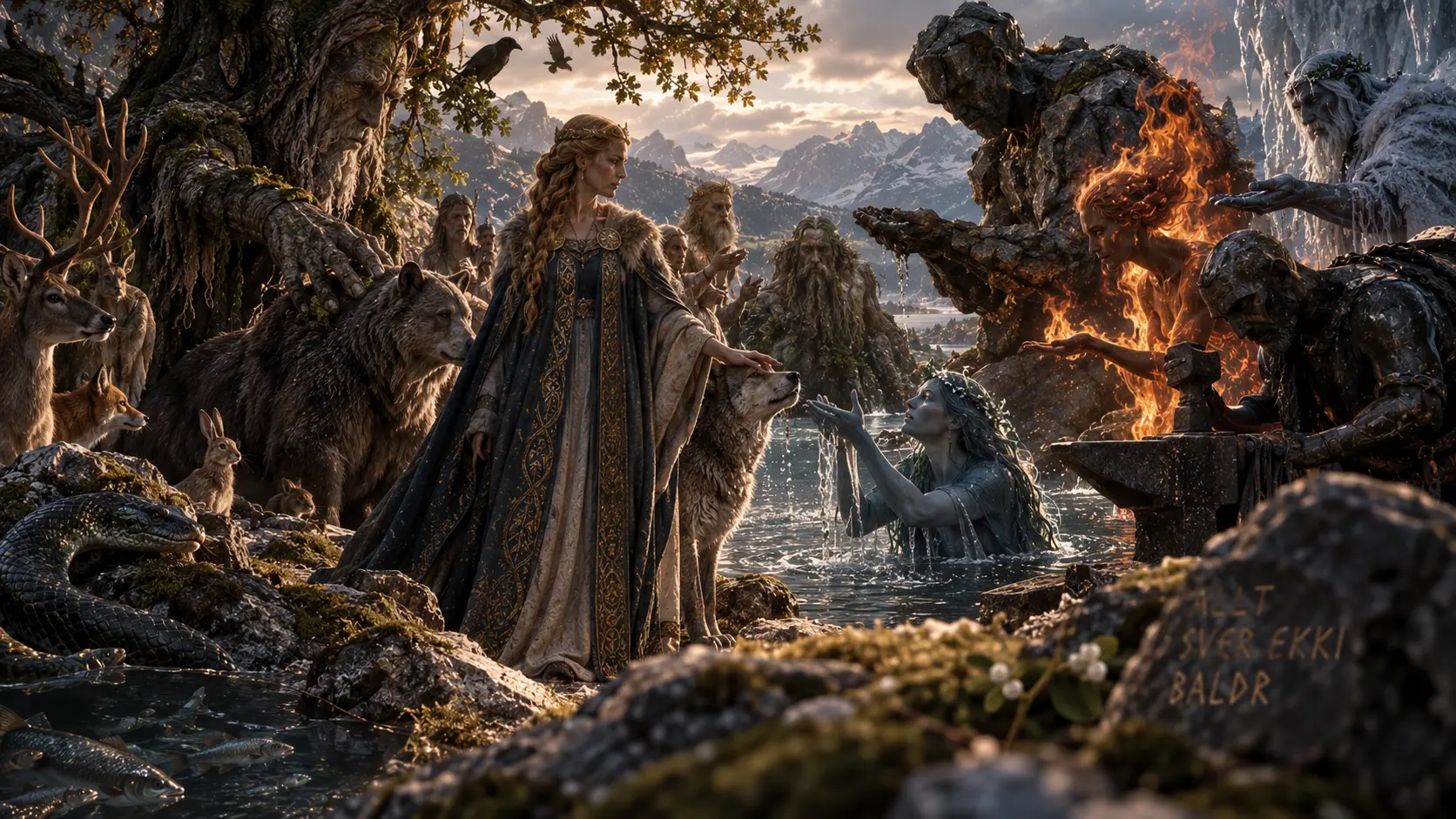
Frigg: Queen of the Æsir, wife of Odin and one of the principal female figures in Norse mythology. She is associated with marriage, motherhood, the home, family protection and knowledge of fate. Her most fascinating quality is precisely what she knows and chooses to keep to herself. In Lokasenna, Freyja states that Frigg knows all fates, although she refrains from revealing them. The sources offer few explanations of the origin or workings of this knowledge, giving her an enigmatic quality. Frigg knows. Frigg watches. And often, she remains silent. The relationship between Frigg and Odin reveals one of the pantheon’s most interesting contrasts. Odin obsessively pursues knowledge. He travels between worlds, questions giants and the dead, sacrifices an eye at Mímir’s well and hangs himself from Yggdrasil to gain knowledge of the runes. Frigg seems to represent another form of wisdom. Odin seeks what he does not know. Frigg keeps silent about what she knows. This difference makes the two figures complement each other in an extraordinary way. Both have a relationship with fate, but respond to it from different positions. Odin tries to understand it and prepare to face it. Frigg seems to recognise its limits. In both cases, one of the fundamental ideas of Norse mythology emerges: knowing what will happen does not guarantee the power to prevent it. Frigg holds a privileged position among the ásynjur, the goddesses belonging to the world of the Æsir. Her importance goes beyond being Odin’s wife. The sources present her as having authority of her own and surrounded by other divine female figures. Among them stands Fulla, her attendant and confidante. Snorri describes Fulla with flowing hair and a golden band around her head. She carries Frigg’s casket, looks after her footwear and knows her secrets. This last detail is particularly fitting. A goddess characterised by keeping knowledge to herself has at her side a woman whose role includes precisely guarding what Frigg keeps hidden. Frigg’s residence is called Fensalir. In Grímnismál, Odin mentions this place among the great divine dwellings and states that it belongs to Frigg. Its name is usually interpreted as “halls of the marshes” or “halls of the swamps”. The sources say little more. This allows us to imagine a residence completely unlike the martial clamour of Valhalla: great wooden buildings surrounded by still waters, reeds, damp forests and banks of mist. The association is particularly fitting for Frigg. Still water can conceal depth. It can also reflect what stands before it. Motherhood is another of Frigg’s major aspects. Her best-known relationship is with Baldr, whose death is one of the fundamental tragedies of Norse mythology. After learning of the threat hanging over her son, Frigg tries to protect him by obtaining oaths from the beings and elements of the world. A seemingly insignificant exception, mistletoe, allows Loki to cause his death through Höðr. Frigg then tries to recover him by sending Hermóðr to the realm of Hel. The complete story belongs to the section devoted to Baldr
Frigg