← Æsir index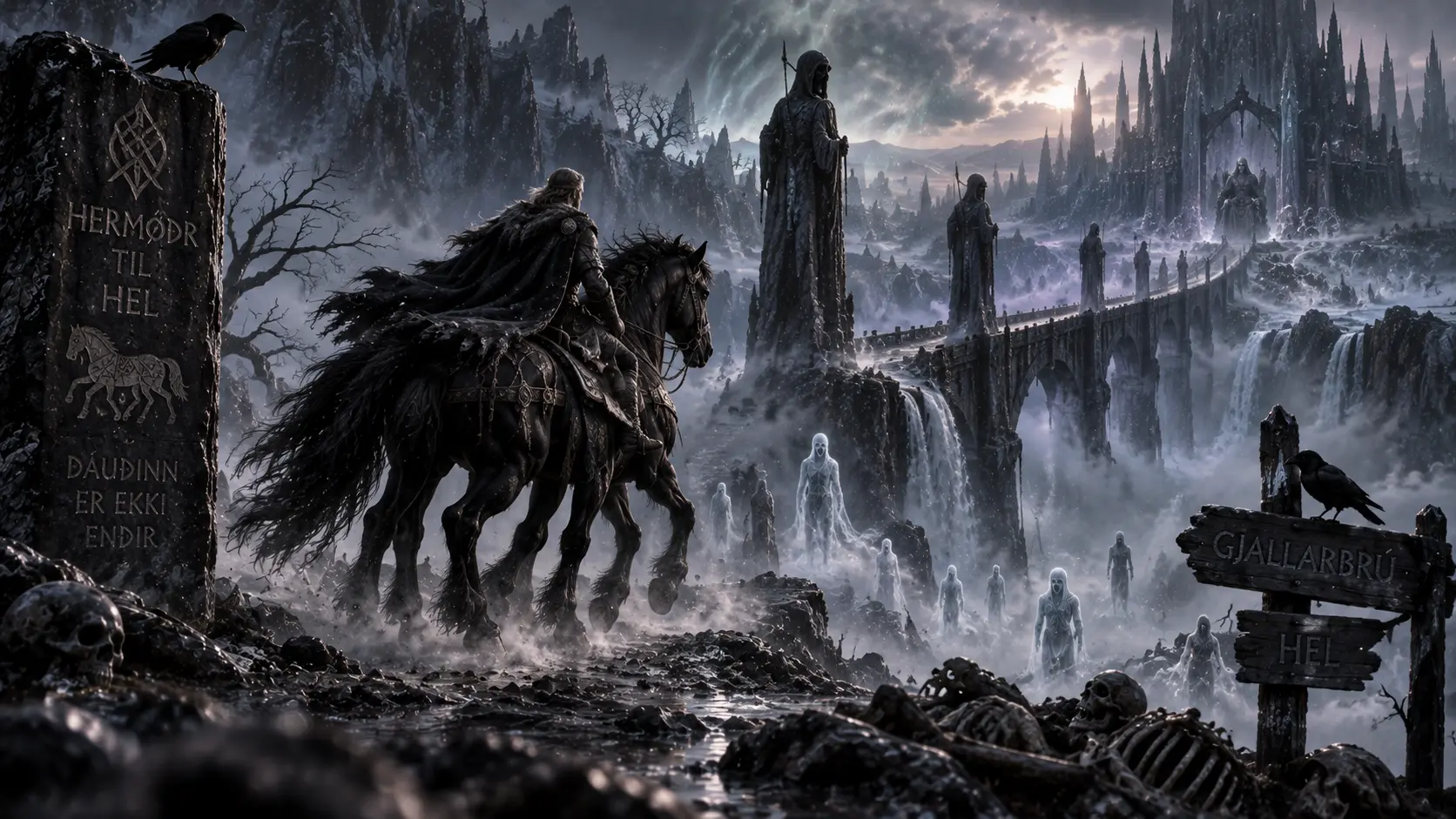
Hermóðr: A divine figure of the Æsir, renowned for making one of the most extraordinary journeys in Norse mythology: descending alive into Hel’s realm to try to bring Baldr back. While other gods stand out for their strength, wisdom or mastery of magic, Hermóðr is defined above all by a single action. When Baldr dies and the gods need someone willing to take the road to the world of the dead, Hermóðr mounts Sleipnir and sets out. His journey lasts nine nights. The death of Baldr sends a shock through the gods. Loki has discovered that mistletoe was excluded from the oaths Frigg obtained to protect her son. Using the blind Höðr, he makes the projectile strike Baldr. The god falls dead. Frigg still holds on to hope. She asks which of the Æsir is willing to travel to Hel, offer a ransom for her son and ask that he be allowed to return to Asgard. Hermóðr accepts the mission. To carry it out, he receives an exceptional companion. Sleipnir. Odin’s eight-legged horse. Hermóðr mounts Sleipnir and begins the descent. He rides for nine nights through deep, dark valleys. The number nine appears repeatedly in Norse tradition and is closely associated with ritual and cosmological events: the nine worlds, Odin’s nine nights hanging from Yggdrasil and other mythical cycles. In Hermóðr’s journey, the nine nights make the route something far greater than a horse ride. It is a gradual descent out of the world of the living. The light disappears. The road continues. Hermóðr keeps going. At last he reaches Gjallarbrú, the bridge over the river Gjöll that leads towards Hel. The bridge is covered in shining gold. There he meets its guardian: Móðguðr. She asks his name and lineage. She also tells him something unsettling. The previous day, five groups of dead men crossed the bridge, yet Hermóðr alone makes a greater din than all of them together. There is a reason. Hermóðr is still alive. The guardian understands that this rider does not belong to the ordinary stream of the dead. Hermóðr explains that he is looking for Baldr. Móðguðr replies that Baldr has already crossed the bridge and shows him the road he must follow towards Hel. Hermóðr continues until he reaches the gates guarding the realm of the dead. They are closed. Then Sleipnir shows why he is no ordinary horse. Hermóðr tightens the reins. The animal leaps. Sleipnir clears Hel’s gates in a single leap. The scene is one of the most visually extraordinary moments in the story. A living rider on Odin’s eight-legged horse crosses a boundary meant to separate the dead from those who still breathe. Hermóðr has entered Hel. Inside the realm, he finds what he has been seeking. Baldr is there. Hermóðr finds him seated in a place of honour. The detail matters. Baldr is dead, but he has not been destroyed. He retains his identity, presence and ability to communicate. Hermóðr spends that night beside him. The mission has reached its destination. Now he must persuade the ruler of the place. Hermóðr comes before Hel and explains the grief Baldr’s death has caused among the gods. He asks that Baldr be allowed to return. Hel sets a test. If Baldr truly is as beloved as the Æsir claim, then all beings must weep for him. If everything that exists mourns Baldr’s death, Hel will allow his return. If even one creature refuses, he will remain among the dead. Hermóðr has achieved something extraordinary. He has reached Hel alive. He has found Baldr. He has spoken to the ruler of the dead. He has even secured a possibility of freeing him. But the final condition lies beyond his control. Before returning, Hermóðr receives objects intended for the living. Baldr gives him Draupnir, Odin’s ring. Odin had placed Draupnir on his son’s funeral pyre. Now that same object returns from the realm of the dead. Baldr also sends other tokens, while Nanna gives presents intended for Frigg and Fulla. Hermóðr thus becomes more than a messenger. He is the bearer of objects that have crossed the boundary of death twice. Draupnir left Asgard as an offering for a dead man. Hermóðr returns it to Odin. Hermóðr sets out on the journey back. He crosses the dark regions again. He returns to Asgard. He delivers the presents and conveys Hel’s condition. Then begins one of the most extraordinary attempts in Norse mythology. Everything must weep for Baldr. Human beings weep. Animals weep. The earth seems to weep. Stones, trees and metals share in the mourning. The whole world seems willing to fulfil the condition. Until a figure called Þökk is found. She refuses. Snorri’s version suggests that Þökk is Loki in disguise. Baldr remains in Hel. Hermóðr has made the impossible journey. But he cannot control what happens after his return. The journey makes Hermóðr one of the great travellers between worlds in Norse tradition. His feat differs from Odin’s. Odin constantly seeks the boundaries between life and death through magic, sacrifices, knowledge and contact with the dead. Hermóðr crosses that boundary physically. He rides to it. He crosses the bridge. He leaps over the gates. He enters. He speaks with the dead. Then he comes back. The direction of his journey is also significant. The dead travel to Hel and remain there. Hermóðr takes the road in both directions. The feat cannot be separated from Sleipnir either. The eight-legged horse is one of the most extraordinary beings associated with Odin and has an exceptional ability to move between places and worlds. Hermóðr needs precisely this mount to reach Hel and overcome its barriers. During this episode, rider and horse form an inseparable pair. Hermóðr brings the will to undertake the journey. Sleipnir makes it possible to cross its boundaries physically. This also explains why a portrayal of Hermóðr should give the horse as much importance as the god himself. There is some complexity surrounding Hermóðr’s genealogy. Snorri uses expressions that have traditionally led to Hermóðr being regarded as Odin’s son and Baldr’s brother. He is therefore often presented this way in modern genealogies. However, older poetic sources offer a less clear picture and do not develop his genealogy unambiguously. It is therefore prudent to distinguish between the tradition transmitted by Snorri and what can be reconstructed with confidence from the sources as a whole. His narrative identity, by contrast, is unmistakable: Hermóðr is the one who rides to Hel for Baldr. Hermóðr does not need to defeat anyone during his great adventure. His courage takes another form. He willingly sets off towards the place from which the dead do not usually return. He travels alone. For nine nights. He crosses a guarded bridge. He enters Hel’s domain. Then he comes before its ruler to ask for one of her dead. The story does not describe grand heroic speeches either. The action is enough. Frigg asks who is willing to ride. Hermóðr mounts. Baldr remains dead. From that point of view, the mission fails. But Hermóðr achieves almost everything that depends on him. He finds Baldr. He obtains an audience with Hel. He secures a condition for Baldr’s release. He returns alive. He gives Draupnir back to Odin. He brings news from the realm of the dead. The final failure comes later, when Þökk refuses to weep. This makes his story more interesting than a simple victorious mission. Hermóðr shows that even an impossible feat can prove insufficient when the world’s fate is already moving towards Ragnarök. In Norse mythology, descending into the realm of the dead is not necessarily the most extraordinary part. Everyone will eventually journey somewhere after dying. What is exceptional is entering it alive. And then returning. Hermóðr crosses a boundary separating two states of existence. When he returns to Asgard, he carries something the other gods do not possess: he has seen Baldr after his death. He has spoken with him. He has seen Hel’s domain. He knows the road. And he has returned to tell the tale. Name: Hermóðr / Hermod. Nature: a divine figure associated with the Æsir. Genealogy: traditionally presented as Odin’s son in the tradition derived from Snorri, although his parentage requires some caution when comparing the sources. Great feat: travelling alive to Hel after Baldr’s death. Purpose of the journey: to request Baldr’s release. Mount: Sleipnir, Odin’s eight-legged horse. Duration of the descent: nine nights. Place crossed: Gjallarbrú, the bridge over Gjöll. Guardian encountered: Móðguðr. Principal encounter: Hel. Object brought back: Draupnir, sent by Baldr to Odin. Outcome: he secures a condition for Baldr’s release, but Þökk’s refusal ultimately prevents his return before Ragnarök. Symbolic attributes: travel, courage, loyalty, messengership, passage between worlds and contact between the living and the dead. Fate during Ragnarök: the surviving sources do not give Hermóðr a clear fate either. Main source: Gylfaginning in the Prose Edda. 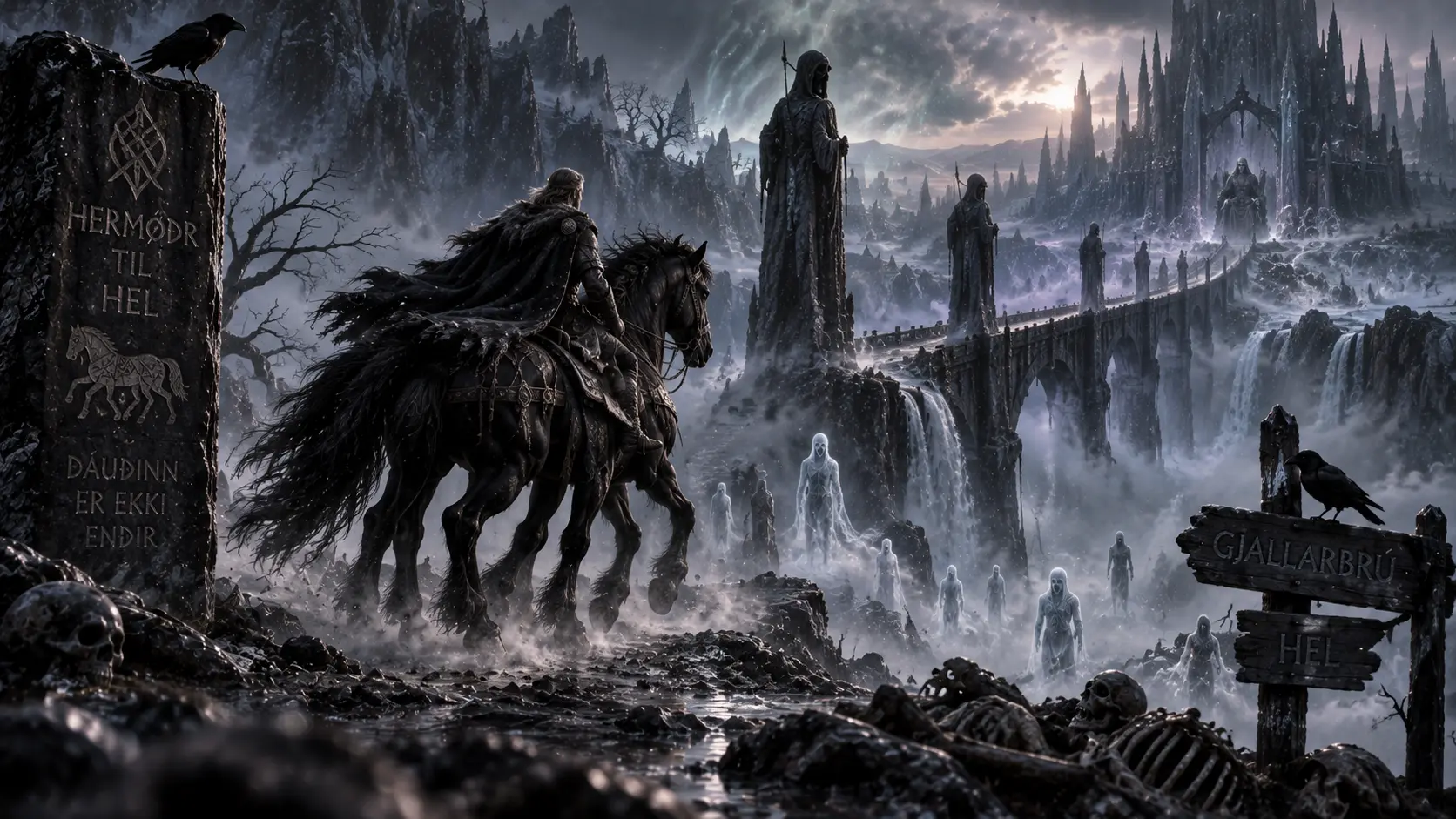
Hermóðr
After Baldr’s death
Nine nights towards Hel
Gjallarbrú
Sleipnir’s leap
Baldr among the dead
Hel’s condition
Gifts from Hel
The return
The messenger between worlds
Hermóðr and Sleipnir
Odin’s son?
Hermóðr’s courage
A journey that fails and succeeds at the same time
The man who returned
Attributes