← Æsir index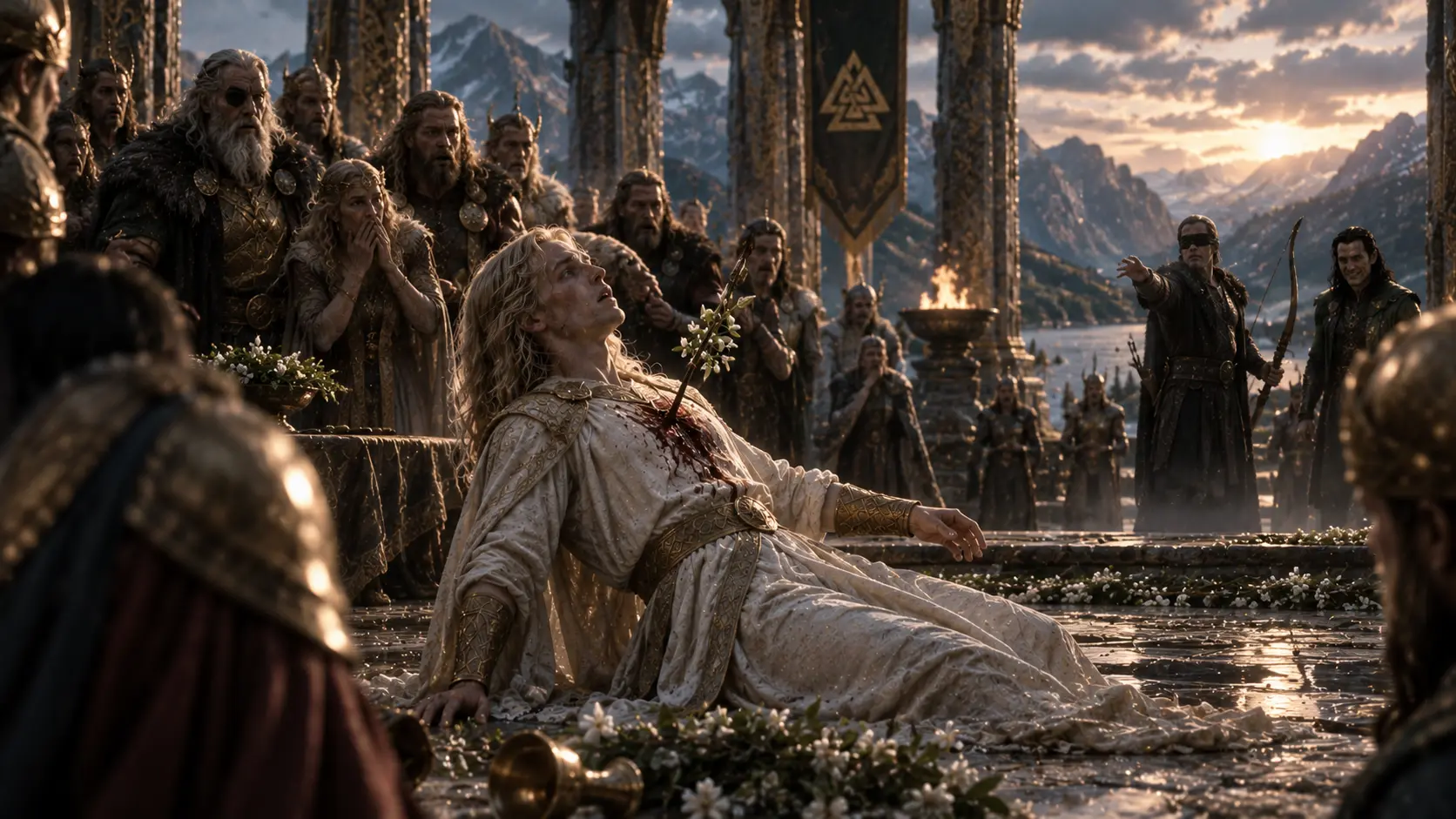
Blindness and fate Höðr, also written Hodr, Hödr or Hoder, is a son of Odin and brother of Baldr. In the tradition transmitted by Snorri Sturluson, he appears as a blind god whose story is marked by one of the greatest tragedies in Norse mythology: killing his own brother without understanding that he is being used to do so. Höðr does not wish Baldr dead. Loki finds the luminous god’s one vulnerability, places the weapon in his blind brother’s hands and guides the throw. Baldr falls. Höðr will die too. Yet the story of the two brothers has an extraordinary ending. When Ragnarök has destroyed the old world, Baldr and Höðr will return together. The victim and the brother who involuntarily caused his death will share the renewed world. Höðr belongs to Odin’s immediate family. Snorri’s tradition presents him as Baldr’s brother and emphasises a trait that will determine his entire fate: he is blind. The contrast between the brothers is especially powerful. Baldr is associated with brightness, beauty and radiance. Höðr lives without being able to see that light. Yet the sources do not portray them as personal rivals in the best-known version of the myth. Höðr does not hate Baldr. Nor does he plot against him. His tragedy is precisely that he is used to destroy him. The story begins when Baldr has dreams foretelling his own death. The gods grow uneasy. Frigg decides to protect her son by obtaining oaths from everything that exists, so that nothing will ever harm him. Metals. Stones. Animals. Plants. Diseases. The forces of the world promise to spare Baldr. There is one exception. Mistletoe. Frigg considers it too young or insignificant to demand an oath from it. That small oversight will be enough. When the Æsir discover that Baldr seems invulnerable, they turn his protection into entertainment. Baldr stands before them. The gods throw objects at him. They shoot projectiles. They strike him. The weapons miss or prove unable to wound him. The scene becomes a public display of his invulnerability. Everyone takes part. Except Höðr. He remains apart. His blindness prevents him from joining a game based on aiming and throwing. That is when Loki approaches. Loki asks Höðr why he is not taking part either. Höðr answers that there are two reasons. He cannot see where Baldr is. And he has no weapon to throw at him. Loki can solve both problems. He gives Höðr the mistletoe. Then he offers to guide his hand. For Höðr, this is still part of the game. The others have been throwing weapons at Baldr for some time without managing to wound him. He has no reason to imagine that the small projectile Loki has just given him can do what swords, stones and other weapons have failed to do. Höðr agrees. Loki guides him. Höðr throws. The mistletoe strikes Baldr. This time the object does not turn aside. It pierces his body. Baldr falls dead. The game ends at that very moment. To the gods, his death is inconceivable. They had turned Baldr’s invulnerability into a source of amusement because they were convinced that nothing could happen to him. But Loki knew about the exception. And Höðr has supplied the hand needed to use it. The tragedy is shared among three characters. Loki knows. Höðr carries it out. Baldr dies. But only the first possesses knowledge and intent. This question is one of the most interesting parts of the myth. In material terms, Höðr kills Baldr. The projectile leaves his hand. But Loki has discovered the vulnerability. Loki obtains the mistletoe. Loki gives him the weapon. Loki guides the throw. Höðr does not know that he can kill his brother. That is why calling him simply “Baldr’s killer” erases the very thing that makes his story tragic. Höðr is the instrument of the murder. Loki turns his blindness and trust into weapons. Höðr’s blindness is not merely a physical trait in the story. It is the mechanism that makes the deception possible. Höðr depends on someone else to tell him where to throw. Loki literally takes the place of his eyes. The image is extraordinarily dark. Höðr has the arm. Loki supplies the direction. One performs the movement. The other knows what it truly means. Baldr’s death arises from that combination. In the Norse world, Baldr’s death demands vengeance. And prophecy already knows who will carry it out. Odin fathers Váli with Rindr. Váli is born specifically to avenge Baldr. He grows at a supernaturally rapid pace. Völuspá foretells that, at only one night old, he will fight the killer of Odin’s son. Váli does not need a long life before fulfilling his purpose. He is born. He grows. He takes up arms. And he kills Höðr. There is a cruelty in this vengeance that is hard to ignore. Odin loses Baldr. To avenge him, another of Odin’s sons kills Höðr. The result is that two of Odin’s sons end up dead through the same chain of events. Baldr falls to Höðr’s projectile. Höðr falls to Váli’s vengeance. Loki has caused far more than one death. He has brought fratricide and vengeance into the divine family itself. Baldr’s tragedy begins with a small sprig of mistletoe and spreads across generations. Váli is almost Höðr’s opposite reflection. Höðr kills without truly knowing what he is doing. Váli is born knowing—or destined to know—his purpose. One becomes an executioner involuntarily. The other exists to become an avenger deliberately. Both are bound together by Baldr. And they have something else in common. They will survive the old world in different ways. Váli will live through Ragnarök. Höðr will return afterwards. There is an important complication. The story of Höðr preserved by Saxo Grammaticus in the Gesta Danorum is very different. There he appears under the name Høtherus and is not simply the blind god used by Loki. He is a heroic warrior. The story also introduces a romantic rivalry involving Nanna. Balderus and Høtherus become adversaries. Høtherus takes an active part in the conflict and eventually causes Balderus’s death with a special weapon. This tradition transforms the character completely. Snorri’s Höðr is a victim of Loki’s deception. Saxo’s Høtherus is an active rival of Baldr. The differences between the two traditions are too great to blend them into a single story. In one: Höðr is blind. In the other, blindness is not at the centre of the character. In one: Loki causes Baldr’s death. In the other, the story unfolds through a different rivalry. In one: Höðr acts without consciously intending to kill. In the other, Høtherus takes a direct part in the confrontation. This shows how greatly myths could change before they were fixed in writing. Snorri’s version eventually became the best known. But it is not the only one to have survived. After his death, Höðr disappears for much of the story. Baldr remains in Hel. The world continues towards Ragnarök. Fenrir breaks his chains. Odin dies. Thor and Jörmungandr destroy one another. Surtr sets the world ablaze. The Earth disappears beneath the waters. Then it rises again. Something surprising happens. Baldr returns. And Höðr appears with him. Völuspá describes the two brothers living together after the destruction. This detail is extraordinary because it completely transforms the last image we have of them. Before Ragnarök: Höðr kills Baldr. Váli kills Höðr. After Ragnarök: Baldr and Höðr share the renewed world. The old tragedy no longer seems to govern their relationship. The victim and the brother who caused his death meet again after the entire world has been destroyed and rebuilt. The sources do not explain what happens between them. They preserve no conversation. We do not know whether Baldr forgives Höðr. We do not know whether Höðr asks for forgiveness. We do not know how much they remember of what happened before Ragnarök. For that reason, speaking explicitly of a reconciliation calls for some caution. But the image the sources do preserve is powerful in itself: they are together. The old world separated them through deception, death and vengeance. The new world brings them together again. Höðr occupies an uncomfortable moral position in Norse mythology. He is materially responsible for one of its greatest tragedies. But he is also a victim of that same tragedy. His blindness allows Loki to manipulate him. His trust turns him into an instrument. Then he receives the punishment intended for the killer. This creates a fundamental difference between Höðr and Loki. Loki knows the consequences. Höðr discovers them when it is already too late. One builds the trap. The other is caught inside it. The contrast between Baldr and Höðr has inspired many later interpretations. Baldr is luminous. Höðr is blind. One represents clarity. The other lives in darkness. It is tempting to turn them directly into personifications of day and night, light and darkness, or seasonal cycles. Such readings may be suggestive, but the medieval sources do not offer an unambiguous explanation of this kind. What they do preserve is an extraordinary narrative contrast. The brother who cannot see ends up destroying the god described as the most radiant. And after the end of the world, they both return together. Many Norse gods shape their identities through decisions. Odin chooses to sacrifice his eye. Týr chooses to place his hand in Fenrir’s mouth. Thor chooses to face the giants again and again. Hermóðr chooses to ride to Hel. Höðr is different. His great mythic act comes precisely from not having enough information to choose. Loki knows. Höðr trusts. And that difference kills Baldr. His story is therefore not only about guilt. It is about manipulation. About responsibility. About knowledge. And about the irreversible consequences of acting under the guidance of someone who can see what you are unable to perceive. Höðr’s return after Ragnarök gives his story an ending granted to very few characters. He dies as a consequence of a terrible act. But that death is not his final appearance. He returns. And when he does, Baldr is at his side. Myth leaves the meaning open. It can be read as the end of their old enmity. As the restoration of a destroyed order. As a sign that the guilt of the old world has lost its power. Or simply as an image of a new cycle. The sources do not require us to choose. The image is enough: the world had to end for the two brothers to be together again. Name: Höðr / Hodr / Hödr / Hoder. Nature: Æsir. Father: Odin in the tradition transmitted by Snorri. Brother: Baldr. Main trait in Snorri’s version: blindness. Role in Baldr’s death: Loki gives him the mistletoe and guides his throw at Baldr. Associated weapon: a mistletoe projectile. Responsibility: the direct agent of Baldr’s death in Snorri’s version, manipulated by Loki and unaware that the weapon is deadly. Avenger of Baldr: Váli. Fate before Ragnarök: killed by Váli. Fate afterwards: returns after Ragnarök and lives in the renewed world beside Baldr.
Höðr / Hodr