← Æsir index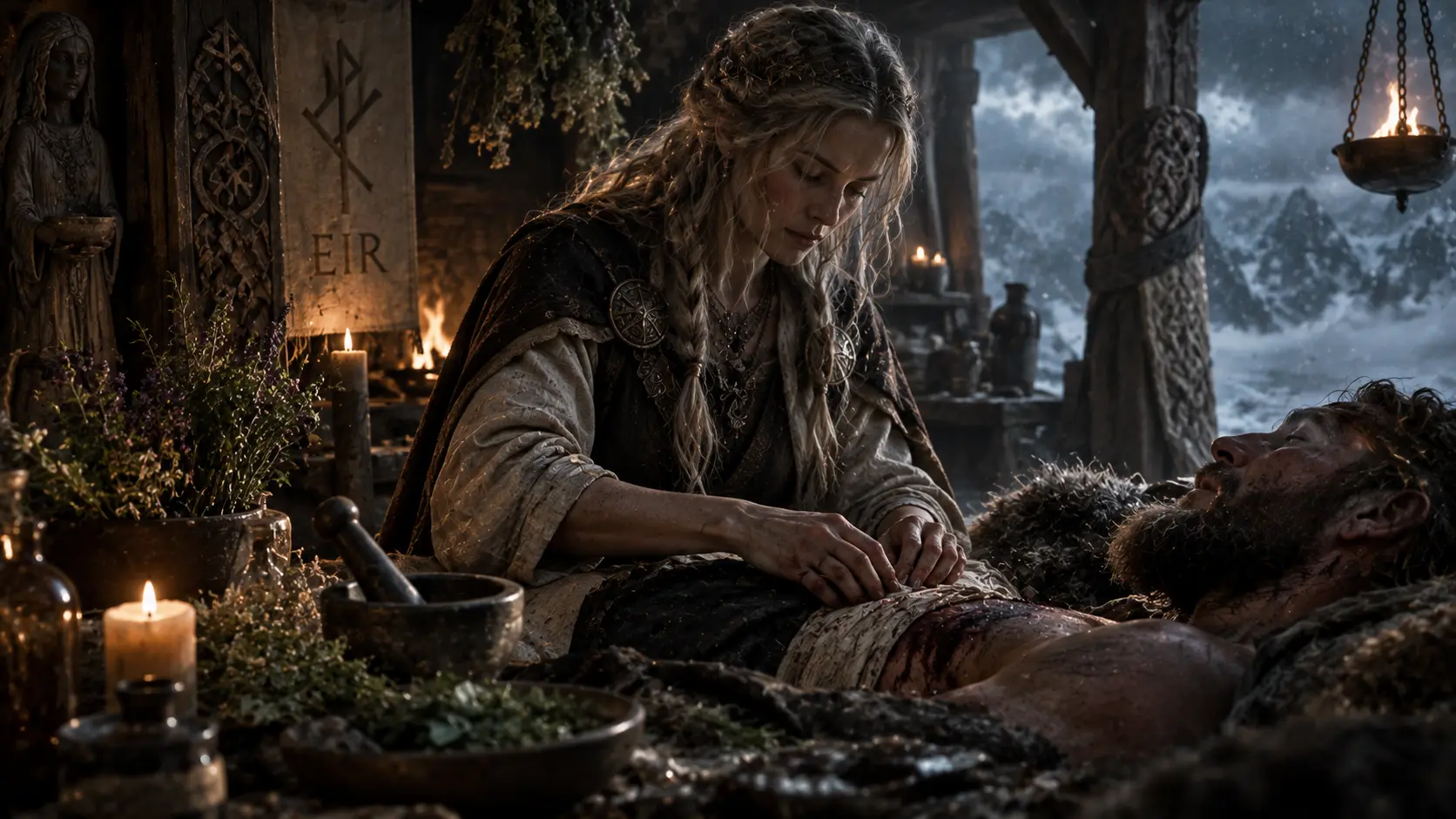
Eir: A figure in Norse mythology associated with healing and medical knowledge. Snorri Sturluson lists her among the ásynjur in Gylfaginning and describes her as exceptionally skilled in medicine. Her name is commonly linked with help, protection, mercy or relief. No great cycle of adventures survives about her. Her power lies in preserving life when the body has been injured. Snorri’s brief description identifies Eir as an excellent physician. We do not know who taught her or where her knowledge came from. Some ancient deities were remembered chiefly for what they did, protected or embodied, even when the stories behind those roles were lost. Eir may be one of them. The Norse understanding of illness, injury and recovery could encompass knowledge of plants and the body, charms, ritual and supernatural forces. The boundary between what we now call medicine and magic was not necessarily fixed. Eir embodies the knowledge that can restore balance to an injured body. The poem Fjölsvinnsmál also names an Eir among the maidens associated with Menglöð. She may be Snorri’s Eir, a different figure with the same name or a trace of traditions that came to overlap. The surviving sources leave the question open. The sources preserve enough to recognise an old tradition, but too little to reconstruct it. We know of Eir’s association with healing, Snorri’s classification and the occurrence of her name in another mythological context. Her kinship, dwelling and any objects unequivocally associated with her remain unknown. No extensive myth survives with Eir at its centre. Thor confronts threats, Odin seeks knowledge to anticipate events and Heimdall watches the borders of Asgard. Eir’s protection begins after the damage is done. Knowing how to treat a wound and sustain an injured body can make the difference between injury and death. No surviving source lists remedies, sacred plants or formulas specific to Eir. Her role can be understood within a broader tradition where plants could serve as remedies, words could form part of charms and knowledge passed down over generations guided their use. The sources connect Eir with the knowledge needed to heal and leave her methods unspecified. Battles, named weapons and monstrous adversaries make memorable stories. A healer’s victory is that a wound closes, a body recovers and a life continues. It takes strength to destroy a life. It takes knowledge to preserve one. Ingrid brings chemistry, plants, runes and seiðr together in her apothecary. In this fictional setting, the chemical properties of a substance, the effects of a plant and the magical tradition behind a rune can all inform the work of a healer. Eir offers a mythological precedent for an idea that recurs in the story: healing means understanding nature and knowing how to intervene. In The Roots of the World, Eira is a dís associated with Max. Eir belongs to Norse mythology and Eira to the fictional saga. Their similar names, Eira’s supernatural nature and Eir’s association with healing and protection raise a question: might they be connected? The resemblance could be coincidence or preserve a trace of something older. The saga leaves the possibility open.
Eir
The healer among the ásynjur
Healing in the Norse world
Eir and Menglöð
An identity difficult to reconstruct
The knowledge that preserves life
Plants, remedies and magic
A different kind of power
Eir in the world of 1931
Eir and Eira in The Roots of the World
Attributes
- Name: Eir, commonly associated with help, mercy, protection or relief.
- Nature: Uncertain. Snorri lists her among the ásynjur. The name also appears among Menglöð’s maidens.
- Main role: Healing and medical knowledge.
- Attributes: Healing, remedies and the preservation of life.
- Associated knowledge: Treating illness and injury in a tradition that could combine practical and ritual knowledge.
- Surviving mythology: Fragmentary, with no extensive myth centred on Eir.
- Connection with Menglöð: An Eir appears in Fjölsvinnsmál. Her identity remains uncertain.
- Fictional connection: Eira, a dís linked to Max, suggests a possibility left open in the saga.
- Main sources: Gylfaginning and Fjölsvinnsmál.