← Æsir index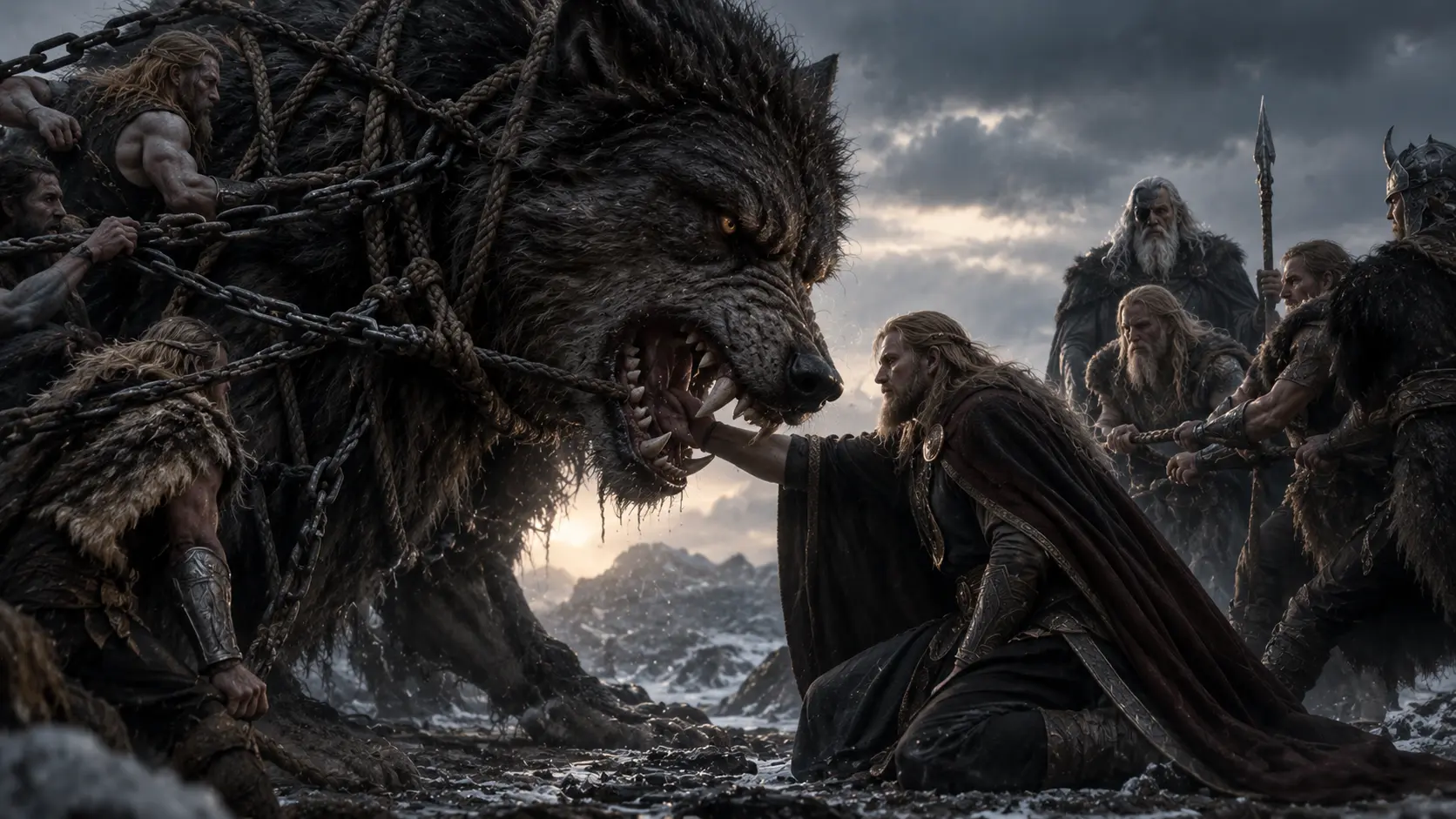
Týr is one of the oldest gods of the Germanic tradition. The Norse sources associate him with war, courage, law and oaths. In his best-known myth, he puts his hand in Fenrir’s jaws as a pledge, knowing what the wolf will do when the gods break their word. His name has cognates in other Germanic languages and goes back to an Indo-European root associated with divinity and the sky. It points to an older religious tradition whose development is hard to reconstruct. By the time of the surviving Norse accounts, Odin held the dominant place among the Æsir. While Thor embodies strength and protection and Odin is associated with strategy, battle fury and victory, Týr suggests courage, discipline and order in conflict. Sigrdrífumál advises carving victory runes on a sword and invoking Týr twice. The arrow-shaped rune Tiwaz (ᛏ) bears his name. Germanic ideas of law, obligation, oaths and order help explain Týr’s role. He pledges his own body to guarantee the gods’ good faith. When they betray Fenrir’s trust, the lost hand becomes the physical consequence of a broken oath. Fenrir is the son of Loki and the jötunn Angrboða and the brother of Jörmungandr and Hel. Prophecies prompt the gods to keep the wolf close while they can control him. According to Snorri, Týr alone dares to feed him. The gods offer Fenrir a test of strength. He lets them bind him with Læðingr and breaks it. He does the same with the stronger Drómi. Ordinary chains cannot hold him. The dwarfs make a thin, soft ribbon from six impossible things: a cat’s footfall, a woman’s beard, a mountain’s roots, a bear’s sinews, a fish’s breath and a bird’s spittle. The gods take Fenrir to Lyngvi, an island in Lake Ámsvartnir, for a third test. The ribbon seems too slight to earn him glory and too suspicious to trust. Fenrir agrees to the trial only if a god places a hand in his mouth as a pledge of good faith. The Æsir understand the risk. Týr steps forward. Fenrir strains and twists, but Gleipnir holds. When he realises he has been deceived, he bites off Týr’s hand. Snorri remarks that all the gods laugh except Týr. Tradition generally depicts Týr without his right hand. Where Odin has Gungnir, Thor has Mjölnir and Heimdall has Gjallarhorn, Týr carries the memory of the bargain in the hand that is missing. The gods protect Asgard through deception. Týr takes part and personally pays the cost. The wolf gains another reason to hate the gods, and their solution sets the stage for his revenge. The gods secure the binding and wedge a sword in Fenrir’s jaws. His saliva forms the river Ván. At Ragnarök he breaks free, ravages the world and devours Odin. Víðarr avenges his father by killing the wolf. Týr’s sacrifice bought time. In Lokasenna, Týr speaks up for Fenrir and Loki taunts him about his lost hand. Loki also makes accusations about Týr’s family. The poem is an exchange of insults, so those accusations require caution. Snorri presents Týr as Odin’s son. Hymiskviða appears to make him the giant Hymir’s son, or at least suggests a family connection. The sources preserve divergent traditions. In Hymiskviða, Týr accompanies Thor to obtain Hymir’s enormous cauldron. The trip leads to Thor’s fishing expedition with Hymir, when Thor hooks Jörmungandr. Týr’s role shows that the surviving tradition extends beyond Fenrir. The Germanic god was equated with the Roman Mars. English Tuesday, the day of Tiw or Týr, corresponds to Latin dies Martis. Other Germanic languages preserve similar traces. Týr faces Garmr, the hound associated with Gnipahellir and the world of Hel. They kill each other. Týr gives up a hand to bind Fenrir and preserve order. He loses his life fighting Garmr as that order collapses. Thor protects through strength and Odin seeks knowledge and ways to shape events. Týr embodies the courage to bear the consequences of a decision. His defining act is a sacrifice. Týr can guarantee that someone will pay if the gods break their word. He makes himself that person. The missing hand stands for courage, sacrifice and obligation, and recalls the broken promise on which the gods’ security depended. Group: Æsir. Parentage: Odin in Snorri, Hymir or his family in Hymiskviða. Domains: War, courage, law, oaths and order. Rune: Tiwaz (ᛏ). Distinguishing feature: The hand lost while binding Fenrir with Gleipnir. Fate: Týr and Garmr kill each other at Ragnarök. Sources: Gylfaginning, Hymiskviða, Lokasenna, Sigrdrífumál and Völuspá.
Týr