← Æsir index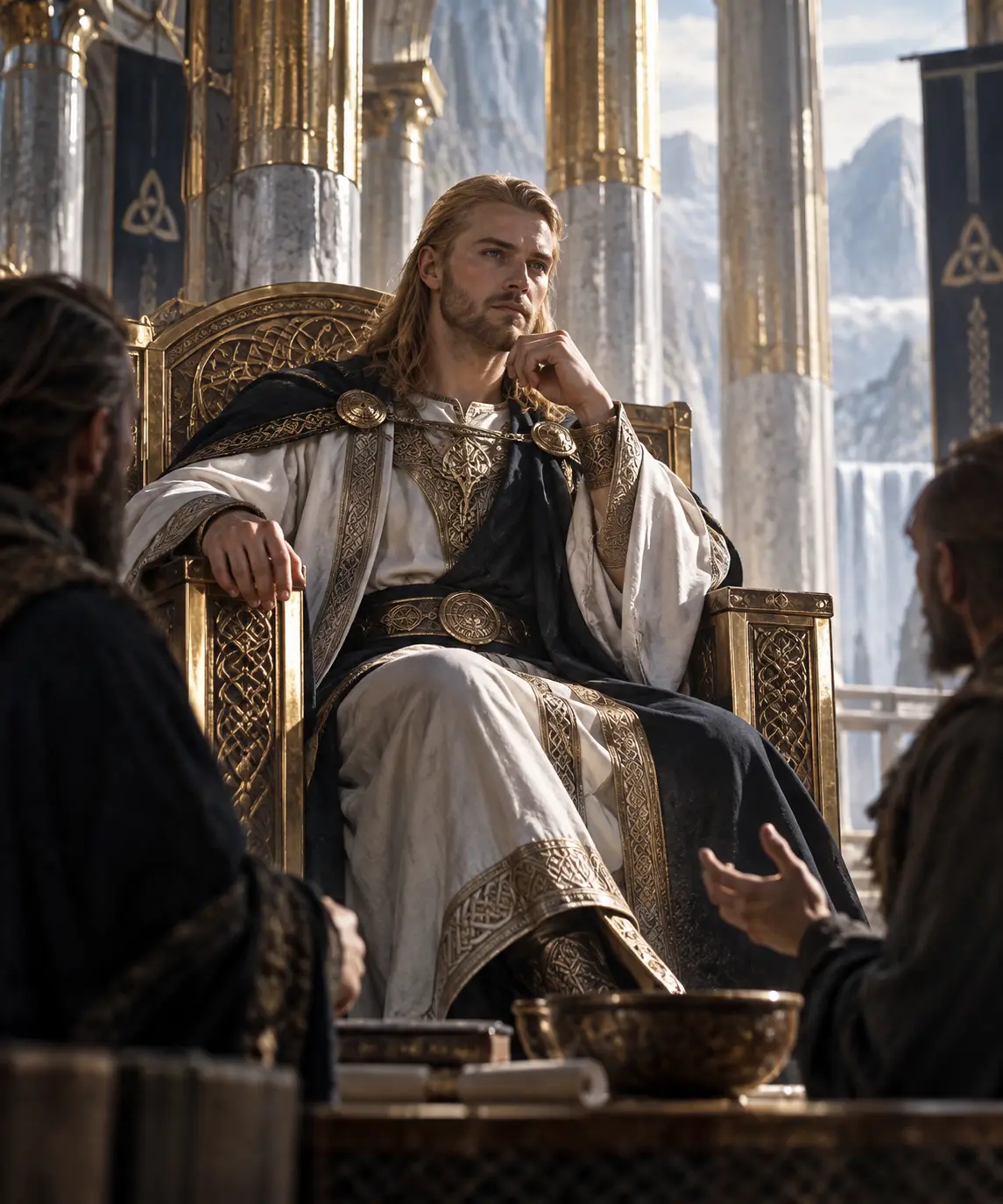
Justice, mediation and reconciliation Forseti is the son of Baldr and Nanna and one of the most distinctive figures among the Æsir. His name is usually interpreted as “the one who presides” or “president,” a meaning that fits the role attributed to him in the sources: hearing disputes and resolving conflicts. While Týr represents the courage associated with oaths, obligation and the sacrifice needed to preserve order, Forseti belongs to another moment in a conflict. When two sides are already at odds, Forseti tries to find a resolution. Snorri Sturluson describes him as a god to whom people with disputes come, and says that everyone returns reconciled after appearing before him. His dwelling is Glitnir, a remarkable hall with golden pillars and a silver roof. There Forseti takes his seat and judges the disputes of gods and men. Forseti belongs to one of the most important branches of Odin’s family. His father is Baldr, son of Odin and Frigg. His mother is Nanna, Baldr’s wife. This makes Forseti the grandson of Odin and Frigg and places him in a family profoundly marked by tragedy. Baldr will be killed through Loki’s deception. Nanna will die after her husband’s death. Baldr will end up in Hel. In the surviving sources, Forseti remains outside the centre of that tragedy. We do not know how he reacts to his parents’ deaths. The silence is striking. We know the son. We know the father’s death. We know the mother’s death. But any account that might have joined those three stories has been lost. The name Forseti is usually connected with the idea of someone who presides over an assembly or court. The word also survived in modern Scandinavian languages with meanings related to presiding. This etymology fits the medieval description of the god especially well. Forseti is not primarily portrayed as a warrior. His authority is expressed while seated. He listens. He deliberates. He decides. His power belongs to the space where a dispute can end before it becomes violence. Forseti’s dwelling is called Glitnir. Grímnismál lists it among the divine residences and describes a shining hall with golden pillars and a silver roof. The name itself conveys an idea of brightness or radiance. The image suits Baldr’s son, a deity characterised by his luminosity. But Glitnir is not merely a magnificent residence. In the tradition transmitted by Snorri, it becomes the place where Forseti resolves disputes. It is a palace. It is an audience hall. And it functions symbolically as a court. In Gylfaginning, Snorri gives one of the fundamental descriptions of Forseti. He says that Forseti is the son of Baldr and Nanna and that he possesses Glitnir. Then he explains Forseti’s role. Those who come to him with lawsuits or disputes return reconciled. The wording matters. Forseti does not merely declare who has won. The result of his intervention is agreement. This helps distinguish several ideas that today we often group under the word “justice.” Judging. Arbitrating. Mediating. Reconciling. Forseti seems especially connected with the last of these. Comparing Forseti with Týr helps clarify the difference between them. Týr is associated with courage, oaths and certain aspects of legal order. His most famous myth ends with a mutilation. To persuade Fenrir to accept the test of Gleipnir, Týr places his own hand in the wolf’s jaws as a pledge. When the gods break the expectation that they will release him, Fenrir tears off Týr’s hand. Order demands a price. Forseti represents another side of that world. His image is not dominated by war or sacrifice. It is dominated by the possibility of resolving a dispute through words and a decision. Týr guarantees. Forseti arbitrates. Calling Forseti simply the “god of justice” is understandable, but it can suggest an overly modern image. The sources do not describe a divine legal system headed by Forseti. Nor do they preserve a law code attributed to him. We also know of no great mythic trials in which he appears delivering a sentence. What we do have is more specific. Forseti resolves disputes. His authority is connected with presiding and reaching agreements. For that reason, mediation, arbitration and reconciliation better describe what is distinctive about the figure. To understand Forseti, it is useful to remember the importance of the assembly in Germanic and Scandinavian societies. Conflicts did not always have to be settled through combat. There were places where free men could gather, present disputes, negotiate compensation and establish agreements. Law depended greatly on the spoken word, memory, oaths and the social acceptance of decisions. Within this cultural context, a deity associated with resolving disputes carries considerable significance. Peace is not merely the absence of war. It also requires ways to stop a chain of vengeance before it continues. This makes Forseti an unusual figure in a mythology full of family conflicts. The Æsir live surrounded by broken oaths. Loki creates enmities. The giants seek vengeance. Baldr dies. Höðr dies. Váli is born to avenge Baldr. Ragnarök ultimately resolves through destruction what gods and enemies have accumulated over generations. Forseti represents a completely different possibility. That two enemies might enter at odds and leave having reached an agreement. In that universe, such an ability may be as extraordinary as Thor’s strength. There is also a deep irony in Forseti’s genealogy. Forseti is Baldr’s son. His family will be shattered by one of the conflicts the gods cannot resolve. Baldr dies through Loki’s manipulation. Höðr, the unwitting cause of his death, will be killed by Váli. Blood demands blood. Vengeance produces another death. And Baldr’s son is precisely the god associated with resolving disputes. The sources do not explore this contradiction. But it is there. The god of reconciliation belongs to a family that could not prevent a chain of vengeance. The sources are silent. Forseti also plays no prominent part in the account of his father’s death. This is especially striking because we know in detail how other figures respond. Frigg tries to recover Baldr. Hermóðr rides to Hel. Odin places Draupnir on the funeral pyre. Nanna dies and is laid beside her husband. Forseti remains outside the surviving account. We do not know whether he was present at the funeral. We know of no intervention by him in the vengeance that followed. Any scene of that kind would belong to a modern literary reconstruction. The loss is even greater when we consider Forseti’s relationship with Nanna. Nanna dies after Baldr and eventually accompanies him to Hel. That leaves Forseti without either parent. But the sources do not tell us what this means to him. Traditions that are now lost may once have existed. It is also possible that Forseti originally belonged to a different body of stories and that the genealogies we know were organised later. There is not enough evidence to resolve this. His family tree has survived better than his biography. The relationship between father and son contains an interesting thematic continuity. Baldr is associated with luminosity, beauty and an exceptionally positive divine quality. Forseti dwells in a radiant hall. Baldr occupies Breiðablik. Forseti occupies Glitnir. Both dwellings carry associations of light. This may suggest a poetic continuity between father and son, though it should not be turned into a religious system that the sources never explain. What is certain is that tradition connects them by genealogy. And both are associated with images of radiance. Here another difficulty arises. Snorri gives Forseti a clearly defined role. Yet he appears very rarely in the surviving mythological narratives. This makes it impossible to determine how widespread his cult was during the Viking Age. He may have been a known but secondary figure. He may have been more important in particular places. It is also possible that part of his tradition has been lost. As with Meili, the number of surviving stories does not necessarily equal a deity’s original importance. There may also be a connection with a Germanic deity called Fosite, associated with the Frisians. Medieval sources mention a sacred island linked to Fosite, known as Fositesland, where there was a spring considered sacred. The resemblance between Forseti and Fosite has led many researchers to connect the two figures. If the identification is correct, the tradition associated with Forseti would have been more widely distributed than the surviving Norse literature might suggest. However, the proposed equivalence does not allow every detail of the Fosite traditions to be transferred automatically to the Icelandic Forseti. These are different testimonies, separated by time, geography and transmission. Medieval Christian traditions about the Frisians describe a place consecrated to Fosite where the spring water had to be treated with great respect. They also mention prohibitions concerning livestock and the desecration of the sanctuary. These stories are interesting because they point to a real religious tradition surrounding a name related to Forseti. But they come from Christian sources and must be used cautiously when reconstructing the ancient deity. The Forseti of the Eddas remains above all Baldr’s son, who presides in Glitnir and resolves disputes. Forseti offers a particularly useful contrast with Thor. Thor resolves many threats with Mjölnir. When a giant threatens order, the hammer speaks. Forseti works with conflicts where another possibility still exists. Listening. Arguing. Negotiating. Deciding. Reconciling. This does not make one god superior to the other. They represent different responses to different problems. Some enemies come to destroy. With some opponents, an agreement can still be reached. Wisdom also means recognising which situation is before you. In a society where the death of one family member could create new obligations of vengeance, reconciling two sides had very concrete consequences. A dispute could end. Compensation could be accepted. An oath could close the conflict. Two families could avoid further deaths. The ability attributed to Forseti therefore has far greater significance than the modern image of a judge sitting quietly in a courtroom. Resolving a dispute could mean stopping the next death before it happened. Forseti needs no hammer, spear or sword to occupy a distinctive place among the Æsir. His principal setting is Glitnir. His instrument is the word. His power lies in enabling those who arrive in conflict to leave reconciled. From a deeply symbolic perspective, this makes him a fitting heir to Baldr. His father represents a radiance that the old world ultimately destroys. Forseti represents another possibility, just as fragile: that conflict can end without destruction. In a mythology moving towards Ragnarök, this possibility takes on an almost tragic meaning. Forseti represents what the world of the gods constantly needs and ultimately cannot achieve: resolving conflict before violence becomes the only answer left. Name: Forseti. Approximate meaning: “the one who presides.” Nature: Æsir. Father: Baldr. Mother: Nanna. Paternal grandparents: Odin and Frigg. Dwelling: Glitnir. Main functions: resolving disputes, arbitration, mediation and reconciliation. Associations: law, agreements, deliberation, authority, speech and peace between opposing parties. Weapons: none are preserved as characteristic. Associated objects: none are clearly established in the sources. Fate during Ragnarök: unknown. Possible connection: Forseti has been linked with Fosite, worshipped among the Frisians, though the testimonies should be kept distinct. Main Norse sources: Grímnismál, Gylfaginning and Skáldskaparmál. Distinctive feature: unlike gods who maintain order through force, sacrifice or vigilance, Forseti represents the possibility of maintaining it through a decision accepted by those who were in conflict.
Forseti