Glossary
Runes
A journey through the signs, alphabets, and meanings of the Nordic runic tradition.
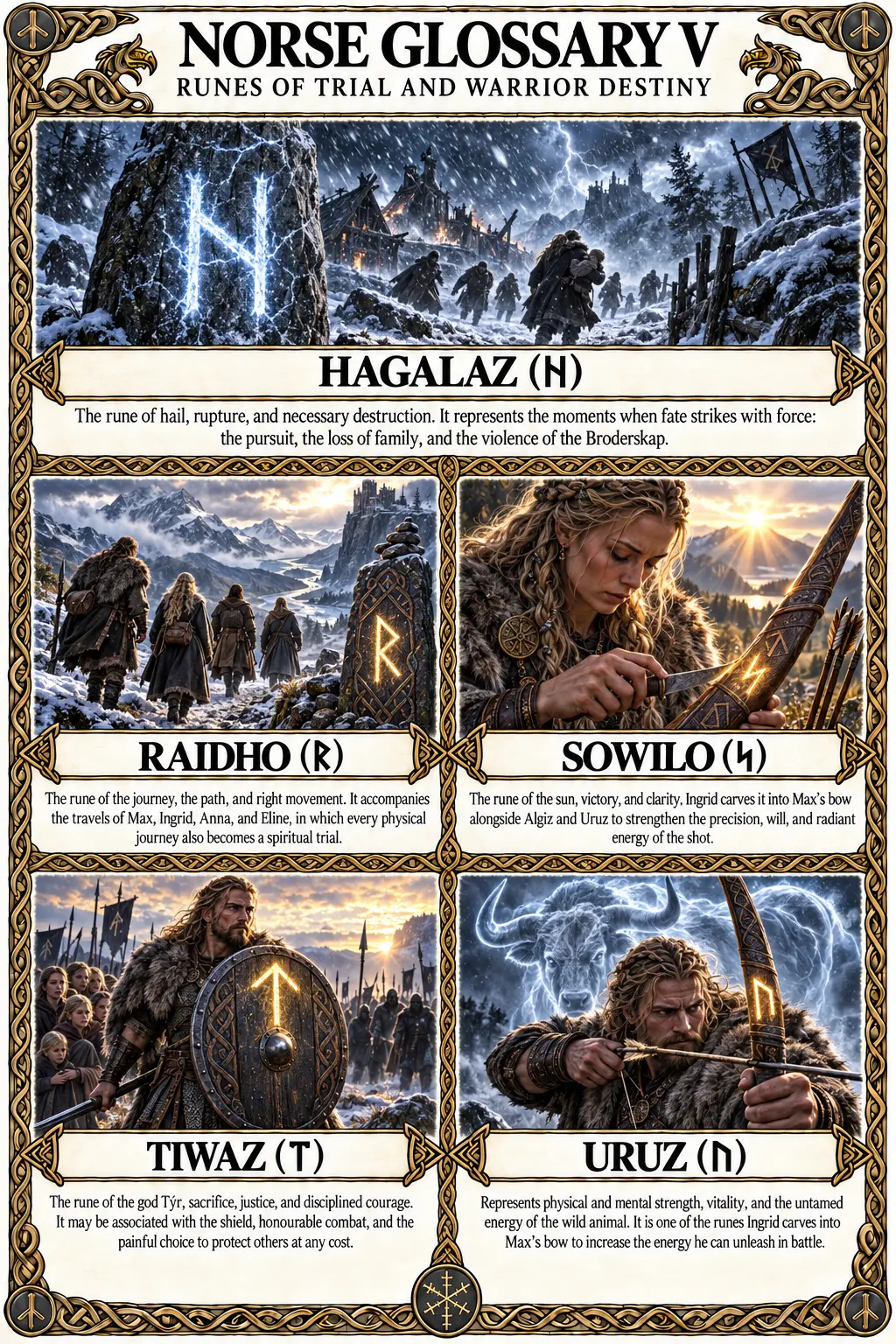
← All glossariesAlgiz (ᛉ): The rune of protection, defense, and the warrior’s shield. It is the sigil Thorvald bears on his ring to conceal himself from his enemies, and the symbol Ingrid carves to ensure that weapons answer to their owners. Ansuz (ᚨ): A rune linked to the gods, speech, inspiration, and sacred knowledge. It may be associated with visions, messages received in dreams, and the wisdom passed down by figures such as Eira, Anna, or Thorvald. Berkano (ᛒ): Symbolizes rebirth, family, and the awakening of that which remains dormant. It is the rune that marks the Vanir bloodline and glows within the fragment of Yggdrasil when Max or Eline connects with their divine heritage. Fehu (ᚠ): The rune of wealth, fertility, and creative power, closely associated with the goddess Freyja. Anna uses it as a symbol of protection and farewell, channeling the energy that sustains life. Hagalaz (ᚺ): The rune of hail, rupture, and necessary destruction. It represents the moments when fate strikes with force: the pursuit, the loss of family, and the violence of the Broderskap. Raidho (ᚱ): The rune of the journey, the path, and right movement. It accompanies the travels of Max, Ingrid, Anna, and Eline, in which every physical journey also becomes a spiritual trial. Sowilo (ᛋ): The rune of the sun, victory, and clarity. Ingrid carves it into Max’s bow alongside Algiz and Uruz to strengthen the precision, will, and radiant energy of the shot. Tiwaz (ᛏ): The rune of the god Týr, sacrifice, justice, and disciplined courage. It may be associated with the shield, honourable combat, and the painful choice to protect others at any cost. Uruz (ᚢ): Represents physical and mental strength, vitality, and the untamed energy of the wild animal. It is one of the runes Ingrid carves into Max’s bow to increase the energy he can unleash in battle. Dagaz (ᛞ): The rune of day, light, and the passage from darkness into clarity. It represents the moment when what remained hidden finally comes to light, and may be linked with revelations, decisive changes, and the awakening of a new stage. Ehwaz (ᛖ): The rune of the horse, associated with movement, travel, and the relationship between rider and mount. In the novels it may represent trust between those who move forward together, and journeys requiring coordination, loyalty, and shared will. Eihwaz (ᛇ): A rune traditionally associated with the yew. Its connection with a resilient tree and with the wood used for bows allows it to be linked with endurance, continuity, and the ability to stand firm before death or adversity. It fits especially well with the saga’s elements concerning trees, roots, and connections between worlds. Gebo (ᚷ): The rune of the gift and the exchange. It represents what is given and the obligation or bond that may arise between giver and receiver. It may be associated with alliances, oaths, sacrifices, and gifts whose true price is discovered only later. Ingwaz (ᛜ / ᛝ): A rune linked to the name Ing, a figure traditionally associated with Freyr. It may represent fertility, continuity of the bloodline, and a contained vital force waiting for the moment to manifest. Within the saga it fits especially well with Vanir heritage. Isa (ᛁ): The rune of ice. It represents stillness, cold, suspension, and what remains frozen or contained. In the narrative it may accompany moments when a power is blocked, a will is paralysed, or something ancient remains preserved while awaiting awakening. Jera (ᛃ): The rune of the year and the harvest. It is linked to the cycle of the seasons and to the result that arrives after the necessary time and work. It may represent consequences, maturation, and the fulfilment of processes that no one can hasten. Kenaz (ᚲ): A rune whose name presents interpretive problems across the different runic traditions, although it is often associated with the torch in the Anglo-Saxon context. In the saga it may serve as a symbol of light, revealed knowledge, and what allows the hidden to be seen. Laguz (ᛚ): The rune of water or the lake. It is naturally related to water, the sea, currents, and travel upon them. Within the novels it may represent deep forces that constantly change and paths that must be followed rather than mastered. Mannaz (ᛗ): The rune of the human being. It represents humanity, community, and the bonds that unite people. It may be used to mark the contrast between the human condition and the ancient bloodlines, powers, and supernatural beings running through the saga. Nauthiz (ᚾ): The rune of need and deprivation. It is linked to the pressure that forces action when options disappear. In the narrative it may represent hunger, privation, endurance, and decisions made because circumstances leave no easy path. Othala (ᛟ): The rune of inheritance and ancestral property. It evokes what is received from forebears: land, home, blood, and legacy. It is especially appropriate for a saga in which ancient lineages and inheritances determine who the characters are and which powers awaken within them. Perthro (ᛈ): One of the runes whose historical interpretation is most uncertain. The exact meaning of its name remains debated, although it has later received associations with chance, fate, and the hidden. Within the saga it may function as a rune of secrets and of what remains unresolved. Thurisaz (ᚦ): A rune whose name is related to the þursar, beings linked with the world of giants and hostile forces. It evokes danger, destructive strength, and confrontation. Within the novels it may signal a power that breaks through defences and is as dangerous to its wielder as to its recipient. Wunjo (ᚹ): The rune of joy and well-being. It represents fulfilment, harmony, and shared happiness within a community. Narratively it is especially powerful when it appears after suffering, as a sign of what the characters are trying to recover or protect. 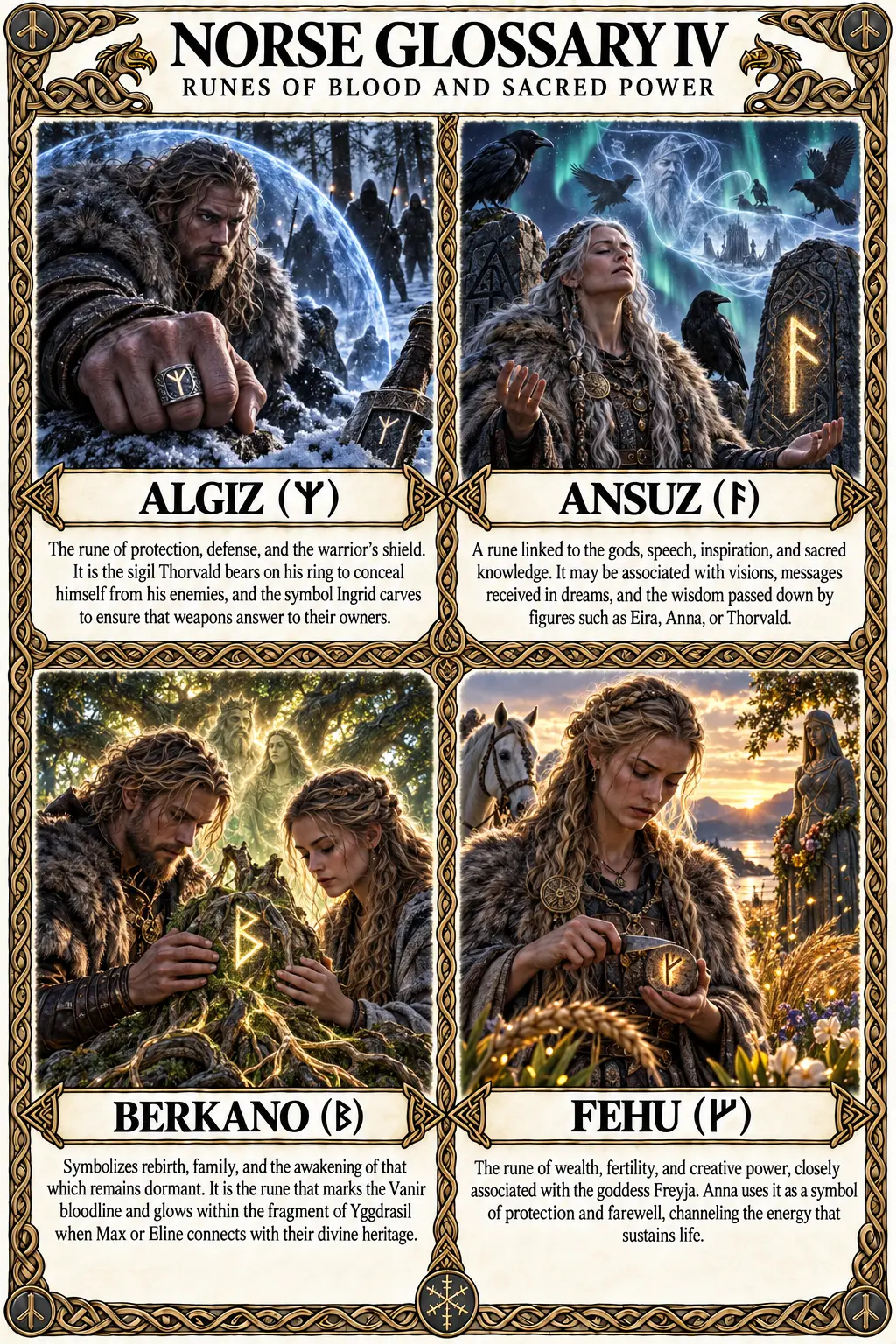
Runes were not an independent language, but a writing system used to represent different Germanic languages. Just as the letters of the Latin alphabet can be combined to form thousands of words, runes primarily represented sounds that could be joined to write names, words, sentences and complete inscriptions. For this reason, the fact that the Elder Futhark contained only 24 runes did not limit the number of words that could be written with them. The runic system changed over the centuries and adopted different forms according to period and territory. The Elder Futhark, composed of 24 runes, is the oldest widely documented runic system and was used approximately between the second and eighth centuries. During the Viking Age, the Younger Futhark became widespread, consisting of only 16 runes. Although the Scandinavian languages had developed new sounds, the number of signs was reduced, so one rune could represent several different sounds. In England and Frisia, the Anglo-Saxon Futhorc developed and expanded the older system to adapt to changes in the language, reaching more than thirty signs depending on the period and variant. During the Scandinavian Middle Ages, runes continued to be used and new graphic solutions appeared to distinguish sounds that the Younger Futhark represented with a single sign. Each rune had a phonetic value, but it also had a name. That name normally began with the sound represented by the rune itself and referred to a specific word or concept. Thus, Fehu (ᚠ) is associated with cattle and wealth; Isa (ᛁ) with ice; Tiwaz (ᛏ) with the god Týr; and Sowilo (ᛋ) with the Sun. This gives runes a symbolic dimension in addition to their function as writing. It is important, however, to distinguish between the historical meaning of their names, associations documented in the sources and magical interpretations developed later. Norse sources also connect runes with knowledge, power and magical practices. In mythological tradition, Odin gains knowledge of the runes after hanging for nine nights on the world tree, wounded by a spear and sacrificed to himself. Texts such as Sigrdrífumál describe different kinds of runes associated with victory, protection, healing, birth, the sea, speech and wisdom. Archaeological inscriptions likewise show that certain runes and formulas could be used with purposes extending beyond simple writing. This does not mean that each rune historically possessed one unique and unchanging magical meaning. Many current associations — protection, transformation, destiny, energy or awakening — come from later interpretations or modern reconstructions. In the novels, runes retain their historical and mythological origins, but they also form part of an original magical system. Their names and traditional associations provide the foundation for powers that can manifest through objects, weapons, blood, knowledge or particular lineages. For this reason, the descriptions in this glossary combine the historical meaning of the runes with the narrative and magical function they acquire within the sagas. ← All glossaries