← Æsir index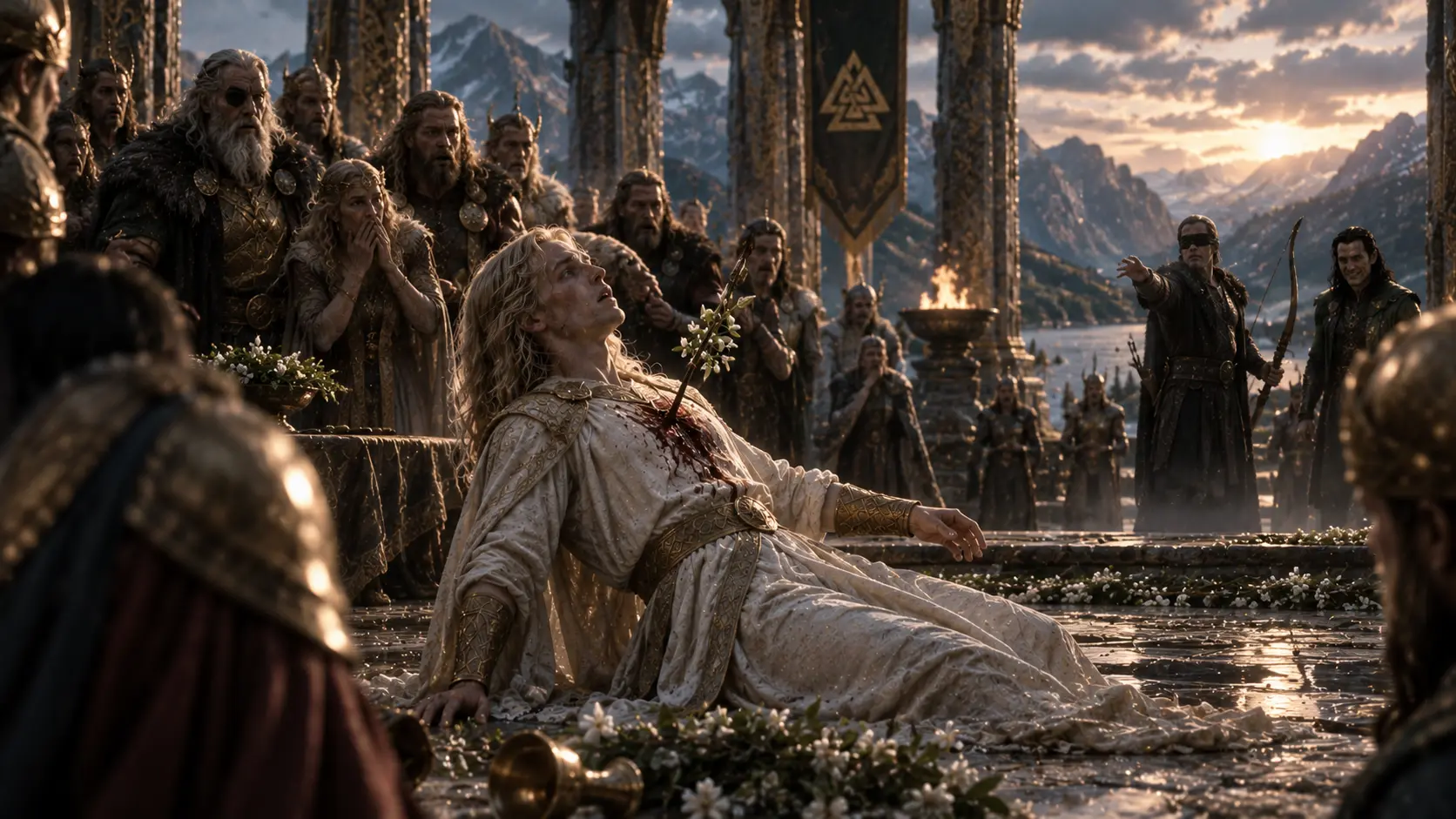
Baldr: Son of Odin and Frigg, husband of Nanna and father of Forseti. He is one of the brightest and most tragic figures in Norse mythology. The sources associate him with beauty, purity and a radiant quality that sets him apart even among the gods. Yet his importance in the mythic cycle comes from an extraordinary contradiction. Baldr seems destined to represent everything that ought to endure. And that is precisely why he must die. His death announces that the order of the world is beginning to break apart and becomes one of the great events preceding Ragnarök. But Baldr possesses something Odin, Thor, Heimdall and many other gods will lose: a future beyond it. Snorri describes Baldr as an exceptionally beautiful and radiant god. His appearance is so luminous that he seems to give off light. He even compares Baldr’s eyebrows to Baldrsbrá, a plant of exceptional whiteness. This brightness suits a character whose story is built around loss. Baldr represents something loved by the gods and condemned to disappear before the world is destroyed. His character is also associated with goodness and wisdom. There is, however, one peculiarity. Snorri says that none of Baldr’s decisions can be fulfilled. The statement is enigmatic, and it fits his fate unsettlingly well: Baldr may be wise, just and beloved, yet he belongs to a story in which certain forces remain beyond his control. Baldr’s dwelling is called Breiðablik, usually interpreted as “broad radiance” or “broad gleam.” In Grímnismál, it is described as a place where very few impure things can be found. The dwelling reinforces the god’s luminous identity. While other figures are associated with fortresses, battlefields, mountains or wild regions, Baldr lives in a place defined by ideas of clarity and purity. Breiðablik seems to belong to the world the gods wish to preserve. That makes it all the more significant that its lord is among the first to vanish. Baldr is married to Nanna, daughter of Nepr. Their union produces Forseti, a god associated with reconciliation and the settlement of disputes. This family gives the tragedy an intimate dimension. Baldr is not only the son of Odin and Frigg. He is a husband. He is a father. When he dies, the loss reaches across several generations of the divine family. Nanna also has a particularly painful place in his funeral. According to Snorri’s account, when she sees her husband’s body, her heart gives way to grief and she dies. Her body is placed beside Baldr’s on the funeral pyre. Even in death, they remain together. The tragedy begins before there is a wound. Baldr starts having terrible dreams of his own death. In Norse tradition, dreams can act as windows onto future events, warnings that reveal what remains hidden during waking life. The gods understand that something threatens Baldr. Odin also seeks answers. In Baldrs draumar, he rides to the world of the dead and awakens a völva to question her. Her answer confirms their fear. Hel is preparing a place for Baldr. His death is already casting a shadow over the realm of the dead before it has happened. Frigg tries to prevent her son’s fate. She obtains promises from creatures, plants, diseases, metals, stones and other elements that none of them will harm him. The protection seems absolute. Baldr becomes invulnerable. The other gods eventually turn this condition into entertainment. They place him before them. They shoot at him. They throw stones at him. They strike him with weapons. Nothing can wound him. What began as a mother’s desperate response to a prophecy becomes a game among the gods. Loki watches. There is one exception. Frigg had considered mistletoe too young or insignificant to demand an oath from it. Loki discovers the vulnerability. He obtains the plant and approaches Höðr, Baldr’s blind brother, who has been left apart while the others take part in the game. Loki places the weapon in his hands. Then he guides the throw. The mistletoe strikes Baldr. The god falls dead. The tragedy is especially cruel because almost everyone taking part had acted in the belief that Baldr was invulnerable. The only existing weakness had been found by the one figure determined to use it. The gods carry Baldr’s body to Hringhorni, his enormous ship. They intend to use it as his funeral pyre. The vessel is so large that even the gods struggle to move it, and they must ask the giantess Hyrrokkin for help. She arrives riding a wolf and manages to push the ship into the water with extraordinary force. Baldr’s body is placed aboard Hringhorni. Nanna is laid beside him. Thor consecrates the pyre with Mjölnir. Odin places Draupnir, his magical ring, on his son’s body. Baldr’s horse is also included among the funeral offerings. Then the ship is set alight. The funeral gathers some of the most important objects and figures of the divine world around a god whose death none of them has managed to prevent. Frigg still refuses to accept that the story is over. She asks who is willing to travel to the realm of Hel and try to bring her son back. Hermóðr volunteers. He mounts Sleipnir, Odin’s horse, and rides for nine nights along increasingly dark roads until he reaches the realm of the dead. There he finds Baldr. Hel agrees to consider releasing him on one extraordinary condition: everything that exists must weep for him. The news travels through the worlds. Humans, animals, trees, stones and metals weep for the god’s death. A figure called Þökk refuses. The tradition passed down by Snorri identifies her—or suspects her identity—as Loki. The condition fails. Baldr remains in Hel. For now. There is a particularly powerful small detail during Hermóðr’s return. Baldr gives him objects to carry back from the realm of the dead. Among them is Draupnir, the ring Odin had placed on Baldr’s funeral pyre. The object a father had given as a funeral offering returns from Hel. Baldr is still dead, but the ring shows that he continues to exist somewhere beyond the boundary. For Odin, who has devoted his existence to seeking knowledge of death and fate, receiving Draupnir again must have carried extraordinary meaning. His son is dead. But he has not vanished. The relationship between Baldr and Höðr has a surprising conclusion. Loki uses Höðr to cause his brother’s death, and Höðr is later killed by Váli, Odin’s son conceived to avenge Baldr. It might seem that their story is forever defined by fratricide. Ragnarök changes that perspective. After the destruction, Baldr and Höðr return together. The victim and the brother who involuntarily caused his death appear together in the renewed world. The sources offer few details about how this reconciliation should be understood. That is precisely why the image is so powerful. The new world begins with two brothers whose relationship belonged to one of the old world’s greatest tragedies. This may be the most important aspect of the character. Baldr dies before Ragnarök. He remains in Hel while the old world moves towards its destruction. Then the final battle comes. Odin dies before Fenrir. Thor kills Jörmungandr and succumbs to its poison. Týr and Garmr destroy one another. Heimdall and Loki kill each other. Fire consumes the world. Then the Earth rises green and renewed from the sea. And Baldr returns. Völuspá foretells that Baldr and Höðr will dwell together again. His death therefore gives him a fate different from that of many other gods. Baldr belongs to the world before Ragnarök. He dies before its destruction. He descends into the realm of the dead. He waits. And finally enters the world born afterwards. Baldr therefore occupies an extraordinary position in the overall structure of Norse mythology. Odin essentially belongs to the doomed world. Thor belongs to the doomed world. Heimdall belongs to the doomed world. Baldr crosses that boundary. He knows Asgard before its fall. He knows Hel. Then he will know the renewed Earth. He is one of the few figures connecting the world of the gods who die with the world of the gods who remain. That is why his story should not be reduced to “the god killed by Loki.” His death is fundamental. His return matters even more. Baldr is a key figure in the novel Grimwolf. His presence makes it possible to explore the most powerful elements of his mythic tradition: the inevitability of fate, a foretold death, family bonds, betrayal, Ragnarök and the possibility that something can survive the collapse of the old order. In a universe where myths leave consequences that pass through generations, Baldr also has an exceptional characteristic. His story remains unfinished for centuries. Other gods await Ragnarök in order to die. Baldr awaits Ragnarök in order to return. Name: Baldr / Balder. Nature: Æsir. Father: Odin. Mother: Frigg. Wife: Nanna. Son: Forseti. Dwelling: Breiðablik. Main attributes: radiance, beauty, purity and wisdom. Element associated with his death: mistletoe. Responsible for the deception: Loki. The one who physically throws the weapon: Höðr. Funeral pyre: the ship Hringhorni. Object Odin places on the funeral pyre: Draupnir. Fate before Ragnarök: remains in Hel. Fate afterwards: returns after Ragnarök and dwells in the renewed world with Höðr. Main sources: Völuspá, Baldrs draumar, Grímnismál and Gylfaginning.
Baldr