Norse tradition speaks of inhabited worlds, divine halls, roads between different realms, and places associated with the dead. It also preserves images of fate and the end of the world. The sources do not always offer one complete map: some places appear in several texts, while others receive only a brief mention.
This glossary gathers these names by theme.
01Worlds and territories
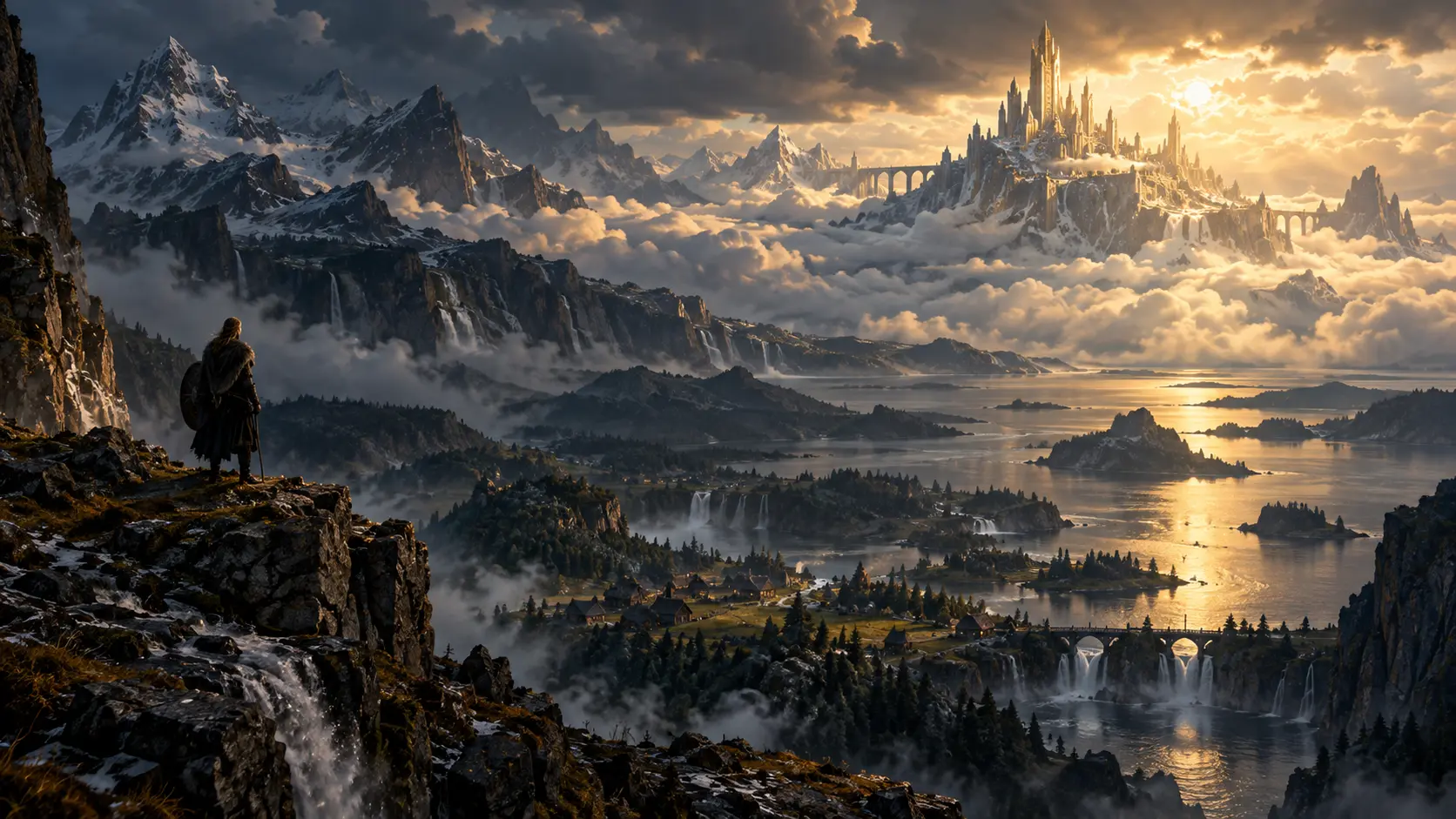
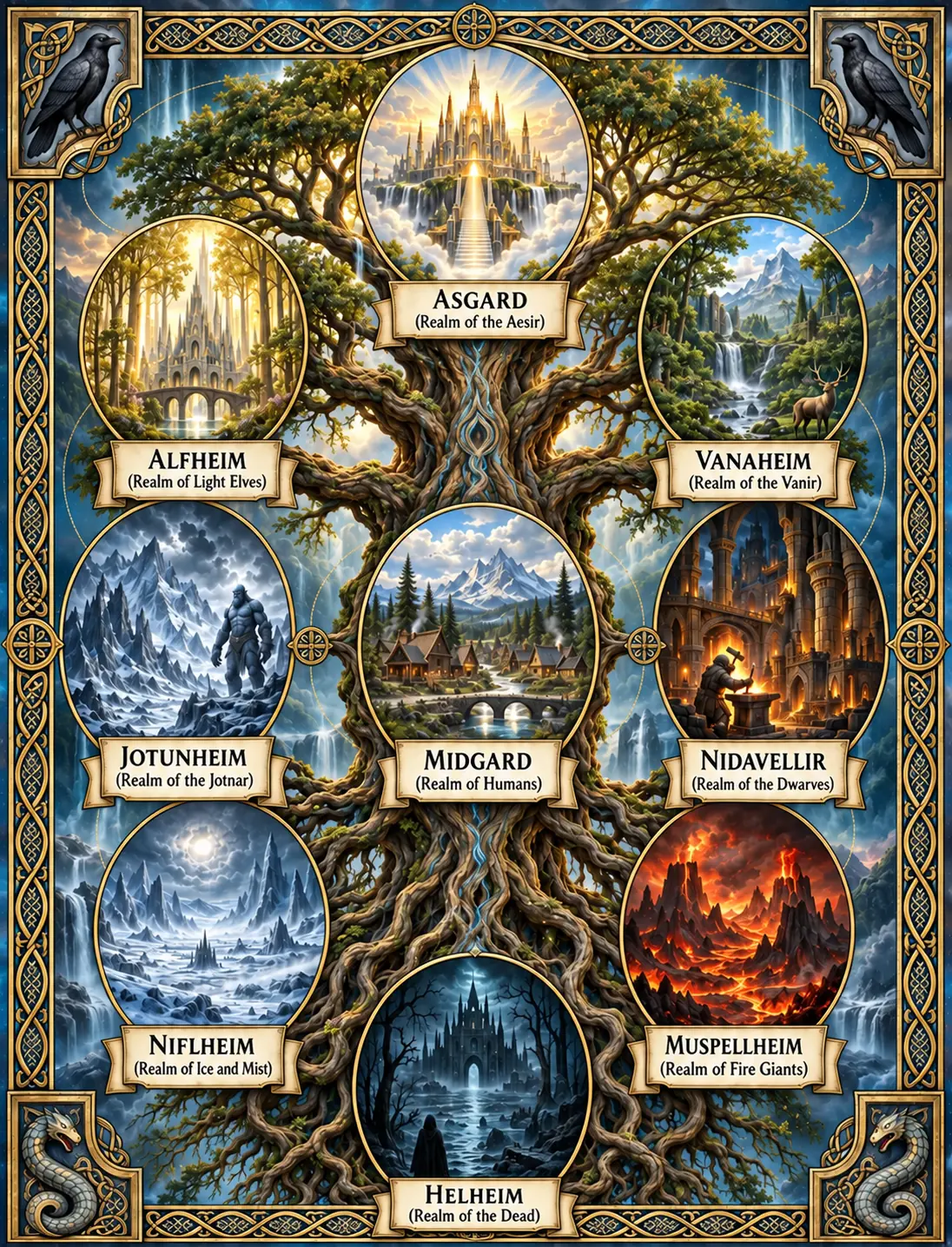
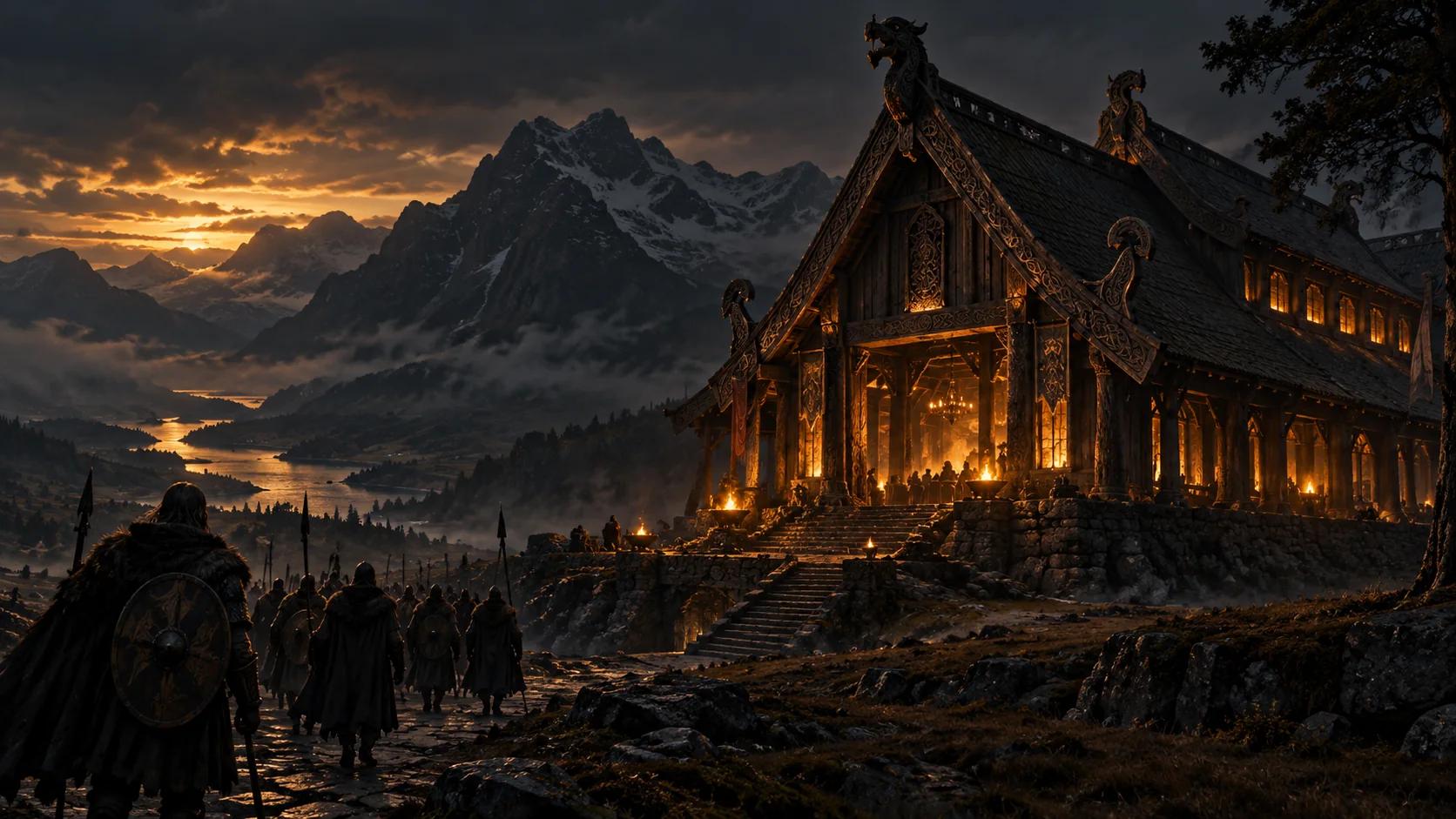
Norse accounts name places inhabited by gods, humans, jötnar and other beings, as well as primordial regions associated with the origin of the cosmos. No single map survives that defines the borders and position of every one of them precisely. Some places appear in several accounts; others are known from only a brief mention.Asgard — Ásgarðr. It is the realm of the Æsir, the divine group to which Odin and Thor belong. The gods’ dwellings, halls and meeting places are found there in the accounts. Bifröst provides a way from earth to heaven, and Heimdall watches over that passage. Asgard is therefore not a single building: it encompasses places associated with different divine figures and with the exercise of their power.
The Æsir deliberate, make agreements, receive news from other realms and prepare there for threats that will eventually reach them. Their defences and watchmen show that their territory has borders, but do not place it beyond danger. During Ragnarök, hostile forces draw near and the order the gods have built collapses.In the novel, Asgard is also associated with height, vigilance and power exercised from above. This is a symbolic reading of its position in the accounts, added to the place’s mythological role.Midgard — Miðgarðr. It is the world intended for human beings. Its name evokes a central, bounded space set against territories beyond its limits. According to Snorri, the sons of Borr shape the world from the body of the primordial giant Ymir; with Ymir’s eyebrows they raise a protective boundary around Midgard for humankind. *Gylfaginning*, *Prose Edda*, English translation by Arthur Gilchrist Brodeur (1916)Midgard does not remain separate from the other realms. The gods intervene in human affairs, creatures from elsewhere threaten it, and the serpent Jörmungandr encircles it from the sea. Thor appears in the accounts as one of its defenders. Because it exists within a wider cosmos, divine actions and dangers from beyond have consequences for those who live there.In the novel, Midgard is the mortal setting where the decisions of gods and ancestors continue to affect the living.Vanaheim — Vanaheimr. It is the realm associated with the Vanir, the divine group that includes Njörðr, Freyr and Freyja. The surviving sources speak of the relations between Vanir and Æsir, but offer few details about Vanaheim’s landscape, borders or particular dwellings. This scarcity of description makes it impossible to reconstruct the realm as a fully known territory.The story of Njörðr shows that the separation between the two divine groups is not absolute. According to Snorri, he was raised among the Vanir and came to the Æsir as part of an exchange of hostages that helped establish peace. His presence, and that of his children, among the gods links Vanaheim with accounts that also take place in the realm of the Æsir. *Gylfaginning*, *Prose Edda*, English translation by Arthur Gilchrist Brodeur (1916)In the novel, Vanaheim also represents fertility, nature, ancient magic and pacts made with the living earth. These associations develop in literary terms a place whose geography the sources scarcely describe.Jötunheim — Jötunheimr. A name associated with the lands of the jötnar. In the accounts, these beings appear as adversaries of the gods, but also as their kin, occasional allies and keepers of ancient knowledge. Their relationship with the Æsir cannot be reduced to a permanent war between two uniform peoples.Many of their dwellings are placed beyond the protected space of the gods or humans. Travelling there may require crossing dangerous territories and encountering powers the Æsir do not control. Jötunheimr, however, has no single, complete geographical description in the sources: different episodes focus on particular places and inhabitants.Its importance also lies in those family ties. The ancestry of several divine figures includes jötnar, and encounters between the two groups are part of both the creation of the world and the tensions that lead to Ragnarök.Álfheimr. It is a place associated with the elves. Grímnismál says that the gods gave it to Freyr in ancient times. Snorri, in turn, uses the name when speaking of the realm of the light elves. These references link Álfheimr with elves and Freyr, although they do not explain at length how its inhabitants live there. *Grímnismál* (*The Lay of Grimnir*), English translation by Benjamin ThorpeThe sources do not provide a detailed description of its borders, buildings or organisation either. The name has a recognisable place among the Norse realms, but its familiar image as a fully mapped kingdom owes much to later reconstructions and depictions.Nidavellir — Niðavellir. A name mentioned in Völuspá in connection with a dwelling of the line of Sindri. Its association with dwarves and craftsmanship is common in modern explanations, but the surviving passage is brief and does not describe Nidavellir as a kingdom of forges, cities and clearly defined rulers. The reading of the name itself and the place to which it refers have also prompted differing interpretations. *Völuspá*, *Poetic Edda*, English translation by Henry Adams BellowsIt is therefore possible to speak of its association with Sindri and with traditions concerning dwarves without attributing to the source a map it does not provide. In the novel, Nidavellir takes on the character of a land of great smiths: that portrayal expands upon the few details that survive.Svartálfaheimr. Its name can be understood as “world of the dark elves”. It appears in the tradition transmitted by Snorri and is associated with beings whom the sources describe inconsistently. The terms svartálfar, dökkálfar and dwarves have led to different interpretations as to whether they refer to separate or partly overlapping groups.Accounts of supernatural craftsmen add to the difficulty: some episodes associated with svartálfar concern makers of objects who would be called dwarves in other contexts. The surviving sources do not clearly establish three distinct peoples, each with its own territory and well-defined traits.Niflheim — Niflheimr. It is a primordial realm associated with cold. In the cosmogony related by Snorri, ice and frost come from its side towards Ginnungagap. The contact of that cold with the heat arriving from the realm of Múspell contributes to the conditions from which primordial life emerges. *Gylfaginning*, *Prose Edda*, English translation by Arthur Gilchrist Brodeur (1916)Niflheim also appears in the description of Yggdrasil. One of the tree’s roots stretches over this region, and the spring Hvergelmir lies beneath it, near the root gnawed by Níðhöggr. Snorri also associates Hel with Niflheim, though this does not automatically make every name for the world of the dead and the realm of cold synonymous. *Gylfaginning*, *Prose Edda*, English translation by Arthur Gilchrist Brodeur (1916)Múspell. A name associated with a realm of fire and heat and with the forces that take part in Ragnarök. In Snorri’s account of the origins, sparks and heat from Múspellheim reach Ginnungagap and contribute to the emergence of primordial life. Múspellheim is therefore not merely a modern name: it appears in that medieval account. *Gylfaginning*, *Prose Edda*, English translation by Arthur Gilchrist Brodeur (1916)At the end of the world, the sons of Múspell advance under the leadership of Surtr. Their arrival links the fiery force present at creation with the fire that will consume the existing order. The texts do not describe every member of this host in equal detail; Surtr is its most recognisable individual figure.Hel. The name may refer both to Hel, the figure who rules over certain dead, and to the realm associated with them. According to Snorri, Hel is Loki’s daughter and was sent to Niflheim, where she was given authority over those who came to her, including people who died of illness or old age. The same author describes her dwelling with walls and gates. *Gylfaginning*, *Prose Edda*, English translation by Arthur Gilchrist Brodeur (1916)The fate of the dead in Norse traditions is more varied than a simple division between Valhalla and Hel. Freyja receives some of those who fall in battle, and other accounts preserve different images of the relationship between the living and the dead. Hel is not simply equivalent to the Christian Hell: identifying the two erases important differences in context, inhabitants and meaning.
02Paths, boundaries and sacred places
In Norse cosmology, a path may lead to the realm of the gods, a root may reach into a distant region, and a well may hold knowledge or be linked to fate. These places do not form one detailed map. Their importance comes from the events and beings the sources place within them.Yggdrasil — Yggdrasill. It is the great tree that supports and connects different realms of the cosmos. Völuspá presents it beside the Well of Urðr; Snorri develops the image of its roots and places sites such as Mímir’s Well and Hvergelmir beneath them. The gods gather beside the tree to hold their assemblies. Yggdrasil is therefore a meeting point for regions, beings and events that do not remain isolated from one another. *Völuspá*, *Poetic Edda*, English translation by Henry Adams Bellows
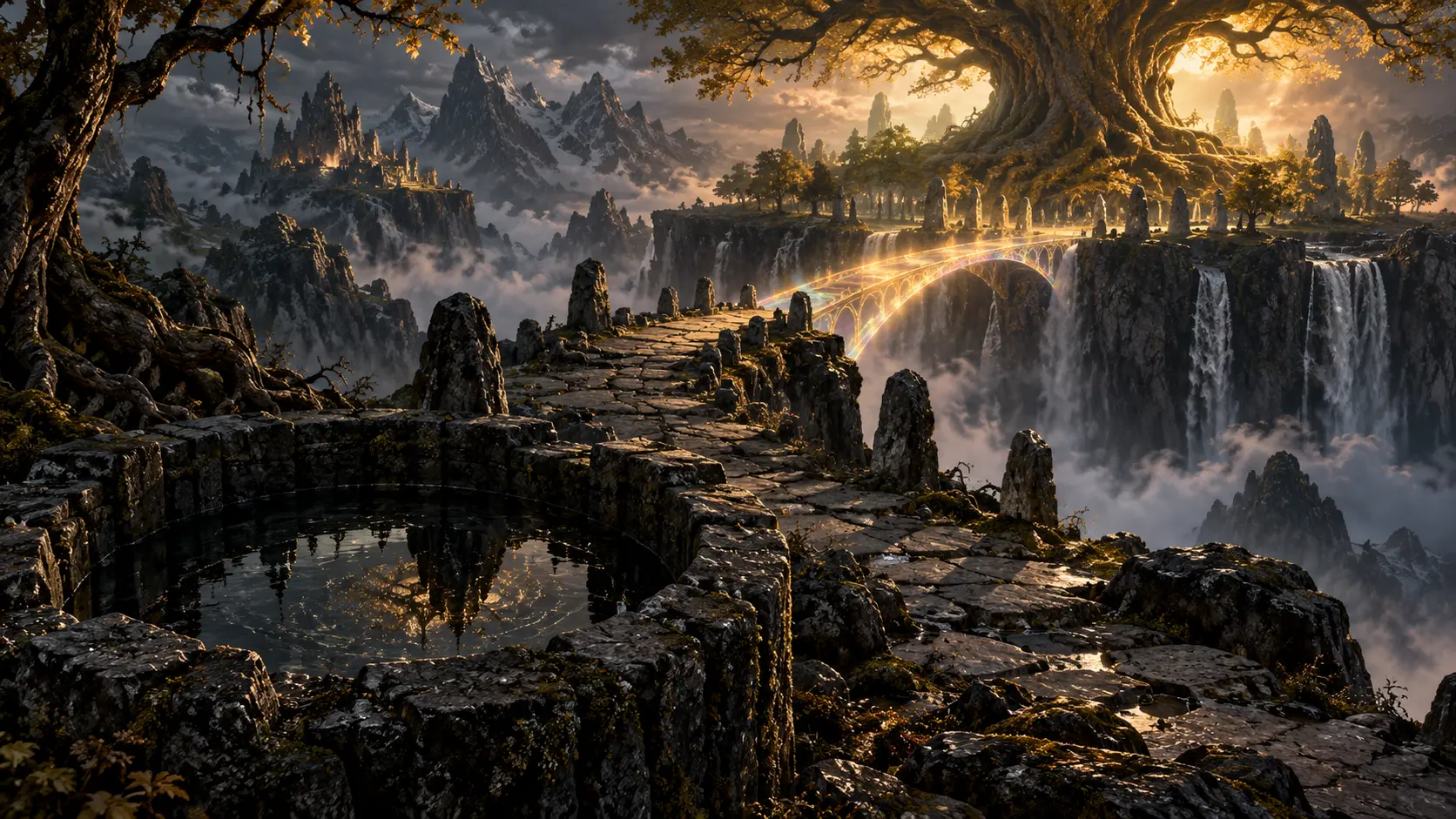
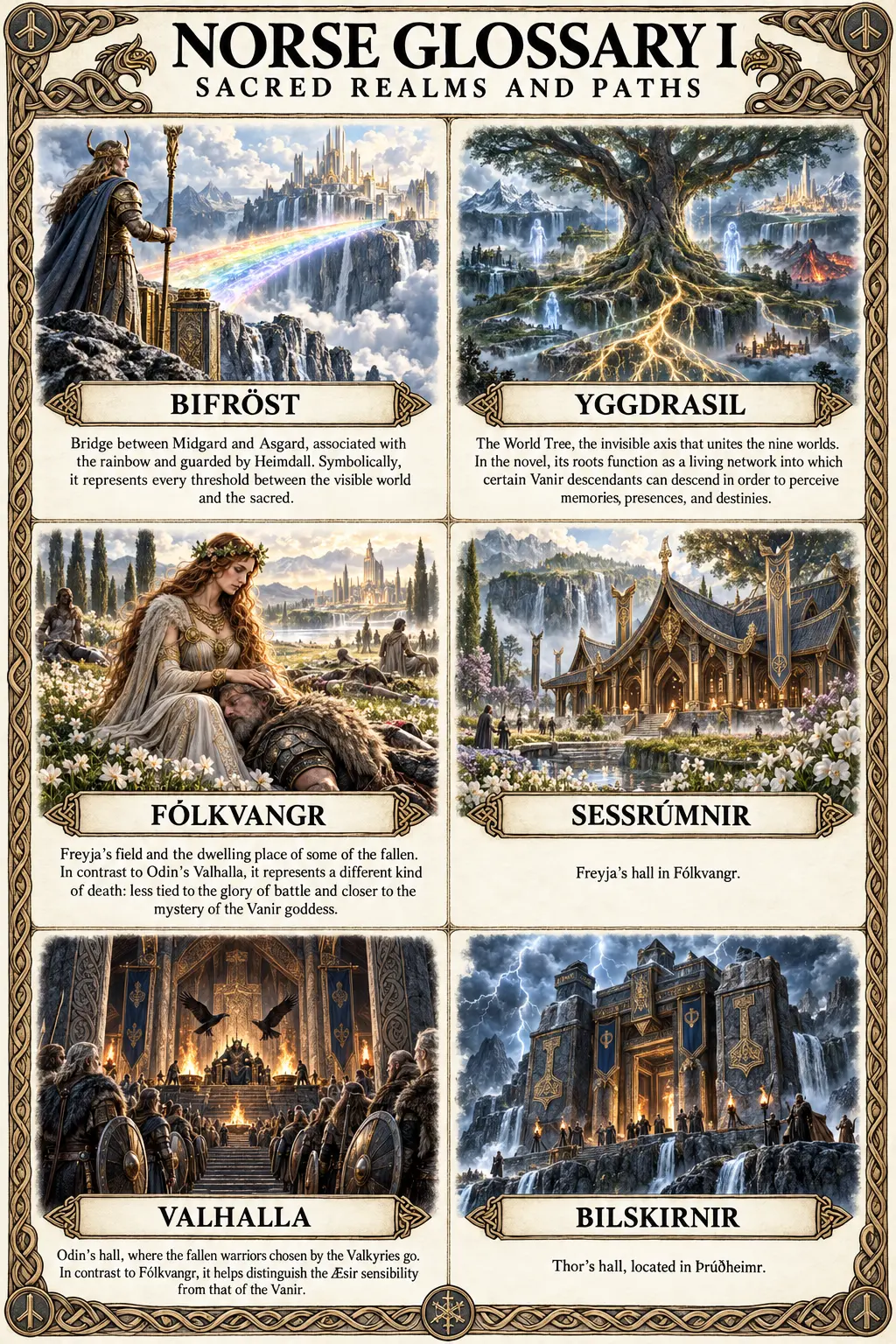
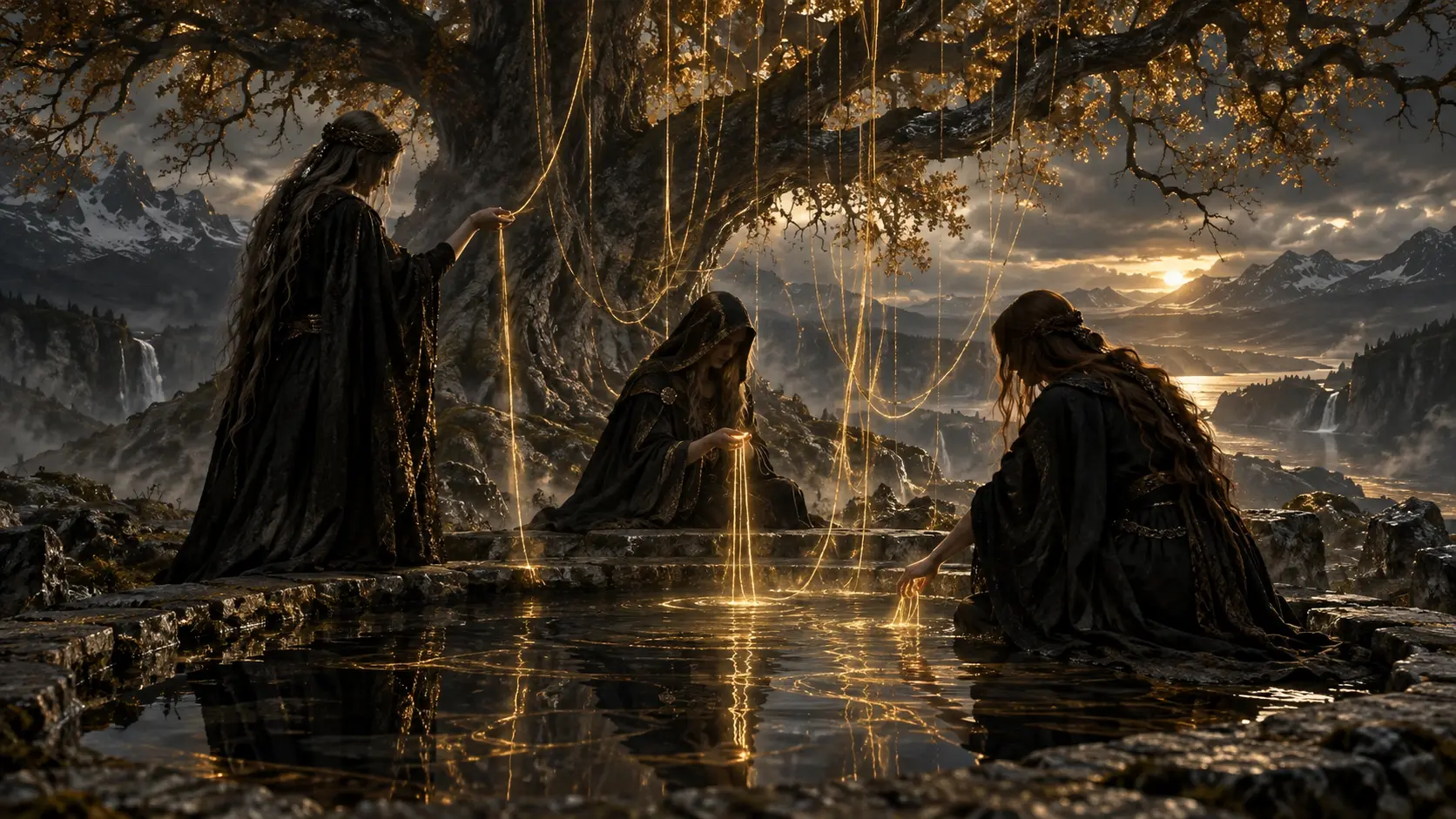
The tree is also exposed to harm. Snorri speaks of creatures that live among its branches and of Níðhöggr, who gnaws at one of its roots from below. The norns, by contrast, take water and clay from the Well of Urðr to sprinkle over it and keep it from withering. Its survival requires care even as it supports the order of the world.In the novel, its roots also form a living network through which certain Vanir descendants perceive memories, presences and possible destinies. Yggdrasil is often described as the tree that connects “the nine worlds”. The sources mention nine worlds, but do not transmit a single, undisputed list of all of them or explain in detail where each lies among the tree’s branches and roots. *Völuspá*, *Poetic Edda*, English translation by Henry Adams BellowsBifröst. It is the bridge built by the gods between earth and heaven. Snorri connects it with the rainbow and describes its colours and extraordinary strength. The Æsir use it to reach the place where they hold their assemblies beside the Well of Urðr. It is therefore a road to the divine realm, not merely an ornament in the sky. *Gylfaginning*, *Prose Edda*, English translation by Arthur Gilchrist Brodeur (1916)Heimdall watches the approach near the bridge’s heavenly end. His vigilance makes sense because Bifröst connects realms without being open to everyone. During Ragnarök, the forces of Múspell advance across it, and the bridge eventually breaks: even a structure built by the gods cannot withstand the final crisis intact.In the novel, Bifröst also represents the danger of crossing a threshold between the visible world and the sacred. This reading preserves its role as a passage while adding the meaning it carries in the characters’ experiences.Well of Urðr — Urðarbrunnr. It lies beside one of Yggdrasil’s roots. According to Snorri, the gods come there to hold their assemblies. Urðr, Verðandi and Skuld, the three norns named together in the account, live near the well. This place thus brings together the world tree, divine decisions and the span of human lives. *Gylfaginning*, *Prose Edda*, English translation by Arthur Gilchrist Brodeur (1916)Snorri describes the water of the well as sacred. The norns take it, along with clay from its banks, and sprinkle Yggdrasil to preserve its branches. This action gives the well another role beyond its association with fate: it helps keep alive the tree that supports the cosmos.Mímir’s Well — Mímisbrunnr. It is a place associated with wisdom and understanding, beneath the root of Yggdrasil that reaches towards the realm of the giants in Snorri’s account. Mímir guards the well, whose knowledge cannot be gained without a price. Odin gives up one of his eyes so that he may drink from its waters. *Gylfaginning*, *Prose Edda*, English translation by Arthur Gilchrist Brodeur (1916)Odin’s sacrifice makes the well an image of the price of knowledge. Its importance returns as Ragnarök approaches: Snorri says that Odin goes to Mímir for counsel before the battle. The place is thus linked both to an ancient search for wisdom and to the need to face the end of the known order. *Gylfaginning*, *Prose Edda*, English translation by Arthur Gilchrist Brodeur (1916)Hvergelmir. It is a spring beneath the root of Yggdrasil that, in Snorri’s account, stretches over Niflheim. It is associated with streams of water and with the depths of the world. In that same realm, Níðhöggr gnaws at one of the tree’s roots; Snorri also mentions numerous serpents associated with Hvergelmir. *Gylfaginning*, *Prose Edda*, English translation by Arthur Gilchrist Brodeur (1916)In contrast to the Well of Urðr, linked with the gods’ assemblies and the care of the tree, Hvergelmir appears in a cold and threatening region. Both springs form part of Yggdrasil’s geography, but the images surrounding them are different. The sources do not explain precisely every physical connection between their waters.Himinbjörg. It is the dwelling of Heimdall, near the heavenly end of Bifröst. Its position accords with the god’s role as guardian of the approach to the divine realm. Snorri describes him as a watchman with extraordinary senses, able to see and hear what other beings would miss. *Gylfaginning*, *Prose Edda*, English translation by Arthur Gilchrist Brodeur (1916)Himinbjörg is also a place where Heimdall lives, not only a watch post. Grímnismál names it among the divine dwellings and depicts Heimdall drinking in his hall. When Ragnarök comes, Heimdall sounds the Gjallarhorn to warn the gods. His dwelling is thus associated both with the daily watching of a boundary and with the announcement of its final breach.Ginnungagap. It is the great primordial abyss in accounts of the world’s beginning. In Snorri’s narrative it lies between regions of cold and fire. Ice and frost come from the cold side; heat and sparks come from Múspell. When the heat reaches the frost, it melts, creating the conditions for primordial life to emerge. *Gylfaginning*, *Prose Edda*, English translation by Arthur Gilchrist Brodeur (1916)Ginnungagap belongs to the account of what existed before the ordered world was formed. It is not an inhabited realm comparable to Asgard or Midgard, nor a place to which mythic figures travel as they would cross a bridge. Its importance lies in being the space where different forces meet and the history of the cosmos begins.Vé. In Old Norse, the word is associated with a sacred place or consecrated enclosure. It can refer to a space distinguished from its surroundings by its religious character. The term therefore belongs to a different scale from the great cosmic realms in this glossary: it also allows us to speak of sacred places associated with human practices. Ancient evidence and the study of these spaces show that there is no need to imagine every vé as a building of the same form. Study of Norse sacred placesHere, vé names a kind of place. It must be distinguished from Vé, the god who appears as Odin and Vili’s brother in accounts of creation. The similarity in spelling does not make every reference to a sacred enclosure a reference to the god.
03Divine dwellings and halls of the dead
Norse sources name many halls, territories and divine dwellings. Some are described precisely; of others, we know little beyond their names and who owns them. Valhalla and Fólkvangr are associated with the battle-dead, while places such as Bilskirnir and Breiðablik are divine dwellings. The distinction matters: not every divine hall is a destination for the dead.Valhalla — Valhöll. It is Odin’s hall, where warriors killed in battle and chosen for him arrive. The einherjar gather there and will form part of his forces when Ragnarök comes. The sources do not present Valhalla as the destination of every dead person, nor do they say that every fallen warrior enters it: Freyja also receives a share of those who die in battle.
In Grímnismál, Valhalla stands in Glaðsheimr. The poem depicts it through warrior imagery: spears above the hall, shields and coats of mail. It also mentions its many doors, through which the fighters will go when they face the wolf. These details express both Odin’s power and the immense host he is preparing for the final battle. *Grímnismál* (*The Lay of Grimnir*), English translation by Benjamin ThorpeSnorri describes the einherjar’s life inside Valhalla. By day they fight one another; afterwards they return to the hall to gather and drink. The boar Sæhrímnir provides food, while the goat Heiðrún supplies mead. Nearby stands the stag Eikþyrnir, associated with the source of numerous streams. Valhalla thus brings together images of war, abundance and preparation for a destruction its inhabitants know will come. *Gylfaginning*, *Prose Edda*, English translation by Arthur Gilchrist Brodeur (1916)Fólkvangr. It is Freyja’s realm, associated with the battle-dead. Grímnismál says that she chooses half of those who fall, while Odin receives the other half. Snorri records this division and places the goddess’s dwelling there. The sources, however, do not explain the criteria by which some go to Fólkvangr and others to Valhalla. *Grímnismál*, stanza 14, English translation by Benjamin ThorpeFreyja’s presence makes it impossible to reduce the warriors’ fate to Odin and his hall. Nor does it allow us to claim that Fólkvangr is a place reserved for less warlike dead: the texts associate it specifically with those who fall in battle. The novel may create a symbolic contrast between the two destinations—for example, by linking Fólkvangr to Freyja’s mystery—but that contrast belongs to its literary interpretation, not to a distinction explained in the medieval sources.We know far less about Fólkvangr than about Valhalla. No comparable description survives of its inhabitants’ activities or of its detailed role during Ragnarök. Its importance lies in part in this clear yet undeveloped presence: Freyja shares with Odin the choosing of the fallen.Sessrúmnir. It is Freyja’s hall in Fólkvangr according to Gylfaginning. Snorri calls it large and beautiful but does not describe its doors, dimensions or the daily life of those who gather there. Therefore, Fólkvangr and Sessrúmnir are not interchangeable names: the first designates Freyja’s realm, and the second her hall in Snorri’s account. *Gylfaginning*, *Prose Edda*, English translation by Arthur Gilchrist Brodeur (1916)The name Sessrúmnir is often connected with spaciousness or an abundance of seats. That interpretation fits the image of a great hall, although it cannot by itself justify attributing ceremonies, feasts or rules of admission to it that the texts do not describe. Compared with the many details preserved about Valhalla, Sessrúmnir remains a dwelling of great importance whose interior we can barely reconstruct.Bilskirnir. It is Thor’s hall. Snorri places it in the realm called Þrúðvangar and presents it as the largest of known houses, with five hundred and forty rooms in his explanation of Grímnismál. Translations do not always render the term for these divisions in the same way; what both sources emphasise is its extraordinary size. *Gylfaginning*, *Prose Edda*, English translation by Arthur Gilchrist Brodeur (1916)Its vastness underscores Thor’s standing among the gods, but Bilskirnir is a divine dwelling, not a general destination for dead warriors. The poem mentions it in a list of places belonging to different divine figures. It does not offer an extensive description of its interior, its visitors or the activities that take place there.Þrúðheimr / Þrúðvangar. These are names associated with Thor’s realm. Grímnismál names Þrúðheimr as the place where the god lives, while Snorri calls his territory Þrúðvangar and places Bilskirnir there. The forms occur in different sources and contexts, so it is more precise to explain how they relate than always to substitute one for the other. *Grímnismál* (*The Lay of Grimnir*), English translation by Benjamin ThorpeThese names make it possible to distinguish the realm associated with Thor from Bilskirnir, his hall. The surviving sources do not provide a detailed map of Þrúðheimr or Þrúðvangar, or describe their borders. What they do convey is that Thor had a dwelling of his own among the divine places.Glaðsheimr. It is the place where Grímnismál situates Valhalla. The poem introduces this realm and, within it, Odin’s great hall where men slain by weapons are chosen. Glaðsheimr thus names the place associated with Odin, while Valhalla is the hall described in the following verses. *Grímnismál* (*The Lay of Grimnir*), English translation by Benjamin ThorpeThe text gives much more attention to Valhalla’s appearance and role than to Glaðsheimr’s geography. It does not define its borders precisely or list every structure it might contain. Its mention is nevertheless important for understanding that the great Norse halls may be situated within wider divine realms.Breiðablik. It is Baldr’s dwelling. Grímnismál says that the hall there was built by the god for himself and presents it as a place where very little evil is found. Snorri emphasises its extraordinary beauty and says that nothing impure can be found there. These descriptions accord with the radiant image of Baldr conveyed by Gylfaginning. *Grímnismál* (*The Lay of Grimnir*), English translation by Benjamin ThorpeThe association gains particular force when we know of Baldr’s death: a dwelling linked with purity and beauty belongs to a god whose loss shakes the Æsir. The sources, however, do not narrate at length what happens inside Breiðablik, nor do they allow us to turn it into a destination for the dead. Above all, it is Baldr’s own dwelling.Gimlé. It is a radiant hall associated with the world that will remain after Ragnarök’s destruction. Völuspá evokes a shining dwelling, while Snorri develops the image of Gimlé as a place that will endure after the present heaven and earth have disappeared. He connects it with those who will lead a just life in the world to come. *Gylfaginning*, *Prose Edda*, English translation by Arthur Gilchrist Brodeur (1916)Gimlé therefore occupies a different position from Valhalla: Valhalla prepares fighters for Ragnarök; Gimlé belongs to the vision of what endures afterwards. Snorri tries to explain how it can survive Surtr’s fire and mentions other heavens in his answer. The passage combines survival, renewal and an idea of justice, although it does not give a complete description of life in that hall.Principal sources for this section:Grímnismál and Völuspá, from the Poetic Edda, and Gylfaginning, from the Prose Edda. The links above lead to English translations of these texts.
04Fate and the choosing of the fallen
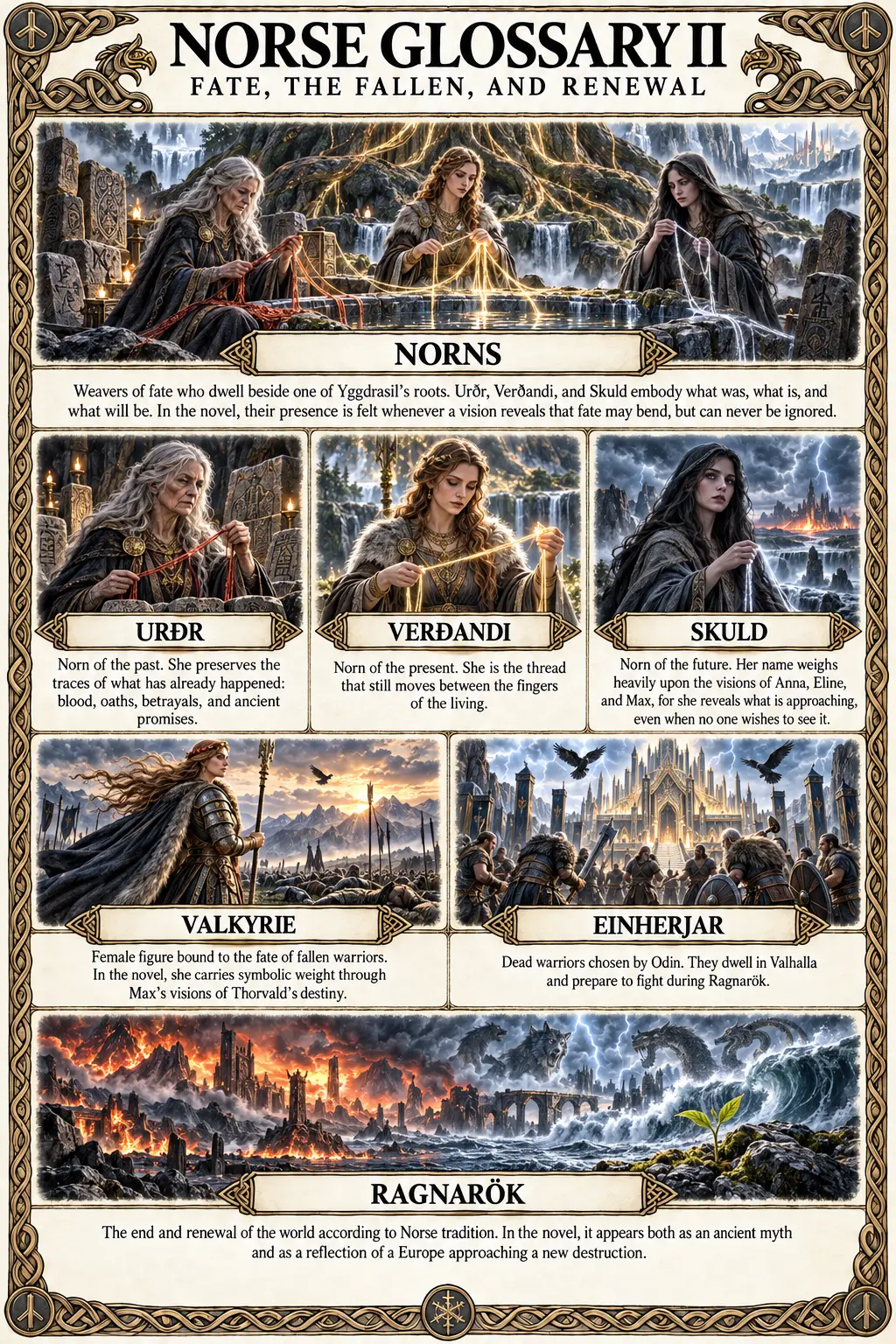
In Norse accounts, fate does not depend on a single kind of being. The norns have a part in people’s lives; the valkyries are linked with battle and the choosing of the fallen; other names, such as fylgja and hamingja, express more personal ties to fortune and the continuity of a family line. Their roles may come close to one another, but the sources do not present them as equivalent.Norns. They are beings associated with fate and the length of life. The three best known are Urðr, Verðandi and Skuld. Snorri places them beside the Well of Urðr beneath Yggdrasil and says that they determine how long people will live. He also describes other norns who arrive when a child is born and shape aspects of that child’s life. In his account, not all have the same origin: he mentions norns connected with gods, elves and dwarves. *Gylfaginning*, *Prose Edda*, English translation by Arthur Gilchrist Brodeur (1916)
The norns are popularly known as “weavers of fate”. This image conveys the relationship between lives and events, although their appearances in the sources are not always limited to weaving: they are also associated with decisions about life and with the care of Yggdrasil. In the novel, their presence is felt when a vision shows a future that can be faced, but not ignored.Urðr. She is one of the three norns named beside the well that bears her name: Urðarbrunnr. Her name is associated with fate and with what has happened. For this reason she is often linked with the past, although the sources do not present her solely as a keeper of memories.The Well of Urðr is also a meeting place for the gods. Snorri says that the norns take water and clay from its surroundings to sprinkle Yggdrasil and preserve its branches. Urðr is thus linked with an image wider than that of an individual life: fate, the world tree and the continuity of cosmic order meet in one place. In the novel, she symbolically preserves traces of blood, oaths, betrayals and ancient promises. *Gylfaginning*, *Prose Edda*, English translation by Arthur Gilchrist Brodeur (1916)Verðandi. She is the second of the three best-known norns. Her name is associated with what is happening or coming into being, hence her usual association with the present. The linguistic connection is suggestive, but the texts do not assign her a separate function that is distinct from those of Urðr and Skuld.Snorri presents the three together in the realm of the Well of Urðr. Their shared action is firmer evidence than the modern image of three goddesses who each govern the past, present and future separately. In the novel, Verðandi represents the moment when the actions of the living can still shape what happens.Skuld. She is the third norn named with Urðr and Verðandi. Her name is associated with ideas such as what is owed, obligation or what must come to pass. She is often linked with the future, though identifying her solely as “the norn of the future” simplifies what the sources convey.Skuld also has a distinctive position: Snorri names her among the figures who ride out to gather the fallen and decide battles, roles associated with valkyries. This overlap shows that the categories “norn” and “valkyrie” do not always have completely rigid boundaries in the texts. In the novel, her name weighs upon Anna, Eline and Max’s visions because it expresses what is approaching and what they will have to face. *Gylfaginning*, *Prose Edda*, English translation by Arthur Gilchrist Brodeur (1916), p. 80Valkyries. They are female figures closely associated with Odin, battle and the choosing of fallen warriors. In Gylfaginning, Snorri says that Odin sends them to battles and links them both with the fate of those who fight and with victory. They are also associated with the warriors gathered in Valhalla. *Gylfaginning*, *Prose Edda*, English translation by Arthur Gilchrist Brodeur (1916), p. 80The surviving poems show valkyries with different names and roles. Some take part in heroic stories and form personal bonds with their protagonists; others appear chiefly as part of the imagery of battle. Reducing them to mere companions of the dead would leave out this variety. In the novel, they carry particular symbolic weight through Max’s visions of Thorvald’s fate.Einherjar. They are the dead warriors gathered under Odin in Valhalla. Their fate after death is tied to Ragnarök: they form the host that will go out to fight when the final confrontation comes. Their presence explains why Valhalla appears at once as a hall of the fallen and a place of preparation for war.Snorri describes an extraordinary routine: the einherjar go out to fight one another, fall in combat and then return to gather in the hall. There they receive food and drink in abundance. This cycle does not undo their earlier death; it expresses that their existence is directed towards one last battle. Not every dead person, nor even every warrior killed in battle, necessarily receives this fate, since the sources also assign Freyja a share of the fallen. *Gylfaginning*, *Prose Edda*, English translation by Arthur Gilchrist Brodeur (1916)Dísir. A name applied to female supernatural figures in different Norse traditions. Depending on the account or context, they may be associated with protection, family, death, fortune or decisive events in a person’s life. The sources do not provide a single description that would assign every dís the same task.The breadth of their meanings explains why, in some accounts, they seem close to beings connected with fate. However, dísir, norns and valkyries are not simply three interchangeable names. Their roles may overlap in certain contexts, while elsewhere the sources present them differently.Fylgja. It is a presence linked to a person and, in some accounts, to that person’s fortune or fate. The term is related to the idea of “following”: a fylgja accompanies or is bound to someone, although it does not always appear visibly to that person.It may take different forms, including that of an animal or a female figure. Its appearance, especially in dreams or visions, can reveal something about the character, danger or fate of the person to whom it is linked. The accounts offer no single rule for interpreting it: its meaning depends on what happens in each story.Hamingja. A term associated with luck, fortune or a favourable power that accompanies a person. In some accounts, this fortune is also linked with a family and can be understood as something that continues within a lineage.Hamingja helps show that fate in Norse accounts is not expressed only through prophecies or the decisions of the norns. It may also appear as a force associated with a person’s course through life, the success of their actions and the bonds between generations. It is not exactly equivalent to fylgja: the two terms may come close in relation to personal fortune, but their uses and nuances differ.
05Crisis, death of the world and renewal
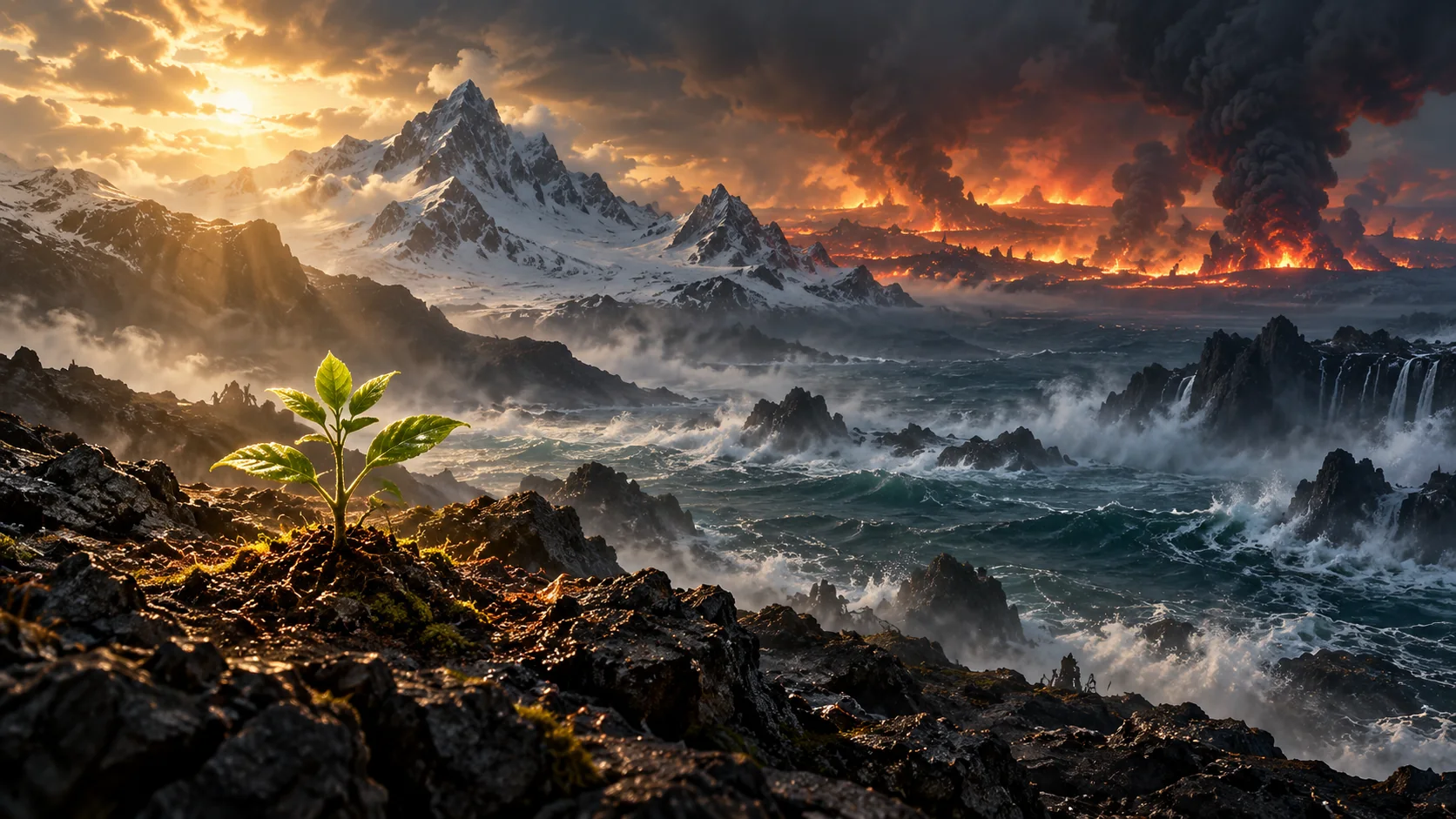
Ragnarök does not begin with a single battle. Human relationships deteriorate first, a devastating winter arrives, and the boundaries that kept the world’s forces apart begin to shift. After the fighting, fire and flood, the sources also preserve images of survival: human beings in hiding, gods who remain and a land that rises again.Fimbulvetr. It is the “Great Winter” associated with the crisis before Ragnarök. The name combines fimbul, “great” or “mighty”, and vetr, “winter”. The form Fimbulwinter appears in modern adaptations and refers to the same event.
In Vafþrúðnismál, Fimbulvetr appears in a question about which human beings will survive after it has passed. Snorri gives a fuller account: he describes three winters in succession with no summer between them, with snow coming from every direction, severe frost and violent winds. Before them he places other winters marked by great wars. *Vafþrúðnismál* (*The Lay of Vafthrudnir*), English translation by Benjamin ThorpeThe breakdown also reaches human society. Snorri describes violence among relatives and the abandonment of family bonds. Cold, war and the disintegration of relationships show that the world’s order begins to give way long before the gods and their enemies meet on the battlefield.Ragnarök. The name given to the series of events that bring about the fall of many gods and the destruction of the known world. It is not limited to a battle: it includes warning signs, the release of bound creatures, the advance of hostile forces, decisive clashes and the devastation caused by fire and water.Among the best-known episodes are Odin’s death at Fenrir’s hands; Víðarr’s vengeance; Thor’s fight with the serpent Jörmungandr, after which both die; Freyr’s fall to Surtr; and the final confrontation between Loki and Heimdall. The sources do not develop all these episodes in equal detail or always arrange them in the same order.Völuspá offers powerful poetic images; Snorri gathers them into a more continuous narrative. *Gylfaginning*, *Prose Edda*, English translation by Arthur Gilchrist Brodeur (1916)The ending is not simply one of total disappearance. After the devastation, the land rises again from the waters and some divine and human figures continue to live. In the novel, Ragnarök also functions as an ancient myth and as a reflection of a Europe approaching a new destruction.Surtr. A figure associated with fire and with the forces of Múspell. During Ragnarök he advances from the south with a sword of extraordinary brightness. Snorri places him at the head of the sons of Múspell, who cross Bifröst as they advance; the bridge eventually breaks beneath them. *Gylfaginning*, *Prose Edda*, English translation by Arthur Gilchrist Brodeur (1916)Surtr fights Freyr. According to Snorri, Freyr’s lack of the sword he had earlier given to Skírnir contributes to his defeat. After the clashes, Surtr spreads fire across the land and consumes the former world. His action completes the destruction, but the Ragnarök narratives do not end there: after the flames comes the possibility of a renewed land.Naglfar. It is the great ship that is freed when the sea floods the land during Ragnarök. Snorri says it is made from the nails of the dead and tells that Hrymr steers it. The image joins death, flood and the advance of forces opposed to the gods. *Gylfaginning*, *Prose Edda*, English translation by Arthur Gilchrist Brodeur (1916)Snorri adds that the uncut nails of a dead person provide material for its construction. A detail of caring for the dead thus becomes part of the preparation for catastrophe. Völuspá also announces that Naglfar is set free, although its images of ships, leaders and armies should not be equated in every detail with Snorri’s later account.Gjallarhorn. It is the horn of Heimdall, guardian of Bifröst. When the final crisis begins, Heimdall sounds it to warn and summon the gods. Its sound marks the passage from signs and omens to the Æsir’s open response. *Gylfaginning*, *Prose Edda*, English translation by Arthur Gilchrist Brodeur (1916)The Gjallarhorn is tied to Heimdall’s role as watchman: he is the one who perceives that the moment has come and sounds the alarm. In Snorri’s account, after the call the gods hold counsel and Odin seeks knowledge before going to battle. The horn does not cause Ragnarök; it announces that events can no longer be kept beyond the divine realm.Líf and Lífþrasir. They are two human beings who survive the Great Winter by hiding in Hoddmímis holt, the wood of Hoddmímir. Vafþrúðnismál names them in answer to the question of who will remain alive after Fimbulvetr. The poem links them with the continuation of human generations. *Vafþrúðnismál* (*The Lay of Vafthrudnir*), English translation by Benjamin ThorpeSnorri incorporates them into his account of the world after the destruction. While many gods and human beings die, Líf and Lífþrasir preserve the possibility of a new humanity. Their survival does not make the catastrophe less grave: it shows that something living remains through it.Hoddmímis holt. It is the wood where Líf and Lífþrasir hide. The sources say little about its exact location or appearance. Its role in the account is clear: it shelters the two human beings through a crisis that threatens to end their species.The name connects this place with Hoddmímir, but the figure’s precise identity and the wood’s relationship to other places in Norse cosmology remain matters of interpretation. It is therefore safe to describe it as a protective forest without assigning it a detailed location that the surviving texts do not provide.