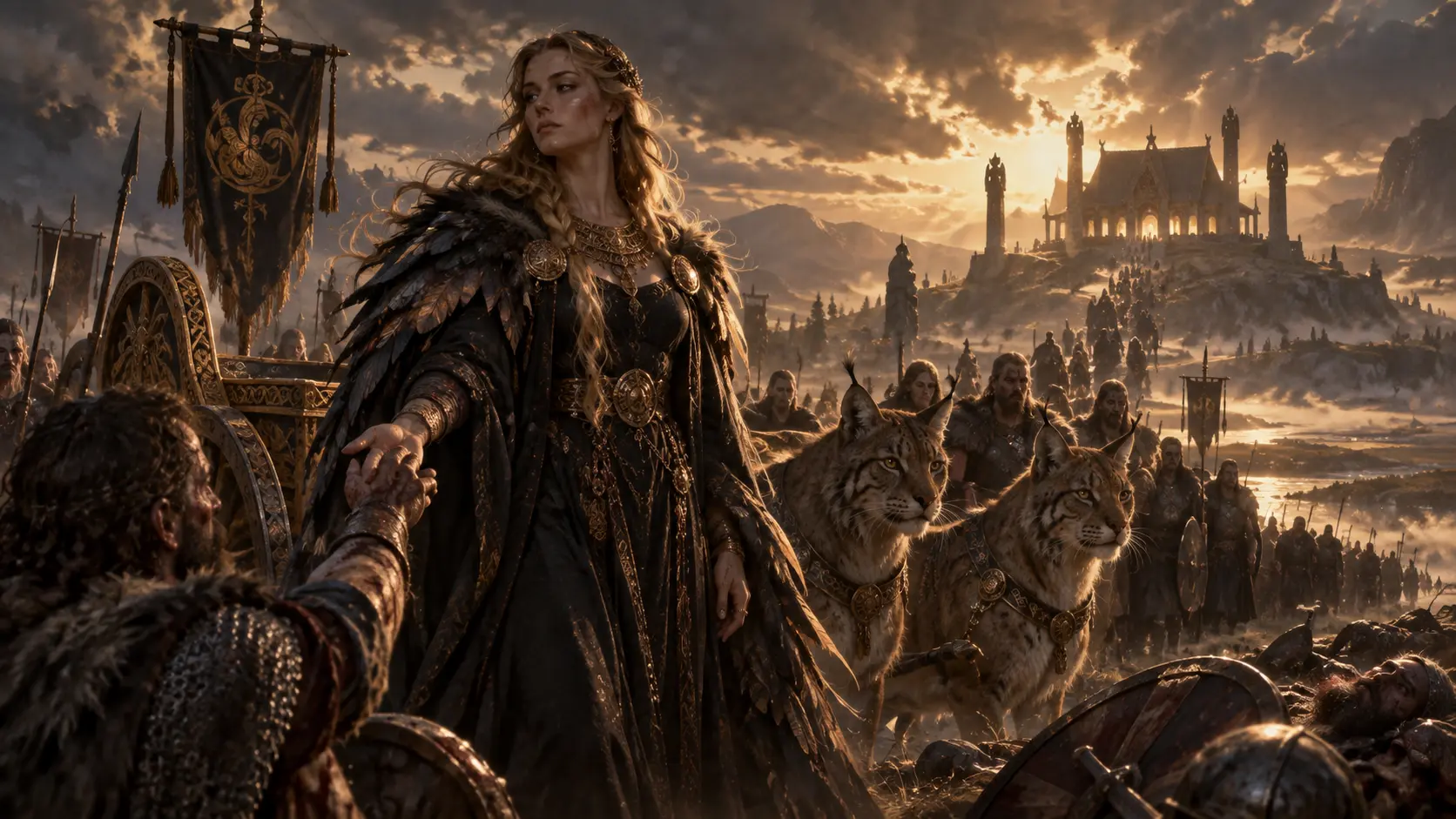
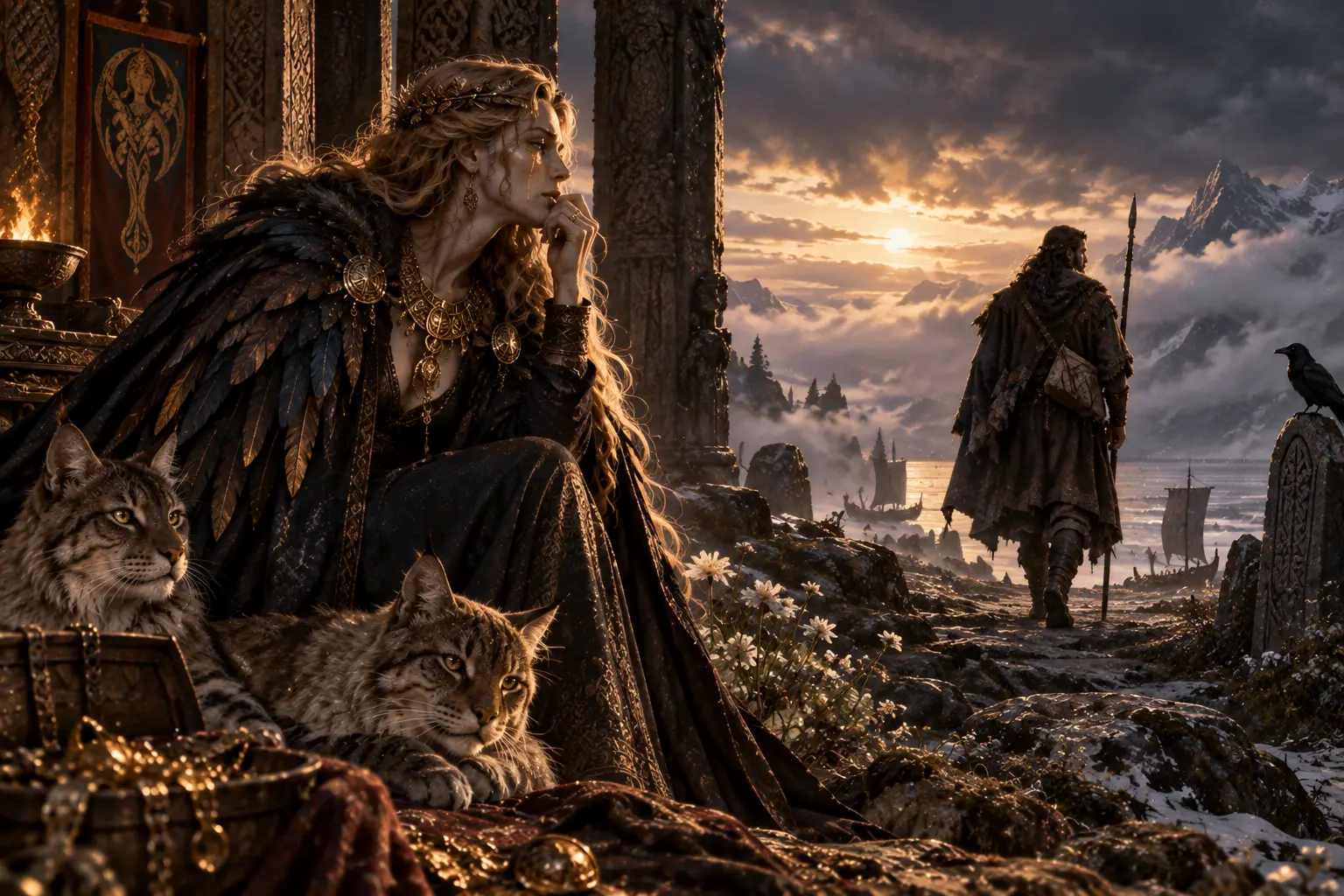
Freyja receives in Fólkvangr the fallen warriors who belong to her, accompanied by her cats and wearing Brísingamen.
Vanir goddess of love, desire, seiðr, wealth and the fallenFreyja is one of the most important and complex divinities in Norse mythology. She belongs to the Vanir, although, after the war between the Æsir and the Vanir, she comes to live among the Æsir together with her father Njörðr and her brother Freyr.The sources associate her with love, desire, sexuality, wealth, magic and death. She also has a close relationship with seiðr, a form of magic which, according to Snorri Sturluson, the Vanir knew and which Freyja taught to the Æsir.Her character combines aspects that modern reconstructions tend to separate: Freyja may be desired by gods and jötnar, practise magic, claim a share of the dead in battle, travel by means of a feather cloak and possess one of the most celebrated objects in the Norse world, Brísingamen.
Name and meaning
The name Freyja means approximately “Lady”.It functions more as a title than as a personal name in the modern sense. Its masculine equivalent, Freyr, means “Lord”.Skaldic poetry also preserves numerous names connected with Freyja, including:MardöllHörnGefnSýrThe existence of multiple names may reflect the importance and antiquity of the goddess, although it is impossible to reconstruct with certainty the origin of each one.
Freyja and the Vanir
Freyja belongs to the Vanir, a divine group particularly associated in the sources with prosperity, wealth and particular forms of magic.Her father is Njörðr.Her brother is Freyr.In Ynglinga saga, Snorri states that Njörðr had Freyr and Freyja with his own sister when he was still living among the Vanir. Marriage customs between siblings were accepted among the Vanir according to this tradition, but were forbidden among the Æsir.The name of Freyja and Freyr’s mother has not survived.Modern identifications with figures such as Nerthus or Njörun have been proposed, but they lack textual confirmation.
The war between Æsir and Vanir
After the war between the two divine families, a reconciliation and an exchange of hostages take place.Njörðr, Freyr and Freyja end up integrated into the society of the Æsir.For this reason, Freyja may appear within the surroundings of Asgard despite originally being a Vanir goddess.Her position constitutes one of the best examples of how the boundaries between the Æsir and the Vanir end up becoming intermingled after the conflict.
Freyja and seiðr
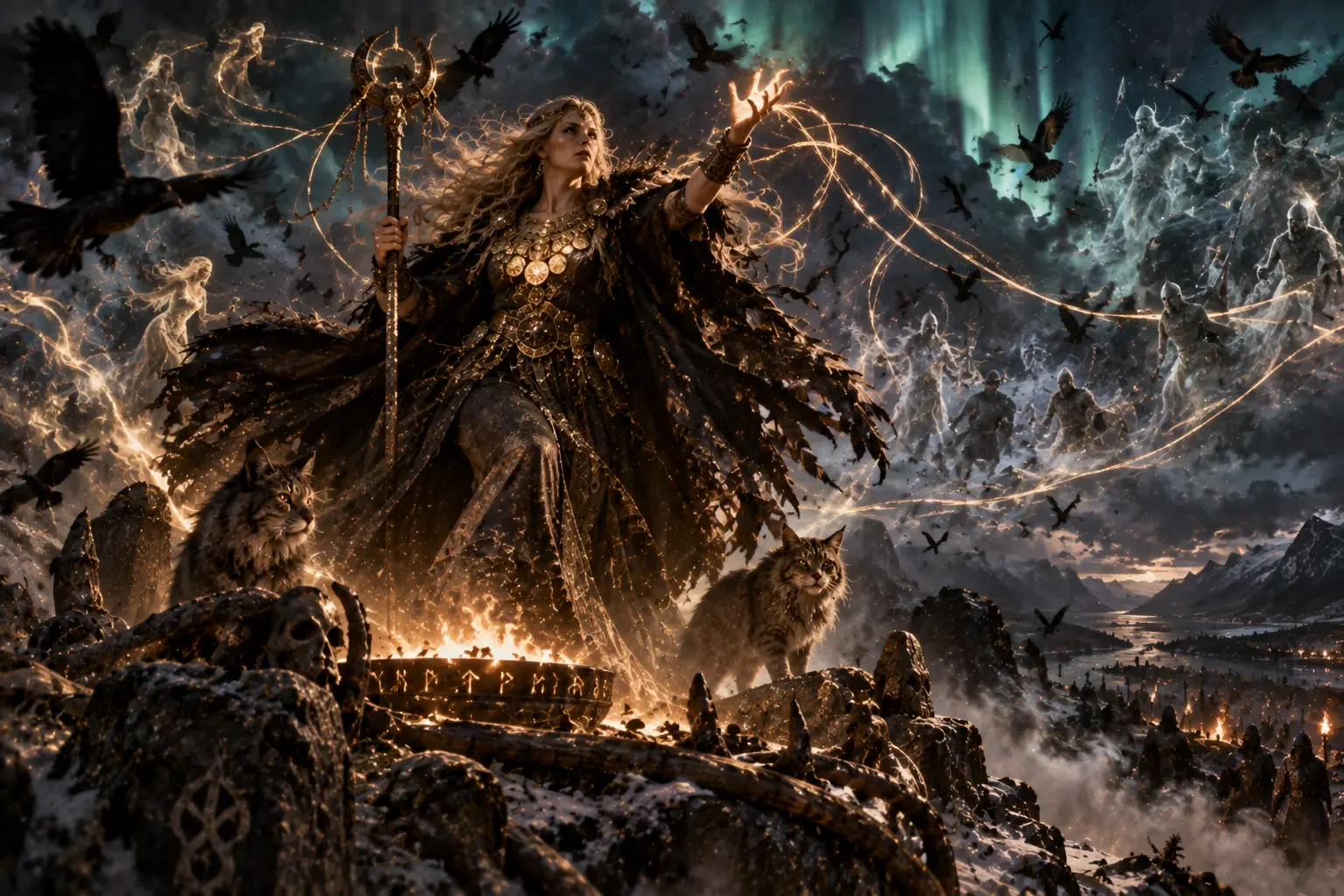
Freyja practising seiðr magic.One of the fundamental characteristics of Freyja is her relationship with seiðr.In Ynglinga saga, Snorri states that Freyja introduced among the Æsir this magical practice, which was customary among the Vanir.Seiðr appears associated with faculties such as altering circumstances, obtaining knowledge and acting upon particular aspects of fate through magical procedures.Its exact nature is difficult to reconstruct because the sources were written from within a later Christian context.The association of Freyja with seiðr, however, is explicit and constitutes one of her best-documented attributes.
Freyja and Odin
Freyja and Odin share several characteristics.Both are connected with magic.Both have connections with supernatural knowledge.And both receive the dead from the battlefield.These similarities have generated numerous interpretations concerning possible connections between their religious functions.However, the sources present them as independent figures.
Fólkvangr
Freyja possesses a territory called Fólkvangr, whose name may be understood approximately as “field of the people” or “field of the army”.Within it is her hall:Sessrúmnir.Grímnismál states that Freyja receives half of those who fall in battle, while the other half belongs to Odin.Although some modern versions state that Freyja chooses before Odin and receives the best warriors, Grímnismál does not expressly establish either of these two conditions. The poem states that Freyja chooses half of the fallen each day and that the other half belongs to Odin, without explaining the order or the criteria of selection.This detail makes Freyja a divinity closely associated with death in warfare.For this reason, reducing her exclusively to a “goddess of love” removes an essential part of her nature.
Freyja and the dead
The relationship of Freyja with the fallen is particularly significant.Odin receives warriors in Valhalla, while Freyja has her own share of the dead in Fólkvangr.The sources offer few details about the procedure through which this division is carried out.Nor do they describe Fólkvangr with the same narrative breadth as Valhalla.However, the division is clearly mentioned in Grímnismál.
Brísingamen
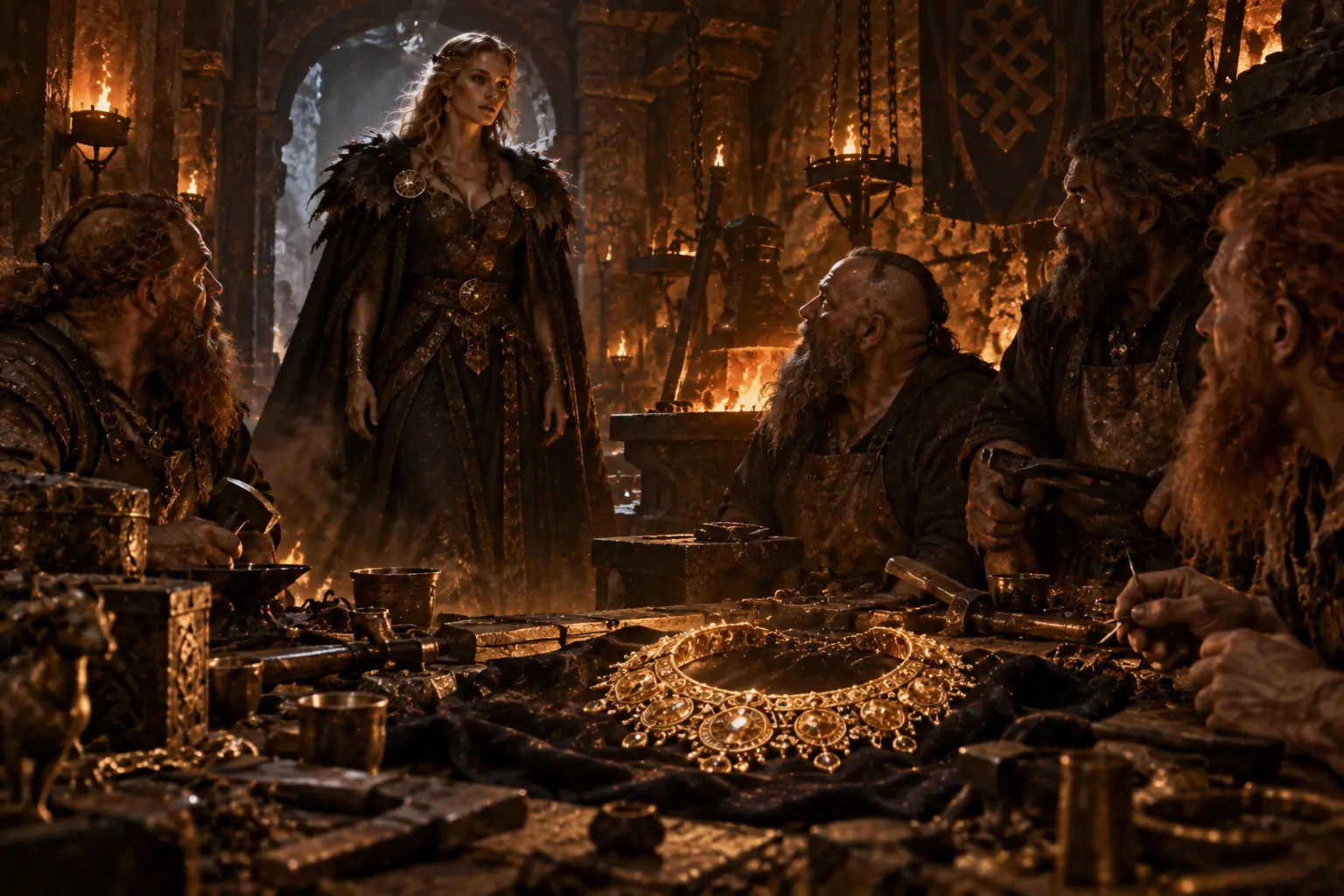
Freyja and Brísingamen before Álfrigg, Dvalinn, Berlingr and Grérr: Freyja contemplates Brísingamen in the workshop of the four dwarves who, according to Sörla þáttr, made the celebrated necklace.The most famous object belonging to Freyja is Brísingamen, an extraordinary necklace or jewel.The sources present it as a characteristic possession of the goddess.Its complete story is preserved in fragmentary form and in relatively late traditions. One of the best-known versions recounts that it was made by four craftsmen or dwarves and that Freyja obtained it from them.Brísingamen reaches such a degree of association with Freyja that it functions practically as one of her emblems.
Loki and Brísingamen
A tradition preserved in Húsdrápa alludes to a confrontation between Loki and Heimdall associated with Brísingamen.Both fight in the form of seals.Snorri also records the relationship between Heimdall and the recovery of the necklace.The complete story that gave rise to these references has been lost, so it is advisable to avoid reconstructing with excessive precision a story that we know principally through fragments.
The feather cloak
Freyja possesses a famous cloak or garment of falcon feathers that makes it possible to travel by flying.Loki uses this object in several stories.In the story of the abduction of Iðunn, the cloak allows Loki to travel as far as Þjazi’s territory.It also appears associated with the story of Þrymr, the jötunn who steals Mjölnir.The object demonstrates that Freyja possesses magical resources of enormous value, even when other characters are the ones who use them in the surviving stories.
Freyja’s chariot
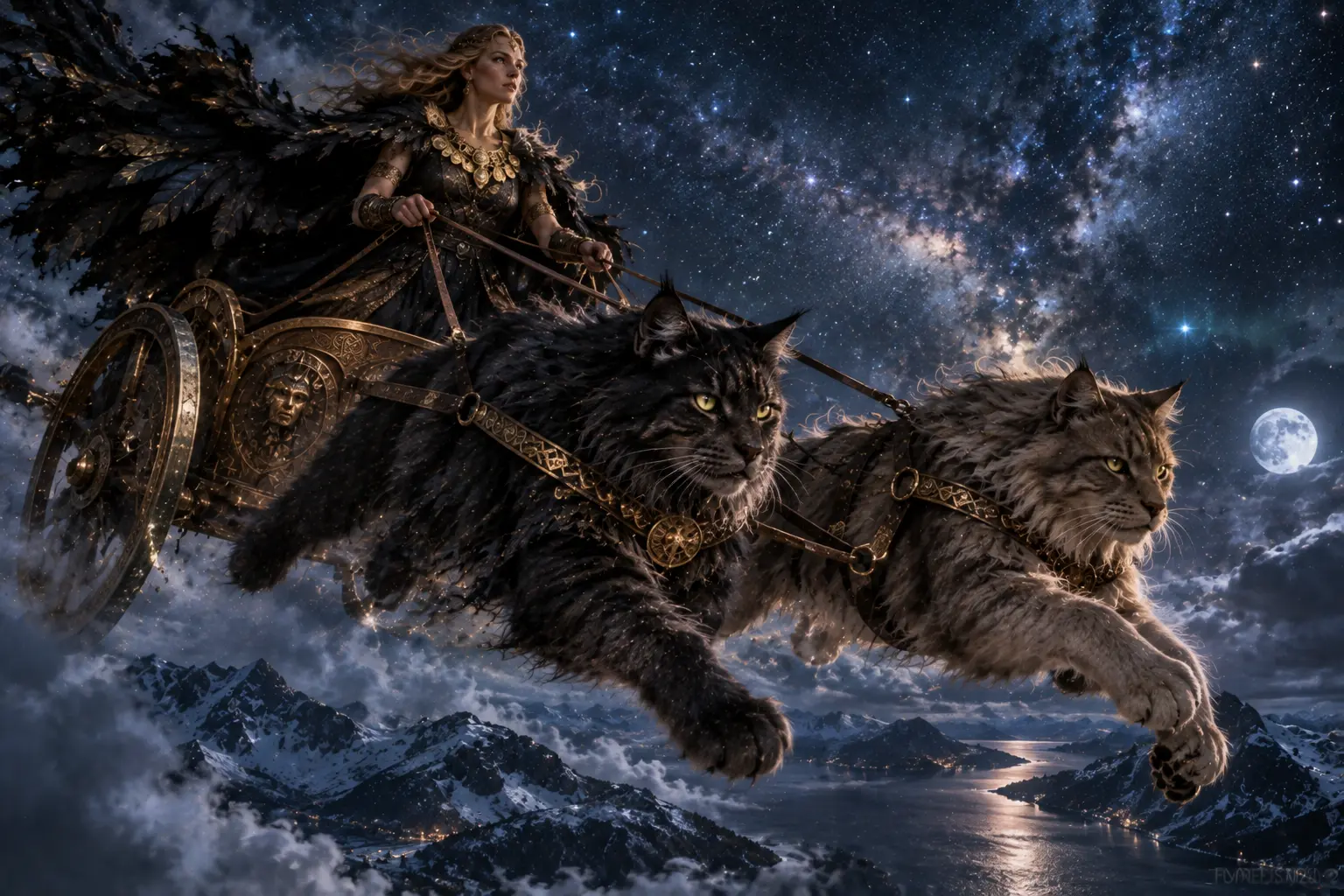
Freyja riding her chariot through the sky.Snorri describes Freyja travelling in a chariot drawn by two cats.The names of these animals are not preserved in the medieval sources.The names that they occasionally receive in modern works belong to later traditions and must be distinguished from the medieval material.Despite this, cats constitute one of the animals most clearly associated with Freyja.
Hildisvíni
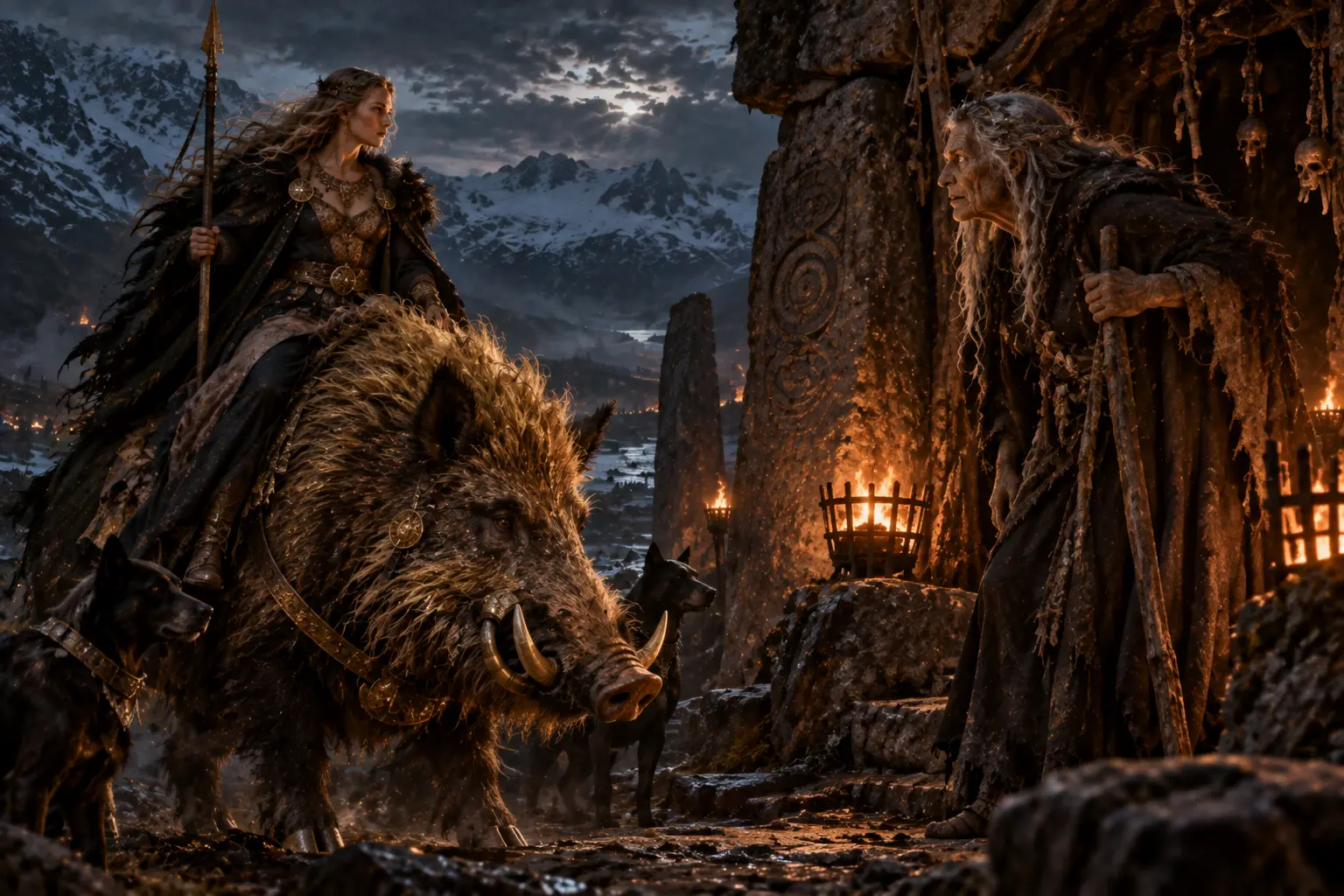
Freyja and Hildisvíni before Hyndla: Freyja arrives riding Hildisvíni before the jötunn Hyndla to obtain the genealogical knowledge needed by her protégé Óttar.Freyja is also associated with a boar called Hildisvíni, whose name means approximately “battle-swine”.In Hyndluljóð, Freyja rides Hildisvíni during her encounter with the jötunn Hyndla.The identity of the boar presents particular features within the poem itself, where it is associated with Óttar, Freyja’s protégé.
Freyja and Óttar
In Hyndluljóð, Freyja helps Óttar obtain knowledge about his genealogy. The inquiry responds to a dispute with Angantýr in which Óttar’s inheritance is at stake, as stanza 9 indicates.To achieve this, she goes to Hyndla, a jötunn capable of remembering ancient lineages.Stanza 10 explains the veneration that Óttar professed for Freyja: he had raised an altar of stones (hörgr) for her and had reddened it with the blood of sacrificed animals, specifically cattle. Thus, stanzas 9 and 10 connect the help of the goddess with the dispute over the inheritance and with the devotion of her protégé.The poem allows us to observe a facet of Freyja different from her association with desire: she acts as the protectress of a mortal and seeks fundamental genealogical knowledge for him.It also shows her capacity to confront verbally a powerful figure from the world of the jötnar.
Óðr, Freyja’s husband
Óðr leaves Freyja to undertake one of his long journeys into unknown lands; his absence will lead the goddess to weep tears of gold and travel the world in search of him.Freyja is married to a mysterious figure called Óðr.The sources offer very little information about him.Óðr undertakes long journeys and disappears for extended periods of time.Freyja searches for him through unknown lands and weeps during his absence.Her tears turn into gold.This motif explains another of the associations of Freyja with wealth and precious metals.
Freyja’s daughters
Freyja and Óðr have two daughters:HnossGersemiTheir names are related to concepts such as “treasure”, “jewel” or “precious thing”.Snorri even goes so far as to explain that the name of Hnoss could be used to designate whatever was particularly beautiful or valuable.
Freyja and gold
Gold maintains a particularly strong relationship with Freyja.Her tears can turn into gold, and poetry employs references to her tears within kennings associated with this metal.Her necklace Brísingamen also reinforces the connection with jewels, splendour and wealth.This association belongs to a much broader symbolic network than a simple representation of Freyja as a goddess of beauty.
Freyja and desire
Numerous stories show that Freyja is considered extraordinarily beautiful.Jötnar and other figures wish to possess her or make her part of agreements.When the builder of the walls of Asgard demands Freyja, Sól and Máni as his reward, the gods end up trying to prevent him from completing his work.Þrymr also demands Freyja as his wife in exchange for returning Mjölnir.These episodes reflect the enormous value attributed to Freyja within the mythical world.
Þrymr and the theft of Mjölnir
In Þrymskviða, Þrymr steals Thor’s hammer and demands Freyja as his wife.Thor and Loki go to Freyja to communicate the proposal to her.Her reaction is furious.The story describes how her necklace Brísingamen moves or breaks because of the violence of her indignation.Freyja refuses to become a bargaining chip.Finally, Thor disguises himself as Freyja and travels to Þrymr’s territory in order to recover Mjölnir.
Freyja and Loki
The relationship between Freyja and Loki appears in different stories.Loki uses her feather cloak and takes part in events associated with Brísingamen.In Lokasenna, moreover, Loki directs extremely aggressive sexual accusations against Freyja.The entire poem is constructed around the exchange of insults between Loki and the gods, so his assertions must be interpreted within that literary context.Loki’s accusations have no value as an objective biography of Freyja.
Freyja and Frigg
Freyja and Frigg are different divinities in the surviving Norse sources.Frigg is Odin’s wife and Baldr’s mother.Freyja is Njörðr’s daughter, Freyr’s sister and Óðr’s wife.However, similarities exist between the two figures that have prompted a long academic debate about their possible historical relationship.The similarity between the names Óðr and Odin (Óðinn) is also striking.This has generated theories according to which Freyja and Frigg could derive from ancient traditions that were related or partially convergent.Despite these hypotheses, the medieval sources treat them as distinct figures.
Freyja and the valkyries
Freyja has an evident relationship with the dead in battle, but the surviving sources lack a direct identification of Freyja as a valkyrie.Her right to receive a share of the fallen in Fólkvangr brings her closer to the sphere of warfare and funerary matters.Simply turning her into a “queen of the valkyries” belongs principally to modern reconstructions.
Freyja as a goddess of love
Freyja is clearly associated with love and sexual relations.Snorri indicates that it is appropriate to invoke her in matters of love.This dimension constitutes an authentic part of her identity.However, her domain is considerably broader.Freyja brings together love, desire, wealth, magic, supernatural knowledge and death in warfare within one and the same figure.
Freyja and fertility
Her membership of the Vanir and her associations with sexuality, prosperity and desire have led to her being closely associated with fertility.The connection is reasonable within the overall range of her characteristics, although “goddess of fertility” remains a modern simplification if it is used as an exclusive definition.Freyja possesses a much more extensive identity.
Freyja and the völur
The close relationship of Freyja with seiðr also brings her conceptually closer to the world of the völur, women associated with prophetic and magical practices.However, Freyja is a goddess, and the völur represent a different category.Similarities in particular types of magical practice do not make the two terms equivalent either.
The worship of Freyja
The importance of Freyja appears to have extended far beyond literary texts.Her name is reflected in different Scandinavian place names, and medieval tradition preserves indications of considerable veneration.Snorri states that, among the goddesses, Freyja was one of the most important.The altar and offerings of Óttar mentioned in Hyndluljóð constitute a literary testimony to the veneration of the goddess. This passage, discussed in “Freyja and Óttar”, does not by itself allow the historical practices of her worship to be reconstructed in their entirety.The evidence concerning the specific practices of her worship is fragmentary, as is the case with a large part of pre-Christian Norse religion.
Freyja after Ragnarök
The principal surviving narratives of Ragnarök lack a clear description of the fate of Freyja.Her death does not appear among the great divine deaths specified during the battle either.For this reason, her final fate must be considered unknown.The absence of a narrated death does not by itself demonstrate that she survives either.
Freyja in the sagas of J. A. Duran Blázquez
In addition to her role within medieval Norse mythology, Freyja occupies an important place within the literary universe of J. A. Duran Blázquez.Her presence and legacy have particular relevance throughout the sagaLas Raíces del Mundo, where the heritage of the Vanir, seiðr, the ancient lineages and the relationship between the human world and the Norse forces form an essential part of the mythological construction of the saga.Freyja also acquires importance through Thirielle within the sagaMirthielle, where the mythology of the ancient lineages is connected with the Guardians, the faerie worlds, true names and the laws that govern the bonds between beings belonging to different worlds. The official website expressly places Thirielle among the Guardians of the Edges and connects her story with ancient prohibitions between humans and faerie beings (J. A. Duran Blázquez — official website).These references belong to the literary universe of the author and must be distinguished from the medieval testimonies about Freyja.SagaLas Raíces del Mundo: Las Raíces del Mundo — official websiteSagaMirthielleand Thirielle’s world:Archive of the faerie world and Thirielle
Attributes
Name: Freyja
Meaning: “Lady”
Nature: Vanir goddess
Group: Vanir integrated among the Æsir
Father: Njörðr
Mother: Njörðr’s unnamed sister
Brother: Freyr
Husband: Óðr
Daughters: Hnoss and Gersemi
Residence: Fólkvangr
Hall: Sessrúmnir
Principal domains: love, desire, seiðr, wealth and those killed in battle
Magic: closely associated with seiðr
Principal treasure: Brísingamen
Magical object: cloak or garment of falcon feathers
Vehicle: chariot drawn by two cats
Associated animal: cats
Associated boar: Hildisvíni
Relationship with the dead: receives a share of those killed in battle in Fólkvangr
Relationship with Odin: both receive the dead and are associated with magical practices
Relationship with Frigg: distinct figures in the sources; possible historical relationship debated by scholars
Relationship with the valkyries: connected with the warrior dead, but without certain identification as a valkyrie
Ragnarök: unknown fate
Principal sources:Grímnismál, Þrymskviða, Hyndluljóð, Lokasenna, Gylfaginning, Skáldskaparmál, Ynglinga saga and skaldic poetry.