Bestla: A giantess of the jötnar lineage, daughter of Bölþorn, wife of Borr and mother of Odin, Vili and Vé. Although the surviving sources tell almost no stories in which she acts, her place in Norse genealogy is extraordinary:Odin’s mother belongs to the lineage of the giants.This relationship is essential to understanding that Norse mythology does not present the Æsir and jötnar as two completely separate species. They are adversaries in many stories, but also belong to the same network of marriages, descendants, alliances and shared knowledge.At the very origin of the Æsir, we find giant blood.
The descendants of Búri
To understand Bestla’s importance, we must return to the earliest generations of Norse cosmology.Before Asgard, Midgard and the great divine lineages, there is the primordial void of Ginnungagap.In that primeval world appears Ymir, ancestor of the giants.There also appears Auðhumla, the primordial cow, who feeds by licking blocks of salty ice.As she licks the ice, she slowly begins to reveal a figure trapped inside it.On the first day, his hair appears.On the second, his head.On the third, his entire body emerges.He is Búri, ancestor of the divine lineage.Búri fathers Borr.And Borr unites with Bestla.The genealogy is thus:Búri → Borr + Bestla → Odin, Vili and Vé.Two lineages emerging from that primordial world finally meet in this union.
Daughter of Bölþorn
Bestla is the daughter of the jötunn Bölþorn.Her father’s name appears in the sources, but we know very little about him. This lack of information makes a reference preserved in the Hávamál especially intriguing.There, Odin recounts some of the knowledge he acquired through suffering, sacrifice and learning.Among his statements, he says that he learned nine powerful songs from the famous son of Bölþorn, Bestla’s father.The text thus introduces a member of Odin’s maternal family as a transmitter of extraordinary knowledge.His precise identity is not entirely clear either.If the Bölþorn mentioned is indeed Bestla’s father—the usual interpretation—Odin would have received some of his magical knowledge from someone belonging to his own maternal family among the jötnar.This detail fits fascinatingly with other stories.Odin seeks wisdom wherever he can find it.Among the dead.Among the völur.At the roots of Yggdrasil.At Mímir’s well.Among the giants.His maternal lineage, too, seems to belong to that ancient store of knowledge.
Mother of Odin, Vili and Vé
Bestla and Borr have three sons:Odin.Vili.Vé.The three brothers will become central figures in one of the fundamental events of Norse cosmology.Their importance does not come merely from belonging to a new divine generation.They will physically transform the universe.And to do so, they must destroy a member of their own mother’s ancient lineage.
The death of Ymir
Odin, Vili and Vé kill the primordial giant Ymir.His death takes on cosmic dimensions.The blood pouring from his body causes a vast flood in which many members of the giants’ lineage perish. Bergelmir and his companion survive, allowing the lineage to continue.The three brothers then use Ymir’s corpse to build the world.From his flesh, they make the earth.From his blood, the seas and waters.From his bones, the mountains.From his teeth and bone fragments, the stones.From his skull, the vault of heaven.The ordered world arises literally from the dismembered body of a primordial being.Bestla’s genealogy adds a particularly interesting dimension to this creation.The sons of a jötunn kill the primordial ancestor of the jötnar and build the world from him.The creators carry within them the blood of what they destroy.
Gods and giants
Bestla is one of the best examples of why we should abandon an overly simple modern interpretation of Norse mythology.The Æsir and jötnar do not simply represent two sides equivalent to “good” and “evil”.They fight constantly.They also share blood.Odin is Bestla’s son.Thor is born of Jörð, a primordial figure genealogically connected with the jötnar.Magni is the son of Thor and the jötunn Járnsaxa.Loki is the son of Fárbauti and Laufey and has family ties to the world of the giants.Freyr falls in love with the jötunn Gerðr.Njörðr marries Skaði.Even some of the gods’ greatest enemies belong to families related to them.The border between Asgard and Jötunheimr can become a battlefield.Blood crosses that border constantly.Bestla shows that this mingling exists from the earliest generations.
Odin’s blood
This genealogy also changes how we see Odin.The chief god of the Æsir does not come from an exclusively divine lineage either.His father, Borr, descends from Búri.His mother belongs to the jötnar.Odin is born from the union of both lineages.He then devotes much of his existence to seeking knowledge often held by beings outside Asgard.This is especially significant because the giants repeatedly appear associated with extremely ancient knowledge.They have existed since the earliest times.Some remember events predating the order established by the Æsir.The giant Vafþrúðnir possesses cosmological knowledge that Odin wishes to test.Mímir is connected with wisdom for which Odin sacrifices an eye.A dead völva is compelled to answer questions about Baldr’s fate.And within his own maternal genealogy appears the mysterious son of Bölþorn who passes nine songs on to him.Odin seeks knowledge among the giants because some of them remember a world older than his own.
Bestla as a lost figure
There is a paradox surrounding Bestla.Her genealogical importance is immense.Her narrative presence is minimal.We do not know how she met Borr.We do not know what relationship she had with her sons.We do not know her position among the jötnar.We do not know her reaction to Ymir’s death.We do not even know what ultimately happened to her.The sources preserved her name and genealogy, but lost the stories that may have accompanied them.This brings her close to figures such as Meili, though for different reasons.We know that Bestla must have existed within a much broader tradition because she is indispensable to explaining Odin’s birth.Then she disappears from the story.Her silence obliges us to distinguish carefully between surviving mythology and modern imagination.We can reconstruct her place in the family tree.We can analyse what it means.To turn her into a sorceress, queen of the giants, Odin’s counsellor or guardian of a particular form of magic would mean deliberately entering the realm of fiction.
A mother between two eras
Bestla also occupies a symbolic place between two moments in the cosmos.Above her stand the primordial generations:Ymir, the first jötnar, Auðhumla, Búri, Bölþorn.After her come:Odin, Vili and Vé.And with her sons begins the construction of the ordered world.Bestla stands precisely on that threshold.By birth, she belongs to the old world.Her sons will build the new one.Her figure can thus be understood as a genealogical bridge between the primordial cosmos and the order of the gods.
Bestla’s paradox
A particularly powerful image lies hidden within her genealogy.A jötunn gives birth to three sons.Those sons grow up.They kill Ymir.From his corpse, they build the world.One of them becomes Odin, lord of the Æsir.And for generations, the descendants of that new lineage will fight the giants.Yet whenever Odin faces one of them, a truth remains impossible to erase:his own mother was one of them.That is why Bestla is far more important than the brevity of her appearances might suggest.She does not need to take part in a battle.Her importance is written in the blood of the gods.
Attributes
Name: Bestla.Nature: Jötunn.Father: Bölþorn.Husband: Borr.Father-in-law: Búri.Sons: Odin, Vili and Vé.Grandchildren and divine descendants: through Odin, her lineage reaches numerous fundamental figures of the pantheon.Cosmological importance: mother of the three brothers responsible for Ymir’s death and the formation of the world from his body.Connection with knowledge: the Hávamál mentions that Odin learned nine songs from Bölþorn’s son, linking his learning with Bestla’s maternal family, although the sources prevent us from reconstructing that figure’s identity and circumstances precisely.Symbolic attributes: ancestry, motherhood, giant blood, union between lineages and continuity between the primordial world and the generation of the Æsir.Fate: unknown.Main sources:Gylfaginning in the Prose Edda and Hávamál.
Visual representation
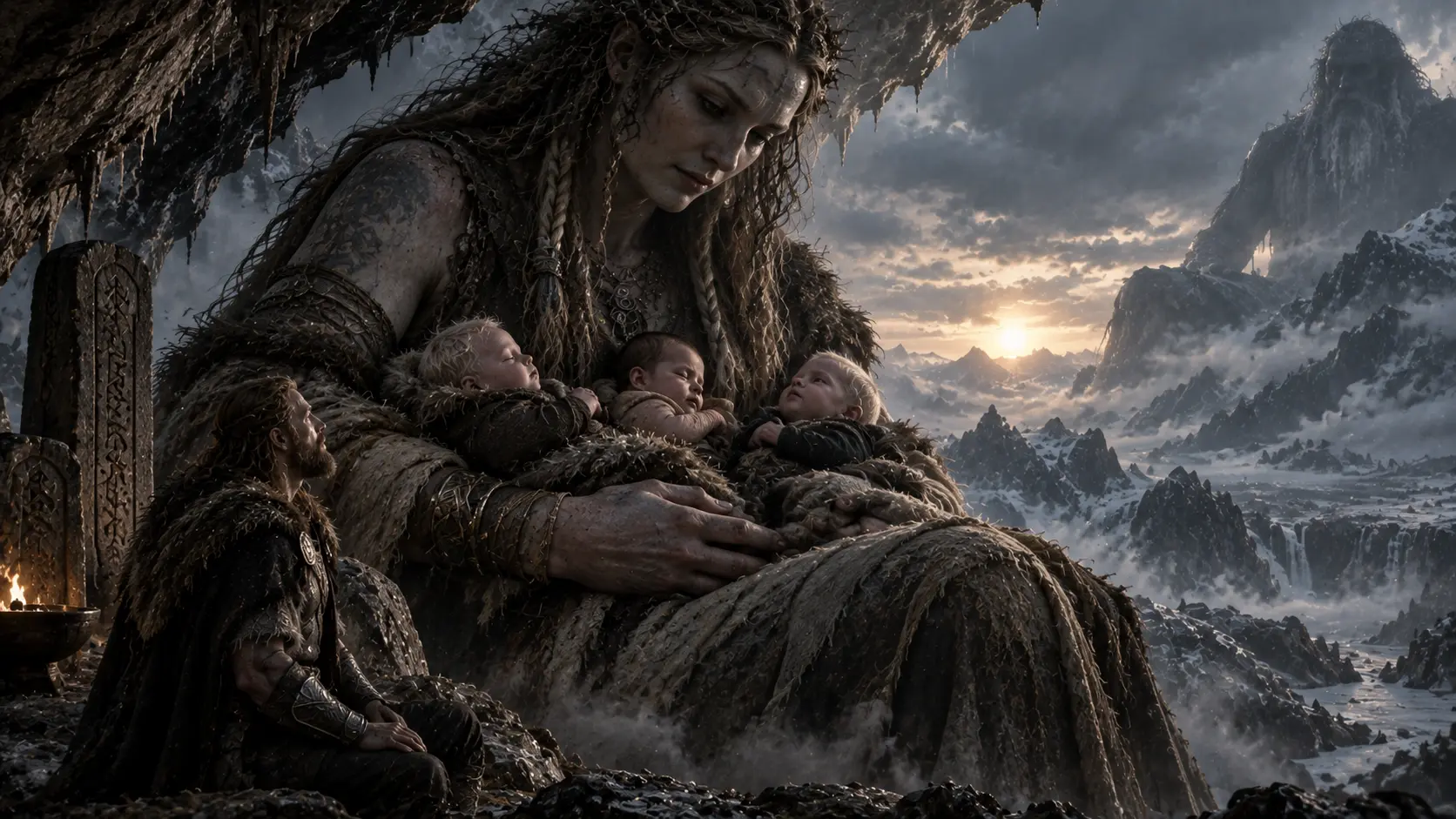
Bestla works best visually if we avoid turning her into a conventional giant warrior.I would show her during the birth of Odin, Vili and Vé.Bestla is clearly larger than a human, yet retains a believable and profoundly ancient appearance. She is inside a stone shelter opening onto a primordial landscape of ice, rock and mist.She holds one of her newborn sons.The other two rest beside her.Borr remains nearby, considerably smaller, visually establishing the union between the two lineages.In the distance, a colossal figure can be seen walking among frozen mountains.Ymir.He is still alive.Bestla looks at her sons.The viewer knows something she may or may not know:those three children will one day kill the primordial giant and build the world from his body.The scene should convey origin, kinship and a future threat still unseen.No combat.No spectacular magic.A mother.Three newborns.And in the background, walking through the ice, the world her sons are destined to destroy.
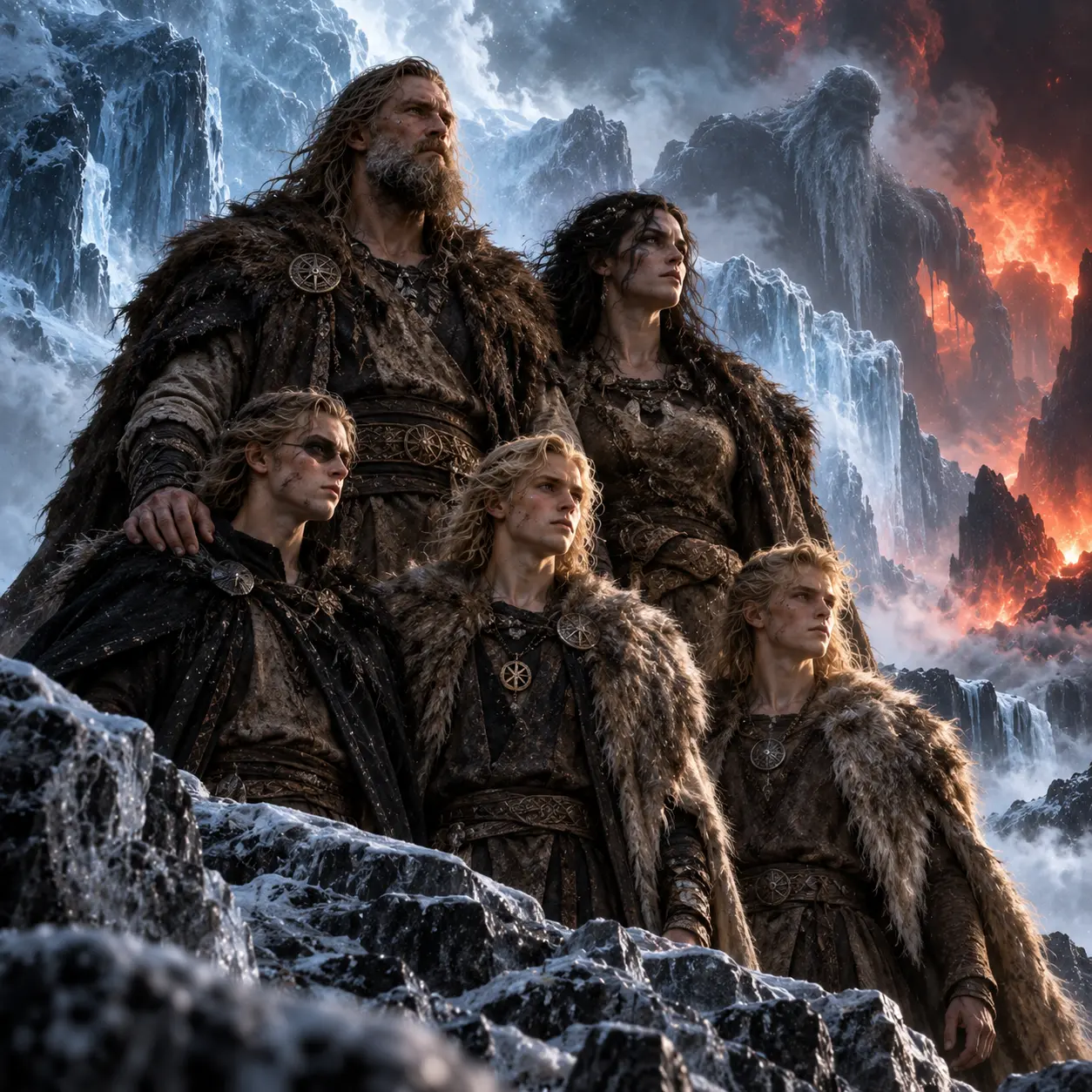
The image shows the primordial family of Borr in the world before the creation of the cosmos as we know it.
The large man at the upper left is Borr, son of Búri. Beside him is Bestla, daughter of the jötunn Bölþorn and Borr’s wife. The three young figures below represent their three sons, Odin, Vili and Vé.
The landscape is visually divided between ice and fire, evoking the primordial forces of Niflheim and Muspelheim around Ginnungagap. The gigantic dark figure in the background is intended to be Ymir, still alive. This anticipates what will happen next: Odin, Vili and Vé will kill Ymir and use his body to form the world.