← Æsir index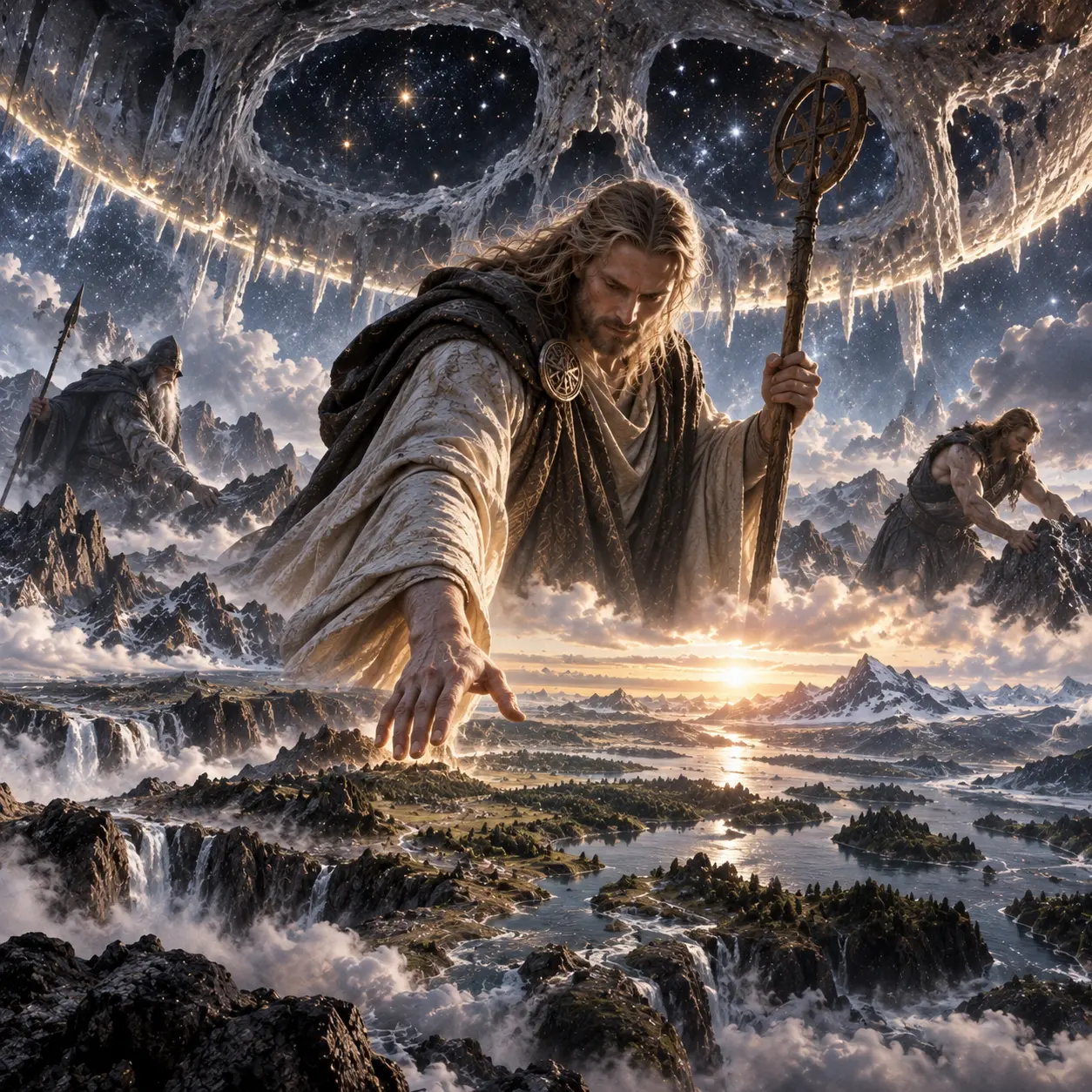
Odin and Vili's brother, and a creator of the world Vé belongs to the divine generation directly involved in forming the cosmos. He is the son of Borr and Bestla, the brother of Odin and Vili, and the grandson of Búri. According to Snorri Sturluson's Prose Edda, the three brothers kill the primordial giant Ymir and use his body to build the world. In the same tradition, they also take part in creating Ask and Embla, the first human beings. After these primordial events, Vé almost disappears from surviving stories. He is fundamental to Norse cosmology, though little is known about him as an individual deity. The Gylfaginning tells how Borr, son of Búri, joined with Bestla, daughter of the giant Bölþorn. Their children were: Odin
Vili
Vé Vé belongs to a genealogy combining two great primordial lines. Through his father he descends from Búri; through Bestla he has jötunn ancestry. Búri → Borr + Bestla → Odin, Vili and Vé The sources say nothing about Vé's birth, childhood or youth. According to Snorri, Borr's sons killed Ymir, the primordial giant from whom the ancient race of frost giants descends. Ymir's blood caused a vast flood in which much of his progeny perished. Bergelmir and his companion survived and continued the lineage of giants. Vé took part in Ymir's death alongside Odin and Vili. The account presents the three brothers acting together. It does not identify a particular blow, weapon or individual task for Vé. After killing Ymir, Borr's sons carried his body to Ginnungagap and made the world from his remains. They made the land from Ymir's flesh, the seas and waters from his blood, the mountains from his bones, and stones from his teeth and bone fragments. His skull became the vault of the sky, and his brain became clouds. They also used Ymir's eyebrows to make a fortification around Midgard, the realm intended for human beings. Vé is one of the three brothers responsible for transforming the primordial giant's body into an ordered cosmos. The Gylfaginning assigns Odin, Vili and Vé another fundamental event: the creation of Ask and Embla. While walking along the shore, the brothers found two pieces of wood. They made the first man and woman from them. Snorri distributes different gifts among the three: Odin gives them life and spirit; Vili gives them understanding and movement; Vé gives them appearance, speech, hearing and sight. Translations of these terms vary somewhat, but the structure is consistent: each brother contributes qualities that turn the lifeless forms into complete human beings. Ask and Embla are given Midgard as their home and become the ancestors of humanity. The Völuspá preserves a different tradition. In this poem, the three divine figures who find Ask and Embla are Odin, Hœnir and Lóðurr, who give the first humans various vital capacities. Vili and Vé do not appear in this version. The difference is one of the most interesting problems in Norse cosmology: Snorri gives Odin, Vili and Vé, while the poetic tradition uses Odin, Hœnir and Lóðurr. The surviving sources do not securely identify Vili or Vé with Hœnir or Lóðurr. These should be treated as variant traditions. Vé also appears in a tradition concerning Frigg. In Lokasenna, Loki accuses Frigg of having been with Vili and Vé, Odin's brothers. Like many of Loki's accusations in the poem, this is part of a hostile verbal confrontation full of insults and provocation; no detailed account of the circumstances is given. A related tradition appears in Snorri's Ynglinga saga. Odin was away for so long that his brothers thought he might not return. Vili and Vé took charge of his household and shared Frigg. Odin later returned and reclaimed his wife. Both accounts attest to a tradition connecting Vili and Vé with Frigg during Odin's prolonged absence. The name Vé is notable because the Old Norse noun vé means a sanctuary or sacred place. The word appears in vocabulary connected with consecrated spaces and religious sites. This linguistic association has led scholars to interpret Vé's name in terms of sacredness, sanctuary or consecration. The meaning of a name should nevertheless be kept distinct from documented mythic functions. No surviving account explicitly presents Vé as a “god of sanctuaries” or as a general consecrator of places. His name has a clear linguistic connection with the sacred, but turning that association into a fully developed divine domain would go beyond the evidence. In Snorri's account, Borr's three sons form a powerful triad in the primordial events. Odin, Vili and Vé kill Ymir, shape the world from his body and create Ask and Embla in the Gylfaginning. After these episodes, their narrative paths diverge sharply. Odin becomes one of the major figures of Norse mythology, while Vili and Vé are mentioned only rarely. The contrast between their enormous cosmological importance and their later absence is one of the most striking features of both brothers' traditions. Because two different triads are associated with the creation of humanity, scholars have proposed theories connecting Vili and Vé with Hœnir and Lóðurr. Such identifications belong to comparative interpretation. The surviving medieval sources do not explicitly identify Vé as Lóðurr, nor do they establish a secure correspondence between the members of the two triads. Vé and Lóðurr should be treated as separate figures unless a specific hypothesis is being discussed. Vé's ultimate fate is unknown. No surviving story describes his death, disappearance or withdrawal from the world. Nor do the sources describe his participation in Ragnarök. After the creation accounts and the references to Odin's absence, Vé almost vanishes from the narrative tradition. This silence contrasts with his original position: he took part in events that defined the existence of the world and humanity. Nature: god of the Æsir lineage Father: Borr
Mother: Bestla
Brothers: Odin and Vili
Paternal grandfather: Búri
Maternal grandfather: Bölþorn Cosmological role: helps Odin and Vili kill Ymir and form the world Creation of humanity: in the Gylfaginning, helps create Ask and Embla and gives them appearance, speech, hearing and sight Connection with Frigg: linked with Vili to a tradition about Odin's absence Meaning of the name: related to Old Norse vé, “sanctuary” or “sacred place” Connection with Lóðurr: proposed in some interpretations, but not explicitly identified in the sources Weapons: unknown Dwelling: unknown Individual cult: no firm evidence survives Fate: unknown Participation in Ragnarök: unknown Main sources: the Gylfaginning in the Prose Edda, the Völuspá and Lokasenna in the Poetic Edda, and Snorri Sturluson's Ynglinga saga.
Vé