← Æsir index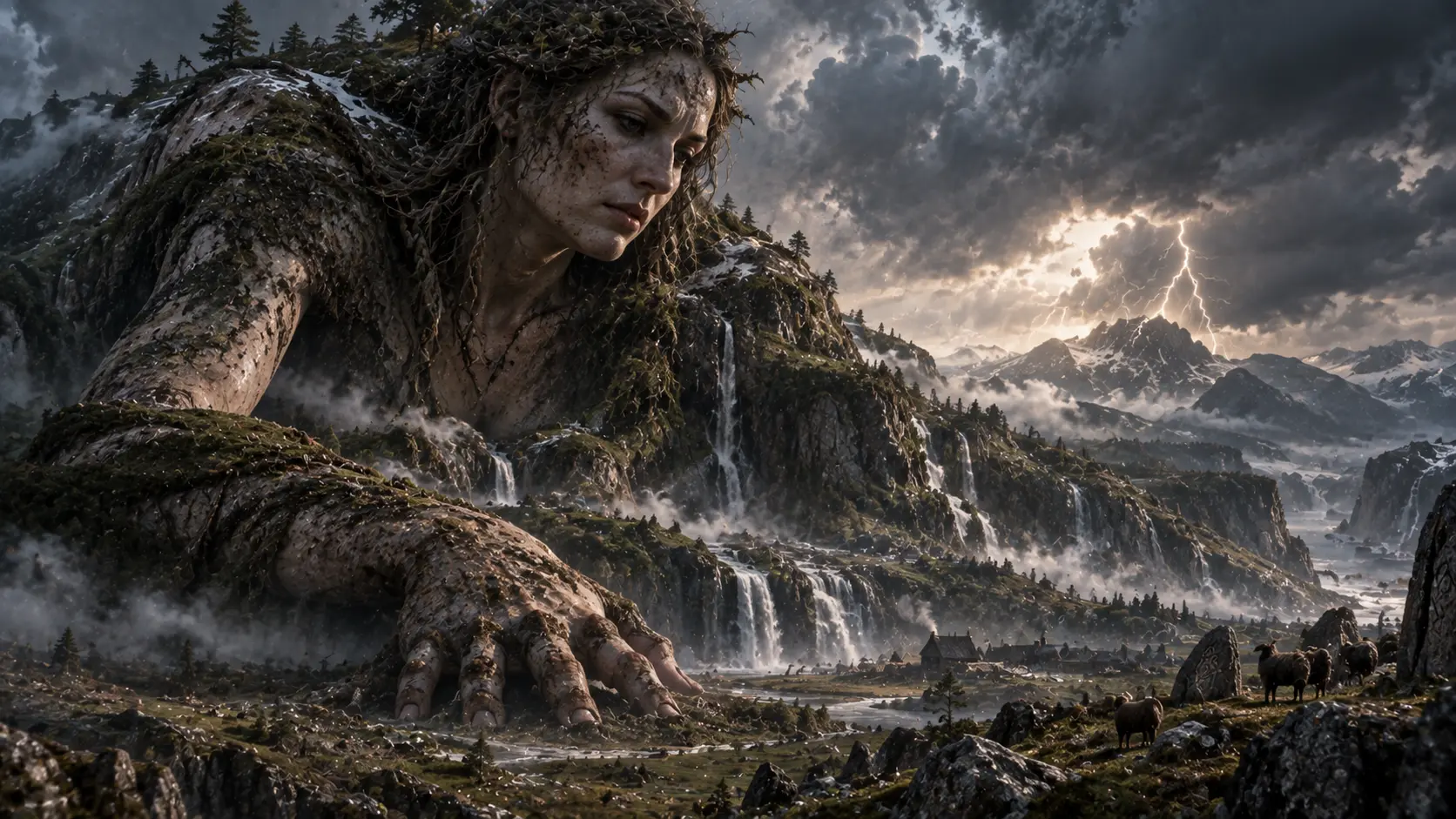
Jörð is the divine personification of Earth and Thor’s mother. Her name means “earth” in Old Norse, making her identity more profound than that of a deity who merely rules over a natural element. Jörð does not rule the Earth from outside it. Jörð is the Earth. The stone. The soil. The mountains. The fields. The ground on which gods, giants and human beings walk. Few surviving stories make her their protagonist, yet her place in the divine genealogy is extraordinary. Odin fathers Thor with her. The lord of the Æsir joins with Earth, and from their union comes the god who will spend his life defending the world. Norse mythology contains many figures whose boundary between person and natural element is indistinct. The sea can become a being. The Sun and Moon have identities of their own. Night can have a genealogy. So can Earth. Jörð belongs to this ancient way of understanding the cosmos. When a poet calls her Thor’s mother, the statement works on two levels at once. Thor has a mother named Jörð. And Thor is a son of the Earth. Both are true within the language of myth. The Old Norse word jörð directly means “earth.” It is related to Germanic words for soil or land and has considerable linguistic antiquity. This distinguishes Jörð from deities whose names require more complex etymological interpretation. In her case, the identification is direct. Her name describes what she is. Jörð. The Earth. That is why it is difficult to separate the divine figure completely from the cosmic element she represents. The most important information about Jörð in the sources is her motherhood. Odin is Thor’s father. Jörð is his mother. The genealogy carries great symbolic weight. Odin is associated with sovereignty, knowledge, war, poetry, magic and an obsessive search for fate. Jörð represents the Earth. Together they produce Thor, the god of thunder and one of the chief protectors of the inhabited world. Thor does not defend a land entirely separate from himself. He defends his own mother’s world. This relationship makes it possible to view many of Thor’s traits from a different perspective. Thor has extraordinary physical strength. He travels constantly through wild lands. He crosses mountains and rivers. He fights giants. He protects Midgard. His power appears in storms crossing the sky, yet his genealogy anchors him literally to the ground. He is Odin’s son. But he is also Jörð’s son. Sky, storm and earth are joined in one divine figure. The sources do not develop this relationship through long conversations between mother and son. Its force lies in the genealogy itself. It is difficult to place Jörð in a rigid category. Her relationship with the jötnar is particularly important. The genealogies transmitted by Snorri place her within a web of kinship linking primordial forces, giants and gods. This again shows that the Æsir and jötnar are not two entirely separate kinds of beings. They marry. They have children. They share ancestors. They form alliances. They betray one another. And they destroy one another too. Jörð occupies one of these boundaries. She is the mother of one of the most powerful Æsir. Yet her genealogy reaches into the world of the giants. The paradox is clearest in Thor. Few gods kill as many jötnar as he does. Mjölnir becomes almost a terror to the giants. Thor crosses their territories and fights figures such as Hrungnir, Geirröðr and other foes associated with their world. Yet his own mother is genealogically connected with the jötnar. And the relationship continues into the next generation. Járnsaxa, Magni’s mother, is also a jötunn. Thor therefore fights constantly against beings whose lineages run through his own family. Norse mythology does not construct a simple war between two biologically separate peoples. It constructs a conflict between relatives. Jörð’s genealogy is difficult because the sources preserve traditions that do not fit together entirely neatly. In Gylfaginning, Snorri gives a genealogy in which Nótt, the personification of Night, has a daughter named Jörð. In this account, Nótt has different children with different partners, and Jörð is born from her union with Annarr. Other genealogical and poetic formulations complicate the picture. It is therefore better not to present Jörð’s ancestry as though there were one perfectly settled genealogy. The tradition preserves a more secure idea: Jörð belongs to an ancient and deeply personified layer of the cosmos. The genealogy that makes Jörð the daughter of Nótt, Night, has extraordinary mythological force. Nótt travels across the sky. Jörð remains below. One represents the darkness passing over the world. The other represents that on which the darkness falls. This genealogy also places Thor within a cosmic family far older than Asgard. His mother is Earth. According to this tradition, his maternal grandmother is Night. Thor may be one of the Æsir’s great warriors, but behind his lineage stand personifications of fundamental forces of the universe. Jörð is also associated with the name Fjörgyn. In poetry, Thor may be called son of Fjörgyn. The identification of Fjörgyn with Jörð is widely accepted in this context. There is, however, an interesting linguistic complication. The masculine form Fjörgynn also appears and is associated with Frigg in certain genealogies. Fjörgyn and Fjörgynn must be handled carefully because their similar names can cause confusion. For Jörð, Fjörgyn functions as a poetic name connected with her identity as Thor’s mother. Another name associated with Jörð is Hlóðyn. In the Völuspá, Thor is described with an expression identifying him as son of Hlóðyn. The context of Ragnarök makes clear that this refers to the thunder god. Hlóðyn is therefore traditionally interpreted as another name or designation for Jörð. Multiple names are not unusual in Norse poetry. Odin has dozens. Other gods and figures also appear under alternative names, epithets or poetic designations. In Jörð’s case, these names help reconstruct a figure with few narrative appearances but a deep presence in poetic language. Jörð presents a problem similar to that of other fragmentary figures, though for a different reason. We know very well what she represents. What is missing are the stories. No great cycle of tales about her survives. Nor do we have an account of her union with Odin. The sources do not describe Thor’s birth from her perspective. We have no conversations between Jörð and her son. Her importance is expressed in another way. Through genealogy. Through poetry. Through the very word used for the Earth. Jörð can lack great adventures and still be fundamental. The association between Earth and fertility is natural and appears in countless religious traditions. It can also be used as a symbolic interpretation of Jörð. It is important, however, to distinguish a reasonable association with the fertility of the land from the claim that the sources clearly present her as a specialised fertility goddess with a well-documented cult and role. The surviving evidence does not support that second portrait with certainty. For this glossary, it is more firmly grounded to define her first as the divine personification of Earth. Fertility, growth and abundance can be understood as symbolic consequences of that nature. The comparison with Nerthus is especially interesting. Tacitus describes Nerthus as Terra Mater, “Mother Earth,” among certain Germanic peoples centuries before medieval Icelandic sources recorded the Norse mythology known to us. This shows how deeply rooted the sacred personification of Earth was in the Germanic religious world. Jörð and Nerthus should not, however, be merged automatically. They belong to different documentary contexts. Nerthus is connected with a specific ritual described by Tacitus. Jörð appears in Norse sources chiefly through genealogy and poetry. Both can illuminate a Germanic tradition in which Earth had sacred character without being turned into a single figure. The union of Odin and Jörð is not preserved in a great narrative either. We know its result: Thor. That is enough to create one of the pantheon’s most powerful genealogies. Odin is restless. He travels. He asks questions. He makes sacrifices. He seeks knowledge. He tries to discover the future. Jörð represents something far more stable. The Earth remains. One travels through the worlds. The other is the ground of one of them. From their union comes a son who combines movement and permanence: Thor travels constantly, but he does so to defend the physical order of the world. An indirect cosmological relationship makes her nature more complex still. In Snorri’s account of creation, Odin and his brothers kill the primordial giant Ymir. They then use his body to form the world. His flesh becomes earth. His blood becomes seas. His bones become mountains. His teeth and bone fragments become stones. His skull forms the sky. The mythology therefore preserves more than one way of expressing what Earth is. There is Jörð, Earth personified. And there is the substance of the world, made from Ymir’s body. These ideas do not have to fit together like pieces of a perfectly systematic modern cosmology. The myths preserve different layers of tradition. That layering is part of their richness. The connection with Ymir adds another irony to Thor’s lineage. The physical world is formed from the body of a primordial giant. Thor’s mother is genealogically connected with the jötnar. And Thor spends much of his life fighting giants to protect that same world. The opposition between god and giant blurs again. Order is born from chaos. The Æsir are partly descended from the jötnar. Earth emerges from a primordial body. And the world’s protector carries the blood of both worlds within him. Jörð does not need to appear in person during the great mythic wars to be present. When Thor fights Hrungnir, he does so on Jörð. When the gods cross Midgard, they walk on her. When armies march during Ragnarök, they march across the Earth. When Jörmungandr rises from the ocean, it encircles the world that Jörð personifies. Her presence is constant precisely because it is elemental. Other gods enter and leave the stories. The Earth remains beneath them all. There is a particularly powerful symmetry between Jörð, Thor and Jörmungandr. Jörmungandr is the Midgard Serpent. Its body has grown until it encircles the world. Thor is a son of Earth. And Thor is destined to face the very creature that surrounds that Earth. During Ragnarök, Jörmungandr rises from the waters. Thor fights it. He finally kills it. Then he walks away. He takes nine steps. The serpent’s venom ends his life. Jörð’s son dies after destroying the creature that encircled his mother’s world. The sources do not give Jörð an individual death comparable to those of Odin, Thor or Freyr. But Ragnarök directly affects what she represents. The Earth suffers the cosmic destruction. Surtr’s fire consumes the world. Then the Earth sinks beneath the waters. Yet the Völuspá announces something crucial. The Earth rises again from the sea. Green. Renewed. The waters fall. Vegetation returns. The world begins again. If Jörð literally represents the Earth, this renewal takes on special meaning. Thor dies. Odin dies. Týr dies. Heimdall dies. Freyr dies. Much of the old order disappears. But the Earth returns. The world that seemed destroyed emerges again. This makes it possible to associate Jörð with something deeper than physical endurance: continuity through transformation. The surface may burn. It may sink. It may be covered by the sea. Then it returns. Thor will not survive to see that renewed Earth. But his sons will. Magni and Móði live through Ragnarök. They will inherit Mjölnir. This creates an extraordinary continuity within the family. Jörð gives birth to Thor. Thor protects Midgard. Thor dies in the world’s destruction. The Earth rises again. And Thor’s surviving sons will walk upon it, carrying their father’s hammer. Three generations are joined through destruction and continuity. Jörð. Thor. Magni and Móði. Jörð does not need Thor’s strength. Her symbolic power belongs to another scale. Thor can break a mountain. Jörð is what the mountain is part of. Thor can cross a valley. Jörð is beneath it. Thor can die. The Earth continues. That is why her strength should not be understood as a capacity for combat. It is endurance. Weight. Matter. Depth. That which supports. Within 1931: The Wolf and the Snow, Jörð has a particularly interesting resonance because of the Vanir’s relationship with the natural world and the way Max learns to perceive what lies beneath the surface. For Thorvald too, Earth would not be an abstraction. It would be snow, rock, roots, moisture, temperature, vibrations and memory. The forest gives information. Snow preserves tracks. Roots connect places. Stone keeps marks. The ground reveals who has crossed it. This lets Jörð remain part of the mythological background without artificially turning her into a direct participant in the Vanir magical system. Max’s ability to hear the deep web of the world is one thing. Claiming that this web is Jörð would be quite another. The sources do not establish that equivalence. Keeping the concepts separate makes both more credible. Jörð belongs to ancient myth. Descent belongs to Max’s mystery. They can resonate with each other without becoming the same thing. Jörð is easy to underestimate because she lacks the grand scenes associated with other gods. She has no Mjölnir. No Gungnir. No Gjallarhorn. No necklace like Brísingamen. Her name itself is her attribute. Earth. Before Thor raises his hammer, there is ground beneath his feet. Before Odin travels through the worlds, there is a world to travel through. Before the giants march towards Asgard, there are mountains from which they descend. And when Ragnarök is over and many of the old gods have vanished, the Earth will rise again from the waters. Jörð remains one of mythology’s oldest ideas: The gods may inhabit the world, rule it, protect it and even die for it; Earth is what remains when their stories end. Name: Jörð, literally “Earth” Other associated names: Fjörgyn and Hlóðyn Nature: Divine personification of Earth Lineage: Genealogically connected with the jötnar and ancient cosmic personifications Mother: Nótt, according to the genealogy in Gylfaginning Father: Annarr in that same tradition Partner associated with her: Odin Son: Thor Notable grandchildren: Magni, Móði and Þrúðr Fundamental domain: Earth itself Associations: Soil, stone, mountains, terrestrial matter, natural growth, endurance and renewal Fertility: A possible and coherent association with her earthly nature, though surviving sources do not define her simply as a specialised fertility goddess Connection with Ragnarök: No clearly narrated individual fate; Earth sinks during the catastrophe and later rises from the sea in the renewed world Genealogical significance: Her union with Odin produces Thor, making the great protector of Midgard a son of Earth herself Principal sources: Völuspá, Lokasenna, Gylfaginning and Skáldskaparmál Jörð does not protect the Earth. Jörð is what everyone else is trying to protect.
Jörð
A goddess who is also a cosmic element
The meaning of Jörð
Thor’s mother
Thor, son of Earth
Jörð and the jötnar
The giants’ enemy carries their blood
Who were Jörð’s parents?
Daughter of Night
Fjörgyn
Hlóðyn
A goddess without great adventures
A goddess of fertility?
Jörð and Nerthus
Odin and Jörð
Jörð and Ymir
The Earth made from a giant
The mother beneath the battle
Jörð and Jörmungandr
What happens to Jörð during Ragnarök?
The Earth after the end
The mother and the children of the new world
A different kind of strength
Jörð in the world of *1931*
The Earth needs no throne
Attributes