← Æsir index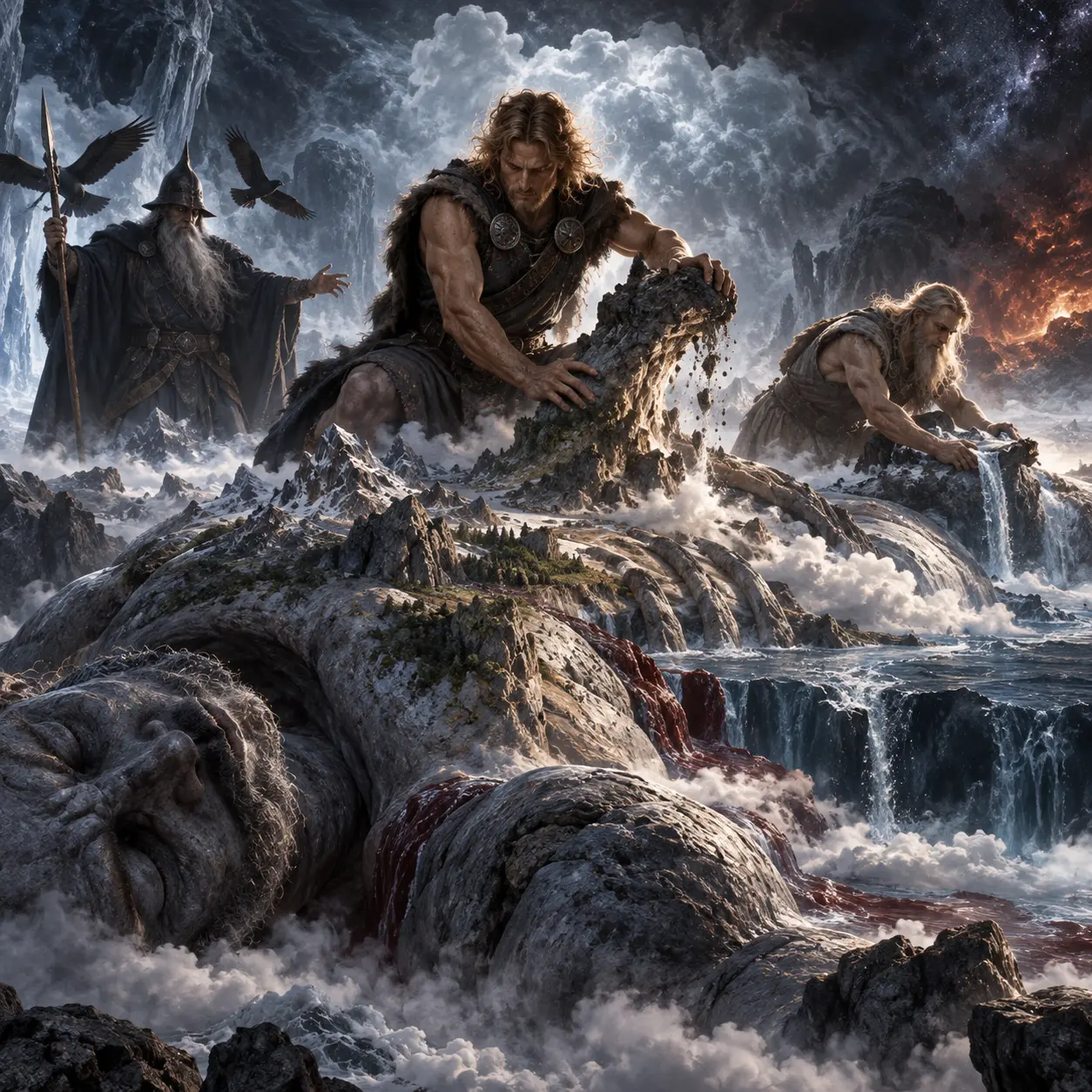
Odin and Vé's brother, and a creator of the world Vili belongs to the first generation of gods born after the primordial beings. He is the son of Borr and Bestla, the brother of Odin and Vé, and the grandson of Búri. Alongside his brothers, he has a central place in Norse cosmology: he takes part in Ymir's death, the making of the world from Ymir's body and, in Snorri Sturluson's account, the creation of the first human beings. Despite the scale of these deeds, Vili appears only rarely in surviving sources and has no mythic cycle comparable to Odin's or Thor's. The Gylfaginning in the Prose Edda tells how Borr, son of Búri, joined with Bestla, daughter of the giant Bölþorn. They had three sons: Odin
Vili
Vé Vili descends from two different primordial lineages. Through his father he comes from Búri; through his mother he is related to the jötnar. Búri → Borr + Bestla → Odin, Vili and Vé The sources provide little information about the brothers' childhood or youth. One of the great events in Norse cosmology is the death of the primordial giant Ymir. According to Snorri, Borr's sons killed Ymir. His blood caused a flood so vast that much of the frost-giant population perished. Bergelmir and his companion survived and continued their lineage. Ymir's death marks the transition from the primordial world to an ordered cosmos. Vili takes part alongside Odin and Vé. The source presents the brothers acting together and assigns no specific task to each one during the giant's death. There is therefore no basis for attributing a particular weapon or individual blow to Vili. After killing Ymir, Odin, Vili and Vé carried his body to Ginnungagap and used his remains to form the world. His flesh became the land, his blood the seas and waters, his bones the mountains, his teeth and bone fragments the stones and rocks, his skull the sky, and his brain the clouds. From Ymir's eyebrows the brothers made a stronghold around the region intended for human beings: Midgard. Norse creation is thus presented as the transformation of a primordial being. The gods build the cosmos from matter that already exists. Vili is part of this creative triad with Odin and Vé. The Gylfaginning also credits Odin, Vili and Vé with creating the first human beings. As the brothers walked along the shore, they found two pieces of wood. They picked them up and gave them human qualities. The resulting beings were: Ask, the man.
Embla, the woman. In Snorri's version, Odin gives them life and spirit. Vili grants understanding and movement. Vé gives them appearance, speech, hearing and sight. Modern translations vary slightly because of the Old Norse vocabulary, but Vili is clearly associated with inward faculties that allow humans to perceive, understand and act. Ask and Embla receive Midgard as their home and become the ancestors of humanity. The Völuspá preserves a different account of the first human beings. In that poem, Odin, Hœnir and Lóðurr find Ask and Embla and give them various vital qualities. The difference between the Völuspá and Snorri's account matters. The surviving poetic tradition uses a triad of Odin, Hœnir and Lóðurr, while the Gylfaginning presents Odin with Vili and Vé. The sources offer no definitive explanation for this divergence. It is preferable to preserve the two traditions as distinct versions. Vili also appears in a tradition about Odin's absence. In Lokasenna, Loki accuses Frigg of having been with Vili and Vé, Odin's brothers. The accusation belongs to the poem's deliberately insulting exchange and is not accompanied by a detailed narrative explaining the circumstances. Snorri preserves a related tradition in the Ynglinga saga. Odin was absent for so long that the Æsir thought he might never return. During that time his brothers Vili and Vé managed his household and shared his wife Frigg. Odin later returned and took Frigg back. Together, the sources show a tradition linking Odin's brothers with Frigg during Odin's absence, though its details and context remain sparse. Vili is closely associated with his brother Vé. Both are overshadowed in the sources by Odin, who later becomes a central figure in Norse mythology. In the cosmological events, however, the three brothers act as a unit: they are sons of Borr and Bestla, kill Ymir, shape the world from his body and, in Snorri's version, take part in creating Ask and Embla. After this primordial stage, Vili and Vé almost disappear from the surviving mythic narratives. The Old Norse name Vili is related to words expressing will, desire or intention. The resemblance between the name's meaning and the role Snorri assigns him in creating Ask and Embla has prompted various modern interpretations. Medieval sources do not explicitly call Vili a “god of will” or establish will as an independent divine sphere under his control. The linguistic meaning of his name should therefore be kept separate from a documented religious function. Vili's ultimate fate is unknown. No surviving source tells of his death or describes his role in Ragnarök. His disappearance is striking given his initial importance. During creation he belongs to the same triad as Odin; afterward Odin becomes one of mythology's central figures, while Vili and Vé fall almost entirely silent. We cannot tell whether older traditions once gave Vili greater prominence than the surviving medieval texts show. Nature: god of the Æsir lineage Father: Borr
Mother: Bestla
Brothers: Odin and Vé
Paternal grandfather: Búri
Maternal grandfather: Bölþorn Cosmological role: helps Odin and Vé kill Ymir and form the world Creation of humanity: in the Gylfaginning, helps create Ask and Embla and gives them understanding and movement Connection with Frigg: linked with Vé to a tradition about Odin's absence; mentioned in Lokasenna and the Ynglinga saga Approximate meaning of the name: will, desire or intention Weapons, dwelling, cult, fate and role in Ragnarök: unknown Main sources: the Gylfaginning in the Prose Edda, the Völuspá and Lokasenna in the Poetic Edda, and Snorri Sturluson's Ynglinga saga.
Vili