Norse Tales & Stories
Thor and Jörmungandr’s First Encounter
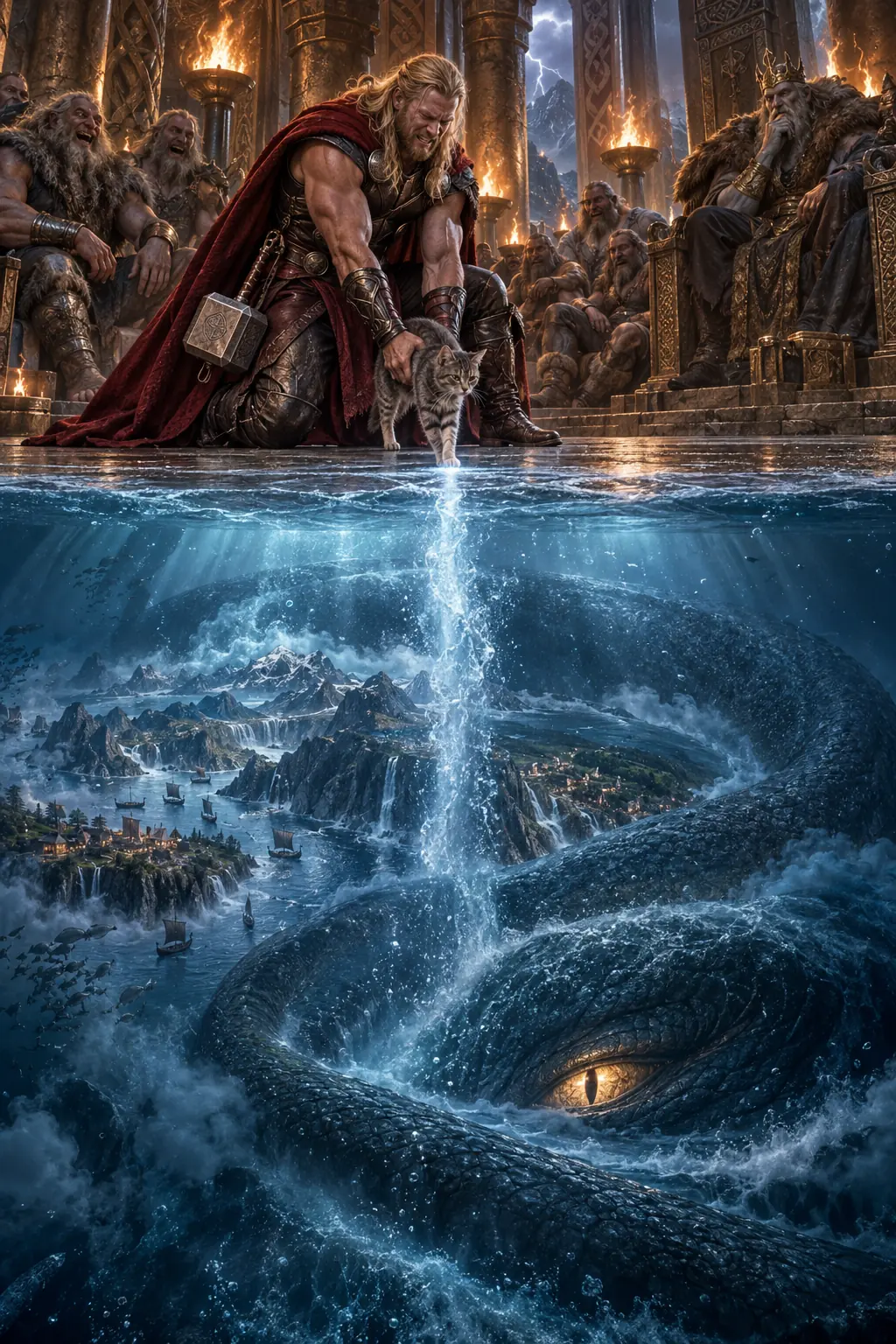
Some encounters happen by chance. A man walks into a tavern on the wrong night, a king takes a different road home from war, or a young woman looks up at the precise moment someone passes beneath her window. From such encounters come love affairs, feuds, songs and, quite often, problems no one could have foreseen.
Then there are the others. Encounters that begin long before those involved ever set eyes on one another, when neither yet knows the other’s face and still something is already drawing them across the world. The meeting of Thor and Jörmungandr was one of those.
For years, one walked upon the earth while the other grew beneath the sea. Between them lay mountains, forests, villages, nine worlds and more water than any man could have imagined.
They were destined to meet.
And the gods, though they often pretend otherwise, fear fate more than men do.
Thor was the son of Odin and Jörð, the Earth, and that explained certain things. His strength, for instance. Thor possessed the kind of strength that turned ordinary objects into fragile things: a door was something he had to remember to close carefully, a drinking horn required more delicacy than he considered reasonable and, whenever he embraced a friend after a long absence, that friend would usually spend the next few minutes discreetly checking that all his ribs were still where they belonged.
It also explained his temper. Storms rarely ask permission, and Thor shared that particular habit. He had a red beard, shoulders broad enough to fill a doorway and hands that seemed designed to settle arguments without resorting to overly elaborate reasoning. When he was angry, those who knew him made sure there were as few breakable things around him as possible.
But those who spoke only of his strength understood little about him. Thor was, above all, a protector. That was what men remembered when the storms came, when something enormous descended from the mountains, or when winter nights made the light of a house seem far too small.
He protected Midgard and those who lived there. He guarded the boundaries separating the known world from the creatures waiting beyond: giants, monsters and ancient beings whose names were best spoken close to the fire. Whenever one of them crossed those boundaries, Thor carried Mjölnir with him.
The hammer would eventually become more than a weapon. Men would wear its symbol around their necks, warriors would speak Thor’s name before battle and farmers would look to the clouds and think of him when the sky thundered. But in those days, Thor was still forging his legend.
Somewhere beneath the waters, another legend was growing.
Her name was Jörmungandr, daughter of Loki and the giantess Angrboða. She had a brother named Fenrir and a sister named Hel, which, even by the standards of Loki’s offspring, made for a complicated family. All three had come into the world accompanied by prophecies, and none promised anything good for the gods.
Odin had heard those prophecies, and Odin paid close attention to any story concerning the future. Perhaps too close. He had learned that Fenrir would have a hand in his death, that Hel would rule over many of the dead and that Jörmungandr would play a terrible part when the end of the gods came.
So he did what the powerful tend to do when confronted with a prophecy they dislike: he tried to prevent it.
Fenrir was bound. Hel was sent far away, to the realm that would eventually bear her name. Jörmungandr was seized by Odin and cast into the ocean surrounding Midgard.
Perhaps he thought the sea would solve the problem. After all, the sea has a reputation for swallowing things: ships, men, crowns, armies and secrets. Many things enter it and never return.
But the sea did something different with Jörmungandr.
It fed her.
The serpent descended into black waters where the light vanished and the cold seemed to belong to an age before the birth of the sun. There she found fish, darkness and, above all, space. The ocean Odin had chosen as her prison offered her precisely what she needed to grow.
And she grew.
The years passed as Jörmungandr ventured into depths no human net could reach. She learned the currents and tides, came to know the movements of the great shoals of fish and listened to the strange language of whales travelling across impossible distances. Far above her, the ships of men seemed like insects scratching at the surface of another world.
She continued to grow until there were places where her body stretched beyond even her own perception. She crossed underwater abysses, rested upon seabeds that had never known daylight and felt storms only as a distant disturbance in the waters above.
At last, her body encircled Midgard.
There, somewhere in that immensity, she found something familiar. Jörmungandr opened her jaws and caught her own tail.
The world lay within her circle.
Men never knew. They fished above her, sailed above her, traded, fell in love and waged war while, miles below, a creature born of Loki encircled the shores of their world. They called her Miðgarðsormr, the Midgard Serpent, and the prophecies said she would remain there until the day she released her tail.
That day would have another name.
Ragnarök.
Then Jörmungandr would rise from the depths. The sea would flood the land, her venom would poison the air, and someone would come to face her.
Thor.
The prophecies were quite specific on that point. The god of thunder would kill the serpent and then walk away from her corpse. He would take one step, then another, until he had taken nine. After the ninth, he would fall dead, overcome by the venom of the creature he had just slain.
Thus they were bound together. Thor was Jörmungandr’s death, and Jörmungandr was Thor’s.
There is a terrible intimacy in knowing that someone was born to kill you.
Thor knew the prophecy, though he rarely spoke of it. He preferred problems that could be hit. A giant could be felled, a wall could be broken and a creature could take Mjölnir between the eyes. The future was more elusive. It is difficult to strike a prophecy with a hammer, even when the hammer is Mjölnir.
Jörmungandr, meanwhile, waited.
Beneath the water, patience comes easily. On the surface, men count the years by harvests, winters, births and funerals. In the depths, there is another clock: currents that shift, migrations that return, waters that grow cold and warm again, long periods of darkness and hunger.
For a long time, Thor and the serpent remained apart. The god walked beneath the sky while Jörmungandr rested beneath the sea, and neither yet knew the other’s eyes.
Thor heard stories. Sailors spoke of shadows beneath their ships that were far too large. Fishermen found fish mutilated in strange ways, and some swore they had seen something moving beneath the waves during a storm, something so enormous they had mistaken its back for an island.
The others laughed.
Men often do that when a story frightens them more than they care to admit.
Thor laughed too.
Until one day he travelled to Jötunheim.
There ruled Útgarða-Loki, a giant renowned for his power and for an even more dangerous talent: he enjoyed making others look foolish. Thor arrived at his stronghold with Loki and his companions after a journey that had already tested his patience, and Útgarða-Loki welcomed them with the giants’ peculiar brand of hospitality.
He offered them food, drink and humiliation.
There were challenges. Loki competed in an eating contest against an impossible opponent. Þjálfi tried to prove his speed in a race. Thor, for his part, was given an enormous drinking horn and told that a good drinker could empty it in a single draught.
That sounded simple enough.
Thor drank.
When he lowered the horn, he expected to find it empty. The level had barely fallen.
The giants laughed.
Thor studied the vessel, raised it to his lips again and drank for longer. When he finished, he drew a deep breath and looked inside.
There was still far too much left.
The laughter grew louder.
On his third attempt, Thor drank until his chest began to ache. He swallowed enough to have left several men sprawled on the floor, but when he finally lowered the horn, there was still liquid inside.
Útgarða-Loki was smiling.
Thor set the vessel on the table.
Carefully.
That should have worried everyone.
“Give me another challenge,” he said.
Útgarða-Loki regarded him from his seat and pretended to think.
“There is a game the children in my household play.”
Thor looked around the hall. Some of the giants were already trying to suppress their laughter.
“A children’s game?”
“Perhaps it would be better suited to you.”
Thor smiled, and anyone who knew him would have recognised that as considerably worse than seeing him angry.
“Show me.”
Útgarða-Loki gestured to one of his servants.
“Bring in the cat.”
Laughter filled the hall.
Then a large grey cat appeared and padded towards the centre with the composure of a creature convinced that everyone present existed solely for its convenience. It stopped, regarded Thor for a moment and seemed to find him uninteresting.
Thor looked at the cat. Then he looked at Útgarða-Loki.
“This?”
“This.”
Thor laughed and bent down. He slipped one hand beneath the animal’s belly and lifted.
The cat arched its back.
Thor pulled harder.
The laughter continued for a few moments, but began to lose some of its enthusiasm. The animal stretched in a strange way and, though Thor pulled at it, its paws remained on the floor.
Thor shifted his footing. His fingers tightened around the animal, the muscles in his arms tensed and the smile vanished from his face.
He heaved upwards.
The floor creaked beneath his boots.
The cat continued to arch.
Then Thor felt something strange. He knew weight: he had lifted rocks larger than houses, felled giants and dragged things that would have required dozens of men to move. This was different. It was like trying to lift a mountain by one of its roots.
He clenched his teeth and pulled again.
Mjölnir hung from his belt. The tendons in his neck stood out like ropes, and his face grew almost as red as his beard.
The cat began to rise.
One of its paws left the floor.
Only one.
No one in the hall was laughing now.
Útgarða-Loki leaned forwards.
Because at that very moment, far from his stronghold, the ocean moved.
Along some shores, the water withdrew from the beaches. Fishermen looked up and saw the water receding beneath their boats with a tide no one had expected. Elsewhere, the waves changed direction and whales fell silent.
Something enormous was being torn from its resting place.
In the depths, Jörmungandr opened her eyes.
She felt an impossible force pulling at her body.
For years she had lain around Midgard, holding the world within her coils. She had known storms, earthquakes and the weight of entire oceans upon her back, but this was different.
Someone was trying to lift her.
Jörmungandr tensed.
In Jötunheim, Thor grunted and pulled again.
The cat lifted another paw.
Útgarða-Loki’s smile vanished.
Thor was too furious to notice.
For a moment, the god of thunder and the Midgard Serpent struggled against one another without knowing it. Between them lay magic, oceans and a giant’s deception, but the strength was real. Thor pulled upwards while Jörmungandr resisted from the depths, and the whole world seemed to have become the rope in that strange contest.
Thor made one final effort.
The cat arched to an impossible height.
Then the god let go.
The animal landed softly on the floor, stretched, licked one paw and walked away with that insulting dignity cats seem to possess even when they have nearly upset the balance of the world.
Thor was breathing heavily.
“A cat,” he muttered.
Útgarða-Loki remained silent.
Thor believed he had failed. He imagined the giants would remember that night as the occasion when the great son of Odin, bearer of Mjölnir and scourge of the jötnar, had been unable to lift a household pet.
The truth was rather different.
Útgarða-Loki revealed it to him later, as Thor and his companions were leaving the stronghold. He admitted that the challenges had been deceptions, and that each concealed something far greater than it appeared to be. The horn Thor had drunk from was connected to the ocean. He had swallowed so much water that the sea level had fallen, and from that feat would come the explanation for the tides.
Thor listened in silence.
Then he remembered the cat.
“And the animal?”
Útgarða-Loki took a moment to answer. Perhaps because even he found it difficult to admit what had happened.
“What you tried to lift was Jörmungandr.”
Thor stopped walking.
“The serpent?”
“The Midgard Serpent.”
The wind passed between them.
Útgarða-Loki looked at the god with an expression that held little of the mockery he had shown that night.
“She encircles the entire world. Her body rests in the ocean and she holds her own tail between her jaws. When I saw you lift one of her paws, I was afraid, Thor. Because what you were lifting was part of the serpent out of the sea.”
Thor looked towards the horizon.
For the first time, he understood that he had already touched the creature destined to kill him.
Without seeing her.
Without Mjölnir in his hand.
Without even knowing she was there.
Far away, beneath miles of water, Jörmungandr was settling her immense body around Midgard once more. The currents closed over her and the darkness slowly returned, but something had changed.
The serpent had felt the god too.
She still did not know his face and had never seen the red of his beard or lightning reflected on Mjölnir. She did not know whose hands had possessed enough strength to tear part of her body from the depths.
But she knew that strength.
And she would remember it.
So would Thor.
Next time would be different. There would be a small boat upon a sea too deep to fathom, a giant named Hymir and the bloodied head of a great ox used as bait. Thor would cast a hook into the darkness and something, far below, would open its eyes.
Then Jörmungandr would bite.
Then Thor would pull on the line.
And for the first time, the god of thunder and the creature destined to kill him would look into each other’s eyes.
But that is another story.
This was the first time they touched.
And neither of them ever forgot the other.