Ribe: The North Sea Trading Gateway of Viking Denmark
- Location
- Southwestern Jutland, present-day Denmark
- Historical region
- Jutland
- Municipality
- Esbjerg
- Historical period
- Established around 700; developed throughout the Viking Age and continued as a medieval town
- Site type
- Trading town, river port and craft centre
A Gateway Between the North Sea and Scandinavia
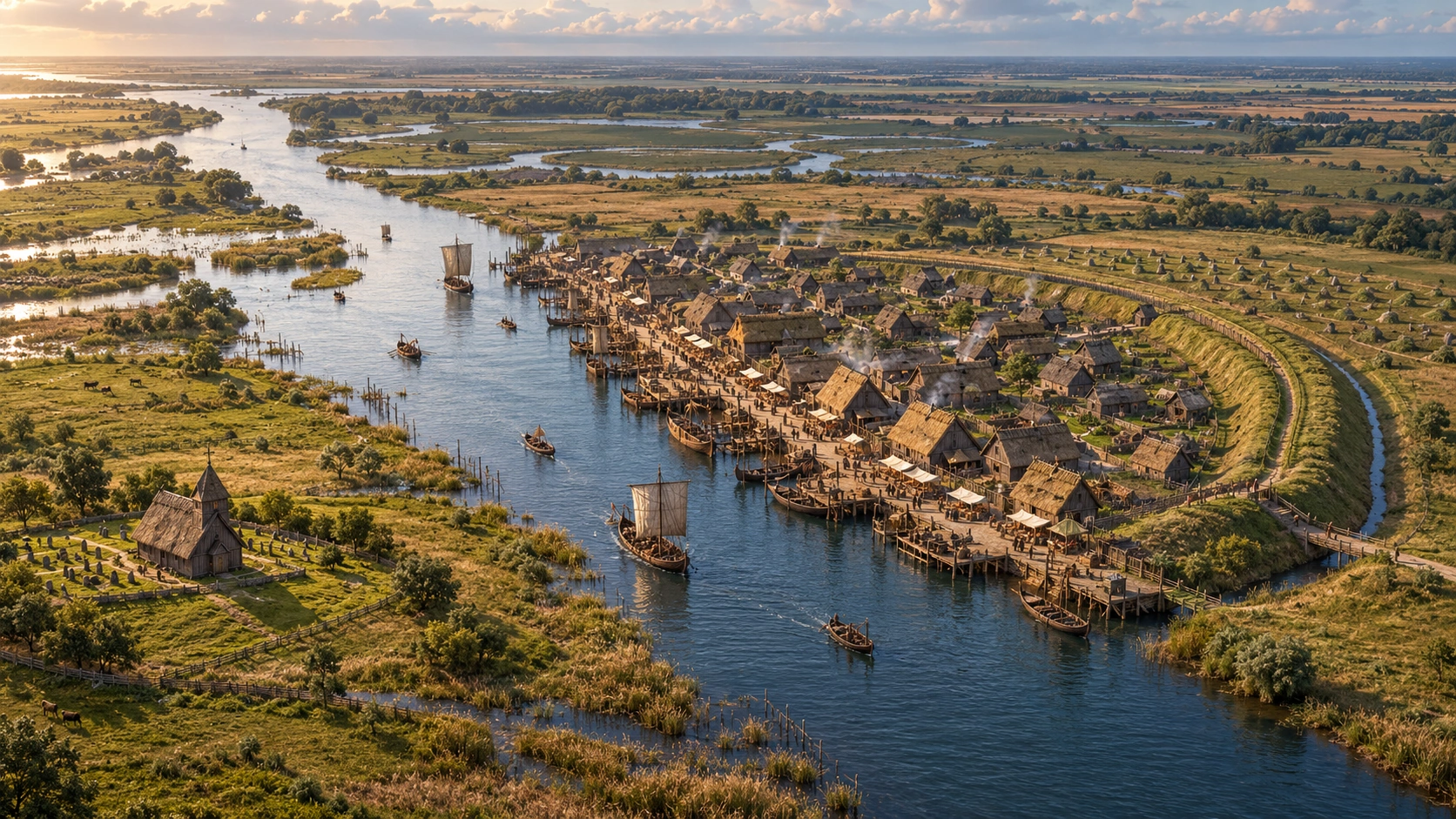
Beside the River Ribe in southwestern Jutland, a trading settlement emerged around the beginning of the eighth century.
Its position connected the North Sea world with the communities and resources of Scandinavia. Merchants and craftspeople arriving here participated in networks reaching towards Norway, the Frankish territories and, eventually, much more distant regions.
Ribe became one of the earliest places in Scandinavia where specialised production and commercial exchange supported the development of a town.
Its beginnings preceded the conventional start of the Viking Age. The settlement therefore offers an opportunity to understand the trading connections that helped make the later Viking world possible.
Unlike Birka and Hedeby, Ribe did not disappear as an urban centre at the end of its Viking history. It developed into a major medieval town, preserving a remarkable connection between its early trading community and the living town that exists today.
Before the Famous Viking Raids
Ribe’s early history challenges the idea that Scandinavian overseas activity began with attacks on monasteries.
By the time of the famous raid on Lindisfarne in 793, merchants and craftspeople had already been visiting Ribe for several generations.
Archaeological research has identified connections with the Scandinavian Peninsula during the first half of the eighth century. Other work places imports arriving by ship from Norway at Ribe by around 750.
These discoveries show that maritime exchange was established before the period most commonly associated with Viking expansion.
Raiding, settlement and commerce developed within a world where people already possessed knowledge of sea routes, foreign markets and the practical demands of travel. Ribe provides some of the clearest archaeological evidence for those earlier connections.
An Organised Marketplace Beside the River
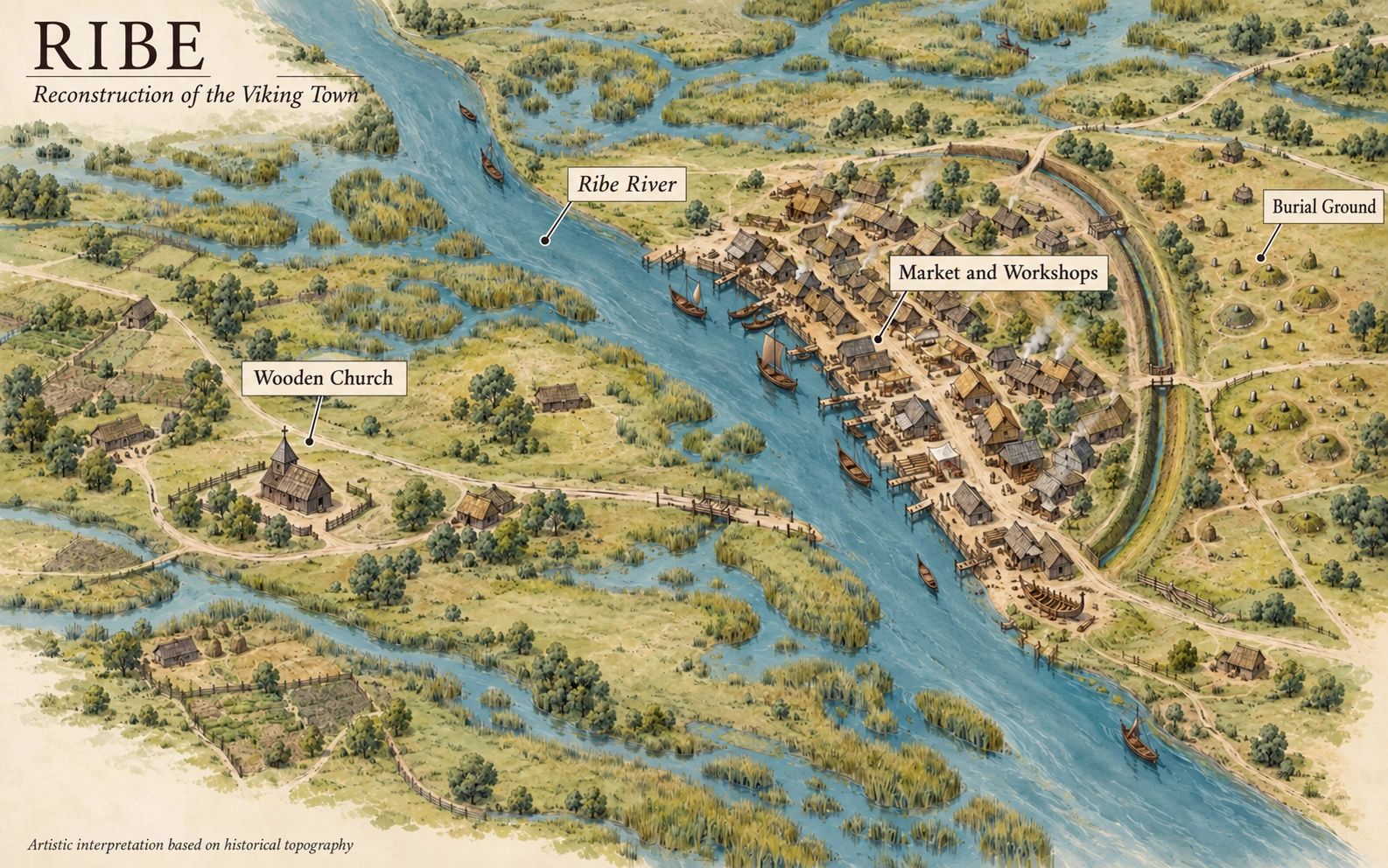
The earliest trading area developed on the northern side of the River Ribe.
Its layout suggests deliberate organisation. According to the National Museum of Denmark, an area approximately 200 metres long and 65 metres wide was arranged around a street, with narrow plots on either side.
Individual plots were approximately six to eight metres wide and separated by boundary ditches and plank-covered paths.
Before this arrangement was established, the ground had been levelled with a substantial layer of sand.
This was more than an accidental gathering of traders. The preparation of the ground and division into plots imply someone capable of organising space and regulating access.
A king or powerful local lord may have provided the protection and authority necessary for merchants to conduct business here.
Within these plots, craftspeople produced glass beads, combs and metal ornaments, bringing manufacturing directly into the commercial heart of the settlement.
From Market to Town
How quickly Ribe became a permanently inhabited settlement has been an important archaeological question.
Older interpretations often pictured an open seasonal market, with temporary structures occupied during particular trading periods.
Research has challenged that simple image, raising the possibility of denser buildings and more permanent occupation at an early stage.
The distinction matters. A seasonal market brings people together temporarily; a town requires continuing arrangements for accommodation, food, fuel, waste and the use of space.
Archaeologists investigate this transition through building remains, floors, hearths and the relationship between household activities and specialised work.
Ribe’s urban development was a process whose changing rhythms must be reconstructed from successive layers of occupation.
A Trading Network That Changed Over Time
Ribe’s international connections did not appear fully formed at a single moment.
Different objects reached the settlement through different networks, and their arrival can be traced through its archaeological layers.
Research distinguishes established maritime connections with Norway from a later increase in goods associated with much wider exchange systems.
Around 790, with an estimated uncertainty of approximately ten years, large quantities of imported beads from the Middle East began reaching Ribe.
Their arrival coincided with a major change in the local bead economy: imported products largely replaced earlier local glass-bead manufacture.
This sequence is significant because it suggests that Scandinavian maritime networks were already operating before the growing flow of eastern goods gave them further momentum.
Ribe was therefore both a participant in existing regional exchange and a place where expanding international networks transformed local work.
Glass Beads Made from the Roman Past
Among Ribe’s most revealing discoveries are the remains of bead-making workshops.
The craftspeople working there reused glass that had already experienced a long history.
Some of their raw material consisted of small mosaic cubes, known as tesserae, removed from older Roman and Byzantine buildings and transported north through trading networks.
Material once used to decorate distant buildings acquired a new purpose in a Scandinavian workshop.
Scientific analysis revealed an especially ingenious technique. Some opaque white beads were made by crushing and remelting transparent mosaic glass at relatively low temperatures.
Air trapped within the glass created bubbles that made the finished beads appear white.
The method reduced the resources needed for production. Craftspeople also recovered gold leaf from gilded mosaic pieces before melting the glass, although tiny traces of gold sometimes remained in the beads.
These discoveries reveal experienced workers who understood their materials and adapted their techniques to the supplies available.
A Small Object with a Northern Journey
Combs provide another connection between Ribe and the wider Scandinavian world.
A study published in 2023 examined combs and workshop waste from contexts dated between 720 and 900.
Using protein analysis and ancient DNA, researchers identified objects made from reindeer and moose antler.
Neither animal lived naturally in Denmark at the time. Their nearest contemporary habitats were on the Scandinavian Peninsula.
Four unusual combs, recovered from contexts dated approximately 720–740, were particularly informative.
Their style and material, combined with the absence of corresponding manufacturing debris in the early layers, supported the interpretation that they arrived as finished objects carried by travellers.
A seemingly ordinary grooming implement could therefore preserve evidence of a journey across the sea.
Such finds reveal connections that would be difficult to detect through written history alone.
The Comb That Says “Comb”
One of Ribe’s most engaging objects is a reindeer-antler comb bearing a runic inscription.
Its message is surprisingly straightforward: “comb”.
The inscription offers a useful reminder that runes did not belong exclusively to kings, memorial stones or ritual objects. They could also appear on possessions used in ordinary life.
The museum identifies the object as one of the relatively few runic finds from the ninth century.
Its appeal lies partly in its simplicity. Across more than a thousand years, someone chose to mark a familiar object with the word describing it.
Whether the inscription served as an exercise, a label or another purpose cannot be established from the word alone.
Bronze Workers and Their Lost Designs
Metalworking was another important part of Ribe’s commercial life.
Excavations conducted in 2017–2018 recovered a substantial collection of casting-mould fragments.
More than 700 fragments preserved impressions of the objects they had been used to produce, including brooches, pendants, amulets, keys, fittings and weapon components.
These fragments can be more informative about local manufacture than a finished object discovered far away.
A brooch could travel through several markets before being lost or buried. Its discarded mould, however, places production within a particular workshop.
Researchers have used three-dimensional scanning to make the impressions easier to study and to reconstruct the designs of objects that may no longer survive.
The moulds also offer the possibility of identifying repeated models and the distinctive working practices of individual craftspeople.
Ribe’s workshops thus contributed to the circulation of artistic styles as well as practical goods.
Coins and the Regulation of Trade
Ribe played an important role in the early use of coins in Scandinavia.
Its archaeological material includes small silver coins associated with the commercial world around the North Sea.
The settlement is particularly connected with issues showing a human face on one side and an animal on the other.
The identity represented by the face remains uncertain. Interpretations of early coin imagery should therefore be treated cautiously.
Ribe’s museum presents local coin use as part of an organised commercial system in which visiting merchants exchanged their currency for the money accepted in the town.
This suggests that the regulation of trade extended beyond allocating plots and protecting visitors. Control over currency could also help structure transactions.
The development of such practices marks an important stage in the economic history of early Scandinavia.
The Damhus Hoard: A Discovery That Changed the Evidence
A remarkable discovery near Ribe greatly expanded knowledge of its early ninth-century coinage.
In 2018, metal-detector finds in a wet meadow near Damhus led to systematic investigations.
The resulting hoard contained 258 coins of a type showing a face on one side and a deer on the other.
Before this discovery, only thirteen examples of that type were known.
Four additional coins combined a ship design with the deer motif.
The National Museum interprets the find as evidence that two different coin types were being produced contemporaneously at Ribe.
The circumstances of deposition are also intriguing. The coins had been buried in an area without evidence of settlement activity.
The museum suggests that they may have been offered to the gods rather than concealed for later recovery.
That interpretation remains a proposal, but it illustrates how money could carry religious significance alongside its commercial value.
A Human Skull Inscribed with Runes
One of Ribe’s most unusual early finds is a fragment of human skull bearing a relatively long runic inscription.
Discovered in 1973, the object also has a drilled hole.
A detailed study of its archaeological context placed its loss or deposition, with considerable probability, between approximately 725 and 750.
Its reading and interpretation have been debated for decades. The National Museum identifies it as an early object bearing a reference to Odin.
The combination of human bone, a perforation and writing makes it an exceptional piece of evidence for the use of unusual materials in objects associated with belief.
Its original purpose and precise message should not be reduced to a confidently reconstructed story. What is certain is that someone deliberately inscribed a piece of human skull in the earliest period of Ribe’s history.
Music in a Trading Town
Ribe’s discoveries also include evidence of musical life.
Finds from the Northern Emporium excavation allowed researchers to reconstruct an instrument known as the Ribe Lyre.
Aarhus University describes it as the oldest stringed instrument found in Denmark.
Its presence adds another dimension to a settlement usually discussed through commerce and manufacturing.
The people who worked at furnaces, shaped antler and exchanged goods also inhabited a world of performance and sound.
The surviving evidence cannot reveal the melodies played or the circumstances in which people heard them. It nevertheless establishes music as part of the human experience preserved beneath Ribe’s streets.
Everyday Life in the Archaeological Layers
The history of Ribe survives through far more than its exceptional objects.
Animal bones, plant remains, insects, manufacturing waste and fragments of buildings help reconstruct the environment of the settlement.
Studies associated with the Northern Emporium project examined animal resources used for both food and craft production.
The material included fish and birds, together with quantities of bone and antler associated with working animal materials. Pine-marten bones were notably abundant.
Such remains help archaeologists connect trade with the practical activities supporting it.
Successive floors and deposits also preserve changes in how particular spaces were used. A place occupied by one workshop could later acquire a different function.
At the Posthustorvet excavation, deposits reached approximately 2.3 metres in thickness, preserving a complex sequence of construction and activity.
The town’s history can therefore be followed through accumulated traces of repeated work and occupation.
Ansgar and the Arrival of a Church
Ribe also became an important centre of early Christian activity in Denmark.
In the middle of the ninth century, the missionary Ansgar obtained permission to establish a church there, conventionally dated to around 855–860.
The church stood on the southern side of the river, opposite the older trading settlement.
Excavations around the present cathedral have revealed a substantial Christian cemetery whose earliest graves belong to the ninth century.
These burials provide archaeological evidence for a Christian community during the Viking Age.
Ribe became an episcopal seat in 948, strengthening its position within the developing organisation of the Danish Church.
The reconstructed Ansgar Church at Ribe VikingeCenter offers an interpretation of what a ninth-century wooden church might have looked like.
It is based on general knowledge of contemporary church building rather than the surviving remains of Ansgar’s actual structure.
From Viking Settlement to Medieval Town
Ribe’s later history differs from that of several other famous Viking trading centres.
Its urban life continued, although the organisation and principal location of settlement changed.
Around 1050, the town’s centre shifted towards the southern side of the river, where the church had already established an important focus.
This was a transformation within Ribe’s continuing history rather than the foundation of an entirely unrelated replacement town.
One particularly unusual detail belongs to the second half of the eleventh century: streets were surfaced with animal bones and small stones.
The use of bones may reflect the shortage of suitable stone in the surrounding sandy landscape.
Ribe’s transition into the medieval period therefore survives through both major institutional changes and practical solutions to everyday problems such as maintaining passable streets.
How a Solar Event Helped Date the Town
Modern research has given Ribe an unexpected connection with activity on the Sun.
An exceptional increase in atmospheric radiocarbon associated with a solar-particle event in 775 left a recognisable signature in organic material.
Researchers identified that signal within Ribe’s archaeological sequence and used it to improve the dating of successive occupation layers.
This helped establish when different imports appeared and how local industries changed.
An event in the Earth’s atmosphere thus became a chronological marker for a trading town more than twelve centuries later.
The result demonstrates why Ribe is important beyond the history of Denmark: its carefully preserved layers allow researchers to develop methods that can improve archaeological dating elsewhere.
Why Ribe Matters
Ribe reveals the commercial foundations of the Viking world.
Its early connections show that Scandinavian seafaring and exchange were developing before the most famous raids.
Its workshops demonstrate technical skill, adaptation and the movement of knowledge. Roman mosaic glass became new jewellery, northern antler arrived in grooming implements, and discarded moulds preserved the designs of local metalworkers.
Its more unusual discoveries—a runic skull fragment, a labelled comb and the remains of a lyre—bring the people of the settlement closer to view.
Across generations, Ribe connected merchants, craftspeople and travellers within an expanding maritime world.
It was one of the places where the North Sea became a route through which early Scandinavian town life took shape.