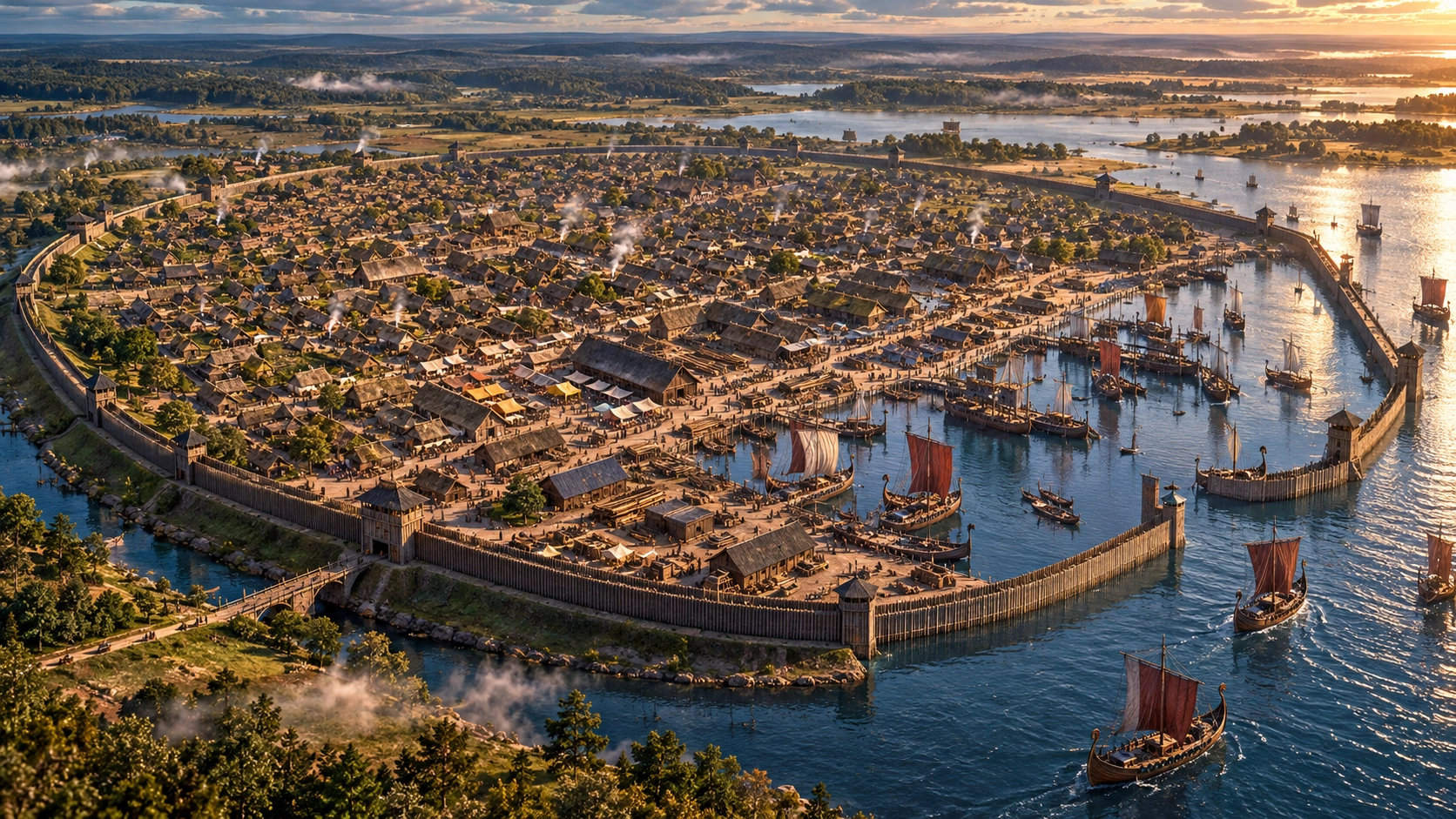
Hedeby: The Great Trading Gateway of the Viking World
- Location
- Near Schleswig, present-day Germany
- Historical period
- 9th–11th centuries
- Site type
- Viking trading town, harbour and craft centre
A Gateway Between Two Seas
At the southern end of the Schlei inlet, close to the modern town of Schleswig, stood Hedeby, one of the most important trading centres of Viking-Age Europe.
Known as Hedeby in Danish and Haithabu in German, the settlement occupied a strategic position near the narrow land corridor separating the Baltic Sea from the North Sea.
For merchants travelling between Scandinavia, the Frankish world, the British Isles and eastern Europe, Hedeby offered a remarkable meeting place. Ships arriving through the Schlei could unload their cargoes, while goods could be transported overland towards the rivers flowing into the North Sea.
This combination of maritime access and overland connections helped make Hedeby a major commercial centre.
The Rise of a Viking Trading Town
Hedeby developed into a substantial settlement during the ninth century, although commercial activity in the surrounding region began earlier.
Its growth was closely connected to the political ambitions of Danish rulers and the importance of controlling trade routes across the Jutland peninsula.
Unlike the scattered farmsteads typical of much of Viking-Age Scandinavia, Hedeby contained densely arranged houses, streets, workshops and trading areas.
The town became a place where merchants, sailors, craftspeople and travellers from different cultural backgrounds lived and worked alongside one another.
The Harbour and Its Trading Networks
Hedeby's harbour was central to its prosperity.
Archaeological investigations have revealed waterfront structures, landing facilities and the remains of vessels that demonstrate the importance of maritime transport.
Merchants exchanged products such as textiles, furs, metalwork, glass, pottery, jewellery and other valuable goods.
The town's connections reached the Frankish territories, the Baltic region, Scandinavia and wider European trading networks.
Silver, including coins from distant regions, played an important role in the Viking economy. Weights and balances found at trading sites illustrate how precious metals could be assessed during commercial exchanges.
Hedeby was not merely a stopping point: it was a place where goods were redistributed, transformed and sold.
Craftspeople and Everyday Life
Behind the harbour stood a busy town of workshops and households.
Archaeological discoveries reveal specialised crafts, including metalworking, bead-making, comb production and textile-related activities.
Wooden buildings stood close together, creating a dense settlement whose streets and working spaces were shaped by generations of occupation.
The inhabitants included people with connections to different regions and traditions. Hedeby's material culture reflects the diversity of a community sustained by international commerce.
The town's success depended not only on distant merchants but also on the everyday labour of its resident craftspeople.
Defending the Trading Centre
Hedeby's wealth and strategic position made it politically important.
The settlement was eventually enclosed by a substantial semicircular earthwork, commonly known as the semicircular rampart. It connected with the wider defensive landscape associated with the Danevirke fortification system.
These earthworks demonstrate the importance of the region to the rulers who sought to control movement, territory and trade.
The visible fortifications developed over time and should not be assumed to have existed in their final form throughout Hedeby's entire history.
Kings, Religion and Cultural Change
Hedeby also played a role in the religious and political transformations of the Viking Age.
In the ninth century, the missionary Ansgar visited the Danish kingdom and was associated with early Christian activity in the trading centre.
The coexistence of different beliefs and traditions reflects the gradual nature of religious change in Scandinavia.
Hedeby was a place where political authority, commercial opportunity and cultural contact intersected.
Conflict and the End of Hedeby
Hedeby remained an important settlement into the eleventh century, but its final decades were marked by conflict.
Historical sources record an attack associated with the Norwegian king Harald Hardrada in 1050. The town suffered further destruction in 1066.
Its commercial importance subsequently shifted towards nearby Schleswig, which developed into a major medieval town.
The end of Hedeby did not mean the end of trade in the region. Instead, it marked a change in the location and organisation of one of northern Europe's most important commercial networks.
Archaeology and World Heritage
The archaeological remains of Hedeby have provided exceptional evidence for Viking-Age urban life, craftsmanship, trade and maritime activity.
Excavations have uncovered buildings, streets, workshops, harbour structures, everyday objects and ships.
Together with the Danevirke fortification system, the archaeological border complex of Hedeby was inscribed on the UNESCO World Heritage List in 2018.
The site is now among the most important places for understanding the development of early towns and trading networks in northern Europe.
Why Hedeby Matters
Hedeby reveals a Viking world built not only through exploration and warfare but also through commerce, craftsmanship and cultural exchange.
Its position between two seas made it a meeting point for people, products and ideas.
Alongside Ribe, Birka and Kaupang, Hedeby demonstrates how interconnected Viking-Age Scandinavia had become.
It was one of the great gateways through which the wider world entered northern Europe.