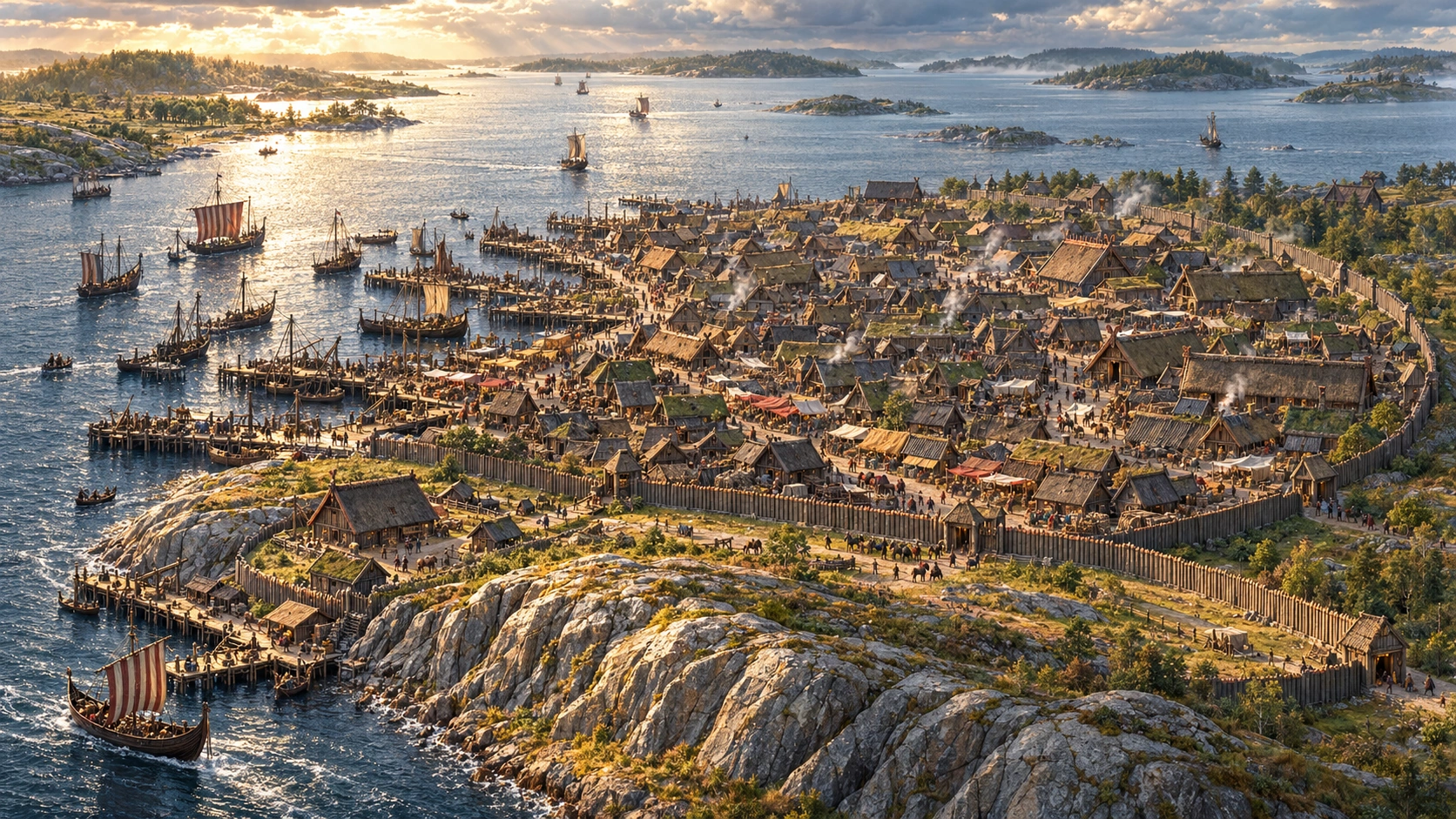
Birka: The Island Trading Town That Connected Viking Sweden to the World
- Location
- Björkö island, Lake Mälaren, west of Stockholm, present-day Sweden
- Historical region
- Uppland
- Municipality
- Ekerö
- Historical period
- c. 750–late 10th century
- Site type
- Viking trading town, harbour and craft centre
- World Heritage status
- Part of the Birka and Hovgården UNESCO World Heritage Site, inscribed in 1993
An Island at the Crossroads of the Viking World
On the island of Björkö, approximately thirty kilometres west of modern Stockholm, stood Birka, one of the most important trading settlements of Viking-Age northern Europe.
For more than two centuries, this island community brought together merchants, craftspeople, sailors and travellers whose connections extended far beyond Scandinavia.
Today, Björkö lies within Lake Mälaren. During Birka’s early history, however, these waters formed part of a Baltic inlet. The gradual uplift of the land later transformed the coastline, separating the lake from the sea.
Birka’s surroundings therefore looked different from the landscape visitors encounter today. Its position offered access to maritime routes while connecting merchants with the resources and communities of the Scandinavian interior.
The importance of the settlement becomes clearer when considered alongside Hovgården, the neighbouring centre of elite power on Adelsö. Together, the two places reveal how trade, political authority and the organisation of territory became closely connected during the Viking Age.
The Rise of an Early Scandinavian Town
Birka is conventionally dated to around 750, although its exact foundation remains uncertain.
Archaeologists reconstruct its chronology through successive building phases, the changing styles of objects and coins recovered from the settlement and its graves.
These methods establish an approximate period of occupation rather than a precise founding year. Some interpretations place the settlement’s beginnings later in the eighth century.
At its height, Birka probably supported several hundred inhabitants. Estimates commonly range between approximately 500 and 1,000 people.
By modern standards, this was a small community. Within the predominantly agricultural society of early Scandinavia, however, a concentrated settlement of merchants and specialised craftspeople represented a significant development.
Wooden houses stood in rows, with workshops and lanes creating a densely occupied environment. Birka is often called Sweden’s first town, although the designation simplifies a more complicated process of early urban development.
The Harbour and the Work Behind Maritime Trade
Birka’s prosperity depended on boats, landing places and the practical work required to keep vessels operating.
Its maritime landscape extended beyond a single harbour. Archaeological investigations have identified evidence of jetties, boat landings and facilities associated with the maintenance of ships.
An especially revealing discovery was announced by Stockholm University in 2022: a Viking-Age shipyard site at Kugghamn, outside the town rampart along Björkö’s northern shore.
The remains included a stone-lined depression with a wooden slipway at its base. Archaeologists also recovered woodworking tools, slate whetstones and numerous boat rivets, both used and unused.
These objects reveal the less celebrated side of Viking seafaring. Ships required repairs, replacement fastenings and skilled labour before they could carry another cargo or begin another voyage.
The shipyard’s position outside the rampart also raises questions about how access to the waterfront was organised. Different landing places may have served different purposes or operated under different forms of control.
Trading Across Cultural Boundaries
Birka participated in networks reaching westwards towards places such as Dorestad and eastwards into commercial systems connected with the Islamic world.
Written accounts mention relations with Dorestad, while imported objects, silver coins and clothing details reveal the strength of wider connections. Some graves contain brooches and pottery associated with traditions found in southwestern Finland; others preserve evidence of clothing influenced by eastern fashions.
These discoveries suggest a community in which people encountered unfamiliar objects, techniques and customs.
They also require careful interpretation. An imported object does not automatically identify the birthplace of its owner, and an eastern garment does not prove that the person wearing it came from the region where its style originated.
Goods could travel through several markets, while fashions could be adopted far from their original setting.
Birka’s archaeology therefore reveals both the movement of people and the circulation of cultural influences, without allowing every individual journey to be reconstructed.
Silver Coins That Became Jewellery
Coins found at Birka were not always used exclusively as money.
Several examples had been pierced or fitted with loops so that they could be suspended, perhaps among beads in a necklace.
A coin could therefore pass through different stages of use: first as a monetary object, later as an ornament and eventually as a burial gift.
Birka has also produced coins minted at Hedeby, providing a tangible connection between two of the Viking world’s major trading centres.
Some depict ships, while others show buildings or birds. Certain designs drew inspiration from Frankish coins, but modified their imagery. Ships that appeared with bare masts on the Frankish models were commonly given sails on the Scandinavian versions.
For a time, the number of these coins discovered at Birka encouraged the mistaken belief that they had been minted there. Their later attribution to Hedeby illustrates how archaeological interpretations change as evidence improves.
The Arabic Ring with a Glass “Gemstone”
One of Birka’s most remarkable objects is a silver ring recovered from a ninth-century woman’s grave, designated Bj 515.
Its violet insert bears an Arabic inscription in Kufic script, interpreted in a scientific study as meaning “for” or “to Allah”.
For many years, the insert was thought to be an amethyst. Microscopic and chemical analysis published in 2015 showed that it was coloured glass.
The researchers also found that manufacturing marks remained visible on the silver, suggesting relatively little wear. They proposed that the ring might have passed through comparatively few owners before reaching the woman buried at Birka.
The object provides striking evidence of connections with the Islamic world. Its significance should nevertheless be expressed carefully: it does not establish the woman’s religion, birthplace or personal travel history.
What survives is the ring and its extraordinary journey into a Scandinavian grave, rather than a complete biography of its owner.
Workshops, Combs and Thousands of Beads
Birka was a major place of production as well as exchange.
Archaeological finds reveal bronze casting, ironworking, comb-making, bead production, textile work and the processing of furs.
Early metalworking offers a particularly interesting clue to the movement of skills. Some of the techniques and jewellery associated with Birka’s earliest bronze workers resemble those used at Dorestad.
Such similarities suggest that trading networks helped carry technical knowledge between communities, although the origins of individual craftspeople remain uncertain.
The scale of the bead discoveries is especially impressive.
Excavations in the Black Earth between 1990 and 1995 recovered more than 6,000 glass beads, together with melted glass and production waste.
Their colours and shapes varied enormously. Some were tiny and monochrome; others had elaborate multicoloured decoration. Certain beads incorporated thin gold or silver foil, creating a glittering effect.
Around 350 additional beads were made from other materials, including amber, rock crystal, carnelian, amethyst, bone and clay.
Although some bead-making took place locally, many examples were imported. Small enough to travel easily and attractive enough to be prized, beads were well suited to the trading networks that sustained Birka.
Textiles: From Fine Stitching to Possible Sailcloth
Textile production left less spectacular remains than silver jewellery, but it was a substantial part of Birka’s working life.
Excavations have recovered spindle whorls, loom weights, needles, needle cases and scissors.
The variety of tools suggests different kinds of work rather than the production of a single standard fabric.
Studies of spindle whorls indicate that craftspeople spun both fine and coarse thread. Fine thread could serve delicate sewing or embroidery, while heavier yarn may have been used for coarse cloth and possibly sail production.
The tools connect domestic labour with the wider maritime economy. The same settlement that received imported luxuries also needed people to spin, weave, sew and repair essential materials.
Despite the abundance of equipment, archaeologists have not securely identified particular buildings as dedicated weaving workshops.
What Did Birka’s Inhabitants Eat?
The remains of meals provide another perspective on the town.
Excavations during the first half of the 1990s recovered approximately six tonnes of animal bone.
Much of the material came from cattle, pigs and sheep, including bones bearing evidence of butchery and food preparation.
Analyses found that pigs and sheep were often slaughtered while young, whereas cattle were more frequently killed at an older age. One possible explanation is that some cows were kept for milk before being slaughtered.
Chicken and waterfowl bones also occur.
Fishing was important, as might be expected in a settlement surrounded by water. Identified fish include pike, perch and zander.
These remains turn an abstract trading centre into a place of ordinary routines: animals being butchered, fish being prepared and household waste accumulating around buildings.
They also represent only a sample of the settlement’s history, rather than a complete account of everyone’s diet.
The Black Earth Beneath the Fields
The area known as Svarta jorden, or the Black Earth, preserves the remains of Birka’s main settlement.
Its dark colour developed through the accumulation of ash, charcoal, organic refuse and other waste during generations of occupation.
In places, the archaeological deposits exceed two metres in thickness.
The soil that once received the town’s rubbish later became productive farmland. Its chemical conditions have also helped preserve bones and objects made from bone and antler.
Birkaportalen estimates that approximately eight per cent of the roughly six-hectare Black Earth area has been investigated archaeologically.
Even this limited sample has produced extraordinary quantities of material. Excavations in the 1970s and 1990s recovered more than 90,000 objects from approximately 450 square metres.
The quiet fields visible today therefore cover an exceptionally rich archive of buildings, working spaces and discarded possessions.
Wealth, Inequality and Enslaved People
Birka’s international connections did not benefit all inhabitants equally.
Richly furnished graves reveal people with access to imported drinking vessels, costly clothing, jewellery, horses and weapons.
Alongside these privileged individuals were enslaved people.
Written evidence records their presence, while iron neck restraints found in the settlement provide material evidence associated with captivity and coercion.
Some enslaved people probably worked in production; others may have been sold onwards through trading networks.
Their proportion within the population remains unknown, and identifying their graves is difficult.
Birka’s commercial history consequently includes both skilled achievement and human exploitation. Its prosperity emerged within a society divided by wealth, status and personal freedom.
A Landscape of Graves
The burial grounds surrounding Birka are among its most distinctive surviving features.
More than 1,100 graves have undergone some form of archaeological investigation, most during the nineteenth century.
They include cremations, burials of unburnt bodies and elaborate chamber graves associated with the wealthier sections of society.
Women, men and children appear within these different categories.
Counting the dead is more complicated than counting visible mounds. Some graves have disappeared through cultivation or other disturbance, while a single mound may contain more than one person.
The cemetery landscape therefore preserves only part of a much larger and more complex history.
Burial practices also changed over time. Some inhumations show Christian influence, although the relationship between religious belief and the arrangement of an individual grave is not always straightforward.
The Woman in Grave Bj 581
Few discoveries from Birka have attracted as much attention as chamber grave Bj 581.
Excavated in 1878, it contained an exceptional assemblage of weapons, two horses, gaming pieces and a gaming board.
For generations, it was presented as a prominent male warrior burial.
Genetic research published in 2017 confirmed that the person buried there was biologically female.
The researchers interpreted the combination of military equipment, burial setting and gaming objects as evidence for a woman of high standing with a warrior role. Their subsequent reassessment explored that interpretation in greater detail.
The distinction matters: DNA established biological sex, while occupation and social position are interpretations based on the archaeological context.
Weapons and gaming pieces cannot independently reconstruct someone’s career. Nevertheless, the grave provides compelling evidence that assumptions about gender can profoundly influence how archaeologists understand the past.
The Child Known as the Birka Girl
Another burial offers a more intimate story.
The child known as the Birka Girl was approximately five or six years old at death.
Her grave contained a gilded brooch, glass beads with gold or silver cores, a knife and a bone container holding sewing needles.
These valuable possessions suggest a family with considerable resources.
The museum notes that the identification as a girl rests largely on the grave goods rather than an entirely certain determination of sex.
The burial also illustrates how children could receive objects associated with adults. Clothing ornaments and sewing equipment helped express identity even at a young age.
Elsewhere at Birka, small objects interpreted as possible toys—including a carved bird—offer glimpses of play alongside the more familiar evidence of trade and warfare.
Fortifications and the House of Warriors
Birka’s defensive landscape included a town rampart, a hillfort known as Borg and an adjacent area commonly called the Garrison.
Investigations of the Garrison revealed buildings occupying several terraces, with evidence extending from the ninth into the tenth century.
One large tenth-century hall became known as the “House of Warriors” because of the numerous weapon finds associated with the area.
Other buildings appear to have served residential, storage or workshop functions.
Burnt structures and concentrations of arrowheads suggest that the complex experienced violent destruction.
These discoveries provide evidence of conflict, but do not identify the attackers or establish a complete explanation for Birka’s abandonment.
Ansgar, Religious Change and a Threatened Town
Birka also occupies an important place in the history of Christianity in Scandinavia.
Around 830, Ansgar and his companion Witmar arrived on a mission supported by the Frankish emperor.
Their experiences are described in the Vita Ansgarii, written by Rimbert several decades later.
According to this account, King Björn permitted them to preach. Hergeir, a prominent figure associated with the king, accepted baptism and established a chapel on his property.
The mission encountered resistance as well as support, and later missionaries were expelled. Ansgar returned in the early 850s.
Rimbert also describes an attack led by the exiled king Anund with a fleet of thirty-two ships. Merchants sought shelter in a fortification, probably Borg, and the town escaped destruction after negotiations, payments and the casting of lots.
These episodes provide rare narrative glimpses of Birka. They must also be read as part of a religious biography written to commemorate a missionary.
Hovgården: Power Across the Water
On neighbouring Adelsö, Hovgården preserves a different aspect of the same historical landscape.
Its hall remains, monumental mounds and later royal associations support its interpretation as an aristocratic centre linked with control over Birka.
The famous “royal mounds” have not all been excavated, and neither their dates nor the identities of those buried within them should be treated as established facts.
Hovgården’s significance continued after Birka declined.
An eleventh-century runestone mentions the title of king, while the medieval palace of Alsnö hus demonstrates the site’s later importance.
In 1280, the Alsnö ordinance associated with this palace granted privileges to the nobility.
The two neighbouring sites consequently followed different paths: Birka ceased to function as a major trading town, while Hovgården remained part of an evolving political landscape.
The Uncertain End of Birka
Birka’s principal trading settlement declined during the late tenth century, often dated approximately to the 970s.
Coins help establish this chronology.
The youngest examples identified in its principal occupation material were minted in the 960s. German and English coins that became widespread in Scandinavia towards the end of the century are absent from the material discussed in Birkaportalen’s chronological assessment.
This pattern supports an end to the main commercial phase before those later imports became common. It does not prove that every part of Björkö was immediately abandoned.
Several explanations have been proposed, including political reorganisation, changing trading routes and difficulties affecting navigation.
Evidence of violence adds another possibility, but no single cause securely explains the entire transformation.
Sigtuna subsequently assumed important central functions in the region.
Birka’s decline was therefore part of a broader reorganisation of trade and power, rather than the disappearance of commerce from the Mälaren waterways.
Rediscovering Birka
Much of Birka’s modern reputation rests on archaeological work begun long before scientific techniques such as DNA analysis became available.
Hjalmar Stolpe first visited Björkö in 1871, approaching the island with a background in the natural sciences.
He subsequently devoted many seasons to investigating its settlement and graves.
His career illustrates how Birka helped shape archaeology as well as Scandinavian history: objects excavated in the nineteenth century continue to generate new questions when examined with modern methods.
The site remains far from fully understood. Excavation, laboratory analysis and geophysical surveys continue to reveal relationships between the settlement, its waterfront, surrounding graves and other occupied parts of the island.
In 1993, Birka and Hovgården were inscribed together on the UNESCO World Heritage List, recognising their exceptional testimony to Viking-Age trading networks and early settlement development.
Why Birka Matters
Birka brings the Viking world into focus through unusually personal evidence.
A glass bead preserves the work of a craftsperson. A pierced coin records an object’s transformation into jewellery. An Arabic inscription reveals the reach of exchange. A child’s grave preserves a family’s investment in remembrance.
Its workshops and waterfront show the labour supporting long-distance trade, while its fortifications and restraints reveal the unequal and sometimes violent society in which that trade operated.
For a little more than two centuries, this island settlement connected the resources of the Scandinavian interior with distant markets and cultural worlds.
Its surviving remains continue to reveal how people worked, travelled, believed and expressed their place within that expanding world.