← Æsir index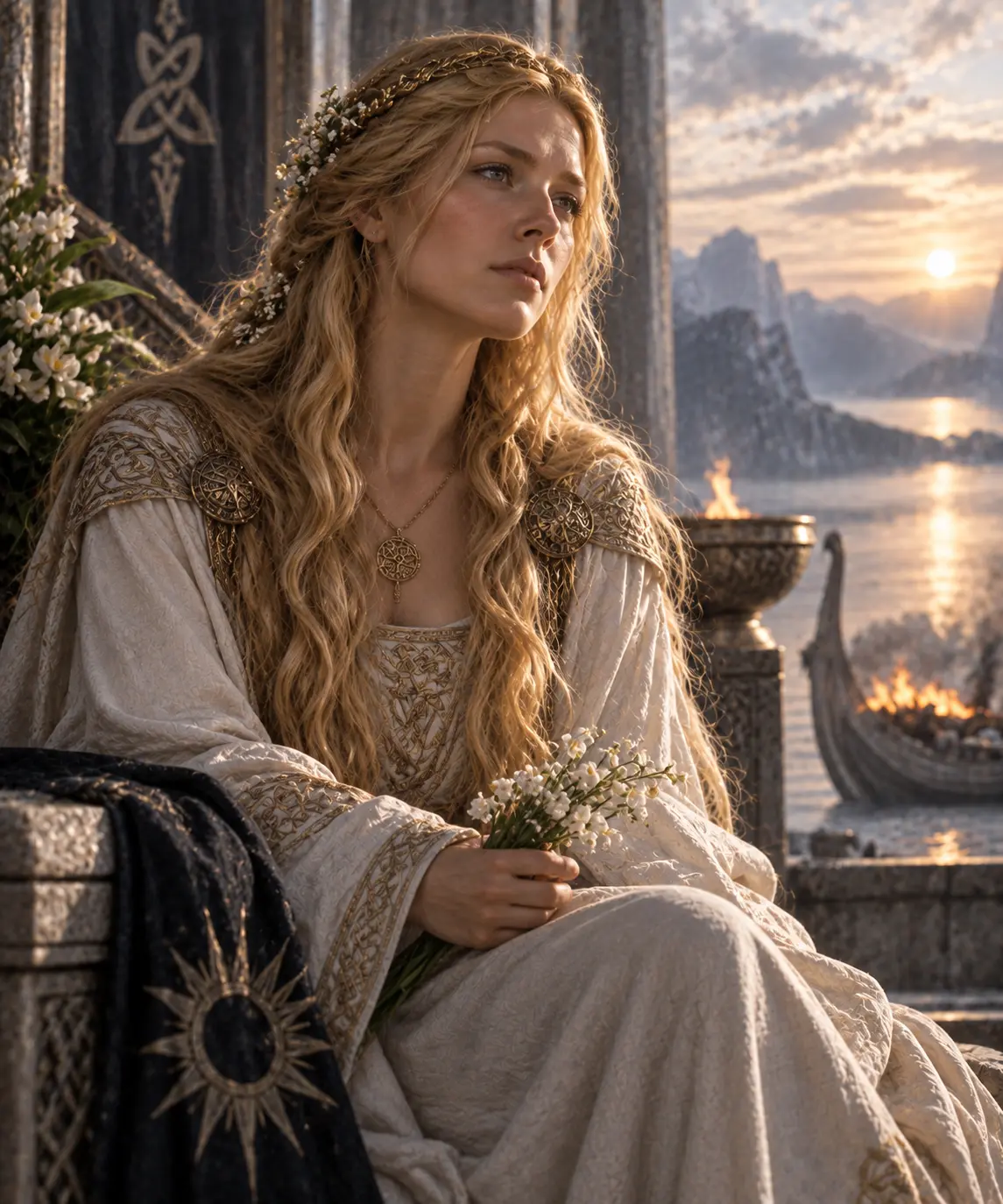
Nanna is a divine figure associated with the Æsir, wife of Baldr and mother of Forseti. Her presence in the Norse sources is brief, but it is bound to one of the most tragic episodes in all mythology: Baldr’s death and funeral. When Baldr dies, Nanna dies too. Snorri Sturluson relates that grief kills her during the funeral preparations. Her body is placed beside Baldr’s on Hringhorni, the enormous ship used as his funeral pyre. They set out together towards death. Nanna’s story continues in Hel, however. When Hermóðr descends to the realm of the dead in search of Baldr, he finds both spouses there. Nanna is the wife of Baldr, son of Odin and Frigg. Their union produces Forseti, a god associated with mediation and the settlement of disputes. This places Nanna within one of the main Æsir genealogies: Odin and Frigg → Baldr and Nanna → Forseti. The sources offer very little information about her life before the tragedy. We do not know how she met Baldr, how their marriage came about, or what role she played in Asgard before her husband’s death. Much of her story has been lost. The tragedy begins when Baldr has dreams foretelling his death. Frigg tries to protect him by obtaining oaths from many beings and elements of the world, so that none of them will ever harm him. There is one apparently insignificant exception: the mistletoe. Loki discovers this vulnerability. He then gives the mistletoe to Höðr, Baldr’s blind brother, and guides his throw. The projectile strikes Baldr and kills him. For Odin and Frigg, this means the loss of a son. For Nanna, the loss of her husband. The gods prepare Baldr’s funeral aboard Hringhorni, which Snorri describes as the greatest of all ships. The vessel is so enormous that the gods are unable to push it into the water. They therefore ask the jötunn Hyrrokkin for help. Hyrrokkin arrives riding a wolf with snakes for reins. Her strength is enough to launch Hringhorni into the water with such violence that fire bursts from the movement and the earth trembles. Baldr’s body is placed aboard the ship. Then another death takes place. According to Gylfaginning, when Nanna sees Baldr’s body during the funeral preparations, she dies of grief. Her body is immediately carried to the pyre and placed beside her husband. Baldr’s funeral thus becomes the funeral of both of them. Baldr has died as a consequence of Loki’s deception. Nanna dies after witnessing the loss of Baldr. Through a physical death, the account conveys the full magnitude of her grief. Hringhorni’s pyre brings together some of the most important elements of Norse mythology. Odin places his ring Draupnir on Baldr’s body. Baldr’s horse is led to the pyre as well. Thor uses Mjölnir to consecrate the funeral fire. During the ceremony, a dwarf named Litr appears before Thor. The god kicks him into the flames, where he dies. At last, Baldr and Nanna lie together aboard the funeral ship. The scene is one of the great divine funerals described by Snorri. Death does not mean that Nanna has disappeared. Frigg asks the Æsir who is willing to ride to Hel and try to bring Baldr back. Hermóðr agrees. He mounts Sleipnir and travels for nine nights along dark roads until he reaches the river Gjöll. He crosses Gjallarbrú, speaks with its guardian Móðguðr, and continues to Hel’s gates. There he finds Baldr. Nanna is beside him. The couple remain together in the realm of the dead. Hermóðr spends the night in Hel with Baldr and Nanna. When it is time to return, the dead send objects back to Asgard. Baldr gives Odin Draupnir, the same ring his father had placed on his funeral pyre. Nanna also sends gifts. She sends Frigg a linen cloth and other presents. To Fulla, who is closely connected with Frigg, she gives a gold ring. This brief episode is one of the few personal actions of Nanna preserved in the sources. Even from Hel, she maintains ties with those who remain among the living. The relationship between Nanna and Frigg has a particularly important family dimension. Frigg is Baldr’s mother. Nanna is his wife. Each loses the same man from a different position. One loses her son. The other loses her husband. The gift Nanna sends from Hel is a final bond between the two women, now separated by the boundary between the living and the dead. Hermóðr asks Hel whether Baldr can return. Hel sets an extraordinary condition: everything in the world must weep for Baldr. Messengers travel through the world and find beings and objects willing to mourn him. At last they reach a figure called Þökk, who refuses. Þökk declares that Hel must keep what she possesses. The tradition passed down by Snorri identifies this refusal with Loki’s intervention. The condition fails. Baldr remains among the dead. Nanna stays beside him. Völuspá foretells that Baldr and Höðr will return after Ragnarök and live together in the renewed world. The poem, however, says nothing about Nanna. It is therefore risky to claim that she will return with Baldr. Her later fate remains unknown. The last situation clearly preserved in the sources places her in Hel beside her husband. Nanna is the mother of Forseti, whose dwelling is Glitnir. Forseti is associated with settling disputes, mediation and reconciliation. The genealogy creates a particularly powerful irony. The son associated with conciliation is born into a family that will ultimately be torn apart by a chain of deception, death and vengeance. Baldr dies. Nanna dies. Then Váli is born or enters the story, destined to avenge Baldr’s death by killing Höðr. The sources are silent about Forseti’s response to losing his parents. Nanna is often associated with love and marital fidelity because of her relationship with Baldr and her death after losing him. This interpretation is consistent with her story. However, the surviving sources provide little evidence for formally defining her as a “goddess of love” or as a deity who specifically presides over marriage. Her myth embodies love, grief and fidelity. Her precise religious function remains unknown. Snorri identifies Nanna as the daughter of Nepr. The difficulty is that very little is known about Nepr. His name appears in genealogies, but the surviving sources contain no important mythic cycle devoted to him. This leaves Nanna’s family origins uncertain. We know her father’s name. Her mother remains unknown. Her marriage to Baldr and motherhood of Forseti are documented far better than her ancestry. There is also a radically different version of Nanna in Saxo Grammaticus’s Gesta Danorum. Saxo transforms much of the Baldr myth into a heroic narrative whose characters differ greatly from those in the Eddic versions. In this tradition, Nanna is presented as a human woman. And the central relationship in her story is not initially with Balderus. She is in love with Høtherus. In Saxo’s account, Balderus sees Nanna bathing and is overcome by the desire to possess her. But Nanna loves Høtherus. The conflict between Balderus and Høtherus therefore takes on a romantic and political dimension. Høtherus is no longer the blind brother manipulated by Loki whom we know from Snorri. He is an active hero. A warrior. A rival to Balderus. And the man loved by Nanna. The story ultimately leads to a confrontation between the two men. The versions must be kept clearly distinct. In the Eddic tradition and in Snorri: Nanna is Baldr’s wife. She is Forseti’s mother. She dies of grief during her husband’s funeral. She is placed beside him on Hringhorni. She remains with Baldr in Hel. In Saxo: Nanna is a human woman romantically connected with Høtherus. Balderus desires her. The rivalry over her forms part of the conflict between the two men. Combining the two traditions would create a biography found in no medieval source. The difference between these versions shows how greatly myths could change. Stories circulated orally. They travelled between regions. Characters changed. Genealogies could be rearranged. Medieval Christian authors interpreted pagan material, often much older, from different perspectives. Snorri’s Nanna and Saxo’s Nanna may derive from related traditions, but the accounts that have survived present profoundly different characters. Nanna’s paradox is that we know far more about her death than her life. The sources allow us to identify: her father, her husband, her son, her funeral, her stay in Hel, and the gifts she sends from the realm of the dead. By contrast, we know very little about her earlier character, possible religious functions, worship or personal attributes. This calls for caution in describing her. Her importance within the Baldr myth is beyond dispute. Her role as an independent deity is much harder to reconstruct. Nanna’s story contains one of the most intimate images in Norse mythology. Baldr, the radiant god, lies dead. The Æsir prepare a funeral worthy of one of Odin’s sons. Hringhorni waits on the shore. The gods gather. The giants watch. Thor consecrates the pyre. And they place Nanna beside Baldr’s body. Later, when Hermóðr crosses the roads leading to Hel, he finds them together once more. Death separates Baldr and Nanna from the world of the living, but the sources present them as united on the other side of that boundary. Name: Nanna. Nature: divine figure associated with the Æsir. Father: Nepr. Mother: unknown. Husband: Baldr. Son: Forseti. Parents-in-law: Odin and Frigg. Associations: love, fidelity, marriage, loss, grief and death. Death: according to Snorri, dies of grief during Baldr’s funeral. Funeral: placed beside Baldr on Hringhorni. Fate after death: Hel. Gifts from Hel: sends presents to Frigg and a gold ring to Fulla through Hermóðr. Own dwelling: unknown. Weapons: none known. Specific powers: none clearly documented. Fate after Ragnarök: unknown. Alternative tradition: Saxo Grammaticus presents a human Nanna, loved by Høtherus and desired by Balderus. Main sources: Gylfaginning, Skáldskaparmál and, for the alternative tradition, Gesta Danorum.
Nanna