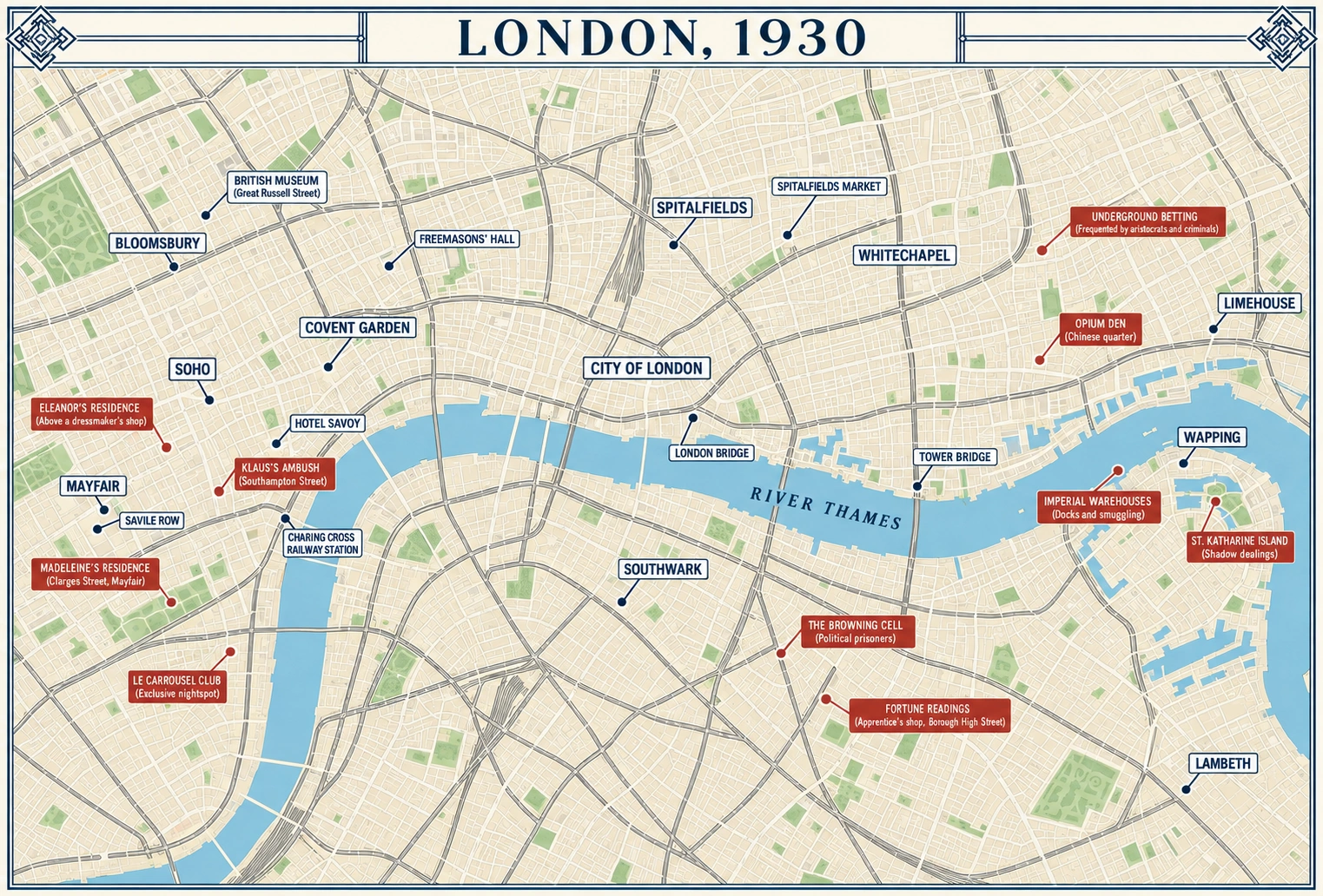
London in 1930 was a city caught between two ages.
The Great War had ended twelve years earlier, yet its presence remained everywhere: in memorials carved with long lists of names, in men with missing limbs selling matches outside railway stations, in widows dressed in black, and in an entire generation that had learned how quickly civilisation could become a battlefield.
Another war still seemed unimaginable.
The British Empire stretched across the globe. King George V sat on the throne. The West End glittered with theatres, restaurants and expensive hotels. Motorcars competed with buses and taxis for space in streets designed for horses. Electric signs illuminated Piccadilly while, only a few miles east, families lived crowded into ageing houses where poverty belonged to everyday life.
London was modernising, though unevenly.
The Underground carried passengers beneath streets that had existed for centuries. Telephones connected offices and homes while messages still arrived by hand. Newspapers could turn murder into public spectacle before breakfast. Ships from Europe, Asia, Africa and the Americas unloaded their cargo along miles of docks and wharves beside the Thames.
And beneath all of it lay the older city.
Roman foundations. Medieval churches. Victorian cemeteries. Private clubs. Locked archives. Warehouses whose windows never seemed to catch the sun.
This is the London into which Eirikr Skarnisson arrives in Grimwolf.
A city large enough for a man to disappear.
And old enough for certain things to have been waiting for him.
THE WEST END
Soho · Mayfair · Covent Garden · Bloomsbury
The West End offered the London that visitors expected to see.
Theatres, hotels, department stores, restaurants, galleries and gentlemen's clubs occupied streets where wealth could be displayed without embarrassment. Yet the districts west of the City were far from uniform. Walk for twenty minutes and London could change its accent, its clothes and its rules.
Mayfair belonged to money.
Its townhouses, private squares and clubs represented a social order in which family names could open doors unavailable to ordinary Londoners. Aristocratic wealth had been challenged by war, taxation and economic change, yet status still mattered enormously. A title, the correct school, the correct regiment and the correct acquaintances remained a form of currency.
In the world of Grimwolf, this is the London in which families such as the Ravenscrofts can exist almost untouched by the city around them.
Their fictional power has supernatural roots, but their social camouflage is thoroughly British: ancestry, property, discretion and the assumption that certain questions simply should not be asked.
A very different West End waited in Soho.
Here London became more international and less respectable. Restaurants, cafés, nightclubs, musicians, artists, immigrants, criminals and people seeking pleasures unavailable in polite drawing rooms mixed within a relatively small network of streets. Soho could be fashionable at one table and dangerous at the next.
Then came Covent Garden.
Today its Piazza is associated with boutiques and visitors. In 1930 it was still dominated by the great fruit, vegetable and flower market. The market building designed by Charles Fowler had opened a century earlier, in 1830, and the surrounding streets were shaped by carts, porters, produce merchants, warehouses, pubs and businesses dependent upon the market.
Before much of London had finished breakfast, Covent Garden had already been working for hours.
That makes it particularly useful territory for Grimwolf.
Among legitimate merchants, specialist dealers and crowded side streets, the novel places the fictional antiquarian Elias Harrow: a man whose clientele is interested in objects far older and considerably more dangerous than fruit and flowers.
It is here that Eirikr encounters one of the central relics of the story — Víðarrs Andlit, the Mask of Víðarr.
The real Covent Garden traded in commodities from across Britain and beyond.
The Covent Garden of Grimwolf trades in a few things that should perhaps have remained buried.
Bloomsbury, immediately to the north, offered another world again. Squares and terraces were associated with scholars, writers, publishers, universities and intellectual life. At its heart stood an institution capable of connecting London with almost every civilisation the British Empire had encountered.
The British Museum.
And for Eirikr, another hunting ground.
THE EAST END
Explore Whitechapel after Jack the Ripper →Whitechapel · Wapping · Southwark
Crossing London eastward changed the city.
The East End had grown around docks, workshops, factories, warehouses and generations of working-class communities. It was also home to successive immigrant populations who had arrived in London seeking work, safety or both.
By 1930, Whitechapel was still haunted in the popular imagination by crimes committed more than forty years earlier.
Jack the Ripper had vanished in 1888.
His London had not vanished with him.
Much had changed, yet overcrowding, poverty and poor housing remained realities in parts of the East End. Streets could change character within a few hundred yards: a busy commercial road giving way to narrow courts, lodging houses, workshops, pubs and alleys hidden behind larger buildings.
At night, geography became more important.
A wrong turning could take someone from a crowded street into near isolation remarkably quickly.
That quality makes Whitechapel important in Grimwolf.
Victor Ravenscroft does not hunt there because the district possesses some inherent supernatural evil. He hunts there because a predator understands geography.
He chooses places where victims can disappear.
Where poverty makes disappearance less surprising.
Where the city has already learned to look elsewhere.
Farther south and along the river, Wapping and the districts facing the Thames belonged to another London: sailors, dock labourers, warehouses, river stairs, public houses and businesses whose fortunes followed the ships.
Southwark, across the river from the City, carried centuries of its own reputation for industry, entertainment, poverty and crime.
This is not the London of aristocratic drawing rooms.
It is the London where information can be bought in a pub, where a sailor can vanish for months without explanation, and where a man with cash in his pocket may discover that everyone has suddenly become his friend.
Klaus understands this London far better than Eirikr does.
Unfortunately, Klaus also understands gambling.
Sometimes rather too well.
THE THAMES AND THE DOCKS
Rotherhithe · Bermondsey · Millwall
The Thames was London's oldest road.
By the 1930s the Port of London had become an immense industrial organism. At its peak during that decade, the enclosed docks controlled by the Port of London Authority contained hundreds of acres of dock water and more than thirty miles of quayside.
Ships brought timber, grain, meat, tea, tobacco, fruit, machinery and countless other goods into the capital.
They also brought people.
Sailors arrived from ports scattered across the world. Languages mixed in dockside streets. Boarding houses, pubs, cafés, warehouses and cheap accommodation existed around an economy that depended upon ships constantly arriving and departing.
The river had its own population and its own rhythms.
Rotherhithe and Bermondsey were shaped by wharves, warehouses and industry. Downriver, the Isle of Dogs and Millwall belonged to a landscape of docks, cranes, factories, railway sidings and labour.
This is where Grimwolf enters London.
Eirikr Skarnisson reaches the city aboard the fictional German cargo ship MS Friedrich, having crossed the North Sea with Klaus, a Bavarian sailor and veteran of the Great War.
They disembark at Millwall.
For Eirikr, London begins far from Buckingham Palace, Piccadilly Circus or the fashionable hotels.
It begins with water.
Cold iron.
Coal smoke.
Ropes striking wet timber.
Men shouting across the docks.
And somewhere beyond the warehouses, millions of strangers who have never heard his name.
Klaus leads him into this world and eventually to The Drowned Gull, the fictional riverside establishment run by Maud.
The location suits both men. Klaus belongs naturally among sailors and dockworkers. Eirikr needs anonymity.
The docks provide it.
The Thames plays another role in Grimwolf as well.
Bodies keep returning to it.
Inspector Arthur Crowley's investigation into the ritual murders begins to reveal a pattern among victims recovered from London's darker margins. The river becomes both evidence and accomplice — carrying away what killers wish to hide and occasionally returning what they believed lost.
London throws things into the Thames.
The Thames has never promised to keep them.
THE BRITISH MUSEUM
Behind its monumental Greek Revival façade in Bloomsbury stood one of the greatest collections of antiquities, books and manuscripts in the world.
The British Museum of 1930 was also different from the institution visitors know today.
Its famous circular Reading Room functioned as part of the national library collections housed within the museum. The modern British Library would only emerge as a separate institution decades later. Scholars therefore came to Bloomsbury not simply to examine antiquities, but to work among vast collections of books and manuscripts.
For Grimwolf, this combination is irresistible.
History has been collected here.
Catalogued.
Numbered.
Placed behind glass.
Yet classification creates an interesting question:
What happens to an object that cannot safely be catalogued?
The novel places two fictional scholars within this historical institution.
Madeleine de Beaumont, an authority on Nordic antiquities, represents scholarship at its most formidable: educated, observant and comfortable discussing objects whose origins reach into the violent cultures of northern Europe.
Eleanor Fairchild, associated with rare and restricted manuscripts, inhabits a more ambiguous territory. Through her, Eirikr begins to discover that Victor Ravenscroft has access to objects absent from ordinary catalogues.
That distinction matters.
The British Museum is real.
Its collections are real.
Madeleine, Eleanor and the hidden network of forbidden Norse material belong to Grimwolf.
The fiction begins precisely where the catalogue ends.
HIGHGATE CEMETERY
London had spent much of the nineteenth century constructing impressive places for its dead.
Highgate Cemetery opened in 1839 as part of the movement to relieve the capital's overcrowded burial grounds. Its original western cemetery was laid out as a landscaped garden of winding paths, monuments and elaborate funerary architecture. An eastern extension followed across Swain's Lane.
Its Egyptian Avenue, Lebanon Circle, catacombs, mausoleums and Gothic structures created an extraordinary landscape of Victorian attitudes toward death.
In 1930, Highgate had yet to become the heavily overgrown place familiar from many later photographs. Maintenance remained considerably stronger during the early twentieth century; its great decline came later.
That distinction is useful for the atmosphere of Grimwolf.
Highgate does not need ruined tombs or supernatural invention to feel unsettling.
Stone angels stand over family graves. Mausoleum doors disappear into the hillside. Paths curve away from sight. Beneath the ground are catacombs built by a society that treated death with architecture rather than discretion.
For a story concerned with Hella, Helheim and the boundary between the living and the dead, few places in London require less embellishment.
Sometimes history has already done the work.
FREEMASONS' HALL
Great Queen Street presents one of the most interesting cases where historical London and Grimwolf deliberately diverge.
Freemasons had occupied the site since the eighteenth century. Following the First World War, plans were made for a new headquarters that would also commemorate thousands of English Freemasons killed during the conflict.
Construction began in 1927.
In 1930, therefore, the magnificent Art Deco Freemasons' Hall familiar today was still being built. The work proceeded in stages while portions of the older complex remained in use. The completed building would be dedicated in 1933.
That unfinished state may actually make the location more interesting for Grimwolf.
A monumental structure rising around older rooms.
Corridors being replaced.
Sections inaccessible behind temporary doors.
Workmen during the day.
Private meetings after dark.
In the novel, Crowley encounters the phrase:
IN AULA UMBRARUM
In the Hall of Shadows.
His investigation eventually connects it with a clandestine gathering associated with the Freemasons' Hall site.
Here the boundary must remain explicit.
The historical Freemasons' Hall and English Freemasonry are real.
The aristocratic supernatural lodge, the sacrifices, the cult of Hella and the Hall of Shadows belong entirely to the fictional world of Grimwolf.
History provides the building.
The novel puts something beneath it.
MOVING THROUGH LONDON
Underground · Streets · Transport
London in 1930 already possessed a transport system recognisably related to the modern city.
The Underground was an established part of everyday life, though the network, stations and line names differed in several respects from those of the present day. The familiar Underground roundel was already being used as part of the increasingly sophisticated visual identity developed under the influence of Frank Pick.
The famous diagrammatic Tube map designed by Harry Beck, however, was still in the future.
That would appear in 1933.
Above ground, motor buses were everywhere. Trams remained part of London's transport landscape, taxis crossed the central districts, private motorcars were becoming increasingly common, and delivery vehicles competed for road space.
Walking remained essential.
This matters when imagining Grimwolf.
Eirikr can descend underground in Bloomsbury and emerge into a different social world. Crowley and Blake can cross the city by taxi while following a murder investigation. Klaus can move through dockside streets on foot because those streets form a geography he understands instinctively.
London's transport network shrinks the city.
Its streets make it enormous again.
A journey of a few miles can carry a character from aristocratic Mayfair to Covent Garden's market, from the intellectual world of Bloomsbury toward the East End, then south or east toward warehouses and the Thames.
Every district has a different population.
Every station offers another place to disappear.
For a hunter, London provides possibilities.
For the hunted, it provides millions of witnesses who saw nothing.
REAL LONDON / FICTIONAL LONDON
Grimwolf uses historical London as its foundation rather than rebuilding the city from scratch.
Real London includes Whitechapel, Soho, Mayfair, Covent Garden, Bloomsbury, Rotherhithe, Bermondsey, Millwall, the Thames, Highgate Cemetery, Savile Row, the British Museum and the Freemasons' Hall site.
The markets, docks, transport networks, social divisions and architecture belong to the historical city.
Other elements belong to the novel.
The Drowned Gull is fictional.
Elias Harrow and his antiquarian business are fictional.
Eleanor Fairchild and Madeleine de Beaumont are fictional figures placed within the historical world of the British Museum.
The Ravenscrofts, their supernatural lineage and their occult lodge belong to the mythology of Grimwolf.
So do the Mask of Víðarr, the Mirror of Jörmungandr, the cursed mirrors, the ritual murders connected with Hella and the ancient struggle hidden beneath London's twentieth-century institutions.
There is a deliberate principle behind that mixture.
The supernatural world rarely replaces history.
It hides inside it.
A fictional tavern stands beside a real dock.
An imaginary manuscript rests inside a real museum.
A supernatural conspiracy meets at a real London address.
The reader should always be able to recognise the city.
Then wonder which parts were invented.
IN GRIMWOLF
Discover Hamburg and Sankt Pauli before London →Eirikr Skarnisson does not come to London looking for adventure.
He comes looking for the Ravenscrofts.
His hunt has already carried him through Hamburg and across the North Sea. London is supposed to be another stop on a longer road of vengeance.
Instead, the city begins closing around him.
A völva leads him toward Covent Garden.
An antiquarian possesses a mask that whispers in Old Norse.
A British Museum scholar knows more about Victor Ravenscroft than she admits.
Bodies marked with strange symbols emerge from the Thames.
Inspector Arthur Crowley follows evidence toward a hall hidden behind respectable London.
And somewhere in the fog, Victor Ravenscroft realises that another predator has entered his territory.
London has millions of inhabitants.
Most will never know that anything happened.
That may be the most London thing about it.