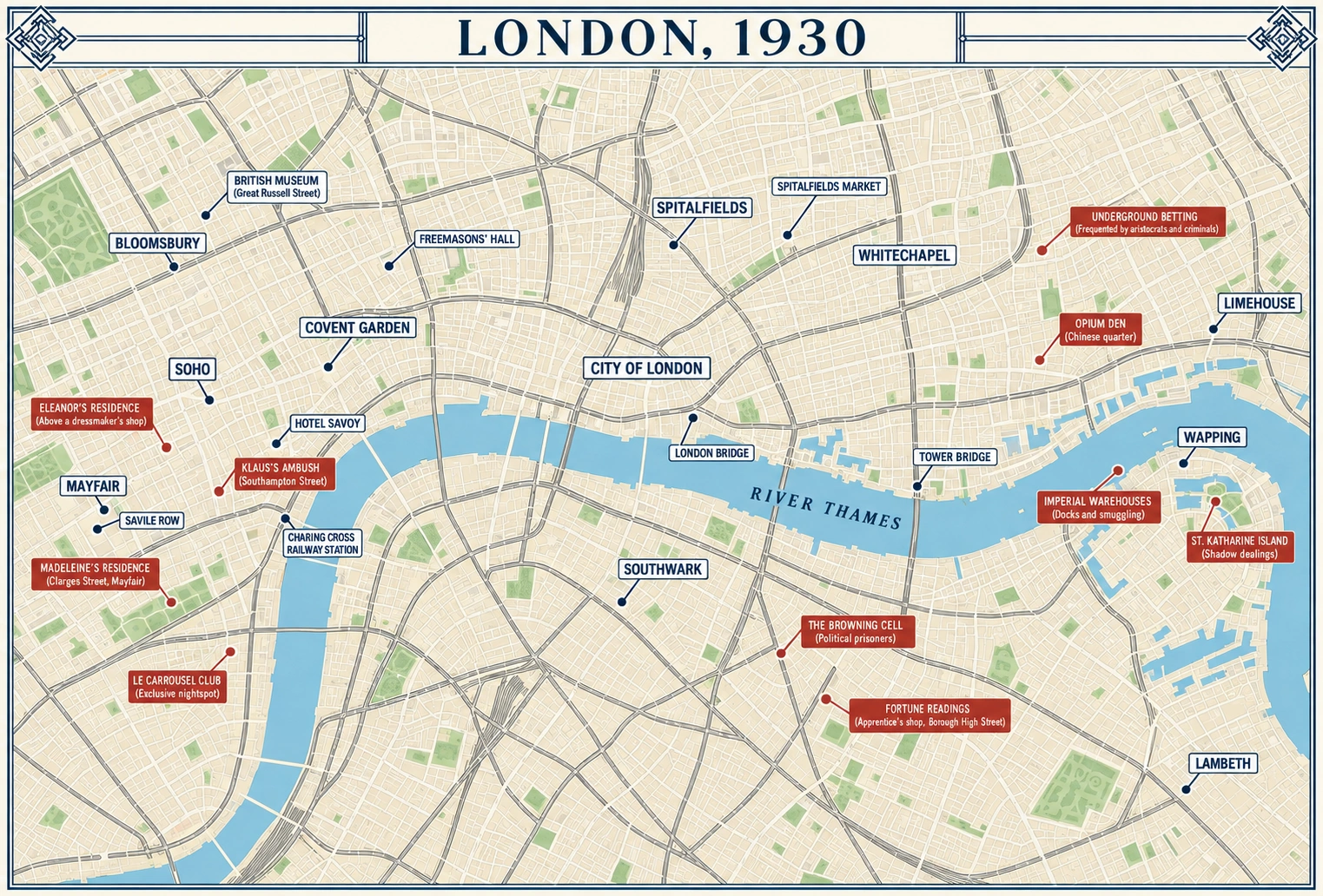
Jack the Ripper belonged to another century.
Whitechapel did not.
By 1930, forty-two years had passed since the murders that made the district infamous throughout the world. Queen Victoria was dead. The Great War had come and gone. Motor buses and automobiles travelled streets once dominated by horses. Electric light had transformed parts of London after dark. A generation had been born, grown to adulthood and started families of its own since the autumn of 1888.
Yet Whitechapel remained trapped, at least in the imagination of outsiders, beneath the shadow of a murderer who had vanished decades before.
The reality was more interesting.
Whitechapel in 1930 was crowded, commercial and intensely alive. It was a place of markets and workshops, hospitals and pubs, synagogues and political clubs, cheap rooms and busy shops. Poverty remained visible, though the district was changing. Old buildings disappeared. Streets were rebuilt. Communities established themselves and moved on. New housing competed with structures inherited from the Victorian city.
The East End had survived Jack the Ripper.
It had survived something far worse as well: the loss of thousands of its men in the Great War.
Now another crisis was approaching. The economic collapse that had begun in 1929 was spreading through Europe and Britain. For families already living close to poverty, there was little distance left to fall.
This is the Whitechapel that exists behind Grimwolf.
Not the frozen Whitechapel of 1888.
A neighbourhood moving forward while carrying its dead with it.
WHAT WHITECHAPEL LOOKED LIKE IN 1930
The first thing to discard is the cinematic image.
Whitechapel was not an endless succession of deserted alleys illuminated by solitary gas lamps beneath permanent fog. That image owes as much to later films and Gothic imagination as it does to the actual East End.
Its main roads could be crowded.
Whitechapel Road formed one of the great arteries leading east from the City. Shops and businesses lined the route. Traders sold goods to people who lived locally and to those travelling through the district. Commercial Street ran north toward Spitalfields, connecting Whitechapel with one of London's great market areas.
Street directories from the period reveal something more mundane and therefore more useful than Gothic legend: tailors, warehouses, banks, merchants, associations and small businesses packed alongside one another.
Whitechapel worked.
It argued.
It bought and sold things.
It smelled of food, tobacco, horses, engines, workshops, damp brick and smoke.
Its streets also preserved older layers of London.
Turn away from the main roads and the scale could contract rapidly. Smaller streets, courts and passages survived beside commercial buildings and blocks of dwellings. Workshops occupied spaces behind shops. Families lived above businesses. Pubs served workers whose trades depended upon markets, factories, warehouses and the docks farther south and east.
The contrast is important.
A person could leave a busy thoroughfare and find relative isolation surprisingly quickly.
That matters in Grimwolf.
Predators require darkness.
More importantly, they require geography.
POVERTY, HOUSING AND THE NEW DEPRESSION
Whitechapel's nineteenth-century reputation for desperate poverty was never the complete story, yet poverty was real.
Attempts to improve working-class housing had already transformed parts of the East End before 1930\. Philanthropic and commercial housing organisations constructed blocks intended to replace some of the worst conditions of the older slums.
The results could still be austere.
Brady Street Dwellings, built in 1889–90 by the Four Per Cent Industrial Dwellings Company, contained 286 flats packed into twelve blocks. Such projects represented an attempt to provide healthier accommodation while revealing the enormous pressure created by London's working-class population.
By 1930, the East End was therefore a patchwork.
Victorian housing stood beside newer dwellings. Some families occupied respectable homes while others survived in cramped rooms. Lodging houses had not disappeared. Neither had overcrowding.
Then came the economic crisis.
The Wall Street Crash of October 1929 did not instantly transform London overnight, but the worldwide depression that followed brought unemployment and insecurity to Britain. Areas dependent upon casual labour and vulnerable industries had reason to fear every lost job.
Poverty creates its own geography.
A wealthy Londoner who vanished could mobilise relatives, lawyers, newspapers and police attention.
The disappearance of someone living precariously — a casual labourer, a homeless woman, a sailor between ships — could be much harder to follow.
That difference becomes important in the fictional Whitechapel of Grimwolf.
Victor Ravenscroft understands it perfectly.
A NEIGHBOURHOOD OF IMMIGRANTS
The East End had received newcomers for centuries.
By the late nineteenth and early twentieth centuries, Whitechapel and neighbouring Spitalfields had become strongly associated with Jewish immigration, particularly families arriving from Eastern Europe and the Russian Empire.
They did not simply occupy the district.
They changed it.
Synagogues, clubs, schools, political organisations, charities and businesses became part of East End life. The clothing trades were particularly significant. Yiddish could be heard alongside English in streets where identities overlapped rather than fitting neatly into the boundaries drawn on maps.
The children of immigrants grew up British while retaining elements of family culture. Community organisations reflected both impulses: preserving identity and navigating the society around them.
Whitechapel was consequently far more cosmopolitan than the stereotype of a homogeneous Victorian slum suggests.
For Grimwolf, this provides an important background.
Eirikr Skarnisson arrives in London as a foreigner.
So does Klaus.
One is a Scandinavian hunter carrying a blood feud older than the country he has entered. The other is a Bavarian sailor and veteran of the Great War.
In Mayfair they attract attention.
Around London's docks and East End, foreign accents are considerably less remarkable.
London has been receiving strangers for a very long time.
Two more scarcely matter.
THE RIPPER'S WHITECHAPEL WAS ALREADY DISAPPEARING
Perhaps the most revealing fact about Whitechapel in 1930 is that parts of the landscape associated with Jack the Ripper had already vanished.
Dorset Street became notorious because Mary Jane Kelly lived and died in Miller's Court, reached through a narrow passage at number 26.
The street's reputation survived the nineteenth century. Its name did not.
Dorset Street became Duval Street in 1904.
Then the city began physically erasing it.
Spitalfields Market expanded during the 1920s. In 1928, buildings along the northern side of Duval Street were demolished.
Miller's Court went with them.
The room in which Mary Jane Kelly had been murdered disappeared beneath redevelopment only two years before the events of Grimwolf.
That is a much more interesting image than preserving Whitechapel forever in 1888.
Imagine someone returning in 1930 after forty years.
He remembers a passage.
It is gone.
He remembers a lodging house.
Gone.
He remembers a pub.
Gone.
In their place stands part of the machinery of a modern commercial market.
London does not preserve every crime scene.
Sometimes it builds over them.
Elsewhere, traces survived. Buildings and street patterns connected with the murders remained recognisable long after the killer himself had passed into legend. Someone walking through the district could therefore move simultaneously through several Whitechapels: the modern neighbourhood around him and the remembered city beneath it.
For a novel about ancient things surviving inside the modern world, that idea matters.
CRIME AFTER JACK THE RIPPER
The Ripper murders created such an enormous mythology that they can distort our understanding of East End crime.
Most criminals were not mysterious nocturnal killers.
Crime was generally more practical.
Theft.
Burglary.
Illegal gambling.
Robbery.
Protection rackets.
Fencing stolen property.
Fraud.
Violence connected with money, territory or personal disputes.
The East End's proximity to docks, warehouses and markets also created obvious opportunities. Huge quantities of valuable goods moved through eastern London. Where goods move, someone eventually discovers how to divert them.
The underworld could overlap with legitimate society.
A bookmaker needs customers.
A thief needs someone willing to buy stolen property.
A gang needs pubs, clubs, informants and corruptible men.
A businessman may need someone capable of solving a problem without producing paperwork.
This is where historical atmosphere and Grimwolf begin to separate.
William Harlow is fictional.
So is his criminal organisation.
Yet the world in which Harlow operates is designed to feel plausible: gambling rooms, protection, informants, hired violence and relationships extending upward toward men who prefer their names never to appear beside the crimes committed for them.
Harlow believes himself powerful.
He is wrong.
Behind him stand the Ravenscrofts.
POLICING WHITECHAPEL
The Metropolitan Police that confronted crime in 1930 was considerably more experienced and organised than the force that had been humiliated by the unsolved Whitechapel murders four decades earlier.
Yet police work remained intensely physical.
Detectives walked streets, questioned witnesses, followed relationships and compared statements. Telephones accelerated communication, while photography and forensic methods offered investigators tools unavailable to earlier generations.
Human intelligence remained indispensable.
Someone had seen the victim.
Someone knew the pub.
Someone recognised the coat.
Someone heard an argument through a wall and decided it was wiser to keep quiet.
Whitechapel also had a long institutional police presence. The Metropolitan Police's historical records preserve H Division among the geographical divisions serving London.
In Grimwolf, this procedural world is represented primarily by Inspector Arthur Crowley and the younger Detective Edward Blake.
Crowley has none of the romantic enthusiasm of the fictional gentleman detective.
He studies people as if performing an autopsy.
Experience has taught him that monsters seldom announce themselves as monsters. They have professions. Families. Invitations to dinner.
Sometimes titles.
His investigation into bodies connected with strange markings eventually pushes him beyond ordinary explanations. The evidence leads toward Norse symbols, ritual killings and people whose social position should place them far beyond the reach of an East End murder investigation.
Crowley's problem is simple.
Evidence does not care about social position.
People do.
WHITECHAPEL AFTER DARK
The neighbourhood changed when businesses closed.
Metal shutters came down.
Shopkeepers counted the day's takings.
Workers left workshops and warehouses. Pubs filled. Buses continued along the larger roads while footsteps carried people through smaller streets toward rented rooms and crowded homes.
Rain made brick and pavement shine beneath streetlights.
Somewhere a wireless played behind a wall.
A door opened and released voices, tobacco smoke and laughter into the street before closing again.
A motorcar passed.
Then the sound disappeared.
London was never completely silent. There was always another engine, another train, another argument, another pair of shoes against pavement.
Yet there were pockets where the city seemed to withdraw.
A yard behind a warehouse.
A narrow passage between buildings.
A street after the last workers had gone.
A riverside structure waiting for morning.
Places where a scream could become somebody else's business.
This is the Whitechapel Victor Ravenscroft understands.
He is wealthy enough to spend his evenings somewhere else.
That is precisely why his presence here matters.
Victor does not kill because he needs money.
He does not kill because he is hungry.
He hunts because he enjoys hunting.
In public he is an aristocrat, an eligible bachelor and heir to an old family. He dresses correctly. He knows the correct people. Servants open doors for him.
After dark, he becomes something else.
A black cloak.
Two long swords.
An iron amulet connected to the dead.
And the certainty of a man who has spent his entire life believing ordinary human beings exist beneath him.
Whitechapel gives him what Mayfair cannot.
Prey.
THE SHADOW OF 1888
By 1930 Jack the Ripper had been absent for forty-two years.
Nobody had proved who he was.
That uncertainty had preserved him.
A murderer who is caught eventually becomes a prisoner, a corpse, a file in an archive.
An unidentified murderer becomes whatever later generations require him to be.
Monster.
Madman.
Doctor.
Aristocrat.
Foreigner.
Conspirator.
Ghost.
Whitechapel inherited all of them.
Yet there is a danger in allowing the legend to consume the neighbourhood. The women murdered in 1888 were real people, while tens of thousands of other people continued living in the East End after the newspapers lost interest.
Children were born.
Businesses opened.
Buildings came down.
Immigrant families became London families.
Men left for war and some returned.
The market expanded directly across one of the most infamous locations in British criminal history.
Life continued.
That is the Whitechapel Grimwolf needs.
Because the frightening thing about Victor Ravenscroft is not that he enters some legendary district of murder.
It is that he brings murder into an ordinary neighbourhood.
WHITECHAPEL IN GRIMWOLF
Victor does not choose Whitechapel because it is cursed.
He chooses it because he understands what the city overlooks.
His victims belong to a London far removed from the drawing rooms where the Ravenscroft name commands respect. Their deaths become part of a larger ritual connected with Hella and the supernatural lodge operating behind London's respectable institutions.
Elsewhere in the East End, another world operates beneath the legitimate one.
William Harlow controls gambling and organised violence. Klaus enters one of his clandestine games and discovers that the cards are marked. What begins as cheating leads to bloodshed, betrayal and eventually a hunt through London's darker industrial landscape.
Inspector Crowley approaches the same world from the opposite direction.
He follows the dead.
Eirikr follows the killers.
Eventually their paths point toward the same people.
This is where historical Whitechapel and fictional Whitechapel meet.
The streets are real.
The poverty is real.
The markets, immigrant communities and changing urban landscape are real.
William Harlow is not.
Victor Ravenscroft is not.
The supernatural rituals belong to Grimwolf.
But Victor understands something that Jack the Ripper discovered long before him:
a vast city can surround a murder with thousands of people and still leave the killer alone with his victim.
There is one crucial difference.
Jack disappeared into history.
Victor Ravenscroft has someone hunting him.