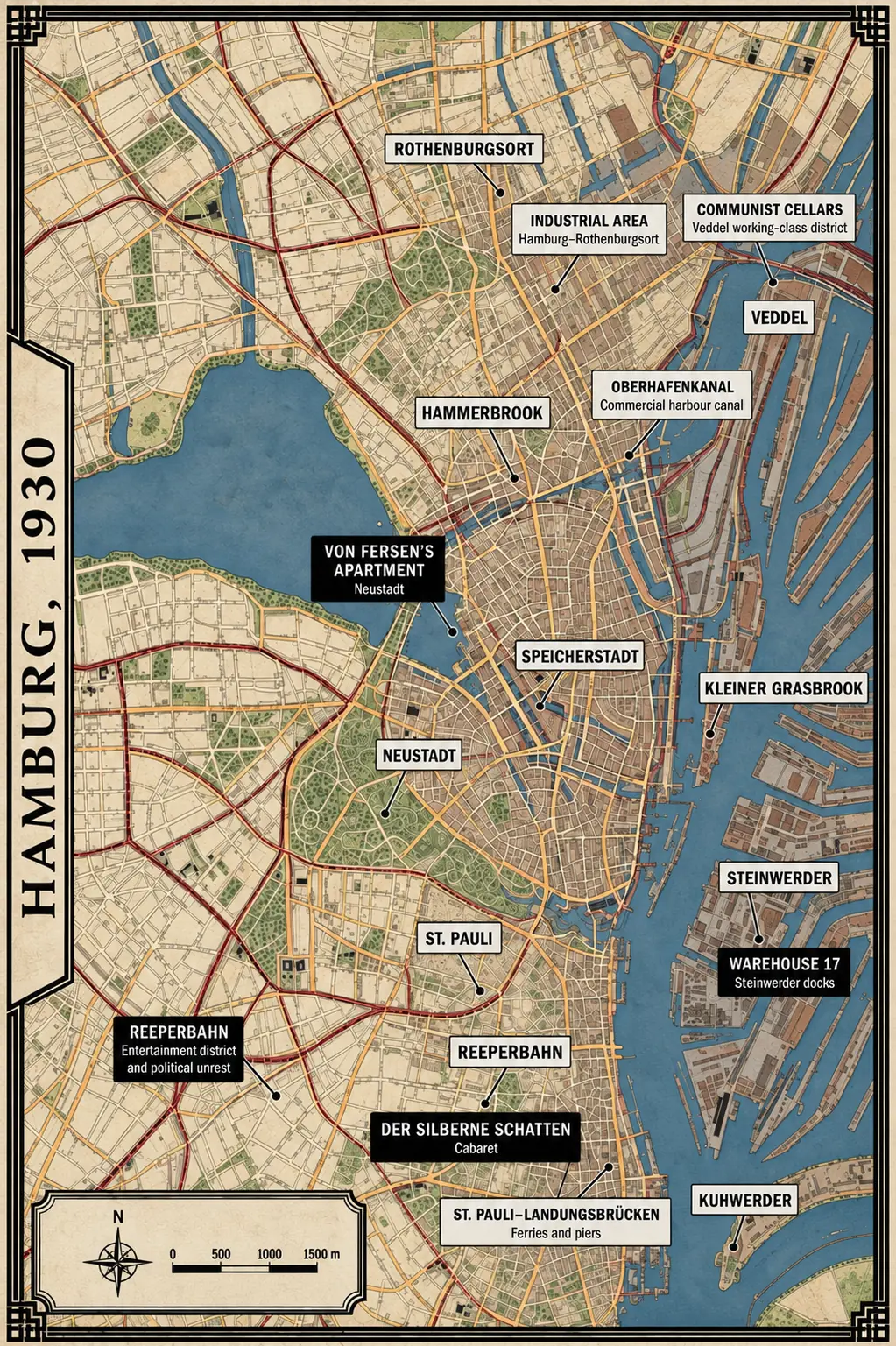
Before London, there is Hamburg.
Before the British Museum, the Ravenscrofts and the bodies surfacing from the Thames, there is another river, another port and another city learning how quickly certainty can disappear.
It is 1930.
Hamburg remains one of Europe's great maritime cities, connected through the Elbe to the North Sea and from there to ports across the world. Ships arrive carrying cargo, sailors and rumours from places most Germans will never see. Warehouses dominate stretches of the waterfront. Cranes rise above the docks. Barges move through dark water. Steam, coal smoke and industrial haze mingle over the harbour.
Beyond it lies Sankt Pauli.
Entertainment district.
Sailors' quarter.
Working-class neighbourhood.
Red-light district.
A place where money earned at sea can disappear before morning.
Hamburg is where Grimwolf begins because it provides something Eirikr Skarnisson understands instinctively.
Movement.
Men arrive.
Men leave.
And some men vanish.
HAMBURG IN 1930
Hamburg entered the new decade carrying wounds that had little to do with mythology.
Germany's defeat in the First World War had destroyed the empire of Kaiser Wilhelm II and produced the Weimar Republic. The following years brought revolution, political violence, hyperinflation and periods of remarkable cultural experimentation.
By the second half of the 1920s, Germany appeared to have regained a degree of stability.
Then came 1929.
The Wall Street Crash developed into an international economic crisis, and Germany was particularly vulnerable. Its recovery had depended heavily upon foreign credit. As that system contracted, businesses failed and unemployment climbed.
The consequences became increasingly visible during 1930.
Hamburg could hardly escape them.
This was a commercial city whose fortunes depended upon international trade. When world commerce suffered, the docks felt it. Behind the statistics were dockworkers waiting for employment, sailors uncertain about their next berth, families watching savings disappear and businesses competing for customers with less money to spend.
Politics moved into the streets.
Communists and National Socialists fought for support among populations shaken by unemployment and resentment. The Nazi Party's electoral breakthrough in September 1930 transformed it into the second-largest party in the Reichstag.
The future had not yet been decided.
That point matters.
Walking through Hamburg in 1930, nobody could know with certainty what Germany would become three years later.
Hitler was not yet Chancellor.
The Weimar Republic still existed.
People still went to work, drank beer, attended theatres, boarded ships, complained about politicians and made plans for next year.
History had not informed them that they were living between chapters.
THE PORT OF HAMBURG
Hamburg existed because of water.
The Elbe connected the city with the North Sea, and the harbour connected Germany with the world. Its importance had grown enormously during the nineteenth century as industrialisation and international commerce transformed European ports.
By the twentieth century, Hamburg possessed an immense system of docks, quays, warehouses, canals and railway connections.
The Speicherstadt — the great warehouse district constructed from the late nineteenth century onward — embodied this commercial power. Long brick warehouses stood above canals where goods could be transferred between boats and storage buildings.
Coffee.
Tea.
Spices.
Tobacco.
Carpets.
Cocoa.
Machinery.
Thousands of commodities passed through a system built around movement.
The harbour was consequently more than scenery.
It created its own society.
Dockworkers lived according to the arrival of ships and availability of labour. Sailors appeared for days or weeks before disappearing again. Shipping companies, customs officials, merchants, policemen, publicans, prostitutes, thieves and smugglers all depended in different ways upon the same maritime economy.
Languages travelled with the ships.
A sailor stepping ashore might hear German followed by Danish, Swedish, Norwegian, English, Dutch or languages carried from considerably farther away.
For Eirikr, this matters.
A Scandinavian stranger attracts less attention in a major international port than he would in a provincial German town.
Hamburg gives him anonymity.
It also gives his enemies the same advantage.
SANKT PAULI
West of central Hamburg, close to the harbour, Sankt Pauli had developed a reputation inseparable from sailors and entertainment.
Its most famous artery was the Reeperbahn.
The name itself preserves the district's older maritime history. Rope-makers — Reepschläger — once required long stretches of open ground to manufacture the ropes demanded by sailing ships.
Industrial change transformed the area.
Entertainment took over.
By the Weimar era, Sankt Pauli contained theatres, music halls, dance venues, bars, restaurants, cheap accommodation, drinking establishments and sexual commerce. Sailors with money and limited time ashore created an obvious market.
Respectable Hamburg knew what happened there.
Respectable Hamburg also went there.
That contradiction is central to Sankt Pauli's character.
A prosperous businessman could spend his day negotiating contracts connected with the harbour and his night pursuing entertainment he would never discuss at home.
A sailor could lose several weeks' wages before sunrise.
A criminal could meet customers without attracting particular attention.
And a hunter could sit quietly in a crowded room while everyone around him assumed he had come for the same reasons they had.
This is the environment into which Grimwolf places Der Silberne Schatten — The Silver Shadow.
The cabaret is fictional.
The world surrounding it is not.
NIGHTLIFE IN THE WEIMAR CITY
The Germany of the Weimar Republic developed a nightlife whose reputation travelled far beyond its borders.
Berlin became its most famous symbol, but Hamburg possessed its own nocturnal culture, shaped strongly by the harbour.
Music spilled from venues.
Alcohol loosened tongues.
Sailors searched for company.
Performers moved between respectable theatres and establishments operating closer to the edges of legality.
Behind entertainment came money.
And wherever large quantities of cash circulate, somebody wants control.
Protection.
Gambling.
Prostitution.
Smuggling.
Black-market goods.
Information.
The boundary between legitimate nightlife and organised crime could become deliberately indistinct.
A nightclub owner might know a businessman.
The businessman might know a customs officer.
A sailor might carry something ashore that never appeared on the ship's manifest.
Nobody involved needs to understand the entire network.
They need only understand whom they pay.
In Grimwolf, that network leads toward Wilhelm von Fersen.
THE POLITICAL STREET
Sankt Pauli's nightlife existed beside a considerably less glamorous struggle.
Germany was becoming violently polarised.
The Communist Party of Germany had strong support among sections of the urban working class, while the National Socialists were expanding aggressively. Their paramilitary formations and political opponents increasingly treated public space as territory to be contested.
Meetings became confrontations.
Marches attracted counter-marches.
Fists became clubs.
Clubs became knives and guns.
Political violence did not remain confined to parliamentary debate because the movements themselves understood the street as a demonstration of power.
Hamburg's working-class districts provided fertile ground for radical politics.
Sankt Pauli would eventually become particularly associated with communist resistance to the Nazis, but in 1930 the outcome of the struggle remained unresolved.
For Grimwolf, this instability creates useful camouflage.
A bruised man in an alley might have been attacked by political opponents.
Gunshots could belong to criminals.
A street fight could begin over ideology, gambling, alcohol or an insult nobody remembers the following morning.
Violence has many explanations.
Eirikr needs only one.
WINTER AT THE HARBOUR
Hamburg in winter is different from the theatrical fog of Gothic London.
The cold comes from the water.
Wind moves along the Elbe and through open docklands. Rain can become sleet. Moisture settles on iron and brick. Ships emerge from low cloud and industrial haze before disappearing behind warehouses and cranes.
The harbour provides a constant mechanical soundtrack.
Chains.
Winches.
Steam.
Metal striking metal.
Ship horns moving through darkness.
Boots against wet quays.
Then quieter spaces between them.
A warehouse after the workers have left.
A service road behind a nightclub.
A narrow street where the music from the Reeperbahn becomes distant.
In Grimwolf, weather possesses another dimension.
Eirikr is descended from the Vanir, from the lineage of Njörðr.
Water answers him.
So does mist.
Snow can become a weapon.
The environment of Hamburg therefore serves two purposes.
Historically, it belongs to a northern European port.
Mythologically, it already belongs to Eirikr.
His enemies simply have not realised it.
DER SILBERNE SCHATTEN
Somewhere within the fictional Sankt Pauli of Grimwolf stands a cabaret called Der Silberne Schatten.
The Silver Shadow.
Wilhelm von Fersen uses the establishment as part of a criminal empire built around smuggling and prostitution.
He is wealthy.
Protected.
Connected.
And considerably more than human.
Wilhelm belongs to the Broderskap, the organisation Eirikr has been hunting since the murder of his wife and children. Beneath his appearance as a criminal magnate lies an older inheritance: he is Æsir-borinn, descended from the Æsir.
That blood has taught him arrogance.
He believes himself protected by forces ordinary men could never challenge.
Eirikr is not an ordinary man.
He enters Wilhelm's territory as a predator enters another animal's range.
He watches.
Learns routines.
Measures exits.
Waits.
Inside the cabaret, Wilhelm possesses money, guards and witnesses.
Outside, Hamburg belongs to winter.
Eirikr prefers outside.
THE HUNT FOR WILHELM VON FERSEN
The confrontation begins with something remarkably mundane.
A car that will not start.
Eirikr has sabotaged it.
Wilhelm leaves the protection of his establishment and enters the street, where the hunter has arranged the geography before his prey understands that a hunt has begun.
Then the old world breaks through the modern one.
Wilhelm manifests weapons that do not belong to a Hamburg criminal in 1930: black iron armour, a runic shield and a long sword.
His bloodline has followed him into the alley.
So has Eirikr's.
Snow and cold cease to be background.
Eirikr manipulates them.
He moves with the speed and precision of a predator, using his knives against openings rather than attempting to overpower armour designed to resist direct attack.
Wilhelm finally understands who has come for him.
He tries money.
Eirikr has no interest in it.
The debt between them was created with blood.
It is paid the same way.
A knife enters Wilhelm's throat.
The Broderskap loses one of its own.
And Eirikr sends his challenge beyond the dying man toward the gods whose descendants believe themselves untouchable.
Hamburg has witnessed many murders.
This one belongs to a much older war.
BEHIND THE BOOKSHELF
Killing Wilhelm is only the beginning.
Before the police can close around the dead man's world, Eirikr enters his apartment searching for information.
The setting changes.
The violence of Sankt Pauli gives way to wealth, books and carefully arranged possessions.
Then Eirikr notices something wrong with the library.
A hidden mechanism reveals a secret chamber.
Inside are objects that change the direction of the story.
A black stone figure of Loki.
A runic necklace set with a blue stone capable of protecting its wearer against mental manipulation by the völur.
A small Vanir dagger engraved with patterns of wind and waves that responds to Eirikr's own elemental nature.
A journal.
A map.
And a crystal mirror.
The mirror shows him snow-covered mountains and hints at the location of the weapon he has been seeking.
The map points north.
Toward Scandinavia.
Yet Wilhelm's records also reveal another trail.
England.
The Ravenscrofts.
Eirikr's journey should take him north.
Instead, vengeance takes him west.
LEAVING HAMBURG
There is no elegant departure.
Eirikr does not board a luxury liner with polished luggage and a first-class ticket.
He disappears into the harbour.
There he finds passage aboard the fictional cargo vessel MS Friedrich, bound for London.
He works below decks among boilers, steam and men whose lives belong to ships.
And there he meets Klaus.
Klaus is Bavarian, a veteran of the Great War, a sailor, a gambler and almost everything Eirikr is not.
He talks.
Eirikr prefers silence.
Klaus dreams of retiring to a farm in Germany.
Eirikr has largely stopped imagining a future.
Klaus laughs easily.
Eirikr's humour tends to leave casualties.
Their friendship begins in the industrial belly of a cargo ship leaving Hamburg behind.
During the crossing, Klaus witnesses something that makes his strange companion considerably harder to explain.
A serious steam burn heals with impossible speed.
The quiet Scandinavian working beside him is not simply another fugitive sailor.
Eventually Eirikr tells him part of the truth.
There is a man in England he intends to find.
A Ravenscroft.
There is a debt.
Klaus understands debts.
Perhaps that is enough.
The MS Friedrich moves down the Elbe toward the North Sea.
Behind them lies Hamburg: cranes, warehouses, cabarets, political violence and Wilhelm von Fersen's blood.
Ahead lies London.
Neither man yet understands what is waiting there.
REAL HAMBURG / FICTIONAL HAMBURG
The Hamburg surrounding the opening of Grimwolf is grounded in the historical city of the Weimar Republic.
Hamburg, the Elbe, the harbour, Sankt Pauli, the Reeperbahn and the Speicherstadt are real.
So are the economic pressures that followed the crash of 1929, the political conflict between communists and National Socialists, the maritime culture of the harbour and Sankt Pauli's long association with entertainment and the sex trade.
Other elements belong entirely to the novel.
Der Silberne Schatten is fictional.
Wilhelm von Fersen is fictional.
The Broderskap and its supernatural bloodlines are fictional.
The secret collection inside Wilhelm's apartment, the Vanir dagger, the runic necklace and the magical mirror belong to the mythology of Grimwolf.
The MS Friedrich on which Eirikr and Klaus travel to England is also part of the fictional narrative.
As in London, the distinction is deliberate.
Grimwolf does not require an imaginary city.
The real one is complicated enough.
The fiction hides behind a nightclub door, inside a wealthy man's library, beneath the deck of a cargo ship and within the blood of people who appear perfectly human until someone tries to kill them.
HAMBURG IN GRIMWOLF
London is where the conspiracy becomes larger.
Hamburg is where the reader learns what kind of man is coming for it.
Eirikr Skarnisson enters the story already damaged.
His family is dead.
The Broderskap is responsible.
He has stopped looking for justice and chosen something older.
Vengeance.
Hamburg establishes the rules of that vengeance.
Eirikr will hunt men more powerful than himself.
He will enter their territory.
He will learn what they fear.
He will refuse their money.
And when the ancient world reveals itself beneath the modern one, he will answer it in its own language.
Wilhelm von Fersen believes his divine ancestry makes him untouchable.
He is the first mistake.
When the MS Friedrich leaves Hamburg for England, Eirikr carries Wilhelm's secrets with him.
He also carries something the Ravenscrofts have yet to understand.
The hunter is coming.
And London is next.