← Æsir index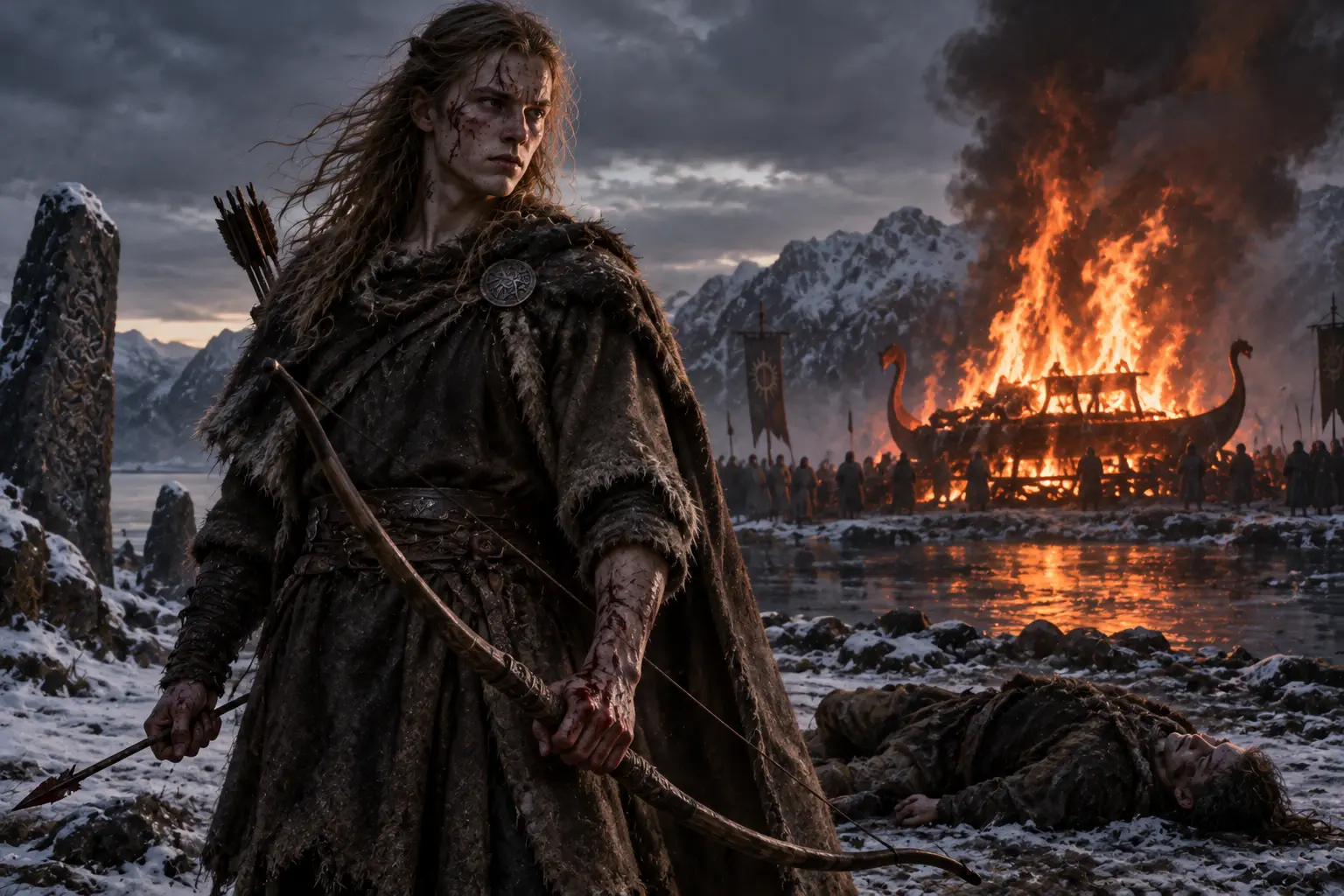
Son of Odin and Rindr, avenger of Baldr Váli is one of Odin’s sons and a figure closely connected with Baldr’s death. His birth serves a specific purpose: to avenge the murdered god by killing Höðr, the blind brother who had thrown the fatal mistletoe at Baldr. The sources present him as extraordinary even among the Norse gods. He grows with supernatural speed and carries out his vengeance when only one night old. Accounts of Váli are scarce after this, though the poetic tradition gives him another important role: he survives Ragnarök. Váli is the son of Odin and Rindr. The identity and nature of Rindr vary somewhat across the sources. In the western Norse tradition, she is associated with Odin as the mother of the son destined to avenge Baldr. Völuspá announces the avenger’s birth after Baldr’s death and connects Rindr with Váli’s arrival. His conception belongs to a chain of events shaped by the need to avenge Odin’s son. Baldr had begun to suffer dreams foretelling his death. His mother, Frigg, obtained oaths from many beings and elements of the world that they would not harm him. Mistletoe was left outside these guarantees. Loki discovered this vulnerability and prepared a mistletoe projectile. During a game in which the gods threw objects at the invulnerable Baldr, Loki gave the projectile to Höðr, Baldr’s blind brother, and helped him throw it. Baldr was struck and died. His death set in motion one of the central events of Norse mythology and created the need for an avenger. That avenger would be Váli. Völuspá describes Váli’s destiny with extraordinary concision. Rindr will bear Odin’s son, and at only one night old he will fight Baldr’s killer. His rapid growth belongs to the supernatural nature of the tale. Váli passes almost directly from birth to becoming the agent of divine vengeance. From the beginning, his existence is defined by one mission: to kill Höðr. This role connects him with a concept of vengeance deeply present in ancient Germanic societies, where the death of a member of a family or group could create obligations of compensation or retaliation. Höðr caused Baldr’s death, although in Snorri’s version he acts under Loki’s manipulation and does not understand the true purpose of the projectile he receives. Váli kills Höðr to avenge Baldr. The tradition thus creates a particularly tragic situation: one son of Odin kills another son of Odin to avenge the death of a third member of the same family. Baldr, Höðr and Váli all belong to Odin’s line, but they are joined by a succession of death and vengeance. Völuspá preserves one of Váli’s most distinctive details. The young avenger will neither wash his hands nor comb his hair until he has brought Baldr’s adversary to the funeral pyre. The image reflects the fulfilment of a duty of vengeance before returning to acts of personal care. It gives Váli an unusual visual identity among the Norse gods: Odin’s son is associated with mourning, blood ties and the immediate fulfilment of a death-debt. Váli is associated with vengeance against Höðr, and some poetic formulations encouraged his later depiction as an archer. The principal sources, however, are much clearer about his role as avenger than about the exact weapon he used to kill Höðr. A bow may appear in later interpretations and reconstructions, but this imagery should be distinguished from a firmly documented signature weapon such as Thor’s Mjölnir or Odin’s Gungnir. After Ragnarök, Baldr and Höðr will return together and dwell in the renewed world. This detail adds a distinctive dimension to Váli’s story. His vengeance answers the order demanded after Baldr’s death, yet the future after Ragnarök will eventually reunite the two brothers whose tragedy occasioned Váli’s birth. Váli belongs to the small group of divine figures who survive the destruction of the old world. The poem Vafþrúðnismál names Víðarr and Váli among the gods who will inhabit the divine sanctuaries after Surtr’s fire has gone out. Both are sons of Odin, and both are closely connected with vengeance. Váli avenges Baldr. Víðarr will avenge Odin by killing Fenrir during Ragnarök. This correspondence makes the two brothers parallel figures in the mythological tradition. A renewed world will emerge after the old order is destroyed. Váli and Víðarr will be among its survivors. Móði and Magni, Thor’s sons, will also survive and inherit Mjölnir. Baldr and Höðr will return from the world of the dead. The older generation, dominated by figures such as Odin and Thor, will have disappeared, while several of their children continue to live in the new world. Váli therefore occupies two opposite positions in the mythic cycle: he is born because of a death and eventually becomes part of the generation that survives the destruction of the cosmos. Váli, son of Odin and Rindr, is Baldr’s avenger and a survivor of Ragnarök. Sources concerning Loki’s punishment also mention a figure named Váli, son of Loki. They are different figures. In Snorri’s account of Loki’s punishment, the gods transform Loki’s son Váli into a wolf, and he tears apart his brother Narfi. Narfi’s entrails are later used to bind Loki. The prose epilogue of Lokasenna preserves a variant of the names: there Narfi is transformed into a wolf, and Loki is bound with Váli’s entrails. This contradiction belongs to the sources themselves and should be preserved as such. Neither tradition makes Loki’s son the same character as Baldr’s avenger. In Saxo Grammaticus’s Gesta Danorum, a euhemerised and substantially transformed version of the story appears. The corresponding avenger is named Bous, son of Odin and Rinda, and the story of Balderus and Høtherus differs considerably from Snorri’s account. Bous is commonly recognised as corresponding to Váli in comparative studies of these traditions. The surviving accounts nevertheless belong to different versions of the myth, and their details should remain distinct. The etymology of Váli does not have a fully certain interpretation. Several linguistic connections have been proposed, some associated with ideas of combat, death or vengeance. Váli’s mythological function as avenger is clearly attested; deriving an exact translation of his name from that function is less certain. It is therefore preferable to retain Váli as a proper name rather than turn a disputed etymology into a divine title. Nature: god of the Æsir line. Father: Odin. Mother: Rindr. Notable half-brothers: Baldr, Höðr, Thor, Víðarr and Hermóðr. Main mythic function: avenger of Baldr. Adversary: Höðr, whom he kills to fulfil the vengeance. Growth: reaches the ability to avenge Baldr when one night old. Distinctive trait: keeps his hands unwashed and his hair uncombed until the vengeance is fulfilled. Weapon: no weapon is firmly established as his exclusive attribute in the principal sources. Parallel: Víðarr, another son of Odin associated with vengeance. Fate: survives Ragnarök. Renewed world: remains among the surviving gods after the old order is destroyed. Namesake: Váli, son of Loki, is a different figure. Saxo’s corresponding figure: Bous, son of Odin and Rinda. Principal sources: Völuspá and Vafþrúðnismál from the Poetic Edda, Gylfaginning from the Prose Edda and, as a parallel tradition, Saxo Grammaticus’s Gesta Danorum.
Váli