← Æsir index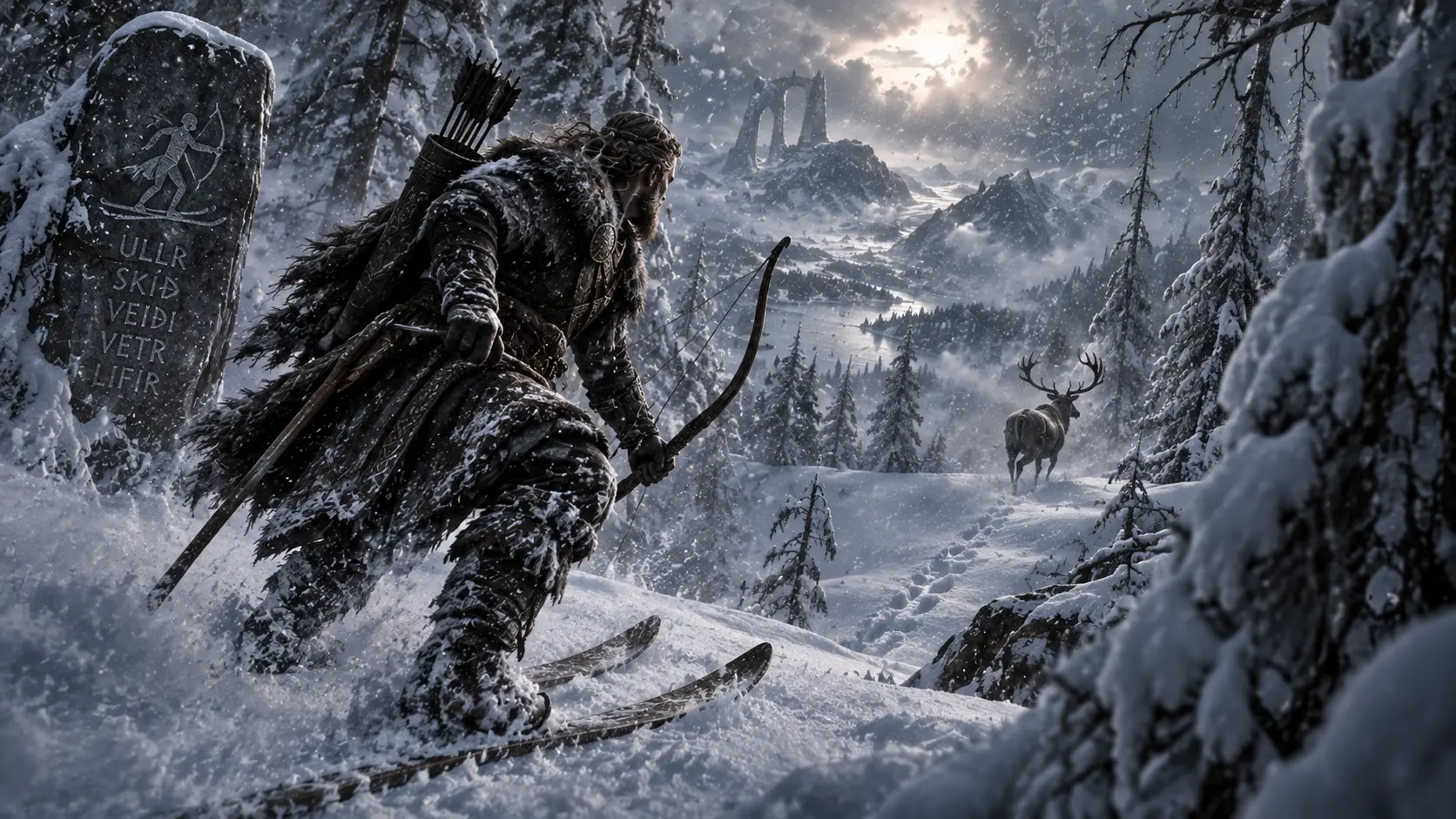
Ullr: A god of the Æsir closely associated with winter, skis, the bow, hunting and martial skill. He is the son of Sif and stepson of Thor, although the surviving sources are silent about his father’s identity. His name appears only rarely in the mythological narratives that have come down to us. Yet that scarcity is deceptive: skaldic poetry, references to ritual practice and, above all, numerous Scandinavian place names connected with Ullr suggest that his cult may have been considerably important before Norse traditions were recorded in writing. Snorri Sturluson describes Ullr as an extraordinary archer and a magnificent skier. He also presents him as handsome, warlike in appearance and especially suited to being invoked in battle. His natural territory seems far from the great halls. Ullr belongs to the snow-covered forest, the mountain, the ice and long winter journeys. In a society where travelling in winter could become a matter of survival, mastering skis meant much more than possessing a sporting skill. It made it possible to hunt, cross snowy terrain, pursue animals, carry messages and travel through places where walking could be exhausting or impossible. The bow shares that same nature. It is a weapon that demands patience, balance, breath and calculation. The archer wins before an opponent can reach him. For a hunter, too, each arrow can mean food. Ullr thus embodies a kind of power different from Thor’s explosive strength. Precision instead of thunder. The connection between Ullr and the bow is particularly ancient. In Grímnismál, his dwelling is called Ýdalir, usually interpreted as “Yew Dales”. The choice of tree is significant. Yew wood was historically associated with bow-making, reinforcing the god’s connection with this weapon. Ýdalir can be imagined as a cold, forested region: snow-covered valleys where the trees that will become bows grow. Even in its name, Ullr’s home contains the material of his weapon. There is another, much more mysterious aspect. In Atlakviða, one of the poems of the Poetic Edda, there is a reference to an oath sworn on Ullr’s ring. The passage is brief and allows few certain conclusions, but it matters because it suggests that the god may have been connected with some kind of ritual practice involving oaths. This considerably broadens his possible religious character. Ullr may have been more than a hunting god or divine archer. His name may have carried authority in ceremonies where the spoken word had sacred consequences. One of Ullr’s great enigmas emerges when two kinds of evidence are compared. The surviving narratives say very little about him. The landscape remembers his name repeatedly. Various places in Scandinavia have names that researchers have connected with Ullr, some associated with terms that may indicate sanctuaries, fields or places of worship. This raises a fascinating possibility: Ullr may have held a far more important religious position in certain periods or regions of ancient Scandinavia, even though many of his myths disappeared before they were recorded in writing. His case is a reminder that the Eddas preserved only a fraction of a much larger oral tradition. Ullr shares several elements with Skaði. Both belong symbolically to the mountains, winter, hunting and travel on skis. However, the surviving sources establish no certain family or romantic relationship between them. It is more interesting to keep them as two different expressions of the same landscape. Skaði represents the wild mountain, independence, hunting and the territory of the giants. Ullr represents the hunter who knows how to cross that territory. She belongs to the mountain. He knows how to survive in it. Their family relationship is also suggestive. Sif is Ullr’s mother and Thor’s wife, making the thunder god his stepfather. Thor dominates through strength, Mjölnir and the storm. Ullr depends on precision, mobility and knowledge of the terrain. One breaks the enemy. The other can reach him from a hundred paces away among the trees. This contrast makes Ullr a particularly interesting figure in Thor’s family. Within the world of 1931: The Wolf and the Snow, Ullr has a particular resonance with Max. Thorvald teaches the boy skills that belong precisely to this god’s symbolic territory: the bow, snow, hunting, balance, silence, orientation and survival in the northern forests. The connection works best when it remains subtle. Max does not need to become “Ullr’s chosen one”. Each time he learns to distribute his weight on the snow, control his breathing before shooting, distinguish a fresh track from one covered in frost, or remain motionless while listening to the forest, he is practising skills an ancient Scandinavian would have recognised within Ullr’s world. This allows the god to enter through Thorvald’s culture. A single line from the grandfather might be enough: —Thor makes noise. Ullr comes home with food. For Max, who must learn that survival depends more on observation than on displays of strength, Ullr can become a particularly fitting mythological presence. Name: Ullr. Family: son of Sif and stepson of Thor. Father: unknown in the surviving sources. Dwelling: Ýdalir, “Yew Dales”. Principal attributes: winter, skis, the bow, hunting, combat and physical skill. Associated ritual object: a ring on which an oath is sworn in the poetic tradition. Animals: the principal sources do not establish an animal belonging to Ullr. Ragnarök: his fate during Ragnarök has not been preserved. Principal sources: Grímnismál, Atlakviða and the Prose Edda, together with skaldic references.
Ullr