← Æsir index← Jötnar index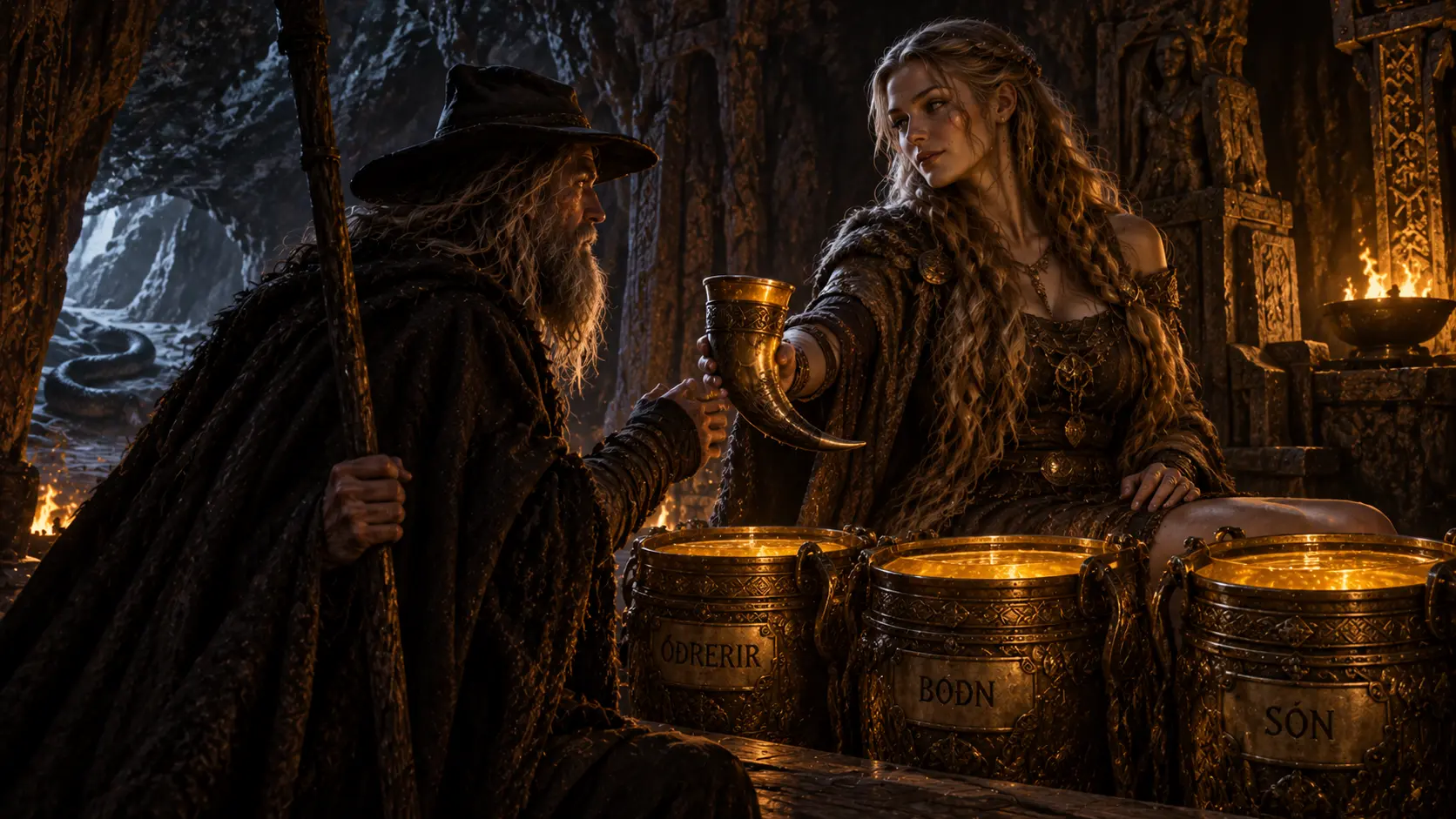
Guardian of the mead of poetry and Odin’s lover Gunnlöð is a jötunn of Norse mythology known chiefly for her role as guardian of the mead of poetry, the wondrous drink that granted poetic inspiration and wisdom to whoever drank it. She is the daughter of the giant Suttungr and a central figure in one of the most important episodes concerning Odin and his search for knowledge. Her story is preserved principally in the Skáldskaparmál of the Prose Edda, while the Hávamál offers an older and more personal poetic version of the encounter between Odin and Gunnlöð. The differences between the two sources are important. Gunnlöð is the daughter of the jötunn Suttungr, who had obtained the mead made from the blood of Kvasir, the immensely wise being born after the war between Æsir and Vanir. The mead was created by the dwarfs Fjalarr and Galarr after killing Kvasir and mixing his blood with honey. The drink was stored in three vessels: Óðrerir, Boðn and Són. Whoever drank it could become a poet or scholar. Suttungr hid the drink inside the mountain Hnitbjörg and left Gunnlöð in charge of guarding it. Gunnlöð remains inside Hnitbjörg watching over the three vessels of mead. Her task is to protect the treasure belonging to her father. There are no accounts in which Gunnlöð makes the mead or originally owns the drink. The mountain serves as a fortified, hidden chamber, making the journey to her extraordinarily difficult. To approach the treasure, Odin adopts the name Bölverkr, generally interpreted as “one who causes misfortune” or “evildoer”. He first comes to Baugi, Suttungr’s brother. As payment for working throughout the summer, he asks for a drink of the mead. Suttungr refuses to give him a single drop. Odin gives Baugi a drill called Rati and orders him to bore into the mountain. After checking that the tunnel passes through the rock, he takes the form of a snake and enters through the hole. According to the Skáldskaparmál, Odin stays with Gunnlöð for three nights. In exchange, she allows him three drinks of the mead. Odin makes extraordinary use of each: with the first he empties Óðrerir, with the second Boðn, and with the third Són. In this way, he drinks all the mead. An agreement that seemed to grant him three drinks ultimately allows him to take the entire treasure Gunnlöð was meant to guard. The relationship between Gunnlöð and Odin has a clear sexual element in the tradition. Snorri explains that Odin slept with her for three nights and that Gunnlöð then allowed him to drink the mead. The Hávamál presents the episode in a different tone. Odin recalls meeting Gunnlöð, acknowledges that he repaid her goodwill and love badly, and makes Gunnlöð more than an obstacle in his quest: she appears as someone whose trust was used to obtain the treasure. After drinking all the mead, Odin leaves Hnitbjörg. He transforms into an eagle and flies towards Ásgarðr. Suttungr pursues him in the same form. When the Æsir see Odin approaching, they place vessels in the courtyard. Odin reaches them and regurgitates the mead into the vessels, thus putting the drink of poetry into the gods’ hands. During the pursuit, some of the mead accidentally falls outside the vessels. Snorri uses this detail to explain the existence of mediocre poetry in a mocking way. The Hávamál preserves one of the most interesting accounts of Gunnlöð because the story is told from Odin’s own perspective. The tradition presents a recurring characteristic of Odin: his search for knowledge can involve deception, seduction, sacrifice and broken trust. Gunnlöð stands at the centre of one such episode. The sources describe a sexual relationship between Gunnlöð and Odin, but we have no basis for considering her Odin’s wife in the same sense as Frigg. It is more precise to describe her as Odin’s lover or temporary companion during the mead episode. Nor is there a firm surviving tradition in which the two subsequently maintain a lasting relationship. The principal sources telling the mead episode provide no clear and secure genealogy arising from their union. Her relationship with Odin should therefore remain centred on the myth of the mead of poetry. Gunnlöð is directly connected with the mead that grants poetry and wisdom, but this does not necessarily make her a goddess of poetry. Her documented role is guardian of the mead. The Old Norse name Gunnlöð consists of elements whose first component, gunnr, is associated with battle or combat. The precise interpretation of the second element and of the complete name presents greater difficulties. After Odin empties the three vessels and escapes from Hnitbjörg, the sources stop following Gunnlöð’s life. Her reaction to his flight, what happened between her and Suttungr, and her subsequent fate are unknown. The Hávamál nevertheless preserves a particularly significant detail: Odin’s own voice acknowledges that Gunnlöð received a poor reward for what she had offered him. Within a tradition in which Odin celebrates his ability to overcome trials through cunning, the episode also preserves the memory of the woman whose trust made obtaining the mead possible. Nature: jötunn Father: Suttungr Uncle: Baugi Relationship with Odin: lover during the theft of the mead of poetry Main role: guardian of the mead of poetry Associated place: Hnitbjörg Treasure guarded: mead made from Kvasir’s blood Vessels: Óðrerir, Boðn and Són Length of the encounter with Odin: three nights in Snorri’s version Children with Odin: none firmly established by the principal sources Classification: jötunn, rather than ásynja Specific powers: unknown Weapons: unknown Cult: no firm surviving evidence Fate: unknown Participation in Ragnarök: unknown Main sources: Hávamál in the Poetic Edda and Skáldskaparmál in Snorri Sturluson’s Prose Edda
Gunnlöð