Contemporary & Independent Tales
Gëlle Fra
A story of memory, freedom and the golden woman who watches over Luxembourg.
There are stories that begin with a birth.
This one does not.
This one begins with a fall.
But to properly tell you how the golden woman of Luxembourg fell, I would first have to explain why she was up there. And to explain that, I would have to tell you about a war. And before I could tell you about that war, I would have to explain something about the Luxembourgers.
And that would take us all night. So it is probably better to begin with the rope.
It was a thick rope.
I do not know who made it. Nor do I know who brought it to the square that morning. Books that remember the names of generals, ministers and governors have a bad habit of forgetting who makes the ropes. But that rope was there.
The men tied it around the golden woman and pulled.
The woman did not fall.
They pulled again.
Nothing.
That was awkward, because the men who had ordered her brought down belonged to that particular sort of men who take it as a personal affront when things refuse to fall on command. So they brought more men, better tools, and pulled again.
But the woman had spent almost twenty years looking down over Luxembourg from the top of her column, and perhaps after all that time she had learned something from the people who lived below. Luxembourgers are difficult to move once they have decided to stay.
And that woman, apparently, was too.
Naturally, in the end she fell.
Everything falls. Kingdoms. Flags. Men. Even women made of bronze and covered in gold.
But I am getting ahead of myself.
I told you this story began with a fall. I did not say that one was the first.
It had all begun twenty-six years earlier.
In 1914.
Although, as with almost every story that begins with a war, it had probably begun long before that. Wars have that bad habit. We point to a date on a calendar and say, “Here. This is where it all began.” It is a convenient way to keep books in order.
History rarely has the courtesy to be so simple. But 1914 will do.
At the time, Luxembourg was a small country. Very small. So small that the men who drew maps could cover almost all of it with the tip of a finger. And, as often happens with small countries, it was surrounded by neighbours considerably larger than itself.
Luxembourg was neutral.
That was written in treaties, signed by important men and guaranteed by still more important men. There were seals, signatures and solemn words assuring everyone that no one would bring a war to its borders.
Paper is an extraordinary thing. It can hold a promise. It can hold a law. It can even hold the word neutrality.
The one thing it cannot do is stop an army.
On 2 August 1914, German soldiers crossed the border.
They came by road and rail. They came with uniforms, horses, rifles and orders written on other pieces of paper. And before that small country could fully grasp what was happening, the war was already inside it.
Luxembourg protested. Germany explained.
Large countries tend to have very long explanations for the things they do to small ones.
They said it was necessary. They said it would be temporary. They said they would respect the country. And perhaps some of those words were sincere.
That is the dangerous thing about certain words: they can be sincere and still be useless.
For four years, Luxembourg remained under occupation.
It was not officially turned into a German province. It kept its government, its institutions and much of its everyday life. Trains kept arriving. Bells went on marking the hours. Bakers continued getting up before dawn and children continued growing, because even during wars someone has to make bread, and children have never learned to wait for adults to put the world right.
But there were foreign soldiers in the streets. And that was enough.
Because an occupation does not need to enter every house to make itself felt inside them.
Some Luxembourgers decided to leave. There were not many. A few hundred at first. More later.
They crossed borders and found ways to reach France. Some were little more than boys. Others had jobs, families, fiancées or mothers who would probably have preferred them to demonstrate their patriotism in a rather less dangerous fashion.
But they went. And volunteered to fight.
Because Luxembourg was neutral and could not claim that war as its own, those men had to do something strange: fight for their country under someone else’s flag.
Many ended up in the French ranks. In time, there were around three thousand of them.
Three thousand.
A small number if you are counting armies. In those years, Europe learned to count men by the million: a million here, half a million there, a hundred thousand dead in one offensive, ten thousand in a morning. Once you count enough dead men, three thousand begins to look like very little.
But numbers have that unpleasant habit of hiding what they contain.
Three thousand men are three thousand names. Three thousand beds empty in the morning. Three thousand mothers waiting for letters. Three thousand pairs of boots. Three thousand people who, at some point, were afraid.
And not all of them came home. Some remained in France. Others returned without a leg, without an arm, or with wounds no one could see. And some came back apparently whole, which is sometimes another way of coming home broken.
The war ended in 1918. Or so they said.
Bells rang. Flags flew. Soldiers began returning home and politicians made speeches about peace.
Europe did what it always does after destroying itself: it sat down around large tables to decide what it had all meant.
And in Luxembourg, a much simpler question emerged.
What do we do with our dead?
It was not a question about bodies. The dead already had graves. It was a question about memory.
Because a grave can hold a man. But it cannot always hold what that man meant.
In December of that year, a group of people met with an idea. They wanted to build a monument. Something that would remain. Something that would say those men had existed. That they had crossed a border of their own free will. That they had fought.
That some of them had died. And that Luxembourg did not intend to forget them.
But there was something else. There is always something else when men build monuments, because statues speak even when no one gives them a voice.
And this one had to say something else as well. It had to say that Luxembourg was still there. Four years of occupation had not turned it into something else. It had not disappeared. It had not forgotten its name.
It was small, yes. But it still belonged to itself.
The problem was that monuments cost money, and Luxembourg had just come out of a war. So they did something fitting for a small country.
They did not look for one rich man. They looked for many poor ones. Collections were organised, boxes were set out for coins and donations arrived from towns and villages. People who would probably never see their own names carved in stone gave a few coins so that other names would not be forgotten.
Special stamps were printed as well.
I have always found that fitting. A stamp is a tiny thing, small enough to fit between two fingertips. It travels stuck to a letter, crossing towns and borders, carrying news from one person to another. For a while, those little scraps of paper helped pay for something meant to outlast any letter.
Coin by coin. Stamp by stamp. Letter by letter. The money accumulated.
And then came a new question. A much harder one.
What shape should memory take?
They could raise a cross. They could build a column. They could carve a soldier in uniform with a rifle, staring for ever towards some battle that had already ended.
But someone decided to hold a competition.
It was 1920. Eighteen proposals were submitted. Eighteen different ways to remember the dead. Eighteen answers to a question that perhaps had no answer.
Among them was one submitted by a Luxembourgish sculptor named Claus Cito. His proposal had a simple title:
À nos braves.
To our brave.
Cito had imagined two soldiers. One had fallen. The other remained beside him. There was no glory in them. No heroic charge. No defeated enemy beneath their boots.
One was dead. The other was still alive.
Sometimes that is the only difference a war leaves behind.
But above them, far above them both, Cito placed a column. And at the top of that column he placed a woman. Not a queen, nor a Luxembourgish grand duchess.
Not a saint. A woman.
He made her tall and slender. He gave her outstretched arms and placed a laurel wreath in her hands. Then he decided to cover her in gold.
I do not know whether Cito understood then what he had just created. Probably not. Artists are rarely that lucky.
He probably thought he was making a monument to remember a war that had ended. He could not know that woman would witness another one. He could not know that one day men would come who would hate her without ever having known her, that they would tie ropes around her body and try to tear her from the sky.
That she would fall.
That someone would pick up a piece of her from the rubble and slip it into a pocket. That she would disappear for decades. Still less could he have known that, many years later, other men would have to go looking for her.
All that would come later.
At that moment she was only a woman drawn on a sheet of paper. She was not yet golden, nor did she stand above the city. She did not yet have anything to remember.
And above all, she had not yet learned how to fall.
The Preparation
Before she became bronze, she was clay. That too seems fitting to me.
Because we tend to imagine that monuments are born as monuments: stone, marble, bronze. Solid. Finished. Wearing that solemn expression that seems to insist they have always been there.
But no. They too begin as fragile things.
Cito first modelled the figures in clay, in his workshop in Bascharage. A little more here. A little less there. A face slowly emerging where before there had been nothing but a damp mass.
First the soldiers. One dead, the other bent over beside him.
Then the woman.
And here we come to one of those small mysteries history is occasionally kind enough to leave us.
We do not know who she was. I mean who she really was.
We do not know whether a woman walked into Claus Cito’s workshop one morning, left her coat over a chair and stood still while he studied her face. We do not know whether she was young, whether her hair was fair or dark, whether she grew bored during the long sittings or whether they talked while he worked.
We do not even know for certain whether there was a model.
Perhaps Cito took the eyes of one woman, the mouth of another and the memory of a third. Perhaps that face existed only in his head. Or perhaps there really was a flesh-and-blood woman who posed for him one day and then went back to her life without imagining that, over the next century, millions of people would lift their heads to look at something of her.
History has forgotten her name. If it ever knew it.
When he had finished with the clay, came the moulds and plaster. Then the figures travelled to Brussels, where the Compagnie des Bronzes did what founders have been doing for thousands of years: gave one thing to the fire so that it could emerge transformed into another.
Clay became bronze. Fragility became strength.
And the nameless woman began to acquire the body by which everyone would eventually know her.
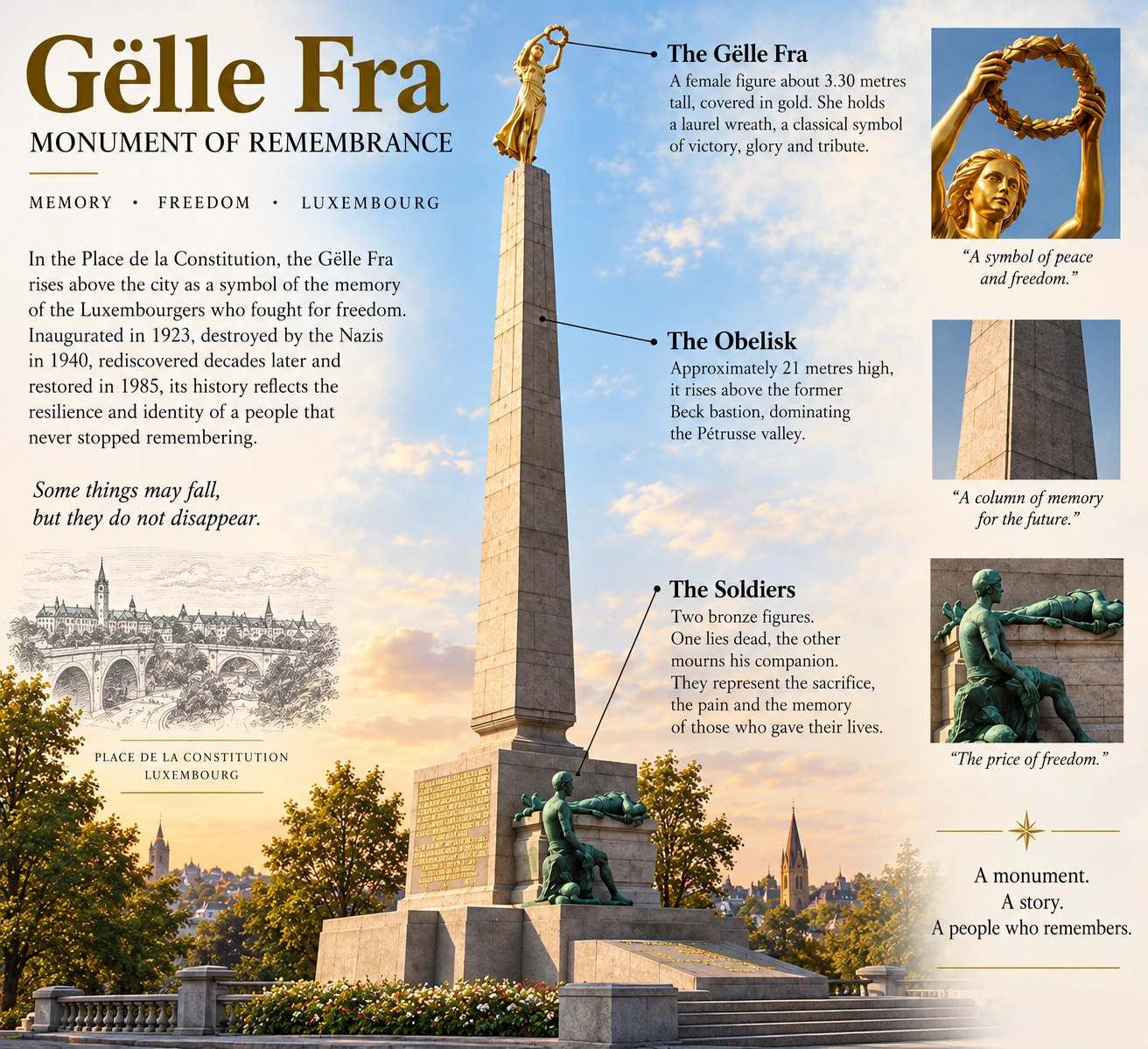
She stood about three metres thirty tall. That does not sound like much when you say it like that. Three metres thirty. But put a woman that size on top of an obelisk roughly twenty-one metres high and the matter changes.
From up there she could be seen from far away. And she, if statues could do such things, could see far as well.
Cito gave her outstretched arms. Between her hands he placed a laurel wreath.
Victory. Honour. Glory.
It is strange how much meaning we are capable of placing inside a circle of leaves.
Then they covered her in gold. And so the golden woman was born.
But it would be a mistake to think that she was the whole monument. She was only the part that looked towards the sky.
Below were the men.
Two bronze soldiers. One lay dead. The other remained beside him. There was no need to write much to explain that. Anyone who had lived between 1914 and 1918 knew what it meant to see one man lying on the ground and another still able to look at him.
Above was gold. Below, bronze. Above, the wreath. Below, the body. Above, victory. Below, the price paid for it.
Perhaps that was why Cito placed the woman so high.
Peace always seems much farther away than the dead.
The construction
Work began in late December 1921.
And almost immediately they discovered that building something intended to last for ever is considerably more complicated than drawing it on a sheet of paper.
The chosen site was the Place de la Constitution. It was a good location.
From there, the monument would overlook the Pétrusse valley. It could be seen from different parts of the city, and the golden woman could rise above Luxembourg like a small motionless flame.
There was, however, one problem. Beneath her feet lay the past.
The square stood above the city’s old fortifications, in the area of the Beck Bastion.
For centuries, Luxembourg had been a formidable fortress. So many armies had coveted its walls that the city had ended up accumulating stone upon stone, tunnel beneath tunnel and defence upon defence.
And although many of the fortifications had vanished from the surface, the earth has a better memory than men do.
When the workers began digging, they found old structures beneath their feet: walls, remains, voids where they had expected solid ground.
The planned foundations were no longer enough. They had to dig deeper. Reinforce more. Spend more.
It always happens that way. First someone says, “We shall build a monument.” Then a man arrives with tools, looks at the ground and replies, “It will cost more.”
In the end, the city paid the additional costs, and the original project had to be altered.
Cito had even imagined water around the monument, a pool that would reflect the column and the golden woman. It would have been beautiful. But beauty, like almost everything else, has a budget.
The pool disappeared from the plans. There would be flowers instead. Perhaps that was better.
Water reflects things. Flowers keep them company when they die.
During 1922, the monument began to rise. Stone upon stone. Metre upon metre. Until the obelisk stood there.
But before it was finished, they did something strange. Something almost no one who later crossed that square would ever see.
On 30 November 1922, they gathered beside the foundations. They had prepared documents and various objects. They placed them inside a box and then buried that box beneath the monument.
A small memory hidden beneath a much larger one.
That was nothing new either. Men have been burying things beneath important buildings for centuries: coins, names, newspapers, letters, documents. Small traces intended for people who have not yet been born.
It is a strange custom when you think about it. We build something because we want the future to remember us. Then we hide a box underneath it in case it does not.
The box disappeared beneath the stone. No one could have known then how important it would prove to have hidden it there, because a day would come when men tried to erase what that monument meant.
In December came the day to raise the woman. Until then she had remained close to the ground, a strange place for someone destined to spend her life in the sky.
Ropes and tackle had to be prepared. The men checked the fastenings while others watched from below. And little by little, very slowly, the golden woman began to rise. First a few centimetres, then a metre. Then more.
Her feet left the ground. Her body passed alongside the stone. She rose above the workers’ heads, above the square and the trees, until she reached the top of the obelisk.
We do not know what the men said as they watched her rise. Perhaps one of them made a joke. There is always someone who makes a joke when everyone else is holding their breath. Perhaps another feared that a rope might snap. Perhaps Claus Cito was there, watching the figure that had begun as clay between his fingers become something that no longer belonged to him.
Because that is what happens with certain works. One man creates them, and then everyone else claims them.
At last the woman reached the top. They secured her in place and removed the ropes.
And for the first time she stood alone above Luxembourg. Golden, arms outstretched, holding her wreath, looking towards the city.
It is worth remembering the ropes.
They will appear again in this story. But the next ones will not be there to raise her.
In May 1923, the soldiers arrived. They were placed below, beside the pedestal: one dead, the other keeping watch over him. And at last Claus Cito’s design was complete.
Death below and hope above. The men on the earth and the woman in the sky.
Only one thing remained: for Luxembourg to make her its own.
That happened on 27 May 1923, although in truth it began the night before.
On Saturday evening there was music in towns and villages across the country: bands, concerts and patriotic songs. For a few hours, that small territory seemed to fill with music. It was a way of preparing for the following day, or perhaps of remembering those who would not be there to see it.
The next morning, a ceremony was first held before the monument to the Unknown Soldier in Notre-Dame Cemetery. Some of the dead had known names, and some were dead whose names had been lost.
Countries need to remember both.
Then came the afternoon. The streets began to fill. Brass bands came, choirs, sports associations, firefighters, representatives of organisations of every kind, people from the city and people from elsewhere. They marched towards the Place de la Constitution.
There were uniforms, flags, instruments gleaming in the light, measured footsteps along the streets. Wreaths were laid. Salutes were fired. The music descended into the Pétrusse valley and returned as an echo.
And above them all stood her: the golden woman.
Perhaps some of those present had contributed money towards building her. Perhaps someone recognised in the bronze soldiers the posture of a brother who had never returned. Perhaps a mother lifted her head and thought of a son buried in France.
That is not recorded in the documents. Documents are good at preserving dates. They are considerably worse at preserving silences, grief, memories and tears.
That day, the Monument du Souvenir was officially inaugurated. But official names have a problem: they are too long for affection.
The people found a better one.
They called her the Gëlle Fra. The Golden Lady.
And so her second life began.
The early years
For the years that followed, she stood there.
That may not sound like much, but it is.
She was there at dawn, in snow and through summer. She watched fashions change, motorcars change and children become adults. She watched those adults grow grey. She watched funerals, parades, celebrations and speeches.
Every year people returned to her feet. Flowers were laid, names were spoken aloud and the dead were remembered.
And little by little, something happened that no one had officially decided.
The Gëlle Fra ceased to belong only to the men of 1914. She began to mean Luxembourg.
Not the Luxembourg of maps or treaties, but something harder to define: independence, freedom, memory. The stubborn idea that a small country is still a country.
For seventeen years she remained up there, through seventeen winters and seventeen springs. People grew used to seeing her, and perhaps that is the deepest way in which a thing can become part of a place: you stop looking at it. You simply know it is there.
Until one day someone tries to take it away from you.
The Second World War
In the spring of 1940, Europe was at war again.
Again.
Another war, other uniforms, other speeches, other men convinced that this time everything would be different.
The golden woman still stood on her column. Twenty-seven years had passed since that first war, and the boys who had survived it were no longer boys. The children who had attended the inauguration were now grown men and women.
And Germany had changed.
A great deal.
On 10 May 1940, before much of Luxembourg had finished breakfast, German soldiers crossed the border again.
Neutrality was still written in the treaties. The treaties were still made of paper.
And tanks, as you can probably imagine, were not.
The Gëlle Fra watched them arrive from above. She could not know what their arrival meant. Statues do not know such things. But if statues could remember, perhaps she might have recognised something familiar in the sight of German soldiers crossing Luxembourg once again.
Of all the buildings, squares, bridges and monuments in Luxembourg, there were few those men would come to hate as much as that woman.
Because victors can tolerate many things. What they tolerate far less well is being reminded of a time when they lost.
And the golden woman had spent seventeen years reminding the world of it, arms outstretched, twenty-one metres above the ground.
And covered in gold on top of that, as if she were deliberately trying to annoy them.
She was too visible to ignore, too beloved to leave where she was and too heavy to remove discreetly.
Her dismantling:
One day, men arrived in the square. They brought tools and ropes.
Remember the first ones?
The ropes they had used to raise her in 1922. These had exactly the opposite purpose.
What had happened to bring things to this point?
The dismantling began in October 1940, although “dismantling” was far too gentle a word for what they intended to do. Governments have a particular fondness for words like that: they do not destroy, they dismantle; they do not erase, they correct; they do not force, they order. But the people of Luxembourg knew perfectly well what was happening. They wanted to bring down the golden woman.
And it was not easy.
The Gëlle Fra had spent almost eighteen years at the top of the monument. She had endured rain, snow, wind and frost; she had watched funerals, parades, speeches and whole generations of children grow beneath her shadow. The first attempts to remove her failed. There were problems with the ropes, with the tools and, above all, with the men charged with doing the work.
Some companies found reasons not to take part: equipment was lacking, resources were insufficient, there were technical difficulties. There are always a great many technical difficulties when no one wants to do something.
But the orders kept coming and, with them, new men, better tools and more ropes. They pulled once and the woman remained above them. They tried again and she barely moved.
Perhaps someone smiled then, although almost certainly not where it could be seen. 1940 was not a good year to smile in front of certain men. Still, there must have been something deeply satisfying about watching an army that had crossed the border in a matter of hours fail to bring down a woman who was not even alive.
In the end, they succeeded.
The statue gave way and began to fall, but not cleanly. Her body struck the obelisk on the way down, and the impact badly damaged her neck and feet.
Then she hit the ground.
The woman who had stood above Luxembourg for almost two decades was now broken, lying among men who had been ordered to make her disappear.
There are photographs of that moment, but photographs have one limitation: they can show us where each person stood, but not what they were thinking.
We do not know who looked away, who felt anger or who immediately understood that this had ceased to be a simple operation against a monument.
What we do know is that the destruction produced exactly the opposite effect from the one its authors intended. Before that day, the Gëlle Fra had been a symbol. After she fell, she became a story as well, and stories are usually much harder to destroy than bronze.
Not everything disappeared. The two figures of the soldiers at the base were saved thanks to the Jacquemart company, which had taken part in the construction of the monument years earlier.
There was something fitting about that: the same hands that had helped raise it now helped hide parts of it. The two soldiers disappeared before they could be destroyed or melted down and remained hidden, waiting for a time when they could be shown again.
The small zinc box buried beneath the monument in 1922 survived as well. It had been placed there with documents and objects intended for the future, at a time when no one could have imagined that one day it would need protecting from an occupying power. An engineer managed to hide it and prevent it from falling into German hands.
There was no ceremony, no speeches, no music for that act. Someone simply decided that a box full of memory should not be found. During an occupation, resistance sometimes takes extraordinarily small forms.
And there was something else.
When the statue struck the ground, one of her feet shattered and among the fragments appeared the big toe. A student who witnessed the scene picked it up and slipped it into his pocket.
The image is almost absurd: a young man walking through an occupied city with a piece of the Gëlle Fra hidden against his leg. Perhaps someone asked what he was carrying and he said nothing. “Nothing” is a very useful word when a country is occupied.
That toe survived and later passed through several hands before ending up in a private collection.
Without context it was no more than a fragment of bronze, but relics always seem absurd to people who do not know their story. A piece of cloth, a letter, a coin or a statue’s toe may mean nothing in themselves. What matters is what managed to survive with them.
The years passed and the golden woman left a strange emptiness above the city. Her absence began to become part of the monument itself. Before, the Gëlle Fra had remembered the dead of another war; now the empty space also remembered those who had brought her down.
The occupation grew harsher. Germanisation, repression, imprisonment, deportation and forced conscription followed. While all this was happening, the woman remained missing.
The end of the war:
Eventually the war ended and Luxembourg was liberated. Flags returned, bells rang and the city began to rebuild. It seemed logical to assume that the Gëlle Fra would immediately return to her place.
But she did not.
Between 1944 and 1945, the base of the monument was rebuilt, and in 1950 the two bronze soldiers returned. One resumed his place lying on the ground and the other remained beside him, exactly as before. Yet whenever people looked up, the top remained empty.
Perhaps children asked what was supposed to be there, and their parents answered that there had once been a golden woman. The next question would have been inevitable: “Where is she?”
That was much harder to answer.
In 1955, remains of the statue appeared during Resistance Week. After fifteen years, parts of the Gëlle Fra were once again shown in public. That proved she had not been melted down or completely destroyed.
But then something almost inexplicable happened.
The pieces vanished again.
Ten years passed, then twenty, then thirty. The men who had seen the statue fall grew old; some died. A new generation came to know her only through photographs and through the stories of those who had once seen her above the city. The pedestal remained, and so did the soldiers, but the woman slowly became an absence people had learned to accept.
Until she turned up beneath a football stadium.
If this story were invented, that would probably be the point at which someone accused the narrator of exaggerating. But true stories sometimes make less sense than invented ones. At the beginning of the 1980s, the remains of the Gëlle Fra were discovered beneath the stands of the old municipal stadium, later known as the Stade Josy Barthel.
For decades she had remained there in the darkness while thousands of people attended matches above her head. There were goals, whistles, arguments with referees, children running through the stands and entire Sundays of football. Beneath all of it lay the woman who had once dominated Luxembourg’s skyline.
The discovery became public in 1981. On 22 June, Tageblatt reported the find, just before the national celebrations. Around forty years had passed since she had been brought down, and more than two decades since her remains had vanished again after the 1955 exhibition.
Then a new question arose: what should be done with her?
They could preserve her in a museum. It was a reasonable option. She was damaged, historically valuable and had survived a war. They could place her behind glass and put up a plaque explaining, “This was the Gëlle Fra.”
But there was a problem with that word, “was”.
Luxembourg did not want to speak of her in the past tense.
The restoration:
In December 1984, restoration began. Jacquemart, Massard of Kayl and Diederich-Colas took part.
The work involved more than repairing a statue. It meant restoring her to a form that would allow her to be placed above the city once again. Some parts were too badly damaged and had to be reconstructed, especially the feet. Others had been warped by the impact against the obelisk.
The restoration could not return her exactly to her 1923 condition, and perhaps that was for the best. Things that survive should not pretend that nothing ever happened to them.
One of the most visible differences was the position of the head. The original figure had looked almost straight ahead, proud and upright. After restoration, because of the damage suffered in 1940, her head remained tilted slightly downwards.
You can see that as a flaw.
You can also see it as a scar.
The Gëlle Fra who would return to the monument was not exactly the same one who had gone up in 1922\. She had been torn down, smashed against stone, mutilated, hidden, forgotten and found decades later beneath a stadium. Asking her to return without a mark would have been as absurd as expecting a man or a country to pass through a war unchanged.
In May 1985, the ropes appeared again.
The same tools that had marked so many moments in her history returned now with a different purpose. In 1922, ropes had raised her for the first time. In 1940, they had been used to bring her down.
More than forty years later, they were going to raise her again.
The statue began to rise slowly beside the obelisk. She passed the same place she had struck during her fall and continued upwards until she reached the top. There they secured her, removed the ropes and the golden woman once again stood above Luxembourg.
The solemn reinauguration took place on 23 June 1985, during the National Day celebrations.
Around three thousand people took part. The Grand Duke was present, along with representatives of the Government, the Chamber of Deputies, the diplomatic corps and the armed forces. Wreaths were laid and speeches delivered.
But some of those present probably needed no explanation at all.
Among them may have been people who had watched the statue fall in 1940. Men and women who had been young then and who now, forty-five years later, were lifting their heads towards the same place once more. Perhaps they remembered the ropes, the sound of bronze striking stone and the empty space that had remained afterwards.
Now the woman was there again.
Not exactly the same.
But there.
And that changed the meaning of the monument.
In 1923, it had been raised primarily to remember the Luxembourgish volunteers of the First World War. By 1985, it represented something else as well: Luxembourg’s own survival in the face of those who had tried to erase part of its identity.
The men who ordered the statue brought down wanted to prove that they could destroy what she represented.
They achieved the opposite.
Before she fell, the Gëlle Fra was a symbol of memory and freedom. After she returned, she became a symbol of resistance as well.
Perhaps that is why it is so fitting that her head now tilts slightly downwards.
She does not look defeated.
She looks at the people.
At those who pass beneath her without knowing her story. At tourists taking photographs. At children asking who that woman is. At old people who may remember something everyone else has forgotten.
Because a monument does not belong only to the sky.
It also belongs to those who lift their heads to look at it.
And if one day someone asks why that woman is standing up there, the simplest answer will be that she is the Gëlle Fra, Luxembourg’s Golden Lady.
But that will not be the whole answer.
Because that figure was first clay, then bronze and finally memory. She was raised, brought down, mutilated, hidden, lost and found. She survived in a buried box, in two hidden soldiers, in a toe hurriedly slipped into a pocket and, above all, in the people who kept remembering that she had once been there.
They raised her once.
They brought her down another time.
Then they lost her.
And finally she returned.
Perhaps that is why her story remains more powerful than the monument itself.
Because there are things that can be broken, buried or left forgotten for decades and still not disappear completely.
Sometimes all it takes is for someone to remember where they once stood.
The golden woman took forty-five years to return to the top of her column. When she did, she no longer looked down in quite the same way.
Neither did Luxembourg.
And when they had finished securing her and removed the ropes, the Gëlle Fra once again did the thing so many men had spent almost half a century trying to prevent.
She remained.