← Æsir index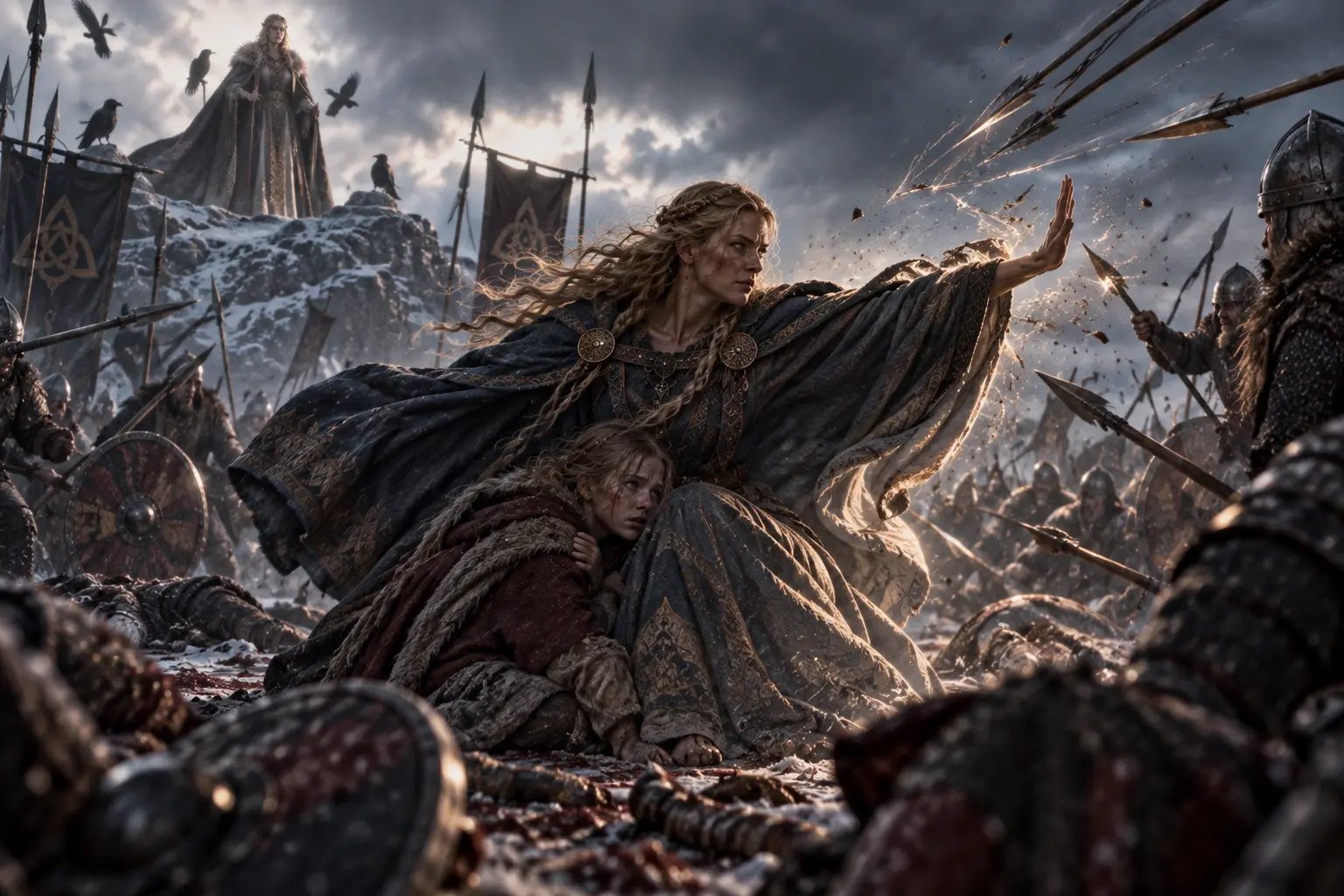
Protection and service to Frigg Hlín is one of the ásynjur closely connected with Frigg. The sources preserve very little information about her, but Snorri Sturluson assigns her a specific role: Frigg charges her with protecting those people whom she wishes to save from some danger. Her figure also presents an interesting problem for the study of Norse mythology. A famous passage in the Völuspá uses the name Hlín in connection with Odin’s future death, which has prompted a long-running debate about the relationship between Hlín and Frigg. In Gylfaginning, part of the Prose Edda, Snorri includes Hlín among the ásynjur and explains her task. Frigg entrusts her with protecting those people whom she wishes to preserve from danger. This description makes Hlín an essentially protective figure. Her actions depend directly on Frigg’s will: the queen of the Æsir determines who should receive her protection. The surviving sources contain no stories describing a specific intervention in which Hlín saves a person. Her role comes from Snorri’s explanation. Snorri connects Hlín’s name with the idea of protection. After explaining her role, he adds a linguistic observation according to which her name is the source of an expression used for someone who finds refuge or protection. Hlín’s etymology has received different modern interpretations, but the association between her name and the act of protecting is part of the medieval tradition itself as transmitted by Snorri. The most enigmatic reference to Hlín appears in the Völuspá, one of the fundamental poems of the Poetic Edda. During the description of the events leading to Ragnarök, the prophetess announces what is usually translated as Hlín’s second sorrow, when Odin sets out to face the wolf Fenrir. The meaning of the passage is problematic. The traditional interpretation holds that Hlín functions here as another name for Frigg. In this reading, Frigg’s first great sorrow would be the death of her son Baldr, and the second would come with Odin’s death during Ragnarök. This interpretation fits the poem’s context, although it raises an obvious difficulty: in Gylfaginning, Snorri presents Frigg and Hlín as distinct figures. The question remains open. One possibility is that Hlín was originally a name, title or aspect of Frigg, and that later traditions eventually treated her as an independent deity. Another possibility holds that Hlín was a distinct figure and that the Völuspá passage uses her name in a way that is now difficult to reconstruct. It must also be remembered that Snorri wrote his Edda during the thirteenth century, long after Iceland’s Christianisation, using poetic material from different periods and traditions. His lists of gods and goddesses are a fundamental source, but they do not guarantee that all these figures had perfectly separate identities during the pagan period. Categorically identifying Hlín with Frigg would therefore exceed what the sources allow us to assert. The expression in the Völuspá is especially powerful because it presupposes an earlier tragedy. If Hlín represents Frigg in this passage, the first sorrow is usually interpreted as Baldr’s death. The second then corresponds to Ragnarök. Odin fights Fenrir and dies devoured by the wolf. Shortly afterwards, Víðarr avenges his father by killing Fenrir. The stanza would thus place Frigg — under the name Hlín — before the two great losses in her family: first Baldr and finally Odin. This reading has a long interpretative tradition, although it depends precisely on accepting that Hlín can function as a name for Frigg. In the arrangement presented by Snorri, Hlín belongs to Frigg’s immediate circle alongside other ásynjur with specific roles. Fulla carries Frigg’s chest, tends her footwear and knows her secrets. Gná travels through different worlds carrying out her errands on Hófvarpnir. Hlín receives the mission of protecting those whom Frigg wishes to keep safe. The three figures are thus connected with different aspects of Frigg’s authority: trust, communication and protection. The scarcity of documentation prevents us from determining how far this structure reflects ancient beliefs or a systematisation made by Snorri from fragmentary traditions. Hlín has no known genealogy, documented dwelling of her own or surviving independent mythological cycle. Clear evidence that would allow us to reconstruct a specific cult dedicated to her is also lacking. Her importance comes from two brief but significant testimonies: Snorri’s description of her as a protectress in Frigg’s service and the mysterious Völuspá reference to “Hlín’s second sorrow”. The tension between these testimonies is precisely the most interesting aspect of this ásynja. In one she appears as Frigg’s servant; in the other, her name seems to occupy the place we would expect to belong to Frigg herself. Group: Ásynjur
Divine circle: Frigg and the Æsir
Principal role: Protection
Task according to Snorri: Protecting the people Frigg wishes to save from danger
Relationship with Frigg: Close; a more complex relationship involving her name or role may also have existed
Genealogy: Unknown
Residence: Unknown
Notable reference: “Hlín’s second sorrow” at Odin’s death during Ragnarök
Identification with Frigg: Possible and debated
Main sources: Gylfaginning in the Prose Edda and Völuspá in the Poetic Edda
Hlín