Glossary
Dwarves, Elves & Mythical Craftsmen
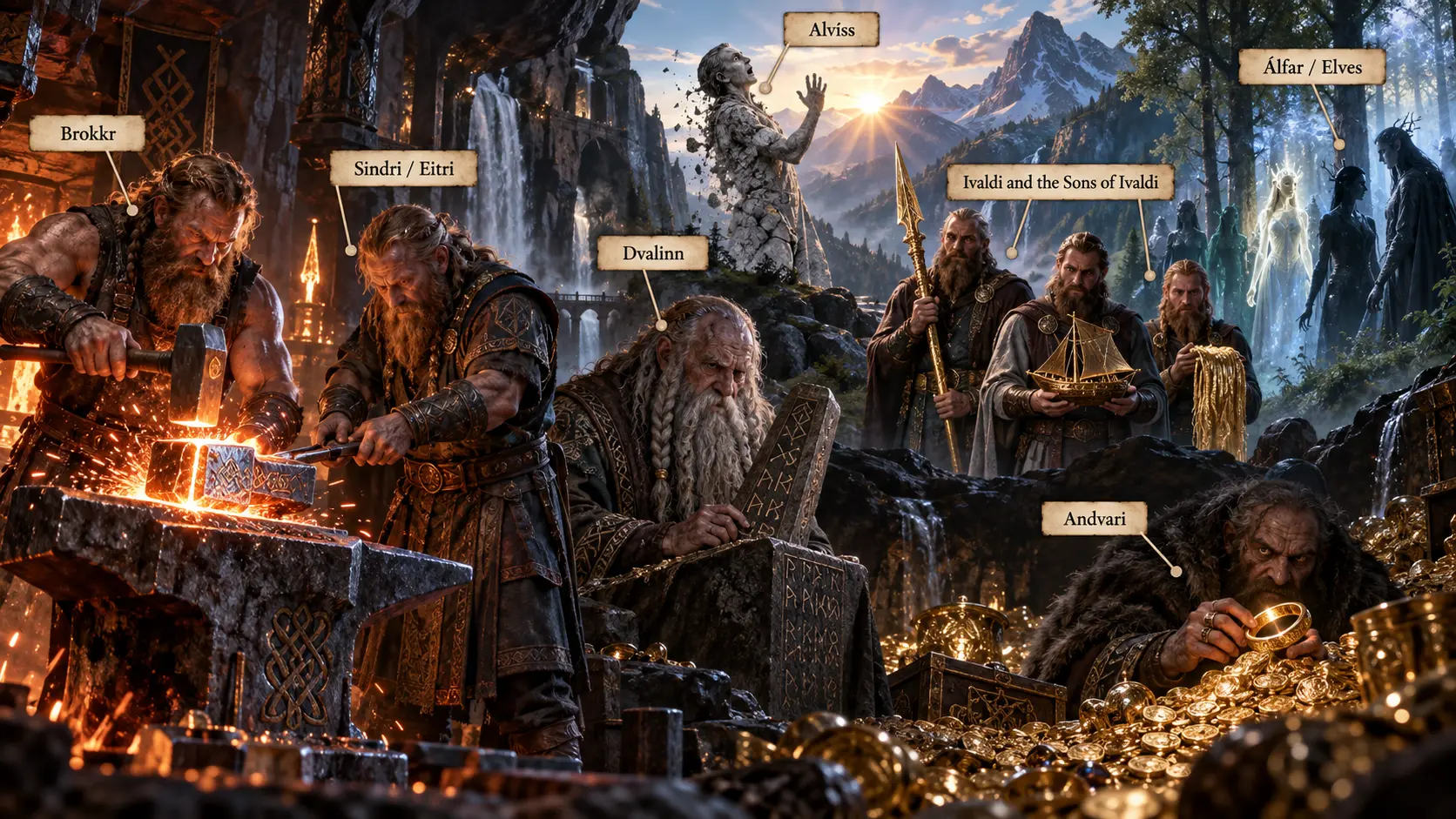
← All glossaries← All Norse glossaries Dwarves and elves occupy a central place in Norse mythology. They are not merely small creatures associated with mountains: they appear as prodigious smiths, guardians of treasures, masters of runes, inhabitants of underground realms, and beings connected with fertility, death, and invisible forces. The sources do not always present a consistent classification. In some texts, the terms dvergar, álfar, svartálfar, and dökkálfar seem to distinguish different groups; in others, their characteristics overlap. Therefore, these identifications should be understood as approximate and dependent on the source. Brokkr: A dwarf craftsman, brother of Sindri or Eitri according to some versions. He takes part in the creation of several divine objects after making a wager with Loki. Among the works produced during the contest are the hammer Mjölnir, the ring Draupnir, and the boar Gullinbursti. Sindri / Eitri: A dwarf smith associated with Brokkr. His name appears in different forms depending on the manuscripts and translations. He is credited with crafting extraordinary objects for the gods, particularly during the challenge against the Sons of Ivaldi. Sons of Ivaldi: A group of dwarf craftsmen famous for creating some of the gods’ most important treasures. They make Sif’s golden hair, the ship Skíðblaðnir, and the spear Gungnir. In some traditions, Dvalinn is associated with this group or with the crafting of certain divine objects. Dvalinn: One of the most important dwarves in the lists of the Völuspá. He is associated with knowledge, runes, and the transmission of magical lore. He is also linked to dwarf lineages and, in some interpretations, to the crafting of divine objects. Ívaldi: Father of the so-called Sons of Ivaldi. His role varies depending on the source: sometimes he is treated as an ancestor or leader of a lineage of craftsmen, while in other versions he is barely mentioned. Fjalar and Galar: Dwarves renowned for their role in the story of Kvasir. They kill the wise man and mix his blood with honey to create the Mead of Poetry, a drink capable of granting inspiration and wisdom. Their deception eventually leads to Suttungr’s pursuit. Völundr / Wayland: A master smith from Germanic tradition associated with the heroic legends of Northern Europe. He is known for his extraordinary skill in metalworking, his captivity, and his revenge against the king who holds him prisoner. Although he is not always classified as a dwarf, he belongs to the same mythical tradition of supernatural craftsmen. Alvíss: An exceptionally wise dwarf who seeks to marry Þrúðr, Thor’s daughter. Thor subjects him to a series of questions about the names given to things among gods, humans, giants, elves, and dwarves. The conversation continues until dawn, when Alvíss is turned to stone. Mótsognir: Presented in the Völuspá as a primordial figure among the dwarves. His name is often interpreted as “the one who feels weariness” or “the one who groans,” although its etymology is not entirely certain. He is associated with the origin or organization of the dwarven race. Durinn: A dwarf mentioned alongside Mótsognir in some versions of the tradition. His name may be connected with the idea of sleep or drowsiness. In later sources, he appears as an ancestral figure of the dwarves. Dáinn: A name that appears among the dwarves and also in other mythological contexts. In Norse tradition, several beings share similar names, so it is not always possible to determine whether they refer to the same character. Lofarr: A dwarf associated with a lineage of beings who leave the mountains and seek a new home. His name appears at the end of a genealogy or enumeration of dwarves in the Völuspá. Nýi and Niði: Dwarves whose names have traditionally been associated with the new moon and the waning moon, although interpretations vary. They form part of the catalogue of names in the Völuspá. Norðri, Suðri, Austri, and Vestri: Four dwarves who support the firmament at the four cardinal points. According to the cosmogonic account, they hold up the sky formed from Ymir’s skull. Lit, Nár, and Náli: Dwarves included in various mythological lists. Some appear as minor figures associated with the underground world or with stories concerning the gods. Andvari: A dwarf who possesses a great treasure and the ring Andvaranaut. Loki forces him to surrender his riches, but Andvari places a curse upon the gold. The curse sets in motion a chain of deaths and misfortunes affecting several heroic lineages. Ótr: Son of Hreiðmarr and brother of Fáfnir and Reginn. He can transform into an otter and is accidentally killed by Loki. As compensation, the gods must hand over a treasure that subsequently becomes cursed. Fáfnir: Originally a man belonging to a family associated with Andvari’s treasure. Greed transforms him into a dragon, making him one of the most famous monsters of the heroic sagas. Reginn: Brother of Fáfnir and Ótr, a renowned smith and Sigurd’s mentor. He reforges the sword Gram so that the hero can kill Fáfnir. His intelligence and technical skill contrast with his ambition and his desire to seize the treasure. Hreiðmarr: Father of Fáfnir, Reginn, and Ótr. He demands compensation from the gods for the death of his son Ótr and receives Andvari’s treasure, the source of the curse that will destroy his family. Read more about Andvari, Ótr, Fáfnir, Reginn, Hreiðmarr, Sigurd, Brunhild, and Ragnar Lothbrok in the book: The Wolf and the Snow. Eikinskjaldi: A dwarf whose name means approximately “oak shield.” He appears in the lists of the Völuspá and forms part of the collection of names associated with dwarf clans. Dóri, Óri, and Glóinn: Names of dwarves included in the catalogues of the Völuspá. Their individual importance is limited in the surviving sources, but they demonstrate the existence of numerous dwarf lineages and groups within the Norse mythological imagination. Haugspori, Hlévangr, Skirfir, Virfir, Skafiðr, and Ai: Minor figures listed among the dwarves of the Völuspá. Many of these names have no independent stories and appear primarily as part of the catalogue of dwarven lineages. Álfar / Elves: Supernatural beings in Norse tradition. They may be associated with fertility, beauty, illness, death, and invisible powers. They do not correspond exactly to the modern image of elves found in medieval-inspired or contemporary fantasy. Ljósálfar: “Light Elves” or “Elves of Light.” Snorri describes them as inhabitants of Álfheimr and as beings brighter than the sun. They are commonly associated with beauty, brightness, and benevolent forces. Dökkálfar: “Dark Elves.” In the Prose Edda, they appear as dark beings associated with the underground world. Some interpretations place them close to the dwarves, although there is no entirely clear distinction between the two groups. Svartálfar: “Black Elves.” The term appears in contexts that may refer to underground beings or to dwarves. For this reason, it is not always possible to distinguish them from the dökkálfar. Álfheimr: A realm associated with the Light Elves. It is one of the supernatural territories of Norse cosmology and is connected with Freyr. Freyr: God of fertility, prosperity, peace, and abundance. He receives Álfheimr as a gift and maintains a symbolic connection with the elves and the generative forces of nature. Alfhild: A name meaning “battle of the elves” or “protection of the elves.” It appears in various Germanic legends and genealogies, although it does not always refer to the same character. Kveldúlf: “Evening Wolf.” A character from the Icelandic sagas whose name reflects the symbolic proximity between nocturnal beings, spirits, and supernatural forces. He is not strictly an elf, but belongs to the same legendary sphere. Niðavellir: A realm or region associated with the dwarves. Its name is usually translated as “dark fields” or “dark plains.” In some traditions, it is identified with or related to Svartálfheim. Svartálfheim: The world of the Dark Elves or underground beings. The identification of this realm is not identical across all sources, and it often overlaps with the domains attributed to the dwarves. Dvergatal: “Catalogue of the Dwarves.” This is the enumeration of dwarf names included in the Völuspá. Many of these names reappear in medieval literature and were later reused in works of fantasy. Runes: A writing system used by Germanic and Norse peoples. In mythology, runes are not merely written signs: they also represent hidden knowledge, magical power, and an understanding of the structures of the world. Andvari’s Treasure: The collection of riches stolen from Andvari by Loki. It includes the ring Andvaranaut and is marked by a curse that affects those who attempt to possess it. Mead of Poetry: A magical drink created from the blood of Kvasir. It grants inspiration, wisdom, and poetic ability. The dwarves Fjalar and Galar take part in its creation, although the giant Suttungr later becomes its guardian. Mjölnir: Thor’s hammer, capable of returning to its owner’s hand after being thrown. It is a symbol of protection, strength, and power against the giants. Its handle is shorter than intended because of Loki’s interference during the forging process. Draupnir: A golden ring belonging to Odin. Every nine nights, it produces eight additional rings of equal weight. It represents abundance, multiplication, and inexhaustible wealth. Gullinbursti: A golden boar made for Freyr. Its bristles shine in the darkness, and it can travel across land and through the air at great speed. Gungnir: Odin’s spear, crafted by dwarf artisans. It never misses its target and represents authority, ritual warfare, and sovereign power. Skíðblaðnir: A ship built for Freyr. It can carry all the gods and can be folded small enough to fit into a pocket. It symbolizes mobility, wealth, and the technical skill of the dwarves. Sif’s Golden Hair: A golden creation made to replace Sif’s hair after Loki cut it off. The magical hair grows again and is associated with fertility and renewal. Andvaranaut: Andvari’s ring. It has the ability to attract gold, but it also carries the curse that brings ruin upon its owners. Gram: A heroic sword associated with Sigurd. Reginn participates in its forging or restoration. It is one of the most important weapons in the tradition of the Völsungs. Gleipnir: The magical binding used to restrain the wolf Fenrir. It was made by supernatural beings from impossible elements: the sound of a cat’s footsteps, a woman’s beard, the roots of a mountain, the sinews of a bear, the breath of a fish, and the spittle of a bird. Although its makers are not always explicitly identified as dwarves, it belongs to the same world of supernatural craftsmanship. The principal references for these figures are the Völuspá, particularly its catalogue of dwarves, and the Skáldskaparmál, the second part of the Prose Edda, which recounts several stories concerning the creation of divine treasures. The heroic sagas, such as the Völsunga Saga, are also important sources for the figures of Andvari, Ótr, Fáfnir, and Reginn. Lists and names may vary between manuscripts and translations; therefore, ancient and modern forms should be regarded as variants rather than necessarily as different characters. The Völuspá preserves one of the principal catalogues of dwarf names in Norse tradition, while the Skáldskaparmál recounts the competition between the Sons of Ivaldi and Brokkr and Sindri over the creation of the divine objects.