Rán is one of the great personifications of the sea in Norse mythology. She is the wife of Ægir and mother of their nine daughters, associated with the waves. Her best-known attribute is a net, with which she catches those who fall beneath the waters. Internet Sacred Text ArchiveHer figure embodies an essential experience of Scandinavian seafaring societies: the ocean could provide food and wealth, but it could also take lives. In Rán, that danger acquires a name, a will and a presence.
Name and meaning
The name Rán is related to the Old Norse noun rán, whose meanings include robbery, plunder or seizure.This association suggests a figure who takes what belongs to others: the sea carries off a sailor and separates him from his family. The usual translation “the robber” conveys this interpretation, though it should be distinguished from the noun’s literal meaning. Wikipedia
Nature
Rán can be described as a female divinity and personification of the sea, particularly its deadly aspect.Her classification calls for more caution than Ægir’s. Her relationship with her husband connects her to the powers of the sea, while lists preserved in the tradition of Skáldskaparmál also include her among the goddesses.Presenting her exclusively as a giantess therefore simplifies an identity that the sources transmit less uniformly. Wikipedia
Rán and Ægir
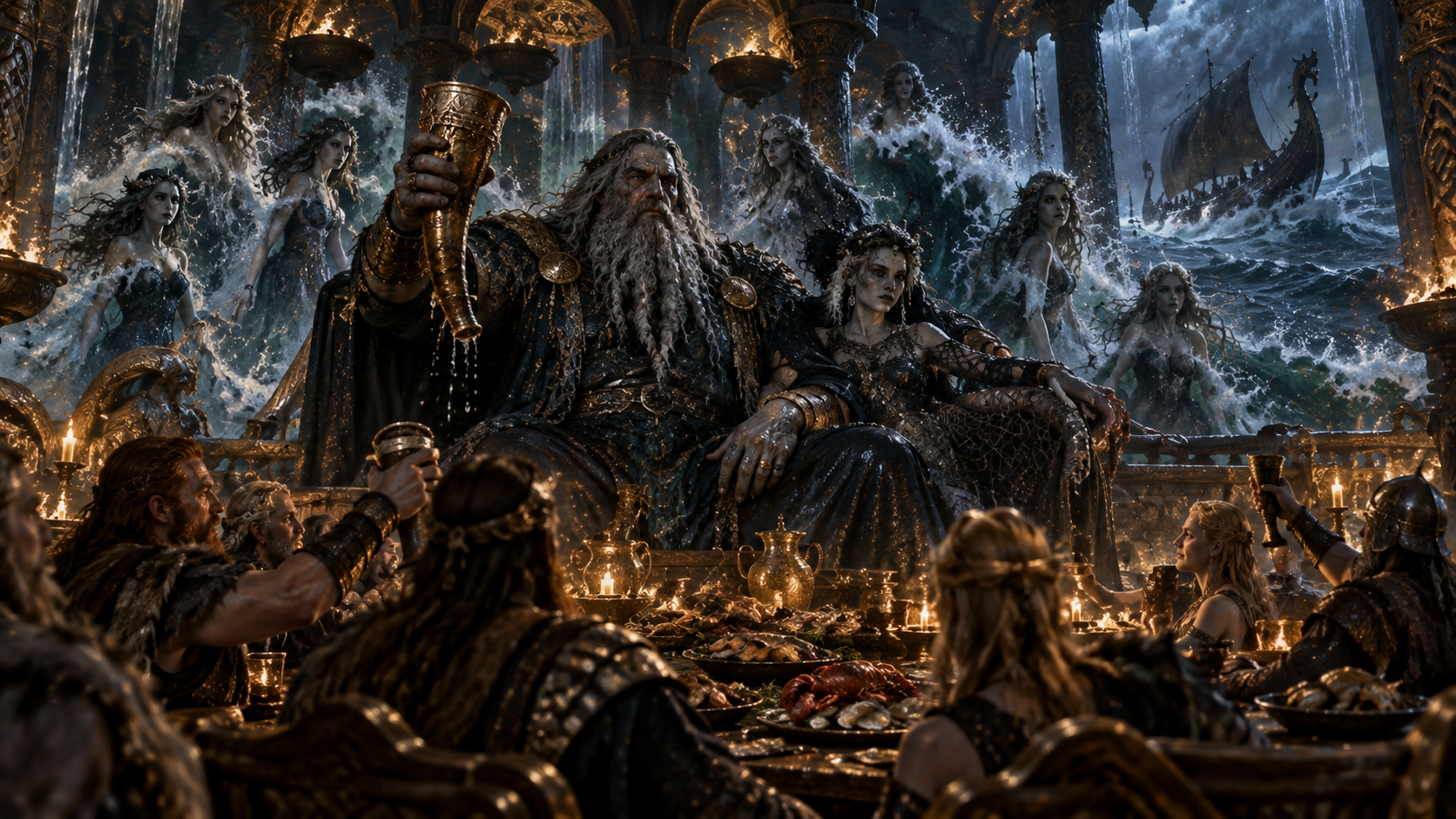
Ægir and Rán at the great feast of the gods.Rán and Ægir form a couple profoundly bound to the ocean.Ægir stands out as a host to the gods; Rán as the captor of men claimed by the sea. This difference allows them to be read as complementary manifestations of the same environment.Yet dividing them into a benevolent husband and an evil wife is too rigid. The sea they both personify brings together hospitality, wealth, violence and loss.
Rán’s net
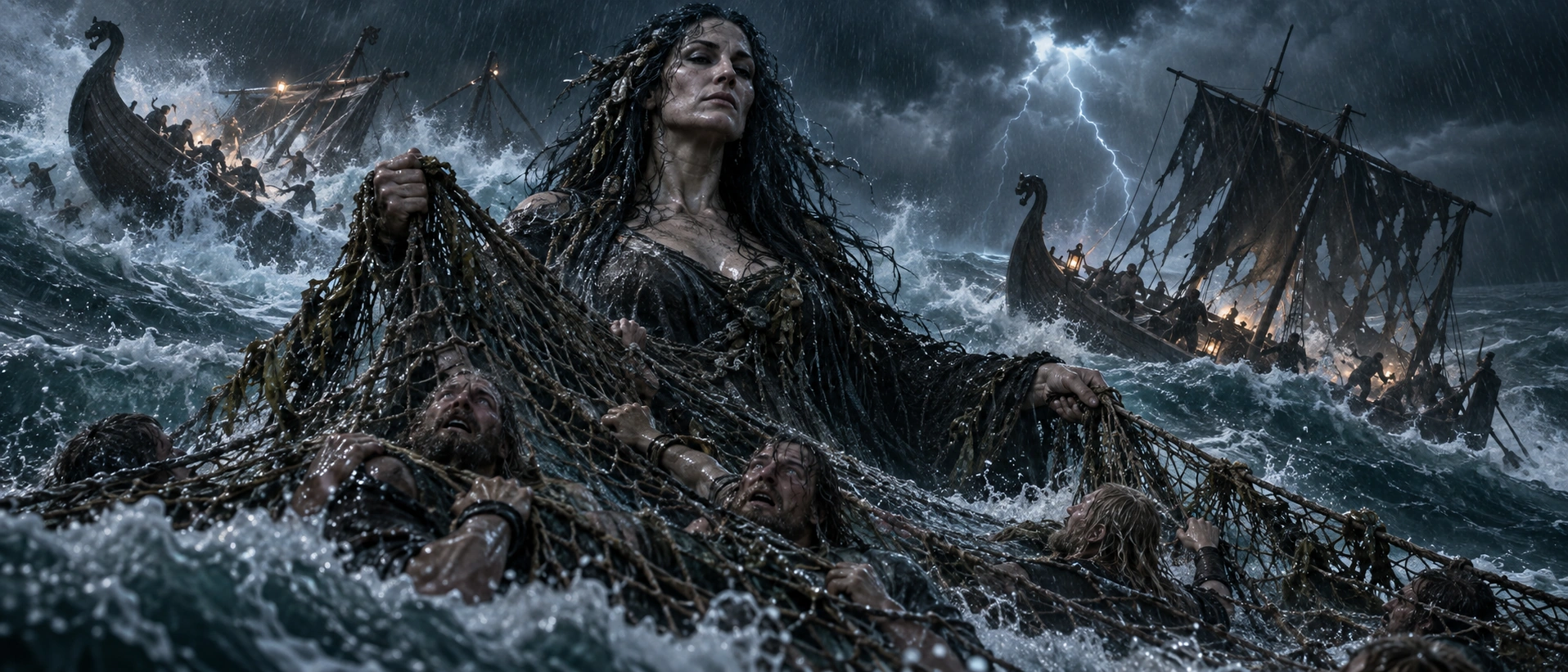
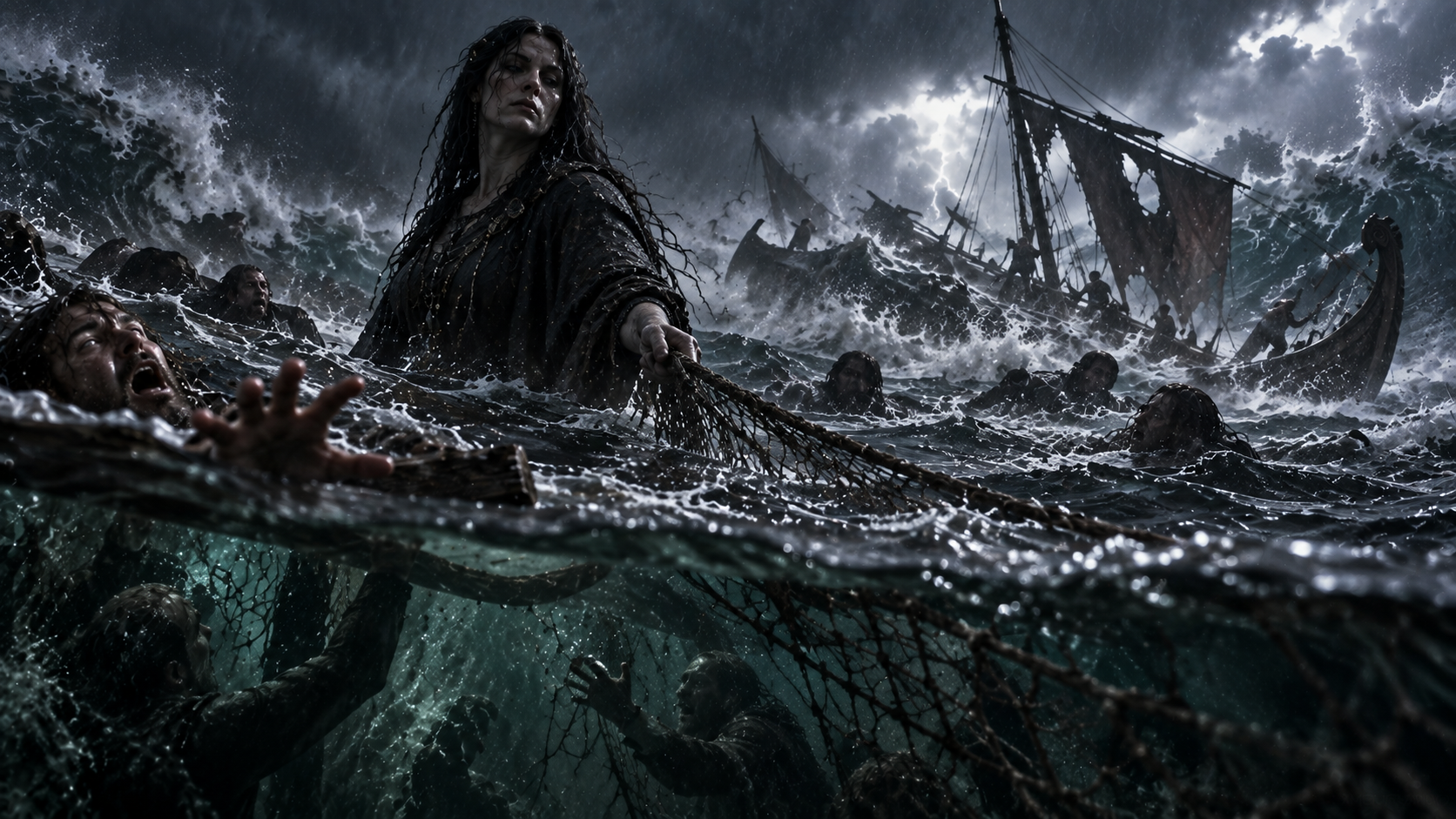
Rán claims the shipwrecked with her net.The net is her most characteristic attribute.In Skáldskaparmál, Snorri presents it as the instrument with which Rán captures men who venture out to sea. The image turns drowning into capture: the sailor is trapped in the domain of a supernatural power.The cited texts provide no precise description of its material, size or making. Imagining it woven from seaweed, hair or golden thread belongs to artistic recreation. Internet Sacred Text Archive
Rán and the dead at sea
Rán is associated with the fate of those who perish beneath the waters.Literary expressions that place the drowned in her company suggest that the seabed receives the dead. These references are scattered, however, and do not allow us to reconstruct a realm organised like an earthly court.Her figure is especially powerful because it turns the body’s disappearance into possession: the sea has claimed the dead.
Loki and the borrowed net
One of the most concrete episodes connected with Rán appears in the prose of Reginsmál.After killing Ótr, who was in otter form, Loki and his companions must obtain gold to pay compensation to Hreiðmarr, the dead man’s father.Loki goes to Rán and obtains her net. He then uses it to capture the dwarf Andvari, who lives in the water in the form of a pike. To keep his life, Andvari gives up his treasure. The Old Ways
The net and Andvari’s treasure
Andvari’s capture connects Rán indirectly with one of the great tragic cycles of Norse tradition.Loki takes the gold and ring that the dwarf tries to keep. The treasure’s curse leads to family conflict and links to the story of Fáfnir, Reginn and Sigurðr.Rán’s part is limited to lending her instrument. The curse comes from Andvari, while her net makes the capture possible. The Old WaysThis story is told at much greater length in the book *The Wolf and the Snow*.
The nine daughters of Rán and Ægir
Rán and Ægir have nine daughters, interpreted as personifications of the waves:Blóðughadda, Bylgja, Dröfn, Dúfa, Hefring, Himinglæva, Hrönn, Kólga and Uðr.Their names belong to the poetic vocabulary of the ocean and evoke different forms of surf. The lists vary: Bára appears in some passages or versions.The genealogy expresses a symbolic relationship: the waves are daughters of the powers that personify the sea. Internet Sacred Text Archive
Rán in poetic language
Rán’s name forms part of the kennings, figurative expressions used by skaldic poets.In this poetic language, the ocean can be described through references to its territory, its paths or its relationship with Ægir.These images can make a voyage sound like travel through the domain of a figure able to capture the traveller. The geography of the sea thus takes on a personal and threatening presence.
Gold and Rán
Skáldskaparmál connects gold with the illumination of Ægir’s hall.From this image come poetic names describing the metal as the fire, light or radiance of Ægir, Rán or their daughters.This association belongs to skaldic language: gold’s brilliance becomes a light connected with the ocean and its supernatural inhabitants. Internet Sacred Text Archive
Appearance and representation
Medieval references tell us far more about Rán’s relationships and her net than about her appearance.A source-based account should leave details such as her eye colour, hair, clothing or apparent age unspecified.For a literary recreation, the net provides the most recognisable visual element. Other physical details may be developed as the author’s choices, distinct from documented attributes.
Relationship with sailors
Rán expresses the fear that a voyage may end in disappearance.Her presence lets us imagine a shipwreck as an encounter with a will waiting beneath the waves. This reading is especially powerful when a dead person’s body remains far from family and funerary rites.In narrative terms, she represents loss arriving from a vast, familiar and dangerous place.
Is Rán a sea goddess?
The expression “sea goddess” is suitable as a general description.More precisely, she can be defined as a sea divinity associated with drowning and the capture of sailors.Her family ties, her net and her presence in poetry offer firmer characterisation than attributing to her detailed rule over every creature in the ocean.
Worship
Rán’s presence in literature demonstrates her importance in the maritime imagination.That presence alone is not enough to establish temples, priesthoods or an organised independent cult. The figure’s mythological importance should be kept distinct from historical evidence for specific religious practices.
Rán at Ragnarök
The principal accounts of Ragnarök do not establish a clear individual fate for Rán.Her role in the final battle, her death or her survival remain unspecified.Connecting her to a specific action during the world’s destruction would require a literary invention of its own.
Attributes
Name: RánCommon form without diacritics: RanMeaning associated with the name: robbery, plunder or seizure; commonly interpreted as “the robber”Nature: female divinity and personification of the seaClassification: sea figure; assigning her exclusively to the jötnar requires cautionHusband: ÆgirDaughters: nine figures associated with the wavesKnown daughters: Blóðughadda, Bylgja, Dröfn, Dúfa, Hefring, Himinglæva, Hrönn, Kólga and Uðr; lists varyMain domains: the sea, drowning, the capture of sailors and death beneath the watersCharacteristic attribute: a netNet material: not precisely described in the cited passagesConnection with Loki: lends him the net used to capture AndvariConnection with Andvari: indirect, through the instrument that enables his captureConnection with gold: her name appears in poetic descriptions of metal as the sea’s fire or radianceResidence: a marine realm; literary references do not provide a consistent architectural descriptionPhysical appearance: no detailed, stable portrait in the cited sourcesAssociated animals: no clearly established emblematic animalWorship: insufficient evidence to reconstruct an organised independent cultFate at Ragnarök: unspecifiedMain sources:Skáldskaparmál, the prose of Reginsmál, Völsunga saga, the Helgi poems, Sonatorrek and Friðþjófs saga hins frœkna.