What becomes of an ancient form of magic when the world stops believing in it?
It does not necessarily disappear.
Sometimes it simply learns how to hide.
In Grimwolf: London 1930, the ancient Norse practice of seiðr does not belong to a forgotten medieval world of longhouses, pagan temples and Viking kings. It survives in a Europe of motorcars, electric lights, telephones, forensic laboratories and railway stations.
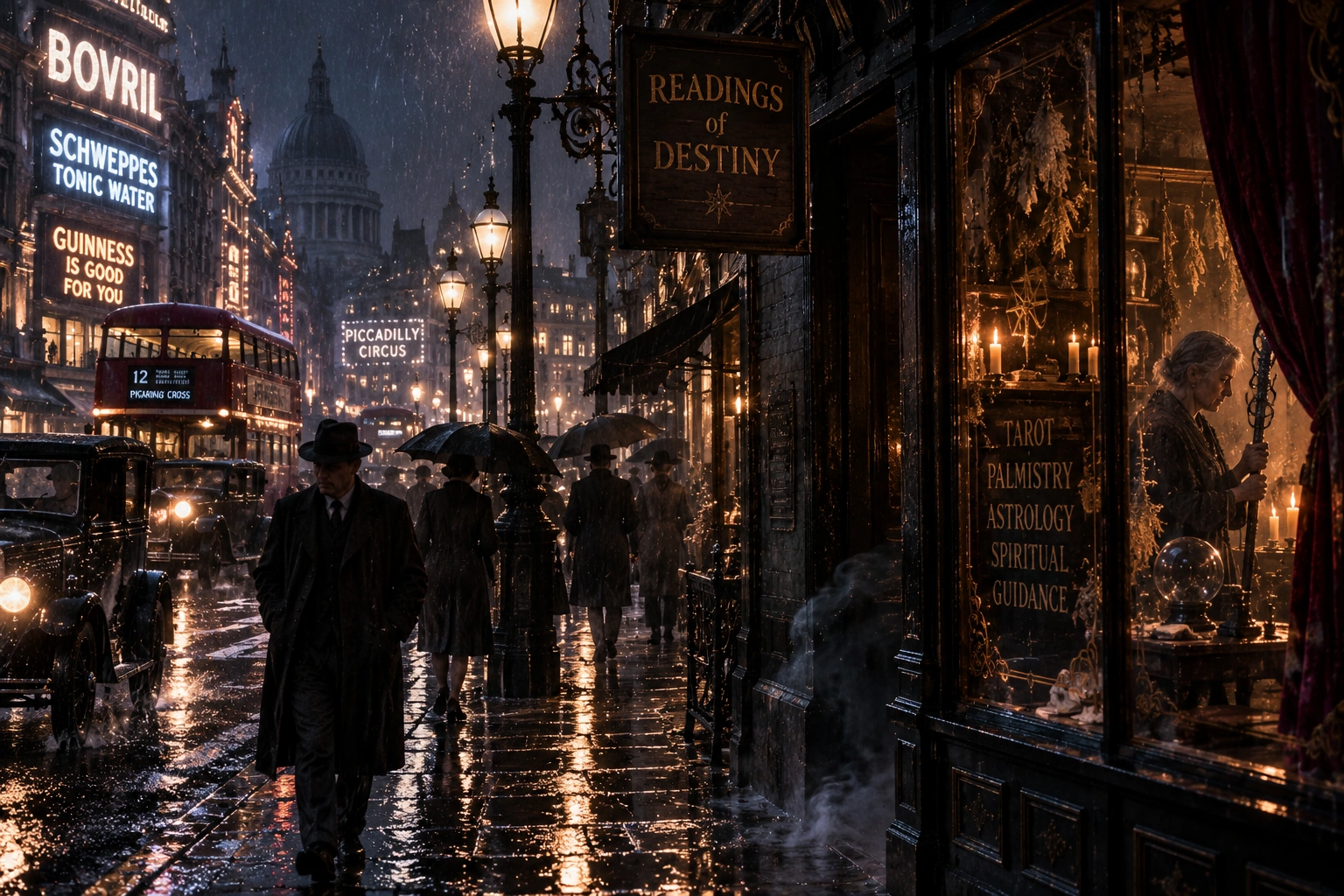
Piccadilly Circus glows beneath electric advertisements.
Scotland Yard catalogues fingerprints and evidence.
Steamships cross the North Sea.
Aeroplanes are beginning to shorten distances that once required weeks of travel.
And somewhere beyond all that machinery, an old woman still strikes a wooden staff against the earth and listens for the dead.
This tension between modernity and ancestral knowledge lies at the heart of the magic in Grimwolf.
The old world has not vanished.
The modern world has simply been built on top of it.
Seiðr in a World of Machines
Magic in Grimwolf is rarely spectacular.
There are no elaborate incantations designed merely to produce light and colour. Seiðr is portrayed instead as something slower, stranger and more intimate.
Breathing.
Rhythm.
Memory.
Altered states of consciousness.
Objects that serve as ritual anchors.
Knowledge passed from one generation to another.
And, above all, the ability to perceive boundaries that most people cannot see.
The völva does not necessarily force reality to obey her.
She listens for places where reality has already become thin.
A grave.
An ancient tree.
A room where someone died.
A piece of earth that has absorbed centuries of memory.
A person standing close to death.
For most of the modern world, these things possess no measurable connection.
For a völva, they may be part of the same map.
The Völva: Between Prophetess, Sorceress and Keeper of Memory
The figure of the völva occupies a distinctive place in Old Norse tradition.
Associated with prophecy and magical practice, she belongs to a world in which knowledge itself could be dangerous.
Grimwolf takes inspiration from that tradition but develops its own interpretation.
Its völur are not simply witches.
Nor are they conventional fantasy sorceresses.
They are women who exist at boundaries.
Between memory and prophecy.
Between healing and harm.
Between the living and the dead.
Between what the modern world considers superstition and what the characters of Grimwolf gradually discover may be something far more real.
Two women embody those possibilities particularly well.
Alrun and Agnes Holloway.
One lives beside the remains of an ancient Viking world.
The other survives beneath the smoke and electric lights of London.
I. Alrun: The Memory of the Earth
Hedeby — Where the Past Never Entirely Died
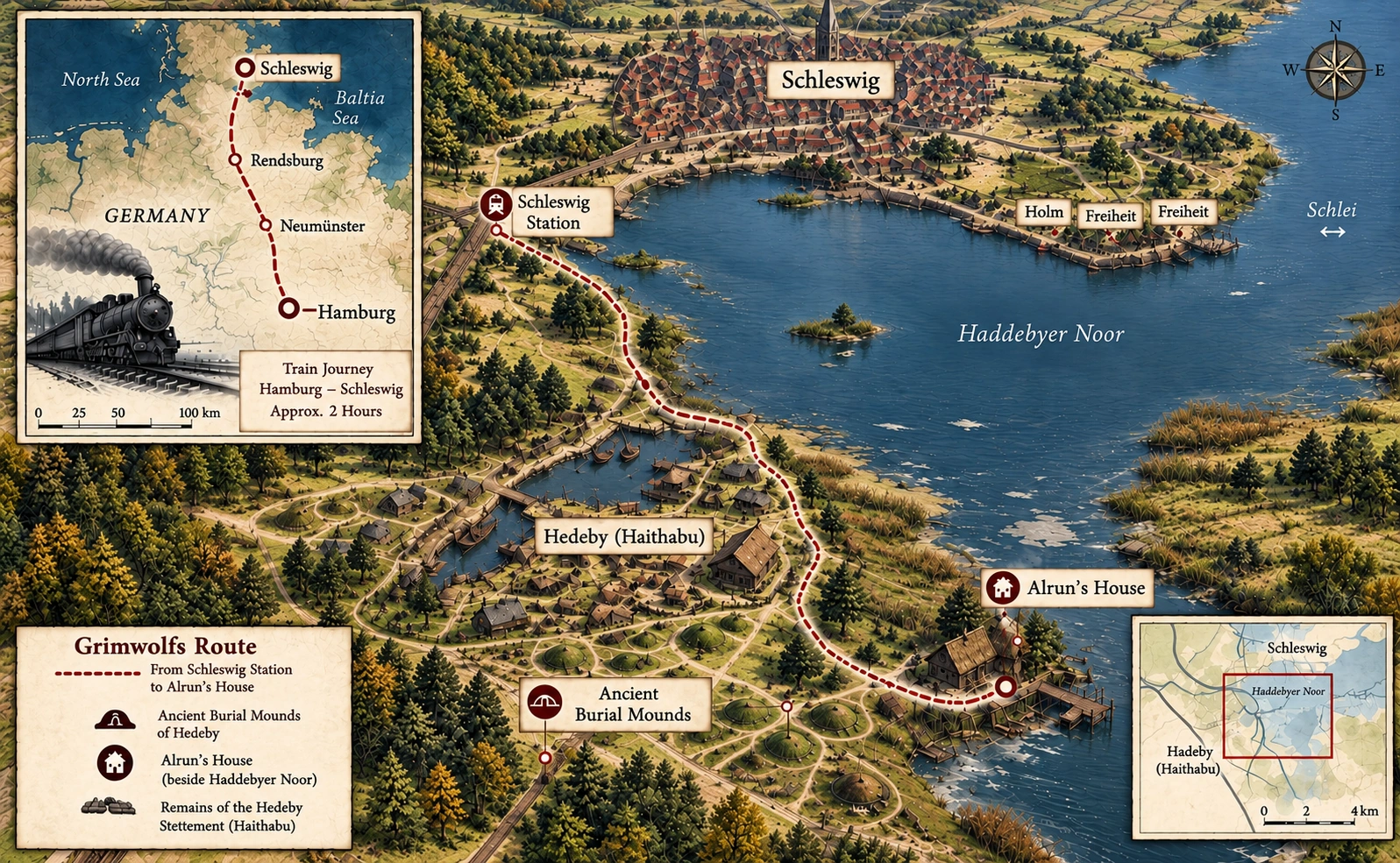
Near the waters of the Haddebyer Noor in Schleswig lies a landscape shaped by memory.
Hedeby was once one of the great trading centres of the Viking Age.
Centuries later, its ships are gone.
Its merchants are dead.
Its markets have disappeared.
But the land remains.
And in Grimwolf, land remembers.
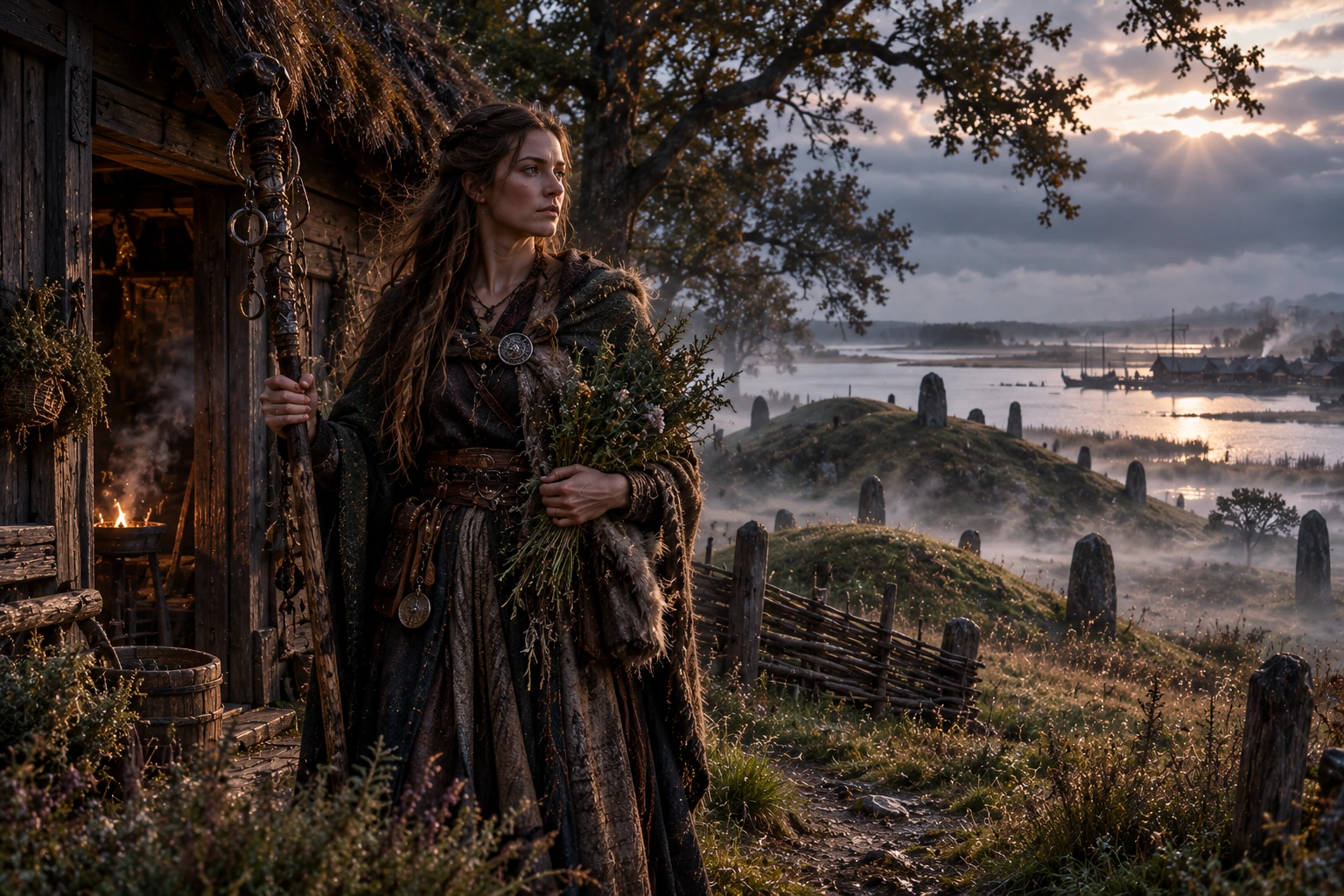
Alrun lives close to that ancient landscape, away from the machinery and crowds of the modern city.
Her world is one of dark timber, smoke, herbs, old trees and burial mounds whose occupants have rested beneath the earth for generations.
To an archaeologist, those mounds belong to history.
To Alrun, history is not necessarily silent.
The Völva of the Old World
Alrun represents perhaps the closest surviving connection to the traditional image of the völva within the world of Grimwolf.
Her knowledge is inseparable from the natural environment.
Juniper.
Mugwort.
Roots.
Soil.
Water.
Smoke.
Wood.
None of these things is magical merely because she touches it.
Their importance lies in knowing what they are, how they interact and what memories or properties they carry.
Alrun's power therefore feels less like domination over nature than participation in it.
She does not stand outside the landscape commanding it.
She belongs to it.
When the Earth Remembers
One of the central ideas behind Alrun's magic is that places accumulate memory.
People die.
Buildings collapse.
Languages disappear.
Religions change.
But the ground remains.
The earth beneath an ancient burial mound has witnessed every generation that came after the person buried there.
For Alrun, that continuity matters.
A grave is therefore more than a location containing human remains.
It is a point of connection.
A place where the boundary between what was and what is becomes unusually narrow.
And if one knows how to listen, the dead may not be entirely beyond reach.
II. Agnes Holloway: A Völva Beneath Electric London
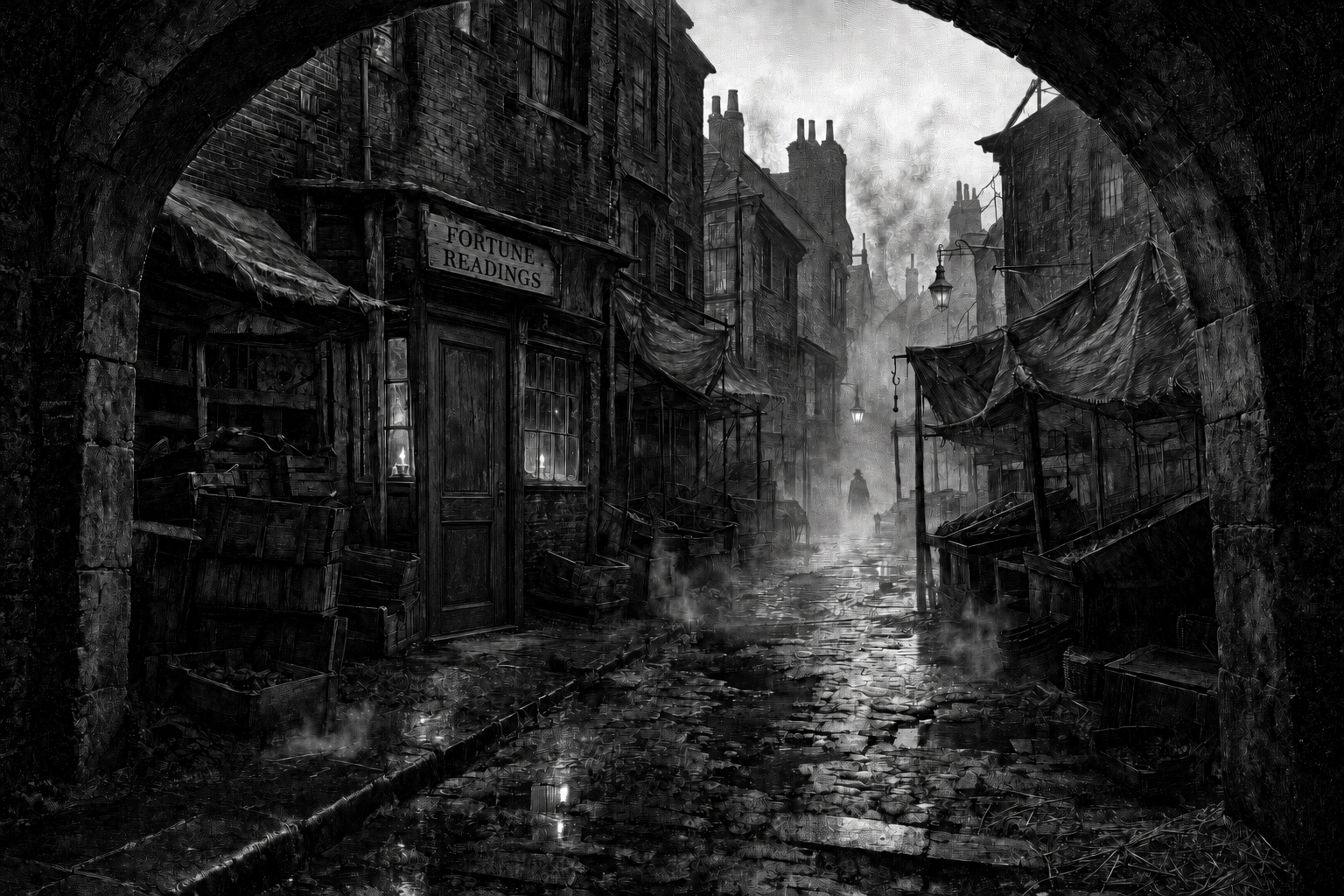
Southwark — Magic Behind a Fortune-Teller's Sign
Agnes Holloway represents the opposite form of survival.
She does not live beside ancient burial mounds.
She lives in London.
Her world is crowded.
Noisy.
Industrial.
Electrified.
The Thames carries ships past warehouses and factories. Motorcars compete with older traffic in the streets. Police officers patrol neighbourhoods filled with thousands of people who would laugh at the suggestion that the old gods still matter.
And yet Agnes remains.
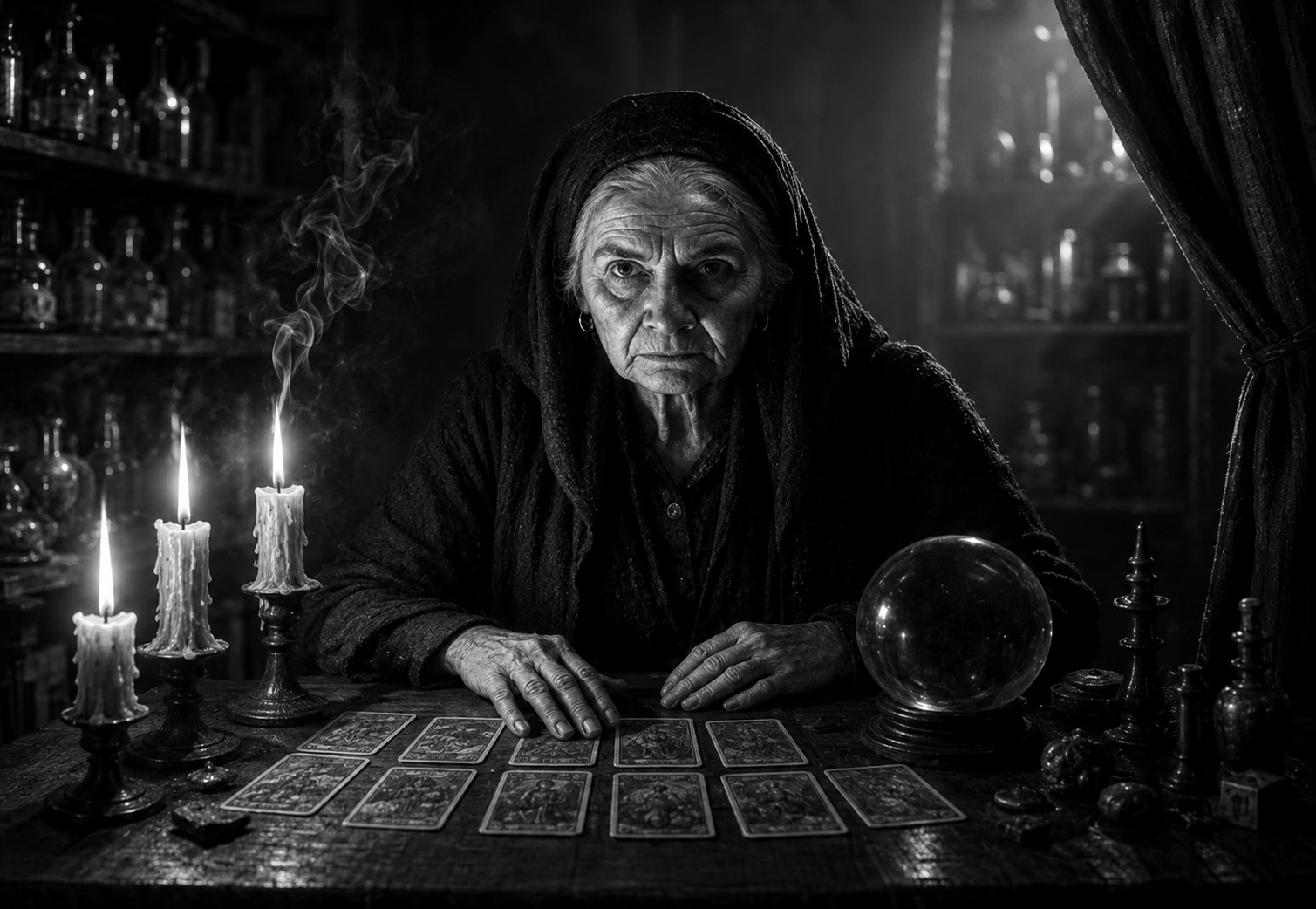
Her modest establishment, Readings of Destiny, appears to offer exactly the sort of services expected from an ageing urban fortune-teller.
Tarot cards.
Palm readings.
Predictions.
Advice.
To a sceptical passer-by, she may appear to be another woman earning a few coins from superstition.
That assumption is useful.
Because in 1930, perhaps the safest place for real magic to hide is behind something everyone already believes to be fraudulent.
The Perfect Disguise
Modernity does not eliminate superstition.
It commercialises it.
London still contains spiritualists, fortune-tellers, mediums and people promising contact with the dead.
Most respectable citizens can dismiss them.
Police officers can ignore them unless a crime is committed.
Scientists can ridicule them.
And that indifference creates an unexpected form of protection.
If everyone assumes Agnes is pretending to possess supernatural abilities, almost nobody has reason to investigate whether she actually does.
Her greatest defence is disbelief.
The modern world protects her precisely because it no longer believes women like her can exist.
A Refuge for Those London Does Not See
But Agnes's shop serves another purpose.
The women who come to her are not all searching for prophecy.
Some are searching for someone willing to listen.
Prostitutes.
Widows.
Seamstresses.
Women abandoned by husbands or lovers.
Women with little money and even less influence.
People who can disappear into a city of millions without leaving much of a disturbance behind.
For them, Agnes offers something that official institutions often fail to provide.
Attention.
No judgement.
A chair.
A warm room.
Someone who remembers their names.
This social role is essential to understanding her character.
Her position between worlds is not merely supernatural.
Agnes also stands between the respectable city and those it prefers not to see.
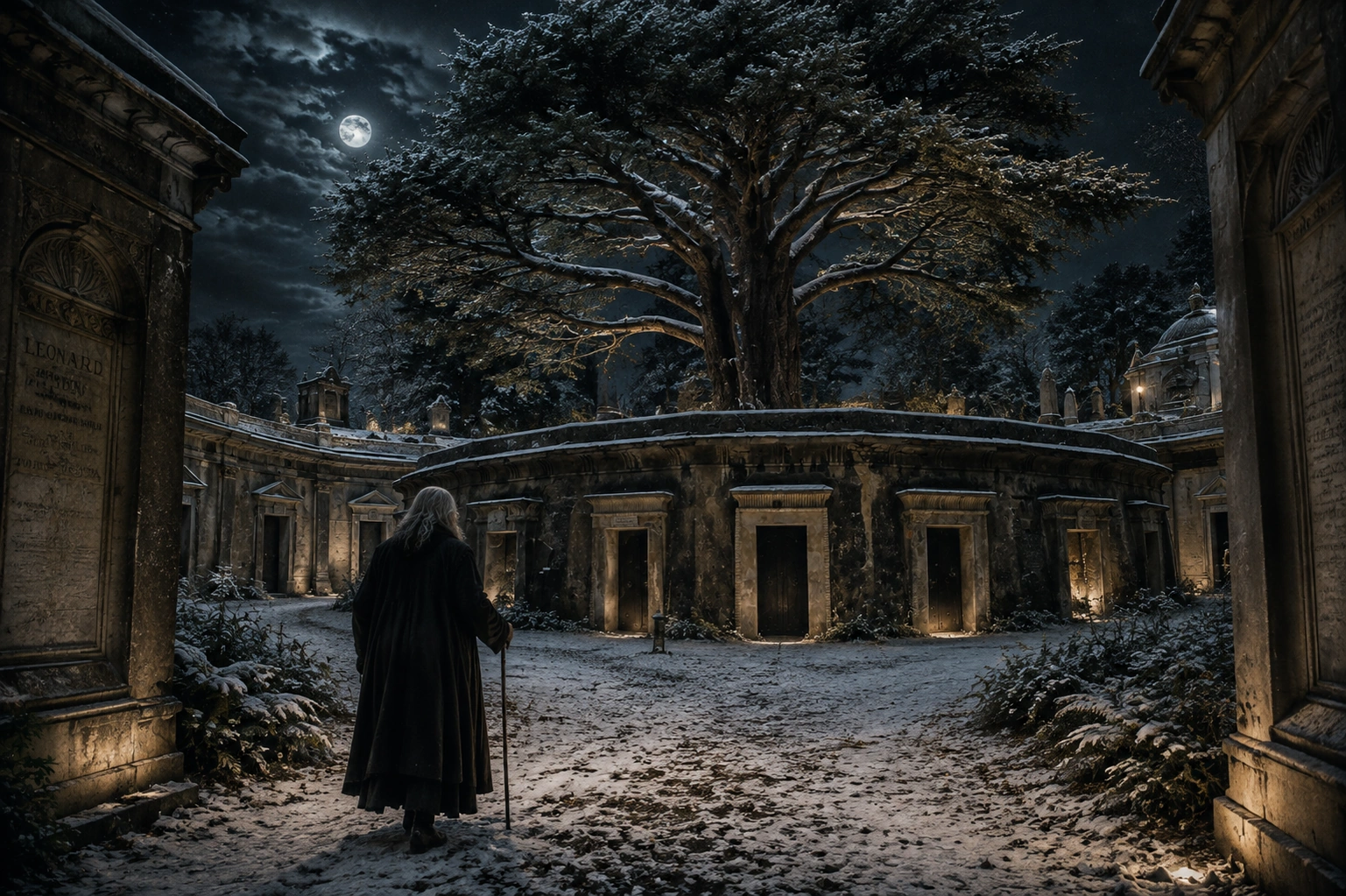
III. The Gandr: A Staff That Holds No Magic
The Tool of the Völva
Among the objects associated with seiðr, few are as immediately recognisable as the ritual staff.
In Grimwolf, both Alrun and Agnes use a gandr, or seiðstafr, shaped and darkened by years of handling.
Metal rings are attached to it.
Wood bears the marks of age.
It looks ancient because it is ancient.
But the staff does not function like a magician's wand.
It does not create power from nothing.
It focuses.
Clink... Clink...
The sound matters.
The staff strikes the ground.
Clink...
A pause.
Another strike.
Clink...
Breathing begins to follow the rhythm.
The mind concentrates.
External distractions become less important.
The person participating in the ritual becomes increasingly aware of the sound, the breath and the voice guiding them.
In the magical system of Grimwolf, ritual is not theatrical decoration.
It creates conditions.
The staff becomes an anchor.
Something physical to which the mind can return while perception begins to move somewhere else.
Magic as Discipline
This distinction is important.
Seiðr requires control.
Concentration.
Breathing.
Knowledge.
Preparation.
A person cannot simply pick up a völva's staff and become a practitioner.
The object is not the source.
The practitioner is.
The tool merely helps shape intention.
That makes the magic of Grimwolf closer to ritual discipline than to the instantaneous spellcasting found in much traditional fantasy.
Power has a cost because concentration has a cost.
Crossing boundaries has a cost.
And losing control can have consequences.
IV. The Circle of Living Earth
When a House Is Built Around Something Older
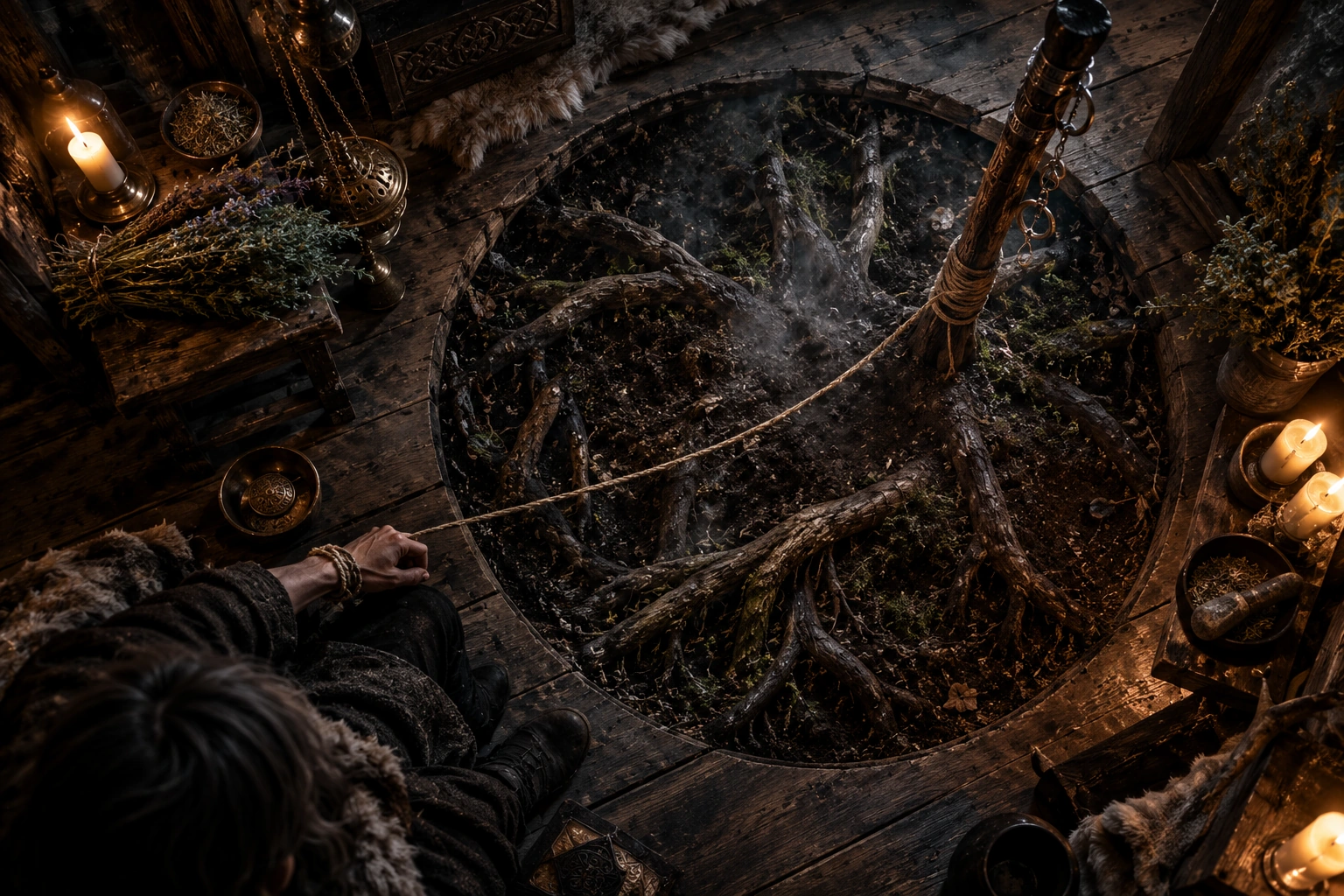
Alrun's home contains another expression of the relationship between magic and landscape.
Wooden floorboards give way to something unexpected.
Earth.
Not decorative soil placed inside a container.
Living ground.
Roots pass through it and descend beneath the house.
The implication is simple but important.
The building was not constructed to separate Alrun from the earth.
It was constructed around her connection to it.
Roots Beneath the House
Within the cosmology of Grimwolf, roots carry enormous symbolic importance.
Yggdrasil connects worlds.
Its image transforms the tree from a living organism into a model of existence itself.
Branches above.
Roots below.
Worlds separated and connected simultaneously.
Alrun's circle of earth reproduces that principle on a human scale.
She does not possess Yggdrasil.
She does not need to.
A root is enough to express the idea.
What matters is connection.
The Woollen Thread
During certain rituals, a simple cord of wool acquires extraordinary importance.
One end remains with the völva.
The other is tied to the traveller.
Physically, it is almost nothing.
A thread.
Symbolically, it is everything.
It represents the path back.
In the ritual logic of Grimwolf, entering an altered state is not necessarily dangerous because of what one may encounter.
The greater danger may be forgetting how to return.
The cord therefore becomes a form of spiritual tether.
A reminder that however far the mind travels, something remains attached to the world of the living.
The idea is almost umbilical.
One world allows the traveller to enter another without entirely surrendering them to it.
V. Mirrors and the Architecture of Grief
Southwark's Other Face
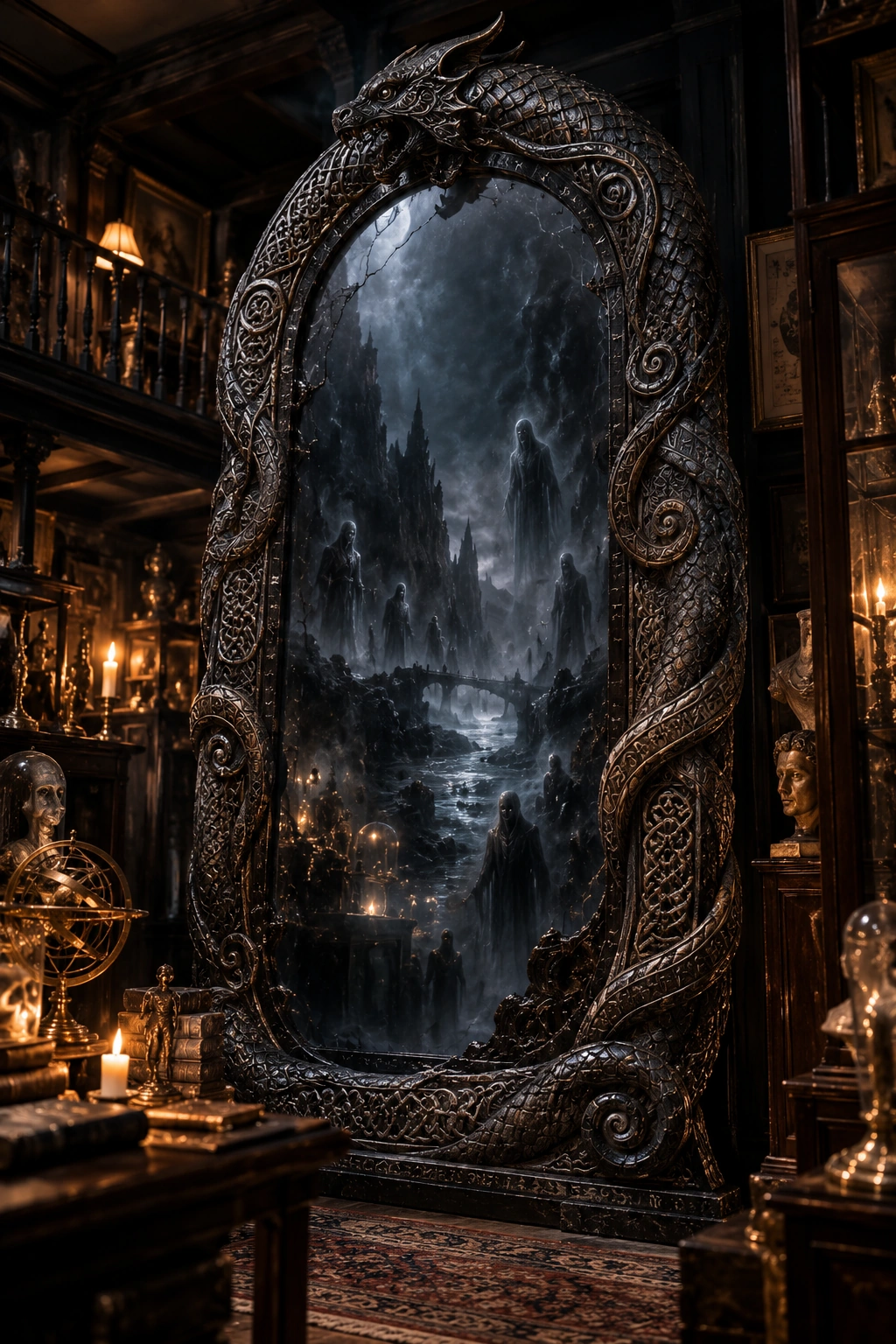
Mirrors occupy a particularly unsettling place in the magical language of Grimwolf.
A mirror should perform one simple function.
It should show what stands before it.
But throughout folklore and occult traditions, reflective surfaces have frequently acquired another purpose: seeing what ordinary sight cannot.
Grimwolf develops this idea through the magic surrounding Agnes Holloway.
Without revealing what lies behind every door in Southwark, it is enough to say that reflection becomes dangerous when the person looking into the glass carries something they cannot let go.
What Does a Mirror Really Show?
A face?
A memory?
A possibility?
A lie?
The dead?
Or simply what the observer most desperately wishes to see?
This uncertainty makes mirrors particularly suitable for the seiðr of Grimwolf.
A sword attacks the body.
A mirror attacks certainty.
When grief is involved, the distinction between vision and desire becomes especially difficult to maintain.
If someone sees a dead loved one standing in the glass, the most important question may not be whether the apparition is real.
It may be whether they are capable of turning away.
The Most Dangerous Visions Are Personal
The magic associated with these reflective surfaces does not need to invent arbitrary horrors.
Human memory can provide far more effective ones.
Regret.
Guilt.
Loss.
People who cannot be saved.
Words that cannot be unsaid.
Moments that cannot be changed.
For someone carrying profound grief, the promise of seeing the dead again may be more powerful than any threat.
That is why necromancy in Grimwolf is not simply about summoning corpses.
It is about the relationship the living maintain with those who are gone.
And sometimes the living are far less willing to release the dead than the dead are to leave.
VI. The Völva as a Liminal Figure
Neither Healer nor Witch
The völur of Grimwolf resist easy moral categories.
They can heal.
They can guide.
They can deceive.
They can conceal.
They can communicate with forces that most people should perhaps never encounter.
This does not make them inherently good or evil.
It makes them liminal.
They exist at thresholds.
And a threshold belongs completely to neither side.
That ambiguity is particularly important in dark fantasy.
A person capable of speaking with the dead may use that ability to comfort a grieving mother.
The same knowledge may also allow someone to disturb boundaries that should remain closed.
The technique has no morality of its own.
The morality belongs to the person using it.
Agnes and the Morality of Survival
Agnes embodies this ambiguity especially strongly.
She helps people whom respectable London ignores.
She listens to women nobody else wishes to hear.
But survival in the hidden world of Grimwolf requires compromises.
There are forces older than Scotland Yard.
There are promises that cannot be broken simply because modern law refuses to recognise them.
And there are debts that are not paid in money.
Agnes understands this.
How far she has gone to survive — and what she has been forced to give in return — belongs to the story itself.
VII. Hel and the Dead
Necromancy Without Demons
One of the most important distinctions in Grimwolf concerns the nature of death itself.
Hel is not Satan.
Helheim is not the Christian Hell.
And communicating with the dead does not automatically imply demon worship.
The cosmology operates according to different rules.
Hel possesses her own domain.
The dead have their own paths.
There are boundaries between states of existence.
The völva's danger comes from approaching those boundaries closely enough to interact with them.
Not every door should be opened.
Not every voice should receive an answer.
And not everything that speaks with the voice of the dead necessarily belongs to the person whose voice it uses.
The Ethics of Crossing the Boundary
This creates one of the most interesting moral problems surrounding seiðr.
If communication with the dead is possible, should it be attempted?
Does grief justify calling someone back?
Does knowledge?
Justice?
Love?
Revenge?
And if the dead answer, how can the living know whether they are speaking to a memory, a soul, an echo or something else entirely?
Modern science in 1930 has no vocabulary for these questions.
Alrun and Agnes do.
But knowing the vocabulary does not make the answers any safer.
VIII. Electricity Did Not Kill Magic
The arrival of electricity transformed the night.
Streets that had once belonged to darkness could now remain illuminated.
Factories could continue working after sunset.
Signs glowed above theatres and shops.
Telephones carried voices across cities.
Radio allowed invisible signals to pass through walls and arrive in distant homes.
To someone born centuries earlier, much of 1930 would itself have looked like sorcery.
And yet none of these inventions necessarily contradicts the magic of Grimwolf.
They simply belong to another system of knowledge.
Electricity does not make the old ways impossible.
It makes them easier to dismiss.
A völva no longer needs to fear that everyone will recognise what she is.
Most people have already decided she cannot exist.
The Last Völur Do Not Need Temples
This may be the greatest difference between Alrun and Agnes.
Alrun survives because she remains close to the old landscape.
Agnes survives because she has learned to disappear inside the new one.
One preserves tradition.
The other disguises it.
One listens to the earth beneath ancient burial mounds.
The other reads cards beneath electric light.
But both understand something the modern world has forgotten:
technology changes the tools available to human beings.
It does not necessarily change the questions they ask.
What happens when we die?
Can the dead hear us?
Can we speak to them?
Can the future be known?
Can grief be undone?
Can destiny be changed?
As long as those questions survive, there will always be someone willing to search for an answer beyond the boundaries of ordinary knowledge.
The Door of the Völva
That is why seiðr survives in Grimwolf: London 1930.
Not because the twentieth century failed to arrive.
But because it did.
The modern city can illuminate its streets, classify its citizens, photograph its criminals and examine its dead beneath the bright lamps of a mortuary.
It can explain disease.
Measure electricity.
Record voices.
Map the human body.
And still, when someone loses the person they love, none of those achievements can answer the question they most desperately want answered:
Where did they go?
Alrun seeks the answer in earth, roots and the memory of ancient graves.
Agnes seeks it among people forgotten by one of the largest cities in the world.
Two women.
Two landscapes.
Two ways of preserving a tradition that should, according to the logic of modernity, have disappeared long ago.
But the old knowledge has not vanished.
It has adapted.
It has learned to live beside electric light.
To hide behind shop signs.
To survive beneath railway lines and paved streets.
To wait in places where the living still whisper the names of the dead.
Because as long as there is grief, there will be memory.
As long as there is death, there will be questions.
And as long as someone desperately wishes to hear one last voice from the other side...
there will always be someone searching for the völva's door.
Explore the Magic and Mythology of Grimwolf
Grimwolf: London 1930 combines dark fantasy, historical thriller, Norse mythology and criminal investigation in a Europe where ancient traditions have survived beneath the machinery of the modern world.
In other articles on this website, we explore Helheim, Yggdrasil, the Vanir gods, forbidden artefacts and the historical locations that shape the world of Grimwolf.
The old gods did not disappear when the electric lights came on. We simply became less capable of seeing them.