A sword behind glass. A dagger bound to wind and sea. A mask that whispers to whoever touches it. A mirror into which no one should gaze for too long.
In the world of Grimwolf: London 1930, ancient objects are rarely mere archaeological remains.
Some have survived for centuries because they were made to endure.
Others were hidden.
Stolen.
Inherited.
Buried alongside people whose names vanished from history.
And some perhaps should never have been found.
While Scotland Yard attempts to understand a series of murders that defy conventional explanation, others are moving across Europe in search of relics whose existence belongs to a far older body of knowledge.
The magic of the Vanir.
The secrets of the Æsir.
The paths to Helheim.
The remnants of Svartálfheim.
The ancient prophecies of Ragnarök.
All have left physical traces upon Midgard.
Because in Grimwolf, the gods may disappear from human history.
Their artefacts do not.
When Archaeology Becomes Dangerous
The London of 1930 is fascinated by the past.
Museums, private collections, archaeological excavations and antiquarian dealers allow objects from vanished civilisations to be placed before thousands of visitors.
To most people, they are history.
To an archaeologist, knowledge.
To a collector, prestige.
But not everyone in Grimwolf looks at these objects in the same way.
Some know what they are looking at.
And that difference can turn an apparently harmless object into something extraordinarily dangerous.
A sword can remain a sword.
A coin can remain a coin.
A mask can lie motionless for centuries.
Until someone capable of understanding it reaches out and touches it.
That is one of the principles governing the artefacts of the Grimwolf universe:
power is not always asleep; sometimes it is simply waiting.
I. The Ulfberht Sword
British Museum — Antiquities Collection
Behind the protective glass of a museum display, an ancient sword seems like one of the safest objects in the world.
No one can wield it.
No one can use it.
It has been catalogued, studied and seemingly reduced to a piece of history.
But one inscription changes everything:
+ULFBERH+T
The so-called Ulfberht swords represent one of the points where Grimwolf directly connects real archaeology with fantasy.
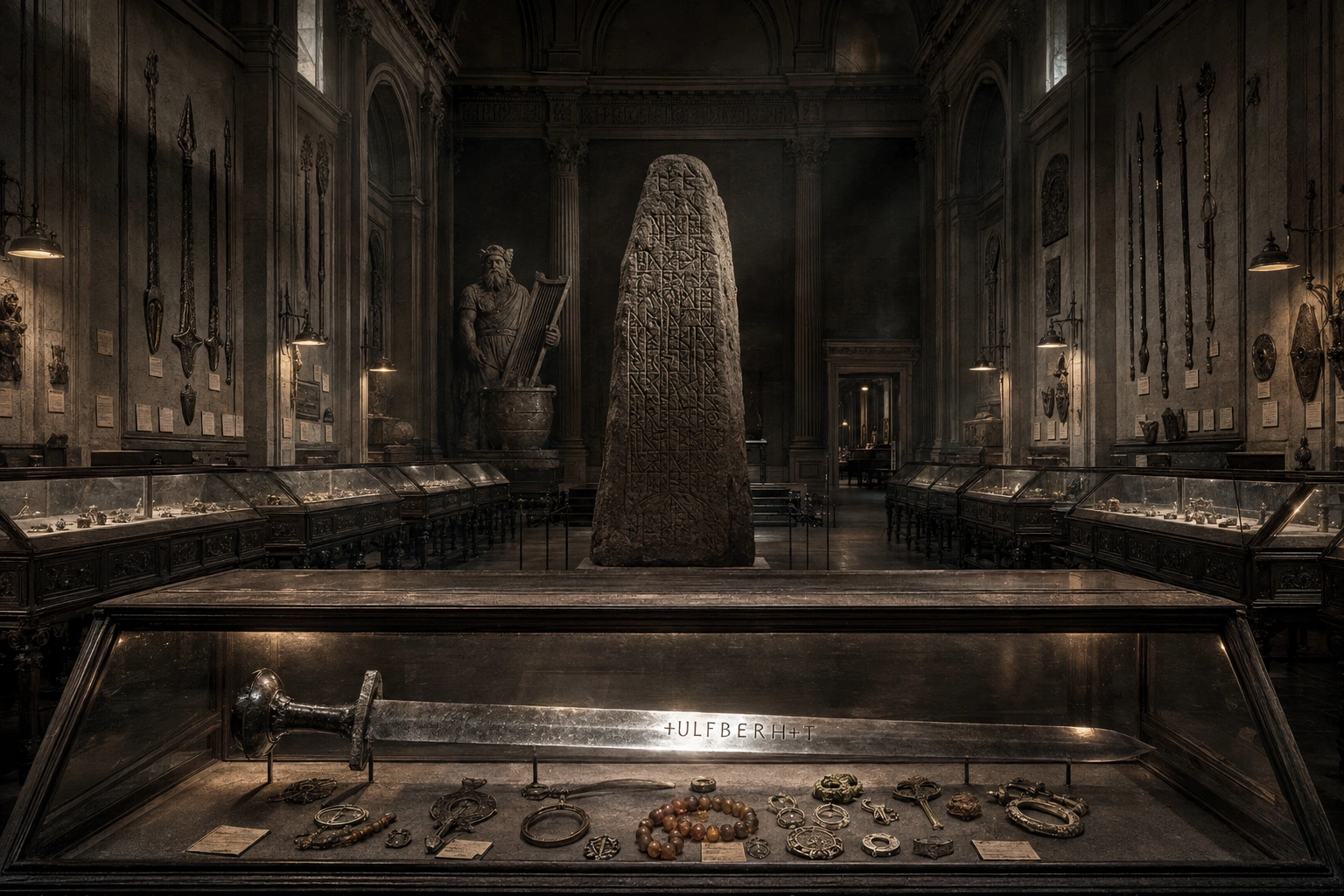
The Historical Mystery of the Ulfberht Swords
The Ulfberhts were medieval swords associated with a distinctive inscription on their blades. Some are remarkable for the exceptional quality of their manufacture and the steel from which they were forged.
For the historian, the mystery lies in metallurgy, trade routes, the workshops that may have produced them and the meaning of the name Ulfberht.
For Grimwolf, there is another possibility.
What if those smiths did not invent everything they knew?
The Explanation That Never Made It into the History Books
When Eirikr looks upon an Ulfberht sword, he does not see merely an extraordinary piece of medieval metallurgy.
He recognises a tradition.
Within the cosmology of Grimwolf, certain forms of human knowledge may preserve fragments of techniques whose origins lie far beyond Midgard.
And few figures better represent absolute mastery of the forge than the legendary craftsmen associated with Svartálfheim.
The makers of impossible objects.
The smiths of weapons destined for gods.
Beings capable of transforming ordinary materials into relics that would eventually become part of legend.
The novel therefore plays with a deliberately unanswerable historical question:
what if some of the inexplicable advances of the past were not inventions, but memories?
A Weapon That Chooses as Much as Its Bearer
Within the lore of Grimwolf, an exceptional blade is not defined solely by its ability to cut.
There is a relationship between the weapon and the person who attempts to wield it.
Will.
Purpose.
Destiny.
To be “worthy” does not necessarily mean to be good.
Ancient objects do not obey human morality.
They may respond to other qualities.
Determination.
Blood.
Lineage.
Strength.
Or perhaps something even the characters themselves do not fully understand.
That is what makes the Ulfberht sword in the British Museum so unsettling.
Thousands of people may pass before it without feeling anything.
But that does not mean it remains the same beneath every gaze.
II. Njarðarblað
The Blade of Sea and Wind
Among the relics connected to Eirikr, few possess a bond as personal as Njarðarblað.
It is more than a weapon.
It is an inheritance.
A ceremonial dagger linked to a tradition far older than human kingdoms and to a form of power very different from the destructive force so often associated with divine weapons.
The Aesthetics of the Vanir
The hilt of Njarðarblað is covered in patterns reminiscent of ocean waves and currents of air.
They are not decorations chosen at random.
The weapon expresses through its very shape what it belongs to.
Water.
Wind.
Movement.
Balance.
Vanir magic in Grimwolf does not necessarily manifest itself through spectacular explosions of power. Its relationship with nature runs deeper.
It does not always command the element.
It listens.
It recognises.
And then it uses.
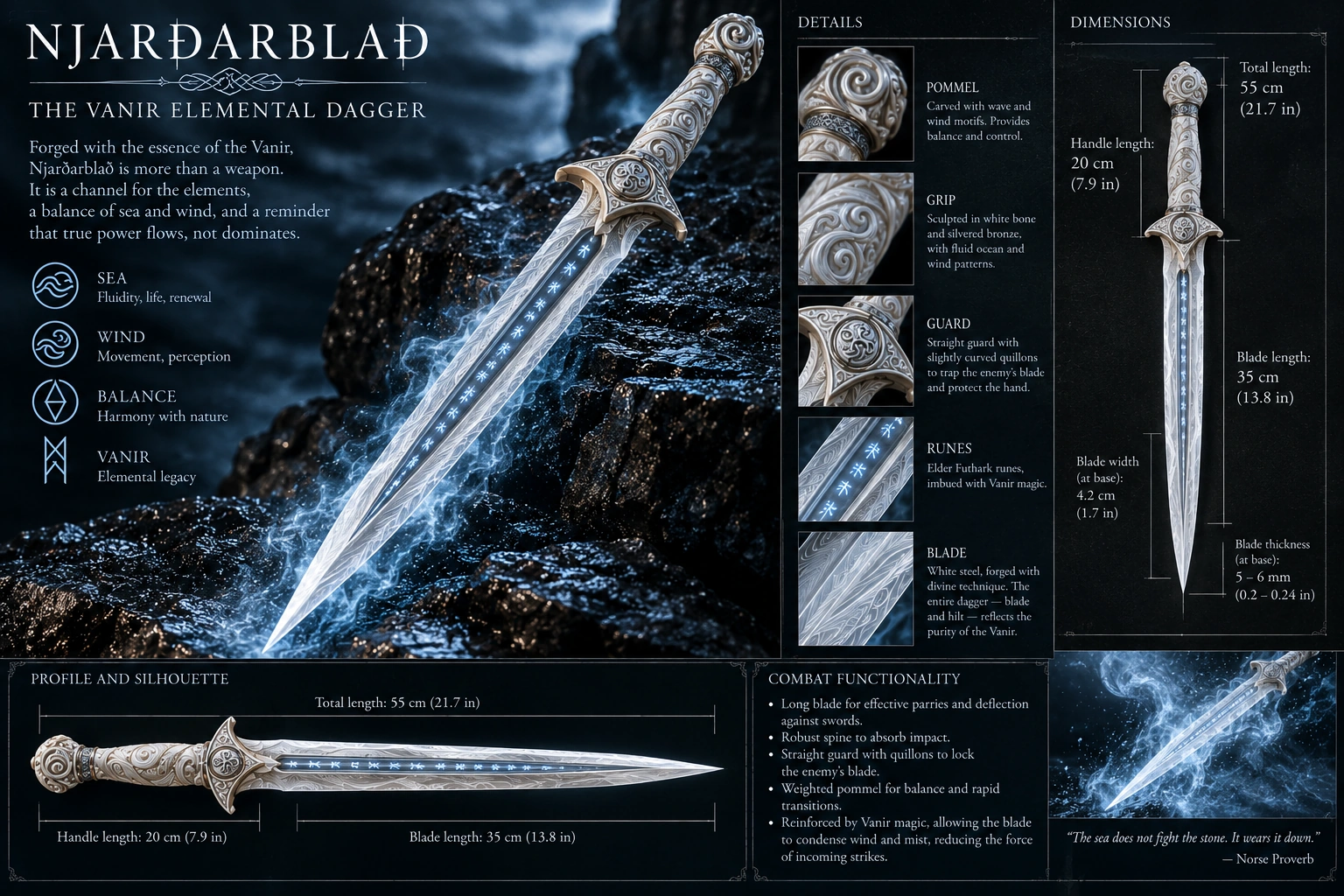
The Legacy of Njörðr
Njarðarblað is directly connected to the domain of Njörðr, the god associated with the sea, wind and seafaring.
That connection is particularly important to Eirikr.
His power does not work like that of a sorcerer memorising an incantation.
It is instinctive.
The air changes, and he senses it.
Humidity rises, and his body recognises it.
The wind meets an obstacle, and he can anticipate where it will try to escape.
Njarðarblað intensifies that connection.
It does not necessarily create something that was not there before.
It allows Eirikr to hear more clearly what was already there.
A Weapon Forged for Balance
Here we also encounter an important distinction between the magical traditions of the Grimwolf universe.
Not every divine object was created according to the same philosophy.
Some were born to conquer.
Others to destroy.
Others to protect.
Njarðarblað belongs to a tradition in which elemental power and balance are deeply intertwined.
But balance does not mean pacifism.
The sea can carry a ship.
It can also sink one.
The wind can fill a sail.
It can also tear a tree from the earth.
Nature does not need to be cruel to be lethal.
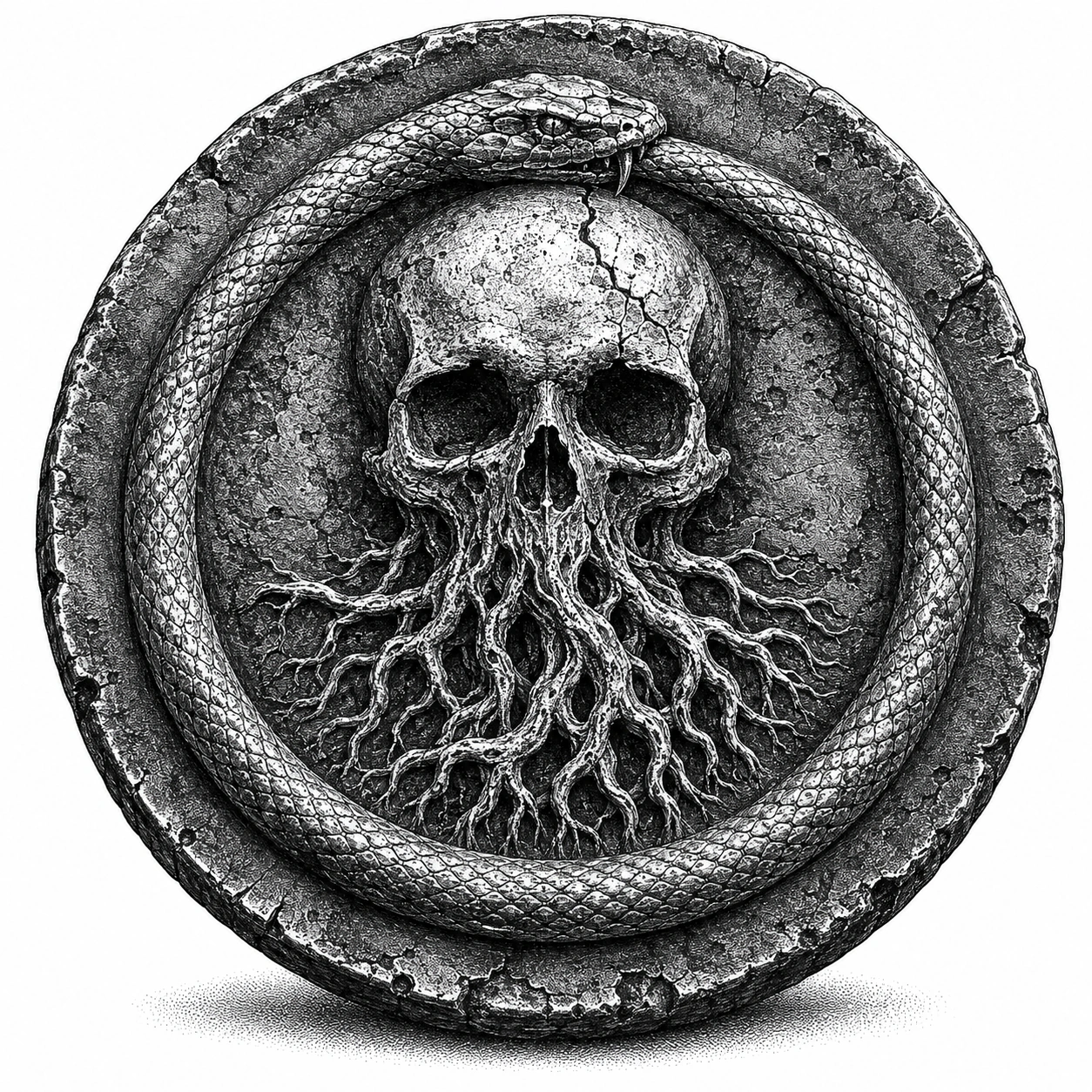
III. The Mirror of Jörmungandr
An Object in Which It Is Better Not to Seek Your Own Reflection
Some relics were created to be used.
Others seem to have been created to tempt.
The Mirror of Jörmungandr belongs to the latter category.
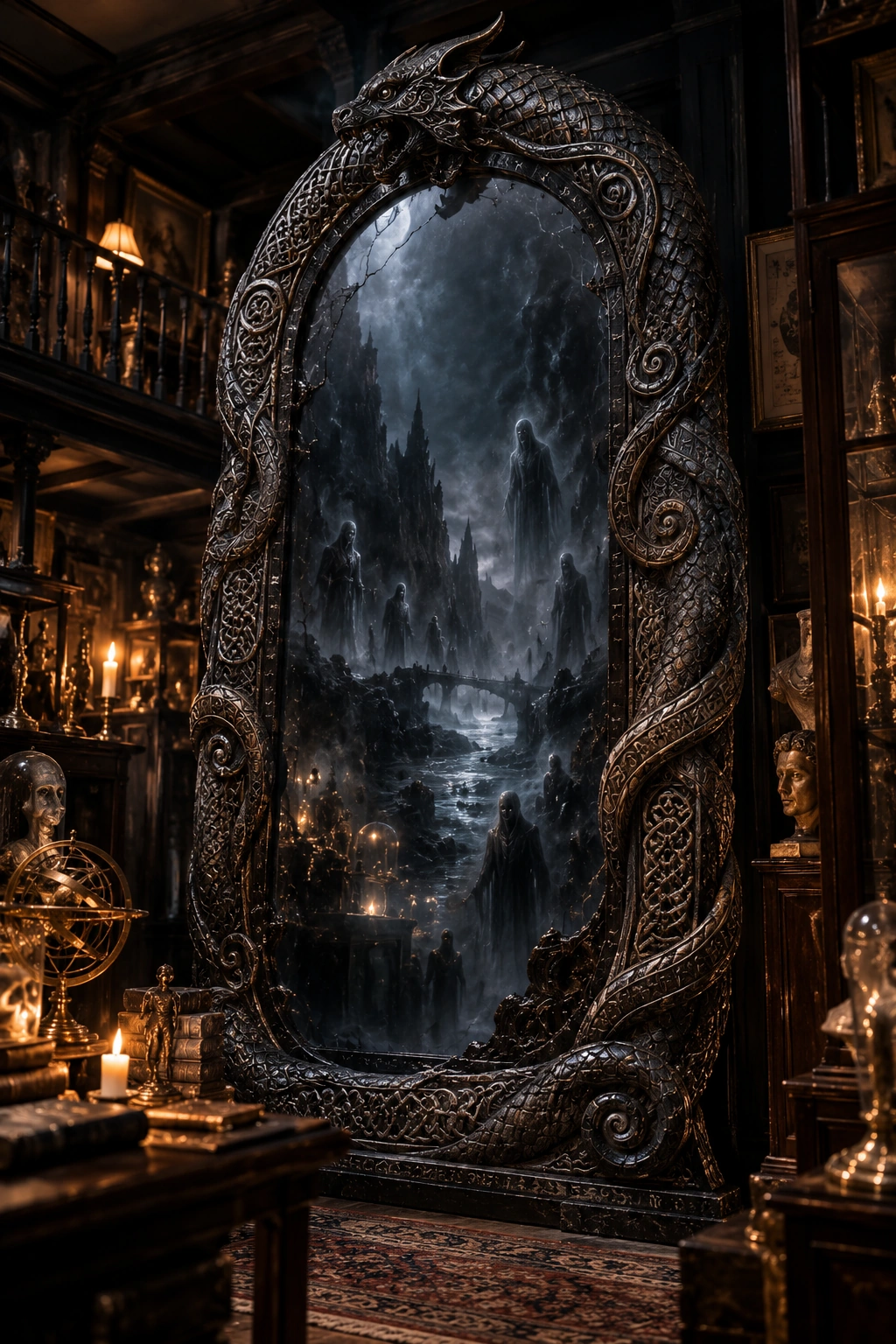
At first glance, it might be mistaken for an extraordinary antiquity of uncertain origin.
A frame of dark stone.
A reflective surface.
A serpent winding around its edge.
But one need only look carefully at the figure to recognise it.
The creature is biting its own tail.
Jörmungandr.
The Midgard Serpent.
The Circle That Never Ends
The image of a serpent devouring its own tail immediately evokes the cycle.
Beginning and end joined together.
Creation and destruction.
Death and rebirth.
Within the world of Grimwolf, that image becomes especially disturbing when connected to Jörmungandr and the prophecy of Ragnarök.
The serpent encircles Midgard.
It does not need to enter the world.
It is already around it.
The frame of the mirror reproduces the same idea.
Anyone who gazes into it is symbolically surrounded by the serpent.
And what appears beyond the glass does not always belong to the present.
A Mirror That Does Not Reflect
The most disturbing function of the artefact concerns precisely what we expect from any mirror.
A reflection.
This one can offer something else.
Its surface is connected to sight, but not necessarily to whatever stands before it.
Shadows.
Fragments.
Faces.
Possibilities.
Memories that may not belong to the person looking into it.
Images whose meaning is understood only when it is already too late.
The mirror therefore occupies a dangerous position between several of Grimwolf's fundamental themes: destiny, death and knowledge.
Because knowing the future seems like an advantage.
Until we discover that seeing something does not mean we can prevent it.
Looking to the Other Side
The artefact is also connected to one of the saga's central themes: the boundary between worlds.
Midgard is not entirely isolated.
Neither is Helheim.
Between them are places, moments and objects capable of weakening the distance.
The Mirror of Jörmungandr belongs to that category.
It does not necessarily function as a physical doorway.
Its danger is subtler.
It allows one to look.
And once someone succeeds in looking into another place, another question inevitably follows:
can whatever is on the other side look back at us?
IV. The Mask of Víðarr
Silent Vengeance
Not every artefact needs to demonstrate its power.
Some simply wait.
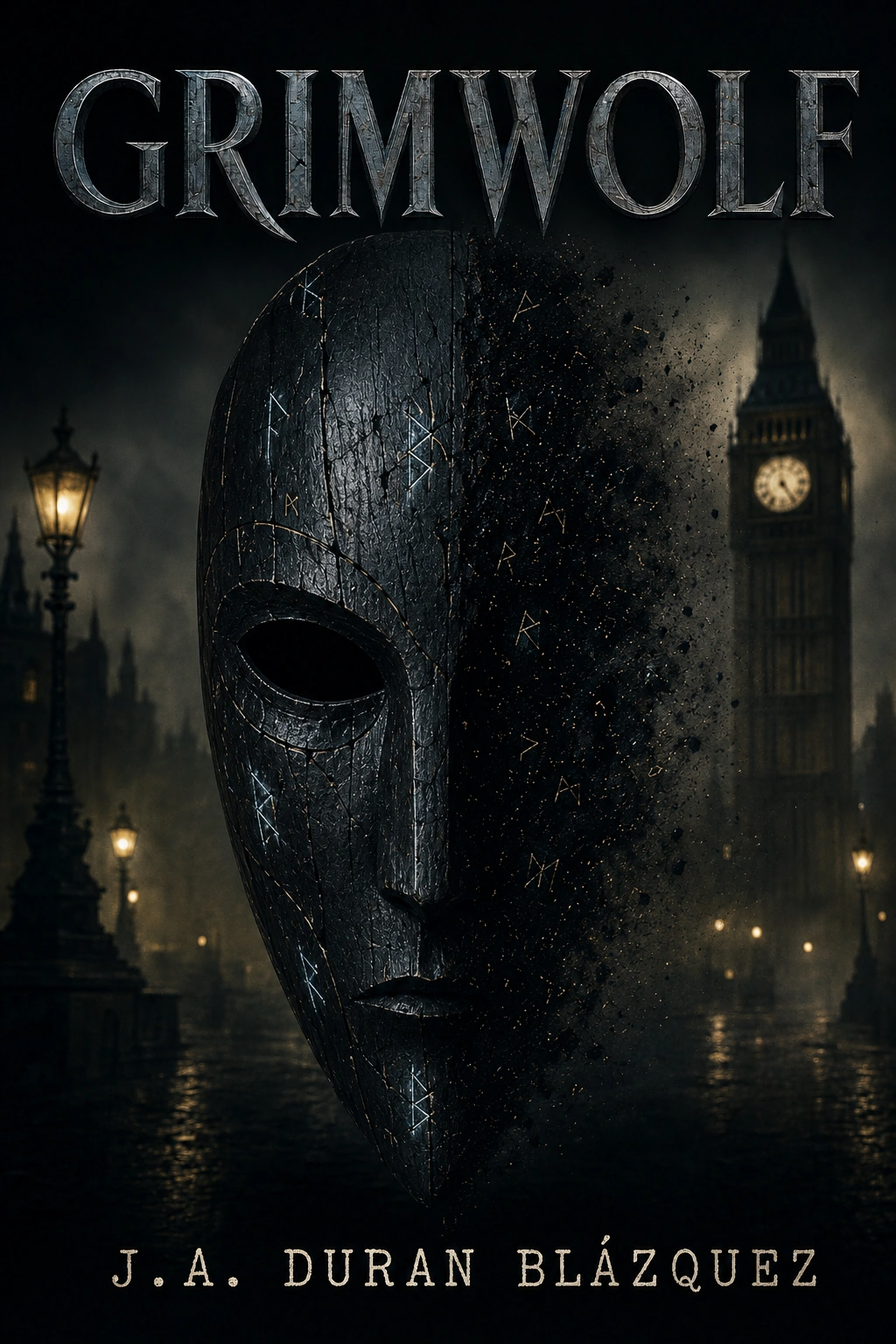
The Mask of Víðarr is one of them.
Black stone.
A matt surface.
An expression difficult to interpret.
It does not appear threatening in the same way as a sword.
It has no blade.
It needs no ammunition.
It does not move.
But when the right person approaches it, the silence is no longer empty.
Víðarr, the Silent God
Within Norse tradition, Víðarr is associated with one of the defining moments of Ragnarök.
He is the avenger.
The silent figure who endures until the moment comes to answer for Odin's death.
That association makes the mask particularly dangerous to someone consumed by the desire for vengeance.
Because the most dangerous artefacts do not always offer what a person needs.
They offer what they want.
The Whisper
When the relic recognises a presence capable of hearing it, it begins to make itself known.
It does not shout.
It does not threaten.
It whispers.
“Tak mik... ek em skuggi þinna þrána. Hefn... máttir...”
The voice promises something profoundly human.
Vengeance.
Strength.
The chance to make those responsible for suffering pay.
And that is precisely what makes it so dangerous.
The Price of Power
The relics of Grimwolf rarely offer anything freely.
Every form of power establishes a relationship.
Sometimes it demands blood.
Sometimes knowledge.
Loyalty.
Memory.
Will.
The Mask of Víðarr raises one of the most important questions surrounding the artefacts of the saga:
if an object grants you exactly the power you desire, how can you be certain that it is still your will controlling it?
The difference between carrying a relic and belonging to it can be extraordinarily small.
And Eirikr knows too well the danger of allowing another will to decide for him.
How far that temptation goes belongs within the pages of Grimwolf.
V. The Coins of Gjallarbrú
The Seal of the Last Name
Some of the most important objects in Grimwolf are also the smallest.
A coin fits in the palm of a hand.
It can be hidden in a pocket.
It can pass from one person to another without attracting attention.
And it can be placed beneath the tongue of the dead.
When Scotland Yard begins to find certain coins associated with the victims of the so-called Fog Killer, what at first appears to be a macabre signature takes on a far deeper meaning.
Two Metals for Two Worlds
The coins combine materials charged with meaning within the novel's ritual system.
Funerary silver.
Iron taken from broken weapons.
On one side appears the face of Hel.
Not as a demonic creature.
Not as a Christian representation of evil.
But with the duality characteristic of her portrayal within the world of Grimwolf:
one side beautiful.
The other dead.
On the reverse appears Jörmungandr, once again linking the object to the cosmic structure surrounding Midgard.
A tiny coin therefore contains symbols of death, passage and destiny.
Why Beneath the Tongue?
The position of the coin is as important as the coin itself.
Within the ritual system created in Grimwolf, the tongue is connected to the name and the final breath.
Identity.
That which allows a person to remain themselves after leaving the body.
The Seal of the Last Name is intended to prevent that identity from disappearing during the passage.
It is not simply money for the dead.
It is a form of recognition.
A declaration:
this soul has a name.
The Road to Gjallarbrú
In Norse mythology, Gjallarbrú is associated with the road to Hel's realm and with Móðguðr, its guardian.
Grimwolf takes these mythological elements and builds its own funerary system around them.
The coin therefore becomes a ritual safe-conduct.
The dead do not simply cross because they have died.
They must arrive.
They must preserve their identity.
They must travel the road.
And certain rules remain in force even after the heart has stopped beating.
This principle is essential to understanding the distinction between biological death and death within the cosmology of Grimwolf.
To die does not necessarily mean the journey is over.
When a Museum Stops Being a Safe Place
The existence of these objects also transforms the way we perceive the settings of the novel.
A museum is no longer merely a museum.
An antiquarian shop ceases to be an eccentric business.
A private collection may conceal something far more dangerous than a stolen artefact.
A warehouse may contain an object someone has spent decades searching for.
And an apparently inert relic may have spent centuries waiting for the right person to appear.
That is one reason archaeology occupies such a distinctive place within the world of Grimwolf.
The past is not dead.
It is stored.
Catalogued.
Buried.
Displayed behind glass.
Or hidden in rooms almost no one is allowed to enter.
Collectors Who Know Too Much
There is also a fundamental difference between owning an antiquity and truly knowing what one possesses.
Most collectors seek objects for their rarity, beauty, provenance or monetary value.
Other characters in Grimwolf have very different motivations.
They search for specific names.
Specific symbols.
Specific materials.
Objects mentioned in documents no historian would consider reliable.
To them, an auction can become an excavation.
A private collection can become an arsenal.
And an antiquarian's catalogue may contain something far more important than its asking price.
That is why certain families, organisations and collectors have spent generations searching for relics whose value cannot be expressed in pounds sterling.
Who Should Possess a Divine Artefact?
The question runs throughout this catalogue.
A museum?
A government?
The person who found it?
The descendant of its former owner?
Someone capable of using it?
No one?
A sword behind glass seems safe until we discover that perhaps the glass is not what prevents it from awakening.
A mask locked inside a room appears harmless until someone hears its voice.
A mirror covered by a cloth still exists on the other side of that cloth.
And destroying a relic does not necessarily guarantee the destruction of whatever it contains.
In the world of Grimwolf, possessing an ancient object may also mean accepting a responsibility whose origins began centuries before its new owner was born.
Archaeology of a Forgotten War
The relics of Grimwolf allow something even greater to be reconstructed.
They are not isolated objects.
They are fragments.
Material evidence of events that humanity first transformed into legend and later into mythology.
A blade preserves a technique that should not exist.
A dagger remembers the power of the Vanir.
A mask preserves the promise of a silent god.
A mirror gazes upon the boundaries of destiny.
A coin prepares a dead soul to travel a road that modern science insists does not exist.
Seen separately, they appear to be anomalies.
Together, they tell another story.
Archaeology then ceases to be the study of a dead past.
It becomes the map of a war that may never have ended.
Because every sword, mask, mirror or coin preserves something of those who created it.
Blood.
Memory.
Oaths.
Will.
And some relics have waited for centuries for someone to speak their names again.
The gods may be forgotten. Their weapons are more patient.
Explore the Relics and Mythology of Grimwolf
Grimwolf: London 1930 combines dark fantasy, historical thriller, Norse mythology and criminal investigation in a Europe where objects from the past may conceal a history very different from the one displayed in museums.
In other articles on this website, we will explore the runes, the Vanir gods, Helheim, Yggdrasil and the relics that connect the world of humankind with the other realms of the Grimwolf cosmology.
Some objects belong in a museum. Others should have remained buried.