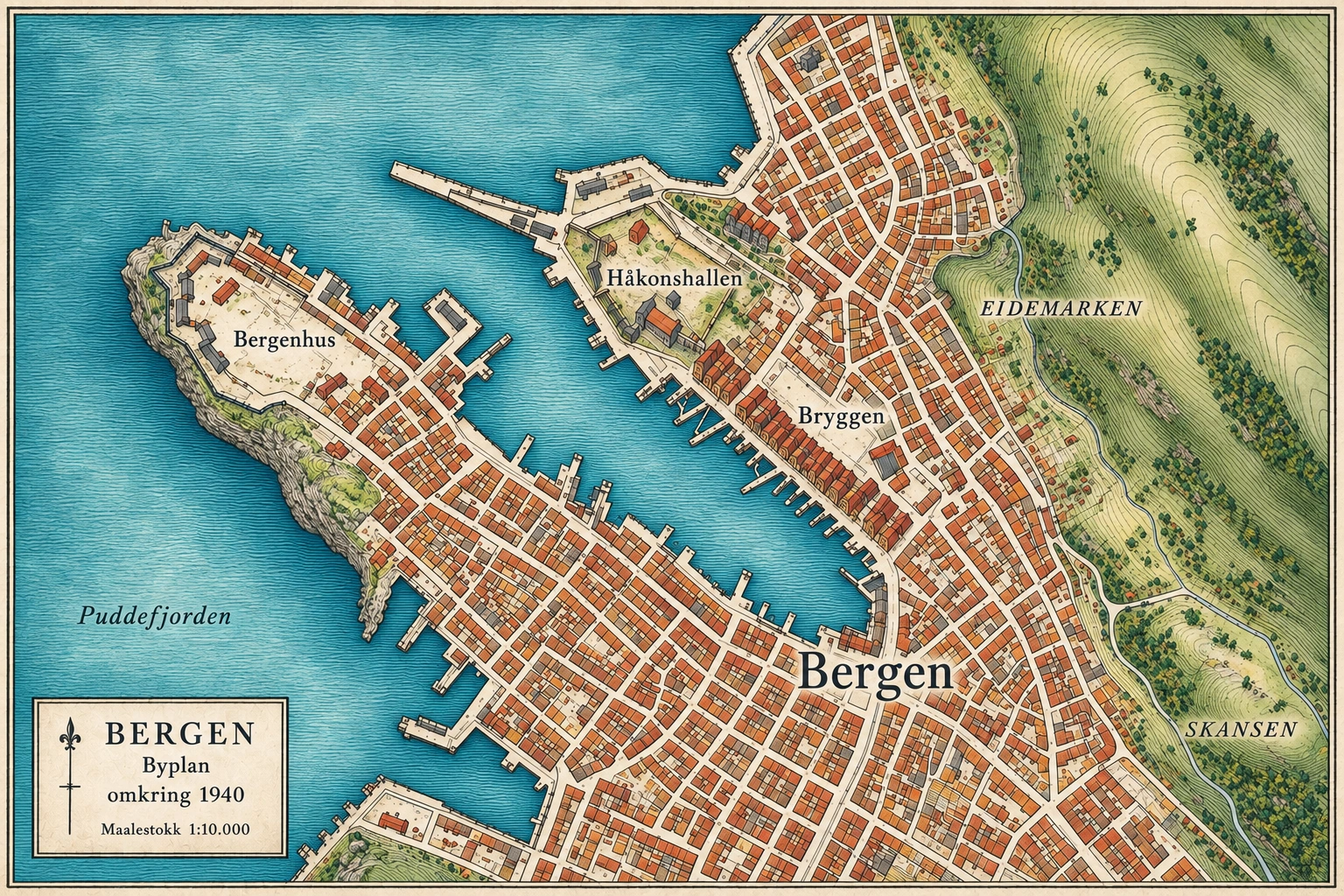
Bergen, Bryggen and the harbour world at the centre of Max’s early story.
Before the forests of Nordland, before Thorvald’s cabin, before Skoll, Eira and the roots of Yggdrasil, Max belongs to Bergen.
It is the city he understands.
Or believes he understands.
In 1931, Bergen was a place where centuries occupied the same streets. Electric trams crossed a city whose harbour had been trading with Europe since the Middle Ages. Motor buses were beginning to compete with the tramways. Fishing boats unloaded beside steamships. Merchants conducted business within walking distance of wooden warehouses whose origins belonged to a commercial world hundreds of years older than they were.
For a twelve-year-old boy, all of this would simply have been home.
The harbour would smell of fish, salt, wet timber and fuel. Ships would arrive carrying strangers. Men would disappear into warehouses. Carts and vehicles would move cargo through streets crowded with workers and customers. Beyond them stood the dark wooden passages of Bryggen.
And beyond Bergen itself waited the sea.
In The Wolf and the Snow, Max’s discovery of the supernatural does not begin with a spell or an ancient god.
It begins when three children enter a warehouse where they should never have gone.
To understand why that beginning belongs in Bergen, we need to walk through Max’s city.
A CITY FACING THE SEA
Bergen had been shaped by the sea for almost its entire existence.
Founded during the Middle Ages and developed into one of northern Europe’s important trading centres, its geography made the relationship inevitable. Mountains enclosed the city from the landward side while Vågen, its sheltered harbour, opened toward the North Sea.
For centuries, ships brought Bergen wealth, food, news and strangers.
That relationship remained visible in 1931.
Fishing vessels, ferries and steamships occupied the harbour. Contemporary photographs show fishing boats beside the quays, wooden boxes stacked around the Fish Market, women and men selling the catch, and vessels lying almost against the urban streets. Photographs from the same period show herring boats filling Bergen harbour with their catch.
Yet this was no city frozen in the nineteenth century.
Bergen had operated electric trams since 1897. The municipality had expanded and modernized the system after taking control of it in 1917, and by Max’s childhood the tram was an ordinary feature of urban life. The first municipal buses appeared in 1928, followed by permanent routes, including a connection between Torgallmenningen and Laksevåg by 1930.
That combination matters.
Max could hear an electric tram and, minutes later, find himself beside buildings whose basic arrangement reached back through centuries.
Modernity had arrived.
It had simply failed to erase what came before.
For Max, Bergen is not historical scenery. It is his territory.
He knows where the streets lead. He knows the harbour. He knows which corners belong to adults and which can be claimed by children.
And he knows Bryggen.
At least, he thinks he does.
BRYGGEN
A Wooden City of Warehouses and Passageways
From the harbour, Bryggen presents a wall of narrow wooden buildings.
Walk between them and the city changes.
The façades give way to passages running deep between rows of timber structures. Galleries cross overhead. Doors lead into rooms and storerooms. Staircases climb into darkness. The harbour remains only metres away, yet the open space of Vågen disappears behind wood.
This arrangement was the product of centuries of trade.
The Hanseatic League established its Bergen trading office at Bryggen during the fourteenth century and dominated the district for almost four hundred years. After the catastrophic fire of 1702, the buildings were reconstructed following the older property pattern, preserving the characteristic narrow rows stretching back from the waterfront.
Long before Max was born, Bryggen had therefore become something unusual: an old commercial machine that continued to exist inside a modernizing city.
Its architecture had been designed around goods.
Stockfish from northern Norway had been one of the great commodities of the Hanseatic trade. Warehouses received, stored and moved merchandise between ships and merchants. Bergen's archaeological record reveals the extraordinary reach of those connections: goods and objects arrived from across Europe and even farther afield.
By 1931, the Hanseatic merchants were long gone.
Their spaces were not.
For three curious children, the attraction is obvious.
A warehouse door.
A passage nobody appears to be watching.
The possibility that something interesting might be inside.
In The Wolf and the Snow, Max explores the old harbour with Axel and Ragnhild and enters what seems to be an abandoned warehouse.
Instead of forgotten fishing equipment or empty crates, they find rifles and bundles of money.
Then they hear men coming.
The childhood expedition ends immediately.
What follows is a pursuit through Max’s familiar world, except that familiarity suddenly works against him. Doors, passages and warehouses that once invited exploration become places where someone can hide.
Or wait.
The fictional contraband belongs to the novel.
The physical world capable of concealing it belonged to Bergen.
THE HARBOUR WORLD
Ships, Sailors and Goods from Beyond Norway
A harbour is never entirely owned by the city surrounding it.
Every arriving ship brings another place with it.
In Bergen, that had been true for centuries.
The city’s commercial importance grew from its ability to connect Norwegian resources with foreign markets. Medieval merchants linked it with northern Europe; later generations maintained maritime connections with Britain, Germany, Denmark and ports farther away.
The result was a city accustomed to outsiders.
Sailors.
Captains.
Merchants.
Dockworkers.
Fishermen.
Agents.
Travellers.
Men looking for work.
Men looking for something else.
The Fish Market provides a useful glimpse into that world. Photographs from the 1930s show an environment that was functional rather than picturesque: fish laid out for sale, wooden containers, workers and customers moving through an active commercial space. Nearby photographs record fishing vessels and ferries working the harbour around the same period.
For Max, these people would form part of the background noise of childhood.
A foreign accent would hardly mean danger.
A sailor carrying a bag would attract little attention.
Cargo moving through a warehouse would be ordinary.
And that anonymity is important to the fictional Bergen.
The Broderskap does not need a secret fortress above the city.
It needs businesses.
Money.
Ships.
Warehouses.
Men willing to keep quiet.
Bergen provides the machinery of legitimate commerce, and the novel imagines what an organization hidden inside that machinery could accomplish.
Ports have always moved more than merchandise.
They move rumours.
Weapons.
Information.
People.
Secrets.
A TWELVE-YEAR-OLD’S BERGEN
There is another reason Max’s first adventure works better in Bergen than it would in a more controlled modern city.
His world is walkable.
The boundaries between neighbourhood, workplace and harbour are porous. Children inhabit streets also occupied by workers, carts, trams, customers and sailors.
Bergen’s historical record preserves glimpses of ordinary life that make the city feel surprisingly close. Shops served surrounding neighbourhoods. Bakeries, barbers and small businesses occupied buildings embedded within residential districts. By the late 1920s, the city even had beauty institutes advertising massage and foot care while traditional neighbourhood businesses continued nearby.
The old and new existed together.
Children did the same.
Max, Axel and Ragnhild therefore do not need an expedition into remote wilderness to find adventure.
Their wilderness is urban.
A quay can become a frontier.
An unlocked door becomes an invitation.
A warehouse becomes a cave.
The difference is that caves usually contain stones.
This one contains guns.
That discovery is important because Max begins the novel with the confidence of a child who believes he understands danger.
He can run.
He can hide.
He knows the streets.
Then armed adults start hunting him.
During the pursuit, something stranger happens.
Max discovers that his body can do things it should not be able to do.
He runs faster.
Jumps farther.
Survives situations that should trap him.
For the reader, the supernatural world has opened.
For Max, something far more frightening has happened.
His own body has become unfamiliar.
And then Thorvald appears.
WHAT MOVED THROUGH THE WAREHOUSES
Trade, Money and Contraband
The rifles hidden in Max’s warehouse are fictional, but the setting is deliberately mundane.
That makes them more convincing.
A functioning port already possesses much of what a smuggling network requires: cargo, storage, ships, paperwork, money and constant movement.
Nothing needs to look suspicious if everything looks busy.
Bergen's commercial spaces had handled goods for centuries. Bryggen itself grew around storage and international exchange, while the wider harbour remained filled with fish traders, exporters, vessels and warehouses well into the twentieth century. Historical photographs from the late 1920s and early 1930s document warehouses used by fish merchants, export businesses, fishing vessels and large quantities of herring moving through the port.
The year matters too.
1931 was a difficult moment in Europe.
The international economic crisis struck Norway severely. Industrial production declined, unemployment rose and labour conflict intensified. The political stability that later generations sometimes associate with Scandinavia should not be projected backward onto this period.
Europe had survived one enormous war.
Another was still eight years away.
Nobody in Max’s Bergen could know what was coming.
That uncertainty is useful territory for The Wolf and the Snow.
Its weapons conspiracy does not claim that the historical Bergen harbour contained the Broderskap or the particular arms cache discovered by Max. Those belong entirely to the fictional world.
But the city gives the conspiracy somewhere credible to breathe.
A crate is unloaded.
A ledger is altered.
Money changes hands.
A warehouse door closes.
From the street, Bergen continues with its day.
BERGEN AFTER DARK
Rain, Winter and the Geography of Fear
Then evening comes.
Bergen changes.
The mountains reduce the horizon. Vågen becomes black water broken by reflected lights. Timber darkens in the rain. The passages between the Bryggen buildings lose whatever warmth daylight gave them.
Footsteps sound different on wet streets when there is nobody beside you.
The harbour does too.
Rigging moves.
Water strikes wood.
Somewhere, machinery stops.
Somewhere else, a ship announces itself.
Bergen's famous rain requires little invention, but atmosphere alone is not what makes the city useful to the novel.
It is the geography.
Open water lies beside enclosed passages.
Broad streets lead toward narrow ones.
Warehouses provide enormous dark interiors close to busy public spaces.
Centuries-old buildings stand within a functioning twentieth-century port.
A man can disappear around a corner.
So can a child.
And when mist moves across Vågen, distance becomes difficult to judge.
The historical Bergen already possesses much of the visual language of a supernatural thriller.
It does not require ghosts.
It requires darkness.
Rain.
Wood.
Water.
And someone following you.
THE BERGEN BENEATH BERGEN
History, Legend and the World of the Novel
This is where historical Bergen ends and the deeper geography of The Wolf and the Snow begins.
The distinction matters.
Mariakirken is real.
Standing behind Bryggen, St Mary’s Church is Bergen’s oldest surviving building, part of the medieval landscape that grew around the harbour. Bryggen itself stands over traces of much older settlement; archaeological remains beneath the modern city preserve structures dating back to Bergen’s earliest centuries.
Bergenhus is real.
At the northern end of Vågen stands Håkonshallen, commissioned by King Håkon Håkonsson between 1247 and 1261. It served as a royal ceremonial hall and later passed through centuries of radically different uses, including military storage. In the nineteenth century its medieval significance was rediscovered, and between 1910 and 1916 its interior received extensive decorative work by Gerhard Munthe.
That last detail is particularly important when imagining Max’s Bergen.
The Håkonshallen a person saw in 1931 was not exactly the building visitors see today.
In 1944 an explosion in Bergen harbour caused its roof to collapse and the interior to burn. The restoration visible today was completed after the war.
So the Bergen of Max is already partly lost.
Then the novel digs beneath it.
In The Wolf and the Snow, Anna and Thorvald eventually return to Bergen and discover a second city concealed underneath the first.
Beneath Bryggen lies the echo of an ancient catastrophe.
The novel connects Bergen with Bergelmir and the blood of the primordial giants. A hidden source of power survives below the city. Passages beneath Mariakirken lead toward Bergenhus. Beneath Håkonshallen, Anna reaches a secret Vanir chamber containing an impossible lake — part blood, part memory, part oracle — capable of revealing movements through time.
None of this is presented as historical fact.
It is the mythology of the novel.
Yet its physical anchors are deliberately real.
That relationship is central to The Roots of the World.
The mythology of The Wolf and the Snow does not replace Bergen’s history. It grows beneath it.
REAL BERGEN / FICTIONAL BERGEN
The boundary can be drawn clearly.
The harbour is real. The Broderskap network controlling parts of it is fictional.
Bryggen is real. Its historic wooden trading buildings, warehouses and passages are real. The supernatural power hidden beneath them belongs to the novel.
Mariakirken is real. The secret route used by Anna and Thorvald is fictional.
Bergenhus and Håkonshallen are real. Håkonshallen has stood beside Vågen for more than seven centuries. The Vanir oracle beneath it exists only in Max’s world.
The same principle applies to Hjalmar Skjold.
His bank.
His influence.
His Æsir blood.
The Broderskap’s arms network.
All fictional.
What matters is that the invented layer attaches itself to places with genuine historical depth.
Bryggen really has burned and been rebuilt.
Real structures lie beneath modern Bergen.
Real archaeological excavations have uncovered traces of the city’s earliest buildings, medieval tools, ceramics, everyday objects and runic inscriptions. Those inscriptions include mundane messages connected with ordinary medieval life, an extraordinary reminder that the people beneath the mythology were once simply people.
This creates the narrow territory in which historical fantasy becomes most convincing.
A cellar can be historical.
A sealed doorway can be plausible.
What waits behind it can belong to legend.
WHERE MAX’S STORY BEGINS
None of this means anything to Max when we first meet him.
He is twelve.
Bergen is home.
Bryggen is somewhere to explore with Axel and Ragnhild.
Warehouses are places where adults store boring things.
The old buildings around him belong to the ordinary landscape of childhood.
Then he opens the wrong door.
Inside are rifles.
Money.
Men who are willing to kill three children to protect whatever is moving through the harbour.
Max runs.
And something buried inside him begins to answer.
His speed is wrong.
His strength is wrong.
The impossible jumps during his escape are the first cracks in the ordinary explanation of his life.
Yet Max still makes the most human choice available to him.
He could escape.
Instead, he goes back for Axel and Ragnhild.
That decision leads him into the trap and brings Thorvald out of the shadows.
His grandfather has spent years trying to keep the old conflict away from the family. Now the conflict has found Max inside his own city.
By the end of that night, Bergen means something different.
The harbour is still there.
The trams still run.
Rain still falls over Bryggen.
Ships still enter Vågen.
Yet Max has learned that another map exists beneath the one he knows.
His family belongs to it.
So do the men hunting him.
Thorvald takes him away from Bergen that same night.
Soon there will be Nordland.
Snow.
A cabin in the wilderness.
A white dog named Skoll.
A bow.
A woman called Eira who leaves no footprints.
And the discovery that the roots beneath an ordinary tree can lead somewhere far older than Norway.
But Max’s story does not begin beneath that tree.
It begins here.
Among wet streets and wooden warehouses.
Beside a harbour that has carried strangers and secrets into Bergen for centuries.
With three children opening a door.
And a boy discovering that the city he has known all his life has another world beneath its feet.