Before the gods go to war, humanity has already begun destroying its world.
In Norse mythology, Ragnarök represents far more than a final battle. It is the collapse of an order. Oaths are broken, bonds unravel, violence spreads, and the known world moves towards a destruction that seems inevitable.
In Grimwolf: London 1930, the first volume of the Grimwolf saga, that process does not begin with giants striding across Midgard or gods taking up their weapons.
It begins with people.
With the unemployed queuing for food.
With veterans who returned from a war only to discover there was no longer a place for them.
With workers fighting in the streets.
With political parties turning desperation into hatred.
And with wealthy men discovering that even chaos can become a business.
That is why 1930 is more than the year in which the novel takes place.
It is part of the plot.
Europe After the Great War
The First World War had ended twelve years earlier, but Europe was still living among its dead.
Millions had died. Others returned physically maimed or psychologically scarred. Empires that had seemed immovable for generations disappeared or fragmented. Borders shifted, and new democracies had to be built upon traumatised societies.
Peace had not resolved all the problems that had caused the war.
It had created others.
Germany offers one of the starkest examples.
Defeat, reparations, political instability and successive economic crises turned the Weimar Republic into a battleground where competing visions of the future clashed violently.
Then came 1929.
The financial collapse that began in the United States spread through a deeply interconnected international economy.
When Grimwolf begins, Europe does not yet know the full consequences of that crisis.
The reader does.
And that difference is crucial.
We know where 1930 is heading.
The characters do not.
Hamburg: A City Staring into the Abyss
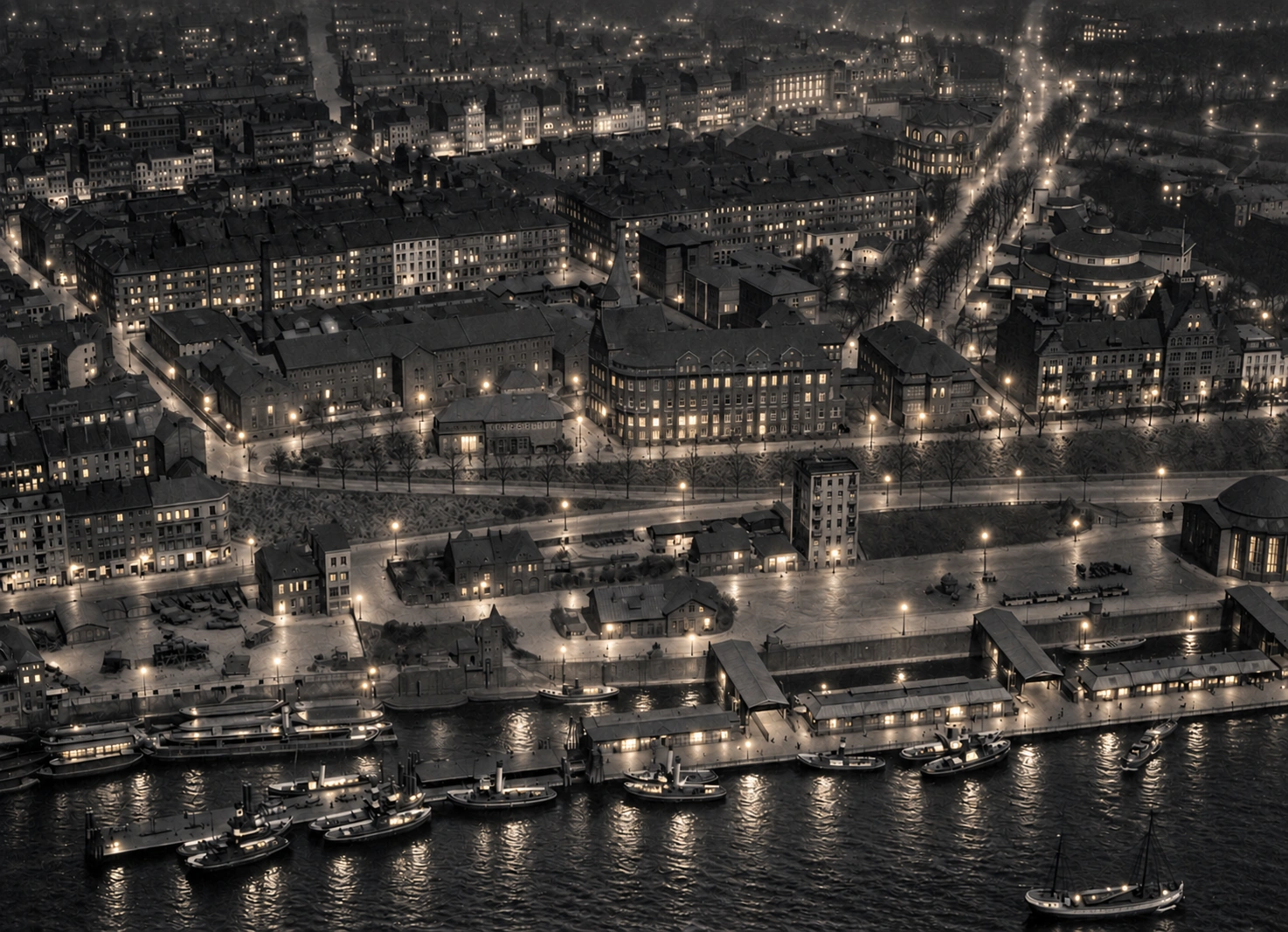
Hamburg embodies that tension.
It is a port city connected to the world, through which goods, ships, workers, businessmen, criminals, prostitutes, sailors and refugees from every walk of life pass.
It is also a city where the contradictions of Weimar Germany are difficult to conceal.
In Grimwolf, the harbour and its surrounding neighbourhoods reveal a society where wealth and destitution can exist only a few streets apart.
There are men who still bear the wounds of the Great War.
Workers who do not know whether they will have a job the following week.
Sailors travelling across Europe in search of a port where there is still something left to transport.
And political organisations that understand exactly what can be done with all that frustration.
Turn it into soldiers.
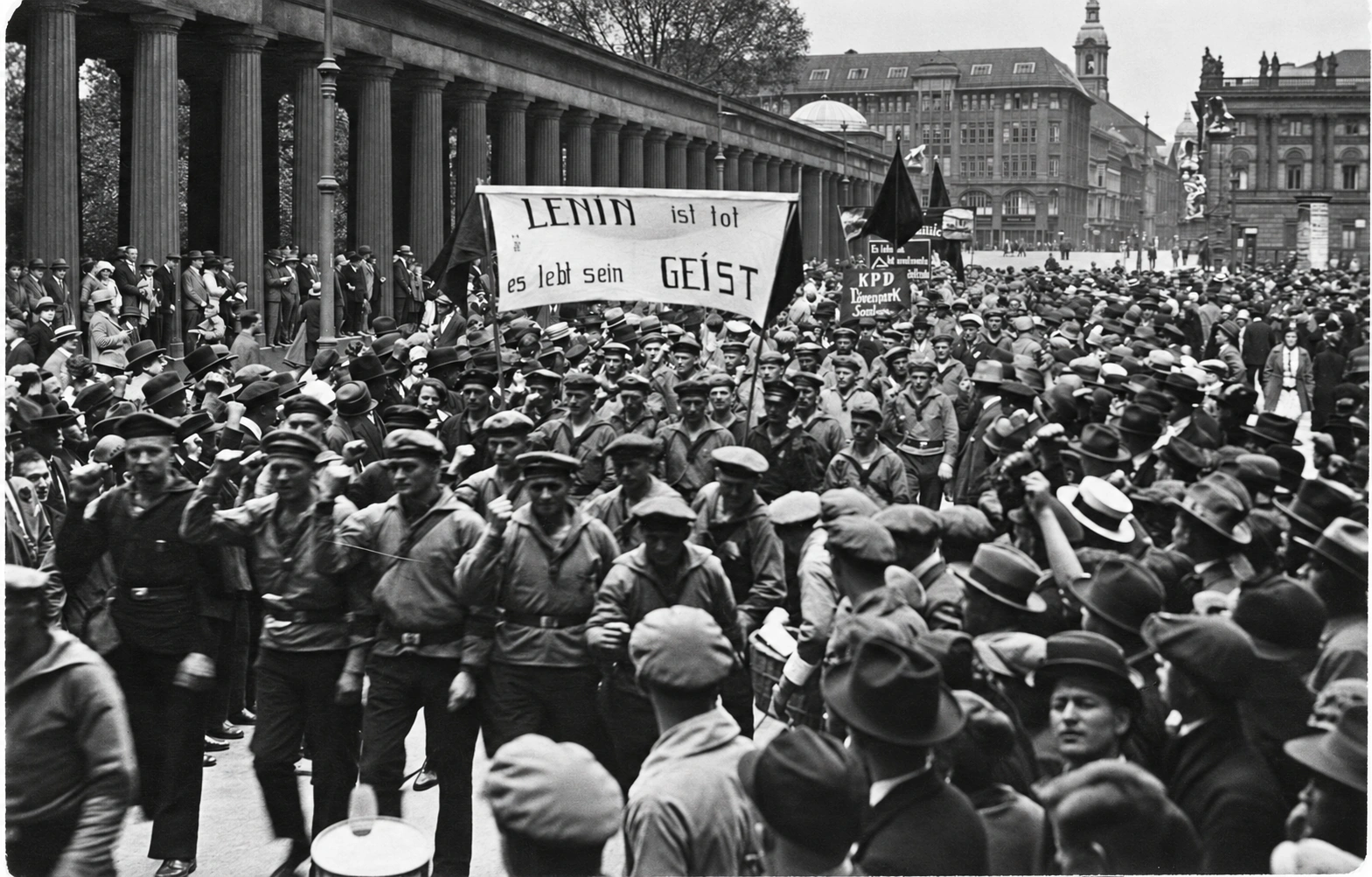
The Reeperbahn: When Politics Leaves Parliament
The Reeperbahn in Grimwolf is more than a place of cabarets, alcohol and nightlife.
It is also a political arena.
Streets become contested territory.
Uniforms immediately reveal which side a man belongs to.
Songs cease to be mere songs and become displays of strength.
A glance can become a provocation.
A stone can lead to a gunshot.
And a gunshot can turn an entire street into a battlefield.
The presence of the Sturmabteilung, the SA or Brownshirts, brings the organised violence associated with the rise of National Socialism into the novel.
Opposing them are communist activists and men associated with the Rotfrontkämpferbund, the Red Front Fighters’ League, whose prohibition did not necessarily mean the immediate disappearance of its networks, sympathisers or former members.
The two extremes confront one another in streets where the state seems increasingly unable to maintain stability.
Then someone throws a stone.
Then comes the first blow.
Then the first gunshot.
And soon nobody remembers exactly who started it.
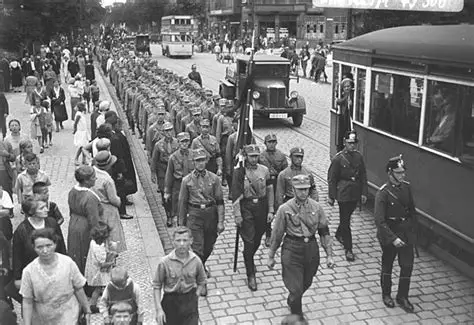
“The Law Changes Uniform from Street to Street”
This idea captures one of the political problems running through the German sections of Grimwolf.
When institutions lose legitimacy, people begin seeking protection elsewhere.
Political parties.
Militias.
Trade unions.
Underground organisations.
Secret societies.
Criminals.
Powerful men.
The uniform determines who holds authority on each street corner.
To Eirikr, all of this seems especially absurd.
He watches men willing to kill and die for flags, parties and slogans that will probably disappear long before the forces he knows.
The man some call Wolf has a different perspective.
He has seen too much.
And he knows that human beings do not need gods to find reasons to kill one another.
Ragnarök Before Ragnarök
Here lies one of the most important thematic connections between history and mythology in Grimwolf.
Ragnarök need not be understood solely as a future supernatural event.
It can also be understood as a pattern.
Before destruction comes the erosion of order.
Social bonds break down.
Violence ceases to be exceptional.
People begin to distrust one another.
Institutions lose authority.
The old rules stop working.
In this sense, the interwar Europe of Grimwolf behaves like a world already entering its own Ragnarök.
And the reader knows something the characters do not.
Europe is barely nine years away from going to war again.
London Is Not Safe Either
Crossing the English Channel does not mean leaving the crisis behind.
London remains the capital of a vast empire, but political and economic power do not eliminate poverty within its own boundaries.
The novel deliberately explores that contradiction.
There is the London of government buildings, private clubs, Scotland Yard and families capable of moving enormous sums of money.
And there is another London.
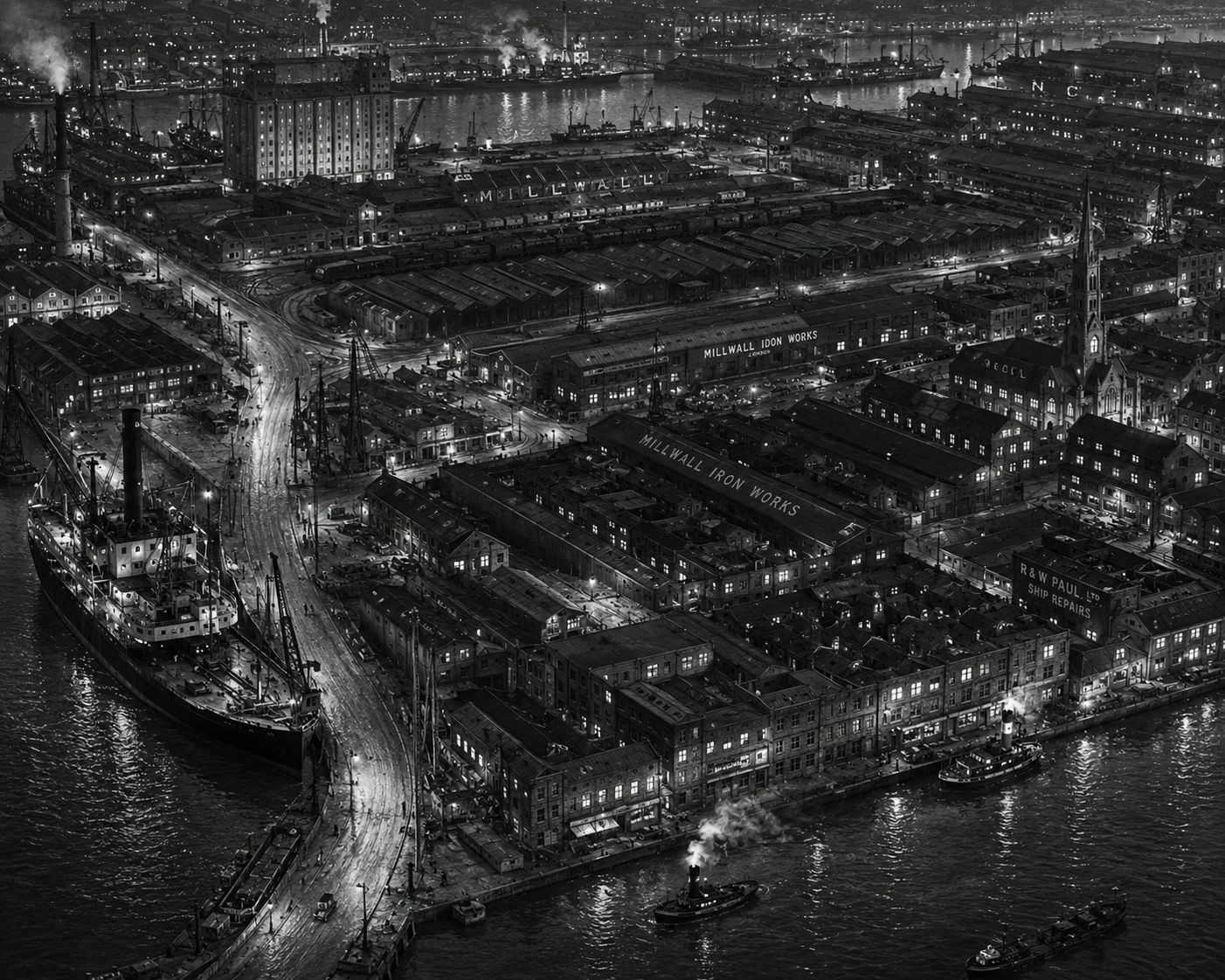
The London of the docks.
Of boarding houses.
Of workers hoping to secure a day’s employment.
Of women for whom a few coins can determine whether they eat that night or sleep under a roof.
Both Londons belong to the same city.
But they rarely inhabit the same world.
Wapping and Millwall: The Empire Seen from the Docks
The docks offer a view of the Empire from below.
Goods arrive from distant places.
Food.
Raw materials.
Manufactured products.
Objects whose origins the men unloading them may never know.
To the great merchants, they represent figures.
To the dockworkers, they represent hours of labour.
That difference matters in Grimwolf.
Prosperity exists, but it is unevenly distributed.
A cargo may be worth a fortune while the men handling it can barely support their families.
And when trade contracts, financiers are not necessarily the first to feel it.
Those waiting by the harbour for someone to hire them are.
The international crisis acquires a human face.
Soho: When Survival Comes at a Price
Poverty also plays a central role in the portrayal of the victims.
Characters such as Alicia Murray and Nancy do not exist merely to provide bodies for an investigation.
They represent people living on society’s margins.
Women for whom prostitution can become a means of survival in a city offering few alternatives.
This also changes how the murders are understood.
The criminal can act because certain lives receive less attention than others.
A poor woman can disappear.
A prostitute can die.
And for long enough, the city can continue functioning as though nothing has happened.
The arrival of the so-called Fog Killer adds another layer of fear.
The streets that provide an income can also become the place where death waits.
Poverty forces people to remain precisely where the danger is greatest.
Klaus Hartmann and the Memory of Money Reduced to Paper
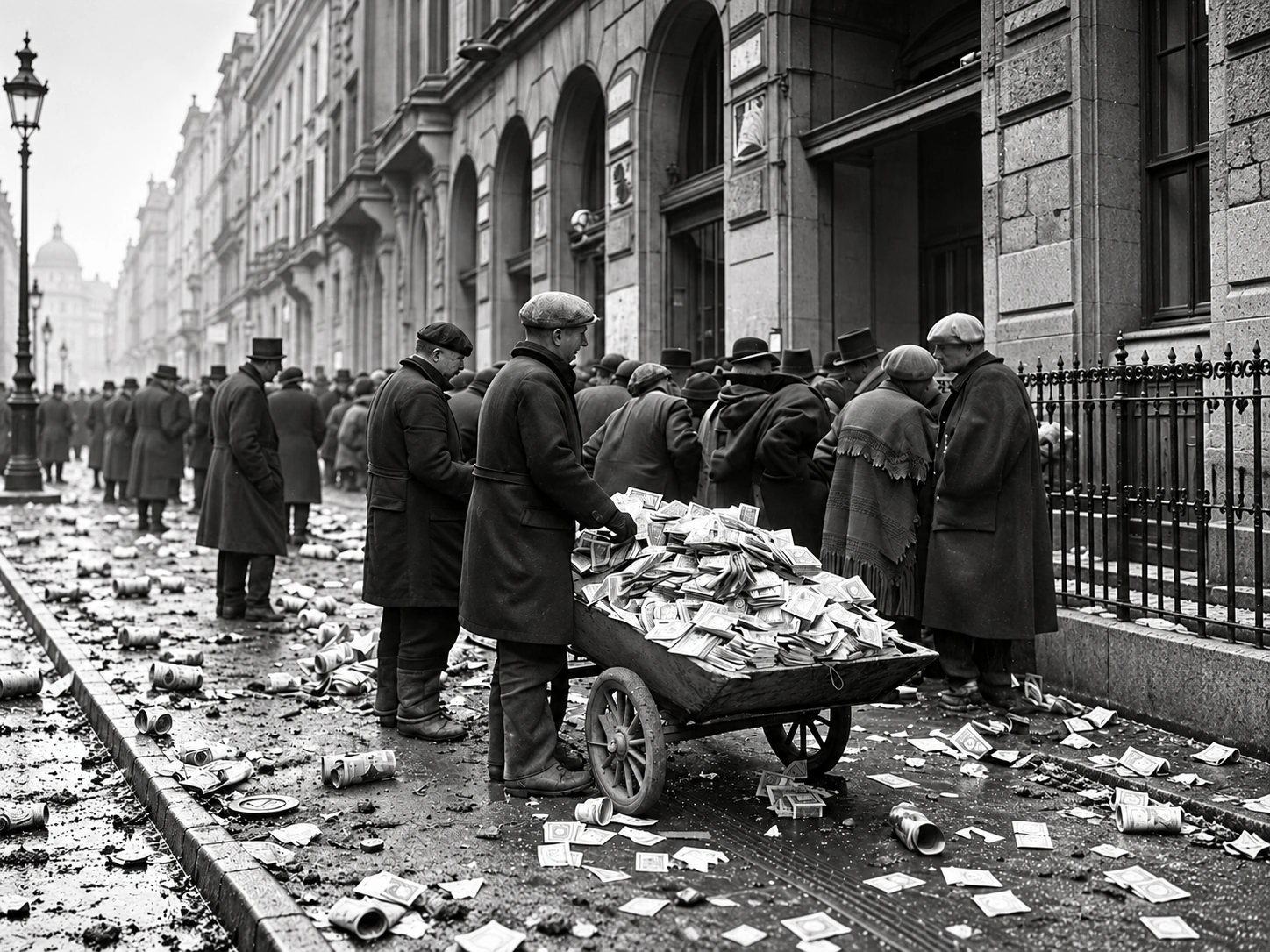
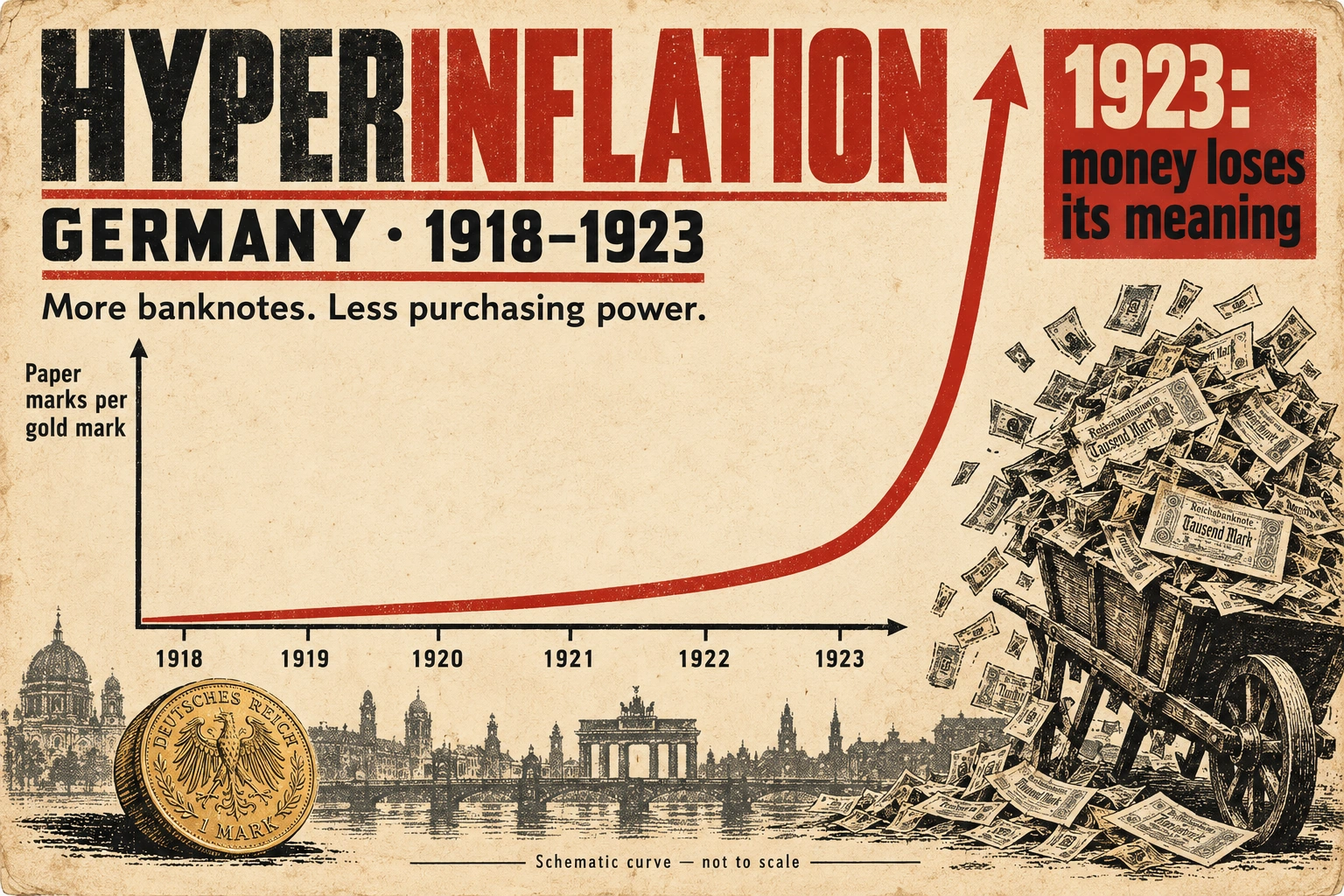
Klaus Hartmann connects the novel’s present with an earlier German trauma: hyperinflation.
For those who experienced Germany’s monetary collapse in 1923, money temporarily ceased to represent security.
Prices could change at absurd speeds.
Savings accumulated over years could vanish.
The currency that was supposed to guarantee stability became little more than paper.
That experience left something deeper than poverty.
It left distrust.
When another international economic crisis arrives, part of the population has already learned that things which seem secure can disappear.
Employment.
Savings.
Government.
Order.
The future.
And when a society loses faith in the future, those who promise to restore it acquire extraordinary power.
Even when the price of that promise is finding someone to blame.
Desperation Needs Someone to Blame
Extremist movements rarely sell ideology alone.
They sell explanations.
If you have no job, someone is to blame.
If you lost your savings, someone stole them.
If your country was defeated, someone betrayed it.
If you are afraid, someone must be the enemy.
The Europe depicted in Grimwolf is full of people seeking simple answers to extraordinarily complex problems.
That need provides fertile ground for radicalism.
But the novel introduces another question.
What happens when those fuelling these conflicts do not even believe in the ideologies they finance?
Wilhelm von Fersen: The Man Who Backs Every Side
Enter Wilhelm von Fersen.
Von Fersen does not embody the fanatic.
He embodies something perhaps more dangerous.
The man for whom other people’s ideology is simply a business opportunity.
While others argue about revolution, nation, race or social class, he sees demand.
Weapons.
Ammunition.
Ships.
Contacts.
Money.
Silence.
Everything has a price.
His power does not come from persuading the masses.
It comes from being able to supply what they will need when they begin killing one another.
Der Silberne Schatten: Business While the World Burns
The cabaret Der Silberne Schatten provides the perfect counterpoint to Hamburg’s streets.
Outside, there is unemployment, fighting and fear.
Inside, there are alcohol, music, politicians, businessmen, former military officers and men who can afford to make certain things happen.
Or ensure that nobody ever learns they happened.
Von Fersen moves comfortably in this environment because he understands something fundamental: crises destroy fortunes, but they also create opportunities to build new ones.
While some men fight for symbols, others sell the weapons.
While some die for a cause, others calculate the profit.
While the police struggle to maintain order in the streets, certain offices work to keep chaos profitable.
The Broderskap: Power Without a Flag
Within the fictional universe of Grimwolf, the Broderskap takes this logic further still.
It does not need to control the government.
It does not need to win elections.
It does not even need a particular ideology to triumph.
Its power comes from networks.
Information.
Smuggling.
Political contacts.
Money.
Favours.
People placed in the right positions.
An arms shipment can travel under apparently innocent paperwork.
A crate officially intended to carry machinery can contain something entirely different.
An official can look the other way.
A politician can receive money.
A ship can change its destination.
Violence that later appears spontaneous may have required months of logistical preparation.
“Both Will Need Weapons”
Von Fersen’s philosophy is distilled into one of his most revealing statements:
“The communists want to destroy the rich. The Nazis want to use them. Both will need weapons, money, ships and men capable of making bodies disappear. I can provide all four.”
The line matters because Von Fersen does not need to decide who is right.
To him, the question is irrelevant.
If one side wins, he will negotiate with them.
If the other wins, he will find a way to make himself useful.
His true loyalty lies elsewhere.
That moral indifference makes him particularly suited to the world of Grimwolf.
Fanatics can start a war.
But they need resources to sustain it.
The Real Monster Does Not Always Have Fangs
Dark fantasy often uses supernatural creatures to embody evil.
Grimwolf deliberately plays with that expectation.
Its universe contains forces belonging to other worlds.
There are gods.
There are rituals.
There are places that defy the laws known to humanity.
But none of this makes the supernatural automatically more monstrous than human beings.
A god may act according to laws that predate civilisation.
A man may choose to sell weapons to two enemies because he knows that the more people die, the greater his profits will be.
Which of the two should frighten us more?
Two Ragnaröks
This is one of the central tensions that 1930 brings to the saga.
There is a mythological Ragnarök.
The one belonging to the gods, to the worlds connected by Yggdrasil, and to forces whose history began long before humanity.
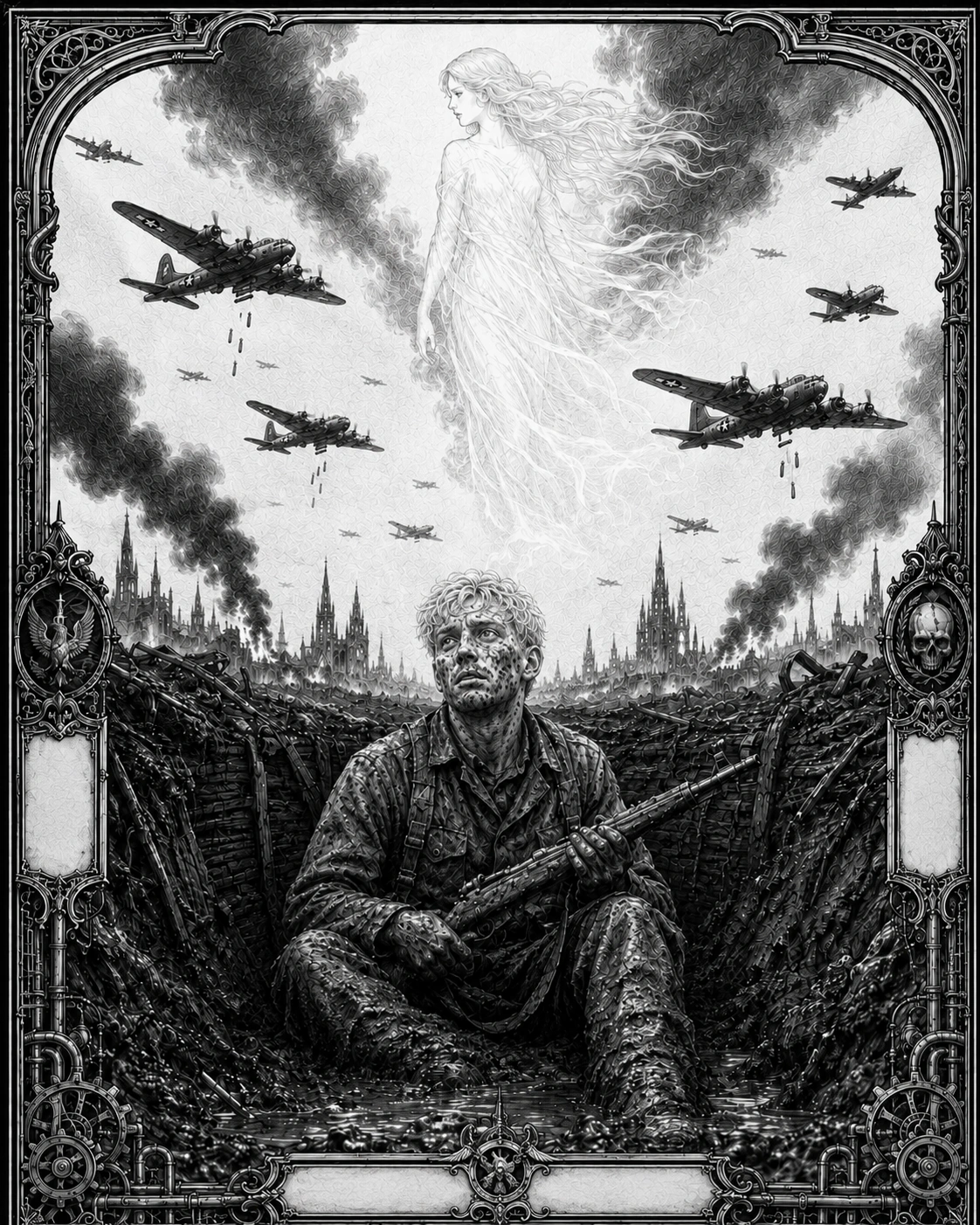
But there is also a human Ragnarök.
That one needs no prophecies.
It is built through decisions.
A vote.
A beating.
An arms shipment.
A lie repeated often enough.
A politician deciding that certain citizens are enemies.
A businessman discovering that financing conflict can be profitable.
A society that ceases to regard violence as exceptional.
The first belongs to myth.
The second belongs to history.
And in Grimwolf, the two begin to draw closer.
The Reader Knows the Future
Setting the novel in 1930 also creates a particular kind of dramatic tension.
The characters do not know what will happen.
The reader does.
When someone speaks of the National Socialists as merely another radical group in a politically fragmented Germany, we know how that story ends.
When conflicts emerge between communists and nationalists, we know the scale European violence will later reach.
When someone thinks things cannot get much worse, we know the years that lie ahead.
That knowledge makes certain scenes more unsettling than any prophecy.
The characters in Grimwolf need seers to know the future.
The reader only needs to know history.
History and Mythology Reflecting One Another
The political situation in Grimwolf should therefore be understood as more than background.
Human history mirrors the saga’s cosmology.
As the boundaries between worlds begin to weaken, so do Europe’s moral and political boundaries.
As ancient forces begin to stir, new political forces prepare another catastrophe.
As some characters seek to open paths to places that should remain closed, other men are opening paths towards a war that could still be prevented.
Both processes unfold simultaneously.
And the characters are caught between them.
Who Really Brings About the End of the World?
Perhaps this is the most important question.
When we think of Ragnarök, we imagine gods and monsters.
Fenrir.
Jörmungandr.
Surtr.
Armies of the dead.
The sky ablaze.
But Grimwolf proposes a more uncomfortable possibility.
Perhaps the end of a world does not need to begin that way.
Perhaps it begins in a beer hall.
In an office.
In a harbour.
At a meeting where someone decides to finance violent men because they are useful.
In a street where two groups stop seeing one another as political opponents and begin seeing enemies who must be destroyed.
The mythological apocalypse is spectacular.
The historical one begins with small decisions.
Conclusion: Before the Gods Came Human Beings
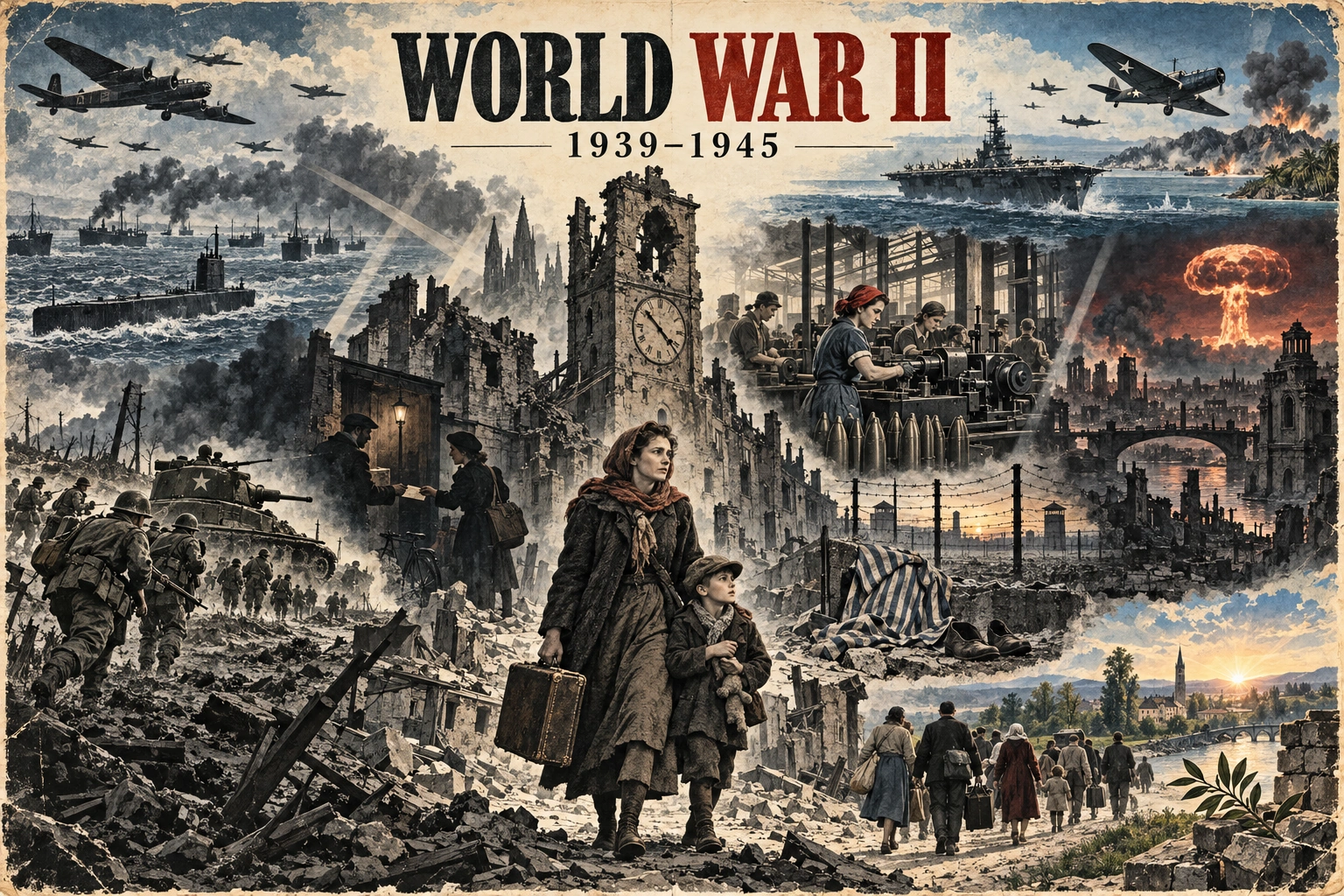
Grimwolf: London 1930 takes place at a moment when Europe still believes it is recovering from one war while beginning, almost unknowingly, the journey towards the next.
Germany is becoming radicalised.
The economic crisis is spreading.
Democracies are revealing their weaknesses.
Political violence is becoming normalised.
Workers fear losing everything.
And certain men discover that fear can be turned into power or money.
Over this human world, another, far older conflict begins to cast its shadow.
That is why Ragnarök in Grimwolf does not necessarily begin when the gods take up their weapons.
It begins much earlier.
It begins when a society stops believing that the person standing opposite is still one of its own.
When hatred becomes identity.
When violence becomes politics.
When war becomes business.
And when those who could stop it discover that letting it continue is more profitable.
Before the gods destroy the world, humanity may already have done much of the work.
The Historical World Behind Grimwolf
Grimwolf: London 1930 combines dark fantasy, historical thriller, Norse mythology and criminal investigation in a Europe poised between two world wars.
The saga does not unfold in isolation from the events of the twentieth century. The economic crisis, political movements, social tensions and cultural transformations form part of the world in which its characters must survive.
In forthcoming articles, we will explore the historical locations featured in the novel, Weimar Germany, interwar London, and the ways human history ultimately connects with Grimwolf’s cosmology.
Because in this universe, history and myth do not follow separate paths. Sooner or later, they meet.