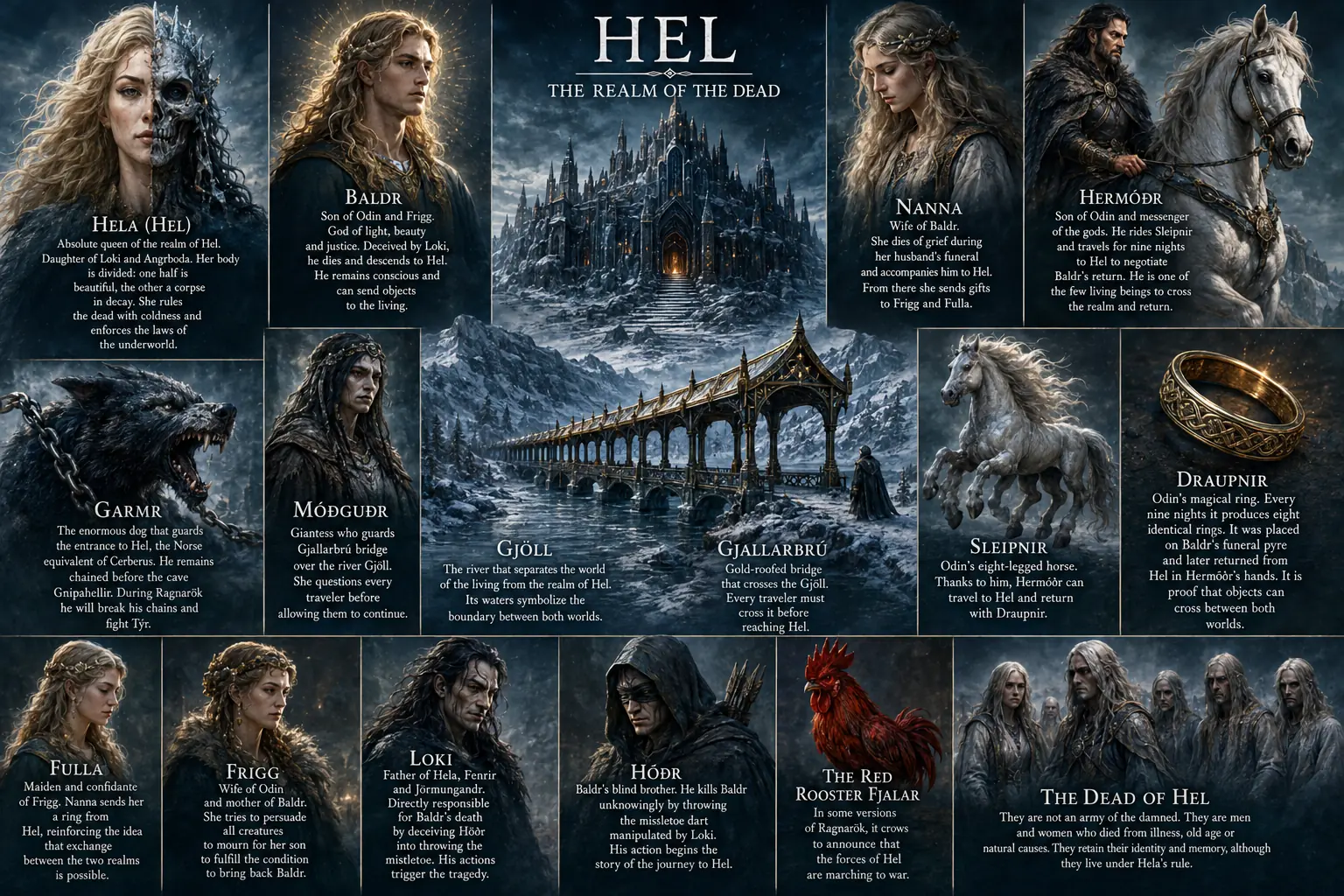
Hel is not Hell.
The similarity between the words has helped create one of the most persistent misunderstandings surrounding Norse mythology. Hel was not simply a Scandinavian version of the Christian inferno, nor was it exclusively a place of punishment for the wicked.
It was a realm of the dead.
And Hel was also the name of the being who ruled it.
In the surviving Norse tradition, the world beyond death is more complicated than a simple division between Valhalla and damnation. Odin receives some of the slain. Freyja receives others. Many of the dead follow different destinations, and Hel becomes particularly associated with those who die outside the heroic economy of battle.
Yet the road to Hel is perhaps even more fascinating than the realm itself.
There is a river.
A golden bridge.
A guardian who questions travellers.
A gate separating worlds.
And according to one of the most remarkable stories preserved in the Prose Edda, a living god once travelled that road and returned.
That story begins with a death that even the gods could not prevent.
The death of Baldr.
And at the end of the road waits Loki's daughter.
HELA — QUEEN OF THE DEAD
Hel is one of the three extraordinary children born from Loki and the giantess Angrboða.
Her siblings are Fenrir, the monstrous wolf destined to kill Odin at Ragnarök, and Jörmungandr, the Midgard Serpent whose body encircles the world.
The gods feared all three.
According to Snorri Sturluson's Gylfaginning, Odin had Hel cast into Niflheim and gave her authority over those sent to her. Her appearance was itself divided: part of her body was described as flesh-coloured, the other dark or corpse-like.
She embodies a boundary.
Life and death.
Beauty and decay.
Presence and absence.
Her realm reflects the same unease. Snorri gives Hel a hall filled with names associated with deprivation and suffering. Yet this should not be simplified into Christian Hell with Norse decoration. The surviving mythology surrounding the dead is fragmented, contradictory in places and preserved through texts written down after Scandinavia had already undergone Christianisation.
What remains is stranger.
Hel is not merely a torturer of sinners.
She is a ruler.
When Baldr arrives in her realm, he is not described screaming beneath instruments of punishment. He sits in a place of honour.
And when the gods demand his return, Hel is powerful enough to tell them under which conditions she will release him.
That authority is important to Grimwolf.
Lady Morgana Ravenscroft is not Hel herself. She is something more useful for the story: a descendant carrying part of Hel's inheritance into the twentieth century.
Morgana moves through shadow and mist. Her connection with the realm of the dead allows her to reach beyond ordinary human boundaries. Even Ravenscroft Castle seems to respond to her presence, with corridors, doors and shadows becoming unreliable around intruders.
And Morgana is not the only connection.
Agnes Holloway, the frightened völva encountered by Eirikr in London, serves Hella to survive.
The old goddess is therefore not merely mythology within Grimwolf.
Her influence has descendants.
Servants.
And unfinished business.
THE ROAD TO HEL
The dead do not simply fall into Hel.
There is a road.
One of our clearest descriptions comes from the story of Hermóðr's journey after Baldr's death.
Hermóðr rides for nine nights through valleys so dark and deep that he sees nothing. Eventually he reaches a river.
Gjöll.
Across it stands a bridge.
Gjallarbrú.
And someone is waiting there.
This geography gives the Norse underworld a quality very different from an abstract spiritual afterlife.
It can be travelled.
Distance exists there.
So do directions.
The road toward Hel leads downward and northward.
There are obstacles between one world and another.
That distinction will become important in Grimwolf.
Because a boundary that can be crossed in one direction might be crossed in the other.
GJÖLL — THE RIVER BETWEEN WORLDS
Gjöll marks one of those boundaries.
Hermóðr encounters it after his long journey through darkness. The surviving account gives relatively little physical description of the river itself compared with the bridge spanning it, leaving considerable room for later imagination.
Its narrative function, however, is unmistakable.
Something separates the traveller from Hel.
And that something must be crossed.
The dead have already passed this way.
Baldr has passed this way.
Hermóðr will follow him.
Beyond the river lies another stage of the journey.
GJALLARBRÚ — THE BRIDGE OF THE DEAD
Gjallarbrú crosses the river Gjöll.
The bridge is described in Gylfaginning as being roofed or covered with shining gold.
That detail is worth remembering.
Modern fantasy frequently imagines the Norse underworld entirely through black iron, bones, ice and decay.
Yet here, on the road to the dead, stands gold.
And the bridge possesses another strange property.
It responds to those crossing it.
When Hermóðr rides onto Gjallarbrú, its guardian remarks that five companies of dead men crossed it the previous day.
Yet the bridge thunders beneath Hermóðr alone as much as it did beneath all of them.
She immediately understands that something is wrong.
Hermóðr does not have the colour of a dead man.
A living being has entered the road of the dead.
And the guardian wants to know why.
MÓÐGUÐR — THE WOMAN AT THE BRIDGE
Her name is Móðguðr.
The source tells us considerably less about her than later artistic traditions might suggest. She is the maiden who guards Gjallarbrú.
But her brief appearance establishes something important.
The road is watched.
Móðguðr asks Hermóðr his name and lineage. She knows the passage of the dead well enough to recognise immediately that he does not belong among them.
Hermóðr tells her the truth.
He is searching for Baldr.
Móðguðr has seen him.
Baldr crossed the bridge before him.
She then gives Hermóðr the direction he needs:
downward and northward lies the road to Hel.
She does not attack him.
She does not prevent him from continuing.
She observes.
Questions.
Judges what stands before her.
Then permits the journey to continue.
For Grimwolf, that is a more interesting model for supernatural guardians than a monster whose only purpose is combat.
Some doors require strength.
Others require an answer.
GARMR — THE HOUND OF HEL
Not every guardian associated with the underworld is so restrained.
Garmr is one of the more enigmatic creatures in Norse mythology, a great hound associated with Gnipahellir, often understood as a cave connected with the realm of the dead.
He appears prominently in the apocalyptic imagery surrounding Ragnarök.
The surviving references are brief enough that later tradition has filled many gaps, and Garmr's exact relationship with Hel should therefore be treated cautiously. Nor should every modern description of him as a straightforward "Norse Cerberus" be mistaken for something the medieval sources explicitly tell us.
What the old poetry gives us is darker and less tidy.
A chained hound.
A cave.
Blood.
The coming collapse of the cosmic order.
And eventually the breaking of restraints.
There is an interesting mirror here for Grimwolf.
Eirikr is called Lobo.
Grimwolf.
The hunter.
Garmr belongs to the boundary of death.
Eirikr's entire existence is becoming an assault upon boundaries.
One guards the road.
The other refuses to accept that any road is closed.
For now, Garmr belongs to the mythology surrounding the novel rather than its established cast.
That may be safer.
Some creatures are more effective while the gate remains closed.
BALDR — THE GOD WHO DIED
To understand Hel, we have to understand why one of the Æsir went there.
Baldr is the son of Odin and Frigg.
Snorri describes him in almost impossibly positive terms: beautiful, wise, gracious and so bright that light seems to emanate from him.
Then Baldr begins to dream of his own death.
Frigg responds by extracting promises from the things of the world that they will not harm her son.
One thing is overlooked.
Mistletoe.
Loki discovers the weakness.
The gods have meanwhile turned Baldr's invulnerability into entertainment, throwing weapons at him and watching them fail.
Baldr's blind brother, Höðr, stands apart.
Loki approaches him.
He places the mistletoe in Höðr's hands.
He guides the throw.
Baldr falls.
The god associated with light and beauty dies because a seemingly harmless thing was overlooked and a blind brother was turned into a weapon.
The Æsir are devastated.
But grief quickly produces a question.
Can he be brought back?
Frigg asks for someone willing to ride to Hel and offer a ransom for her son.
One god accepts.
HERMÓÐR'S RIDE
Hermóðr the Bold mounts Sleipnir, Odin's eight-legged horse.
Then he rides into the realm of the dead.
Nine nights.
Dark valleys.
Gjöll.
Gjallarbrú.
Móðguðr.
Then the gate of Hel itself.
Hermóðr tightens Sleipnir's girth, mounts again and drives the horse forward.
Sleipnir jumps.
Not through the gate.
Over it.
Hermóðr reaches Hel's hall and finds his brother there, seated in the high seat.
Baldr remains himself.
Death has changed his location, not erased his identity.
Hermóðr stays overnight.
The following morning, he asks Hel to release Baldr, telling her of the enormous grief his death has caused among the Æsir.
Hel agrees to a test.
If everything in the world — living and dead — weeps for Baldr, she will release him.
If anything refuses, he remains with her.
For one extraordinary moment, resurrection appears possible.
NANNA — LOVE BEYOND THE PYRE
Baldr does not arrive in Hel alone.
His wife, Nanna, sees his body prepared for the funeral pyre.
According to Snorri's account, her heart breaks from grief and she dies.
She is placed beside Baldr on his funeral ship. Odin places another object upon the pyre:
Draupnir.
His golden ring.
Later, when Hermóðr finally reaches Hel, Baldr and Nanna are both there.
And when Hermóðr prepares to return, something extraordinary happens.
The dead give him gifts for the living.
DRAUPNIR — THE RING THAT RETURNED
Draupnir belongs to Odin.
Every ninth night, the magical golden ring produces eight rings of equal weight.
At Baldr's funeral, Odin lays Draupnir upon his son's pyre.
The ring therefore crosses into death with Baldr.
Yet when Hermóðr prepares to leave Hel, Baldr gives Draupnir to him and asks that it be returned to Odin as a remembrance.
Nanna also sends gifts from Hel: cloth and other presents to Frigg, and a golden ring to Fulla.
This apparently small detail has enormous imaginative consequences.
Objects can cross the boundary.
Something belonging to the world of the living can enter Hel.
Something inside Hel can return.
The border is permeable.
And that idea matters enormously to the mythology of Grimwolf.
The novel is filled with objects whose significance exceeds their physical form: Eirikr's Vanir dagger, his protective runic necklace, the Mirror of Jörmungandr, Victor's iron amulet and, above all, the Mask of Víðarr.
These artefacts are not merely magical equipment.
They connect bloodlines, gods and worlds.
Draupnir provides an ancient precedent for a disturbing possibility.
Death does not necessarily end an object's journey.
FRIGG AND FULLA — THOSE WHO WAIT
While Hermóðr rides into darkness, Frigg waits.
She has already attempted to protect Baldr from death by persuading the world not to harm him.
Now she must attempt something even greater.
To bring him back.
Nanna's gifts make the connection between the women particularly poignant. Something belonging to a woman who has crossed into death returns to the women who remain among the gods.
Fulla, Frigg's confidante, receives a ring.
Frigg receives gifts from her dead daughter-in-law.
The journey between worlds is therefore not simply heroic.
It is personal.
The living and dead are still exchanging tokens.
Still remembering one another.
That idea becomes considerably darker when placed beside Eirikr Skarnisson.
LOKI — THE FATHER ON BOTH SIDES OF DEATH
Behind Baldr's death stands Loki.
He discovers the weakness.
He manipulates Höðr.
He creates the circumstances that send Baldr to Hel.
There is a brutal symmetry in this.
Hel is Loki's daughter.
Loki engineers the death.
His daughter receives the dead god.
The family exists on both sides of the boundary.
And the tragedy is still unfinished.
The gods send messengers throughout the world asking everything to weep for Baldr.
Everything does.
Almost.
They eventually encounter a giantess named Þökk.
She refuses.
Baldr remains in Hel.
The Prose Edda explicitly identifies this refusal with Loki's work, ensuring that Baldr cannot return before Ragnarök.
Loki has not merely killed a god.
He has prevented the gods from undoing the death.
In Grimwolf, Loki's legacy is equally difficult to contain.
The Ravenscroft bloodline combines supernatural inheritances connected with Loki, Hel and Odin. Victor seeks ancient objects. Morgana commands powers associated with the dead.
The old family conflicts have survived into a century of automobiles, telephones and machine guns.
The gods have modernised remarkably well.
THE DEAD OF HEL
One of the easiest mistakes in modern fantasy is to turn Hel into a kingdom populated by interchangeable undead soldiers.
The surviving myth is stranger.
Baldr retains his identity.
Nanna retains hers.
They recognise Hermóðr.
They possess memories.
They send gifts.
They communicate with the living.
Death has separated them from the Æsir without reducing them to mindless corpses.
That distinction offers Grimwolf something far more unsettling than an army of zombies.
What if the dead remember?
Eirikr's entire existence is built around people who are gone.
His wife.
His son.
His daughter.
Their murder by the Broderskap has transformed him into Grimwolf. Every man he hunts is another step in a vengeance he knows cannot restore what was taken from him.
But Eirikr inhabits a world where the Norse gods are real.
Hel is real.
The road of the dead may be real.
Then the question changes.
His family is dead.
But are they gone?
And if Hermóðr once travelled the road to Hel while still alive...
could Eirikr?
HEL AND RAGNARÖK
Hel is not the final chapter.
Ragnarök is.
The old cosmic order eventually breaks. Wolves, gods, giants and monsters move toward the conflict that has been foretold for them.
Garmr breaks free.
The dead and the powers associated with the underworld become part of the catastrophe.
Yet Baldr's story contains something unexpected.
After Ragnarök, after Odin and Thor have fallen and the world has endured destruction, Baldr returns.
And he is not alone.
Höðr comes back from Hel with him.
The murdered and the instrument of his murder emerge together into the renewed world.
Hel therefore contains another paradox.
It is the realm of death.
But it is not necessarily forever.
HEL IN GRIMWOLF
For most people in London in 1930, Hel belongs to dead mythology.
A story preserved in manuscripts.
A subject for antiquarians.
Something scholars can translate safely beneath the lights of the British Museum.
They are wrong.
Agnes Holloway knows it.
Lady Morgana Ravenscroft knows it.
Victor Ravenscroft carries an amulet capable of connecting him with the dead.
And Inspector Arthur Crowley is following a series of murdered bodies marked with symbols he does not yet understand.
Twelve victims.
A ritual.
A door.
The conspiracy Crowley uncovers is attempting to turn ancient cosmology into physical reality: to open a passage toward Helheim.
Eirikr approaches the same mystery from another direction.
He is hunting the Ravenscrofts because vengeance is the only language he still trusts.
Yet there is a danger far greater than Victor waiting behind them.
Eirikr has spent years accepting one certainty:
his family is dead.
Norse mythology offers him a far more dangerous possibility.
The dead may still remember.
There is a river between them.
There is a golden bridge across it.
A woman guards that bridge.
Beyond her, the road continues downward and northward.
And once, according to the old story, a living man rode that road and came home.
Lady Morgana Ravenscroft knows the old stories.
More dangerously, she may know which parts are true.
And somewhere beyond Gjöll,
the dead remember.