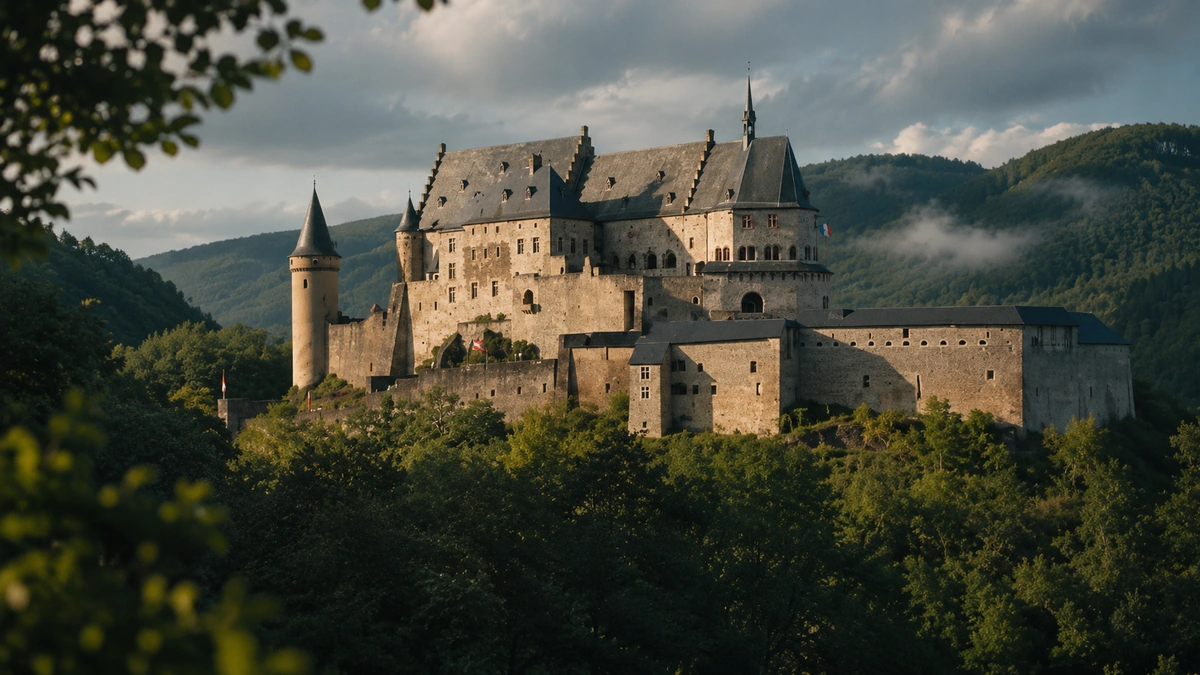
Within the walls of one of Luxembourg’s most impressive fortresses lives an old story of hidden treasure, a hound wreathed in flames and a secret buried beneath the stone. In Bajo el mismo cielo azul, that legend gives rise to a story of love, power and memory spanning almost four centuries.
The castle overlooking the Our Valley
There are places whose story seems to continue long after their protagonists have disappeared. Vianden is one of them.
In the north of Luxembourg, very close to the German border, the Our river passes through a valley surrounded by forested hills. Over the village stands the castle of Vianden, a fortress of towers, walls and sloping roofs that retains the footprint of numerous centuries of occupation.
From the streets of the old town, the castle seems to watch the houses that descend towards the river. Viewed from the slopes surrounding the valley, it is part of a landscape where medieval architecture and nature remain closely united.
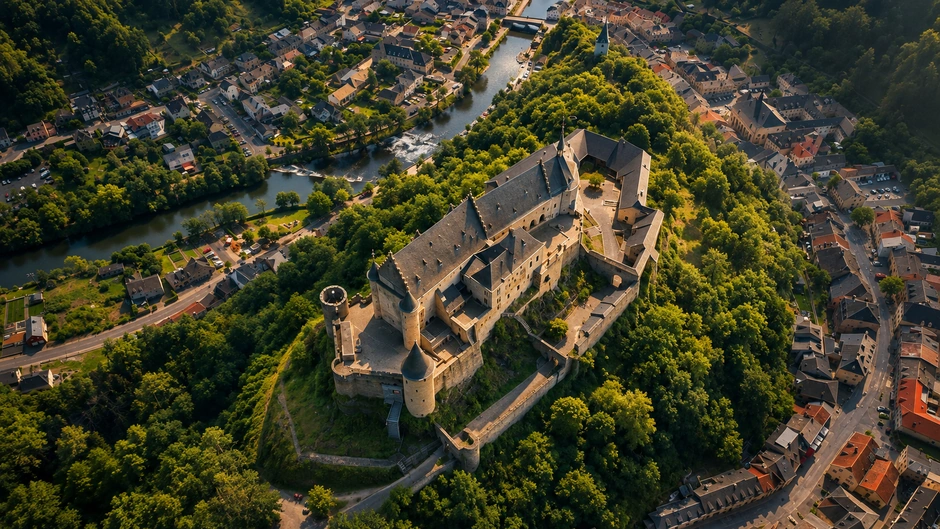
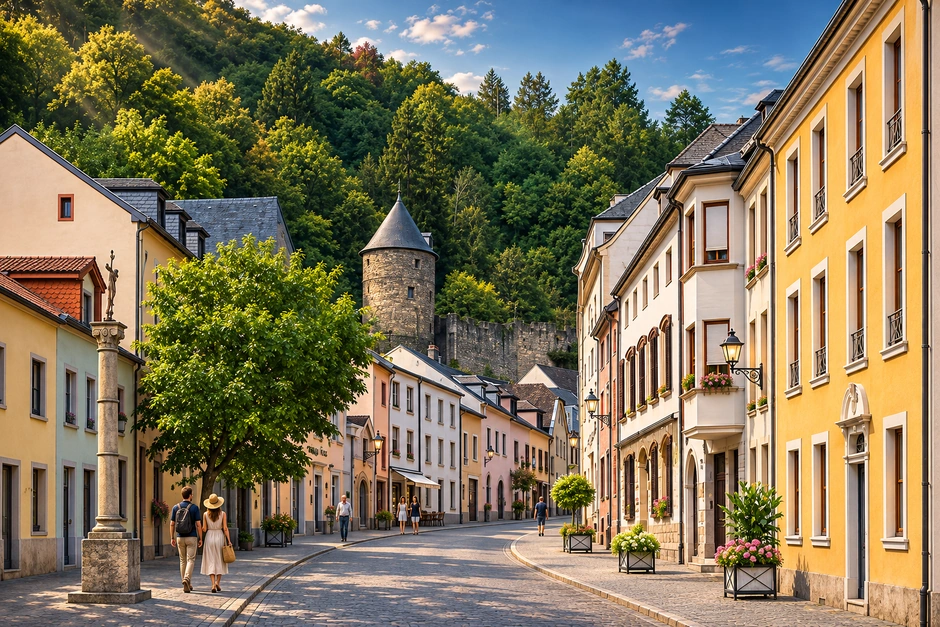
However, Vianden’s history began long before the construction of its large halls and chapels.
Archaeological excavations show that the promontory was already fortified in Late Antiquity. A Roman fort once stood near the routes linking the Rhine, the Ardennes and the Moselle Valley. Its remains were later incorporated into the first medieval buildings.
In time, the site became the seat of a powerful family of counts. The castle reached the height of its architectural splendour in the twelfth and thirteenth centuries.
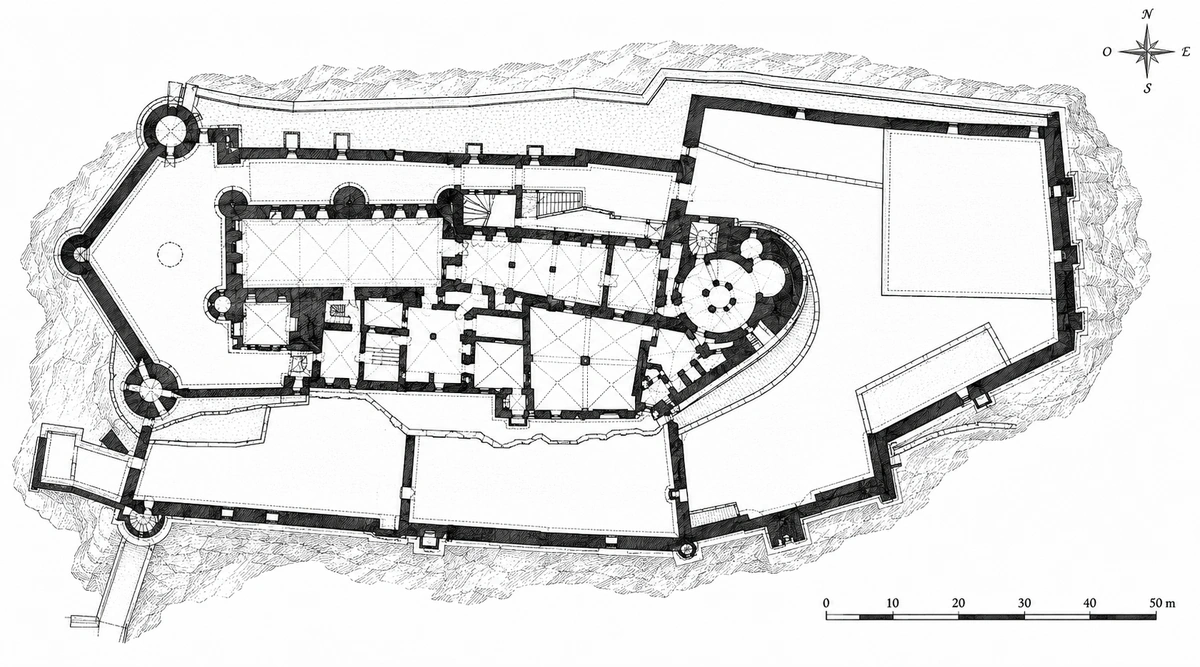
But the castles retain something more than the memory of their masters. They also keep the stories invented by those who lived in their shadow: peasants, craftsmen, soldiers, servants and travelers.
Among those stories stands one of the most disturbing of the local folklore.
It is the tale of a treasure hidden in a well and the fire hound that guarded it.
The treasure no one could recover
The popular tradition of Vianden speaks of hidden riches in the depths of the castle.
In one version, a great chest lies hidden in a well. It promises a fortune to anyone who can bring it up, but an extraordinary obstacle stands in the way: a supernatural hound guards the treasure.
The flames are what set this guardian apart from any ordinary dog. Its presence makes the well a dangerous place, poised between the world of the living and a realm that seems to obey other laws.
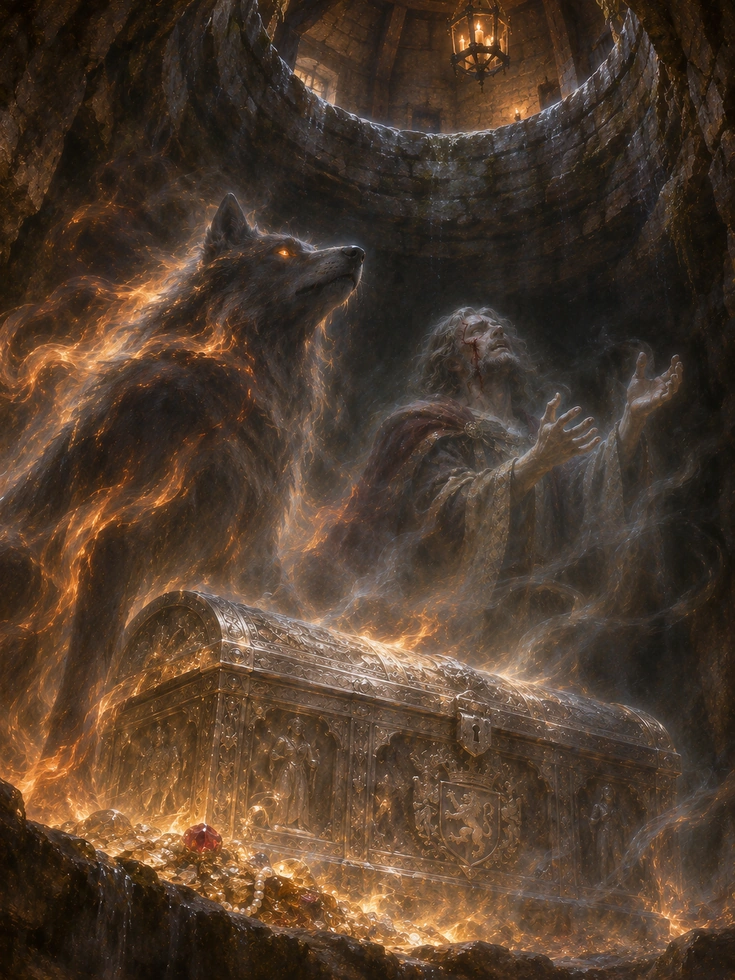
The legend belongs to a much wider European tradition: that of treasures buried under the surveillance of supernatural creatures.
These stories often share a pattern. The treasure is hidden and hard to reach, and anyone who seeks it must meet a condition. Some seekers must keep silent. Others must show courage, heed a warning or face an apparition.
Fortune seems to be at hand, but the attempt to get it ends up revealing human weakness.
Nicolas Gredt recorded the Vianden tradition in his 1883 collection Sagenschatz des Luxemburger Landes. One of the tales, Schätze und Schatzheber zu Vianden, describes the treasures and the people who tried to dig them up.
The publication shows that these beliefs were part of the Luxembourg narrative heritage of the 19th century. Its oral origin may be earlier, although it is difficult to establish when each version began to be told.
What is really interesting is that the castle already possessed a second existence: the one that was given to it by the stories transmitted from generation to generation.
The well: a threshold between worlds
Why is a well so suitable for a supernatural legend?
In the everyday life of a fortress, water was indispensable. A castle could withstand a siege thanks to its walls, but needed reserves for its inhabitants.
Wells, cisterns and water supply systems were therefore vital to defensive architecture.
At the same time, a well gathered features that fed the popular imagination.
It was deep, dark and difficult to explore. From the mouth of the well, one could hear water echoing below or a stone falling into the depths. The bottom remained hidden even when the rest of the castle was familiar.
That combination of utility and mystery explains its presence in numerous traditional accounts.
The well represents a vertical boundary between the known world and what remains hidden. Descending means temporarily abandoning the security of the surface.
In treasure legends, this descent usually acquires a symbolic meaning: who descends seeks material wealth, but ends up facing his own fears.
The supernatural guardian performs a similar function. It prevents the buried from returning easily to the world of the living.
In Vianden, the figure of the fire hound adds a especially powerful dimension to that idea.
The fire hound and its cultural significance
Dogs occupy a unique place in the European imaginary.
For centuries they have been companions of humans, guardians of houses and flocks, animals associated with loyalty and protection. But they also appear in stories about cemeteries, lonely paths, nightly appearances and borders between life and death.
The British tradition knows spectral black dogs. The classical mythology presents Cerberus, the guardian of the underworld. In different regions of central Europe there are accounts of supernatural animals that guard forbidden places or hidden riches.
These figures belong to different traditions and it is advisable to avoid considering them as manifestations of a single myth. However, they share a symbolic association: the dog can become a protector of a boundary that humans fear to cross.
Fire has another meaning.
It can represent destruction, punishment and danger, but also purification, vigilance and an energy that escapes human control.
A dog surrounded by flames, placed on a treasure at the bottom of a well, thus brings together three images of enormous narrative force: the Guardian, the Forbidden Wealth and the Underground Darkness.
The creature ceases to be a simple monster. It is the expression of a prohibition.
The treasure exists, but it may never have been intended to belong to those who find it.
Vianden in the seventeenth century: a fortress after its heyday
The legend acquires a special resonance when the castle is contemplated in the context of the Thirty Years' War.
By 1640, Vianden had preserved much of its imposing medieval architecture, although the political power of its ancient counts had diminished considerably.
The great construction period of the 12th and 13th centuries had been left behind. After the disappearance of the county line in 1417, the castle passed to the house of Nassau. Their functions were gradually transformed and several lordship dependencies were destined for storage or administrative activities.
During the first half of the 17th century new residential dependencies were built for administrators, while other areas were adapted to agricultural and craft functions.
The castle still visually dominated the valley, but it already belonged to a different political world.
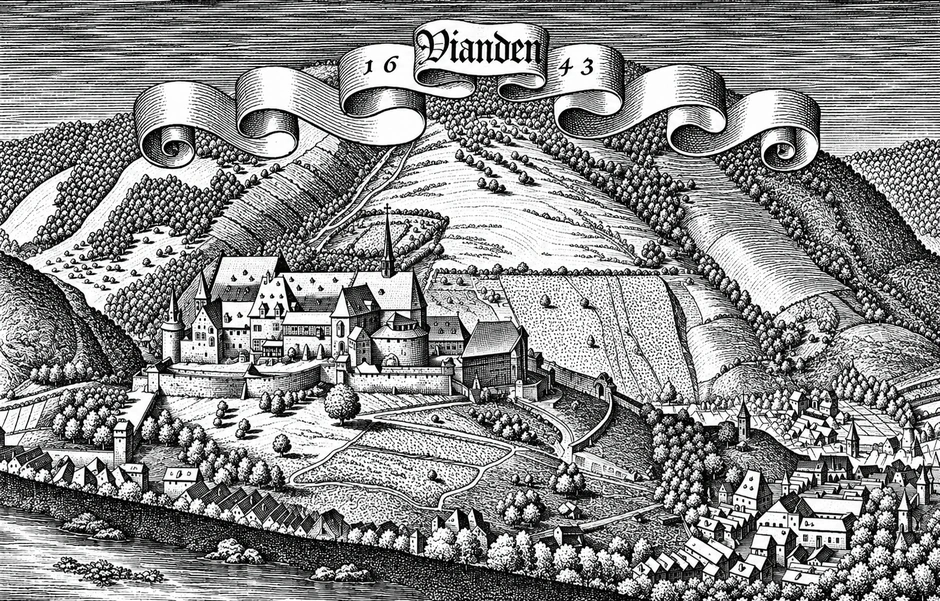
This transformation coincides with a especially difficult time for large regions of Central Europe.
The Thirty Years' War, which took place between 1618 and 1648, caused troop displacement, destruction, diseases, economic crises and deep insecurity among civilian populations.
In rural territories, war could be felt even far away from the large battlefields. The passing of soldiers, supply demands and uncertainty affected peasants and craftsmen.
It was a world in which social differences were decisive and the protection of a powerful authority could determine the fate of a family.
This is the context chosen for one of the stories of "Bajo el mismo cielo azul".
The guardian of the well in Bajo el mismo cielo azul
In the novel by J. A. Durán Blázquez, the castle of Vianden becomes the scene of a story that unites popular tradition with a plot of love, abuse of power and secrets.
The story begins in 2026.
Valentina and Jonas spend their summer holidays with their grandmother Élise, who lives in an ancient stone house located outside the city centre, on a forested slope from which the village and the castle are seen.
During a family conversation, Jonas asks if there are treasures hidden in the fortress.
Élise then recalls the story of a silver coffin hidden in one of its wells and protected by a dog wrapped in flames.
What begins as a legend intended to entertain children leads the reader to the 17th-century Vianden.
There lives Margarethe, a twenty-three-year-old who has inherited from her mother a small house, a garden and a deep knowledge of medicinal plants.
Margarethe prepares remedies, gathers herbs and helps the neighbors who come to her. Her independence arouses admiration in some people and distrust in others.
She is accompanied by Falko, a dog she took in as a puppy.
Her life is linked to Matthias, a village carpenter with whom she dreams of building a simple future, away from the ambitions of the powerful.
But Baron Konrad von Falkenberg is fixed on Margarethe.
The difference in social position and the authoritarian character of the noble transform the desire into a threat. From that moment on, the story ceases to be merely a story about a hidden treasure.
It becomes a confrontation between those who possess power and those who try to preserve their freedom.
The castle then acquires a double meaning.
It is the visible symbol of the baron’s authority, but also a place where old beliefs seem to retain a force that men have forgotten.
The well, initially associated with wealth and superstition, ends up occupying a decisive place in the destiny of the characters.
The novel thus develops a possible human history behind a supernatural legend.
Margarethe: knowledge that inspires fear
One of the most interesting aspects of this literary recreation is the character of Margarethe.
His knowledge of medicinal plants comes from family experience, observation and a tradition passed from mother to daughter.
During the Modern Age, these knowledge coexisted with university medicine, religious practices and different forms of popular healing.
In many rural communities, people who knew the properties of herbs played an important role. They prepared infusions, ointments and remedies for frequent ailments, although the effectiveness and risks of those treatments could vary considerably.
The social position of a healer could be contradictory.
Their neighbors needed their help, but some could also be suspicious of knowledge that escaped their understanding.
This tension is especially significant in a time marked by witchcraft-related judicial proceedings.
Witch persecution in Europe had complex causes: personal conflicts, religious beliefs, community tensions, judicial structures and power relations. Reducing them to a exclusive persecution of women using medicinal herbs would be historically inaccurate.
However, the vulnerability of an independent woman to an accusation or to the influence of a powerful man constitutes a verosimile conflict for the time.
Margarethe represents that social fragility, but also the resistance of someone who tries to decide about his own life.
Her story introduces a question that goes beyond the supernatural: what happens when a community begins to fear what it used to need?
Matthias, Konrad and two forms of power
The relationship between Matthias and Margarethe provides the emotional center of the story.
Matthias is a craftsman. Their world is made up of wood, everyday work and the possibility of building a shared life.
Konrad belongs to the domain of the lord authority.
The opposition between both characters allows to explore two ways of understanding human relationships.
For Matthias, love means imagining a future with Margarethe: a house, a garden, and an existence that they can build between them.
For Konrad, desire is contaminated by the habit of getting what he wants.
The difference between the two is essential to understanding the conflict.
In the 17th century society, hierarchies conditioned everyday life. Economic position, birth, and relationships with authorities could influence access to justice and the ability to defend against an accusation.
The novel uses that context to show how a personal obsession can become a form of violence when backed by power.
In the face of this, the bond between Margarethe and Matthias acquires a dimension that transcends romance.
Your love represents the possibility of choosing your own life.
Falko and the other dog in the story
There is an especially suggestive contrast between Falko, Margarethe’s dog, and the supernatural creature who keeps the well.
Falko belongs to the everyday world.
It is an animal that accompanies, protects and shares the life of its owner. Her presence introduces moments of affection and familiarity within a story marked by the threat.
The fire hound, on the other hand, belongs to the world of legend.
It is a creation associated with darkness, punishment and what remains buried.
Both represent different forms of surveillance.
One protects by fidelity. The other keeps a secret whose nature is impossible to fully understand.
This parallelism enriches the symbolism of the narrative without the need to identify the two animals as one creature.
In a story where humans can use their authority to harm others, a dog’s fidelity acquires a particular resonance.
Élise and the memory of centuries
The structure of “Bajo el mismo cielo azul” adds a dimension that distinguishes the novel from a simple folklore adaptation.
Margarethe’s story reaches the reader through Élise.
For Jonas, the story is a fascinating adventure: a castle, a treasure and a creature wrapped in flames.
Valentina, more observative and skeptical, begins to pay attention to the details her grandmother seems to know.
The fundamental question ceases to be whether the fire hound really existed.
What is disturbing is the familiarity with which Élise speaks of people and events separated from the present for several centuries.
The old photographs, documents and objects preserved in his home gradually reinforce that suspicion.
Vianden then works in two times.
In the 17th century, it is the stage of the history of Margarethe and Matthias.
In 2026, it is the place from which Valentina and Jonas begin to understand that family legends could hide something more than imagination.
The castle remains in the same valley as generations change.
And Élise’s memory seems to extend far beyond what should be possible.
From folklore to fiction: what belongs to each world
The story of the fire hound allows us to observe how an oral tradition can transform into a contemporary narrative without losing its identity.
The starting point is a popular belief: a treasure hidden in the castle and a supernatural creature in charge of guarding it.
The novel preserves that core and builds around it a story with characters, motivations and conflicts of its own.
Margarethe, Matthias, Konrad and Falko belong to literary recreation. Their lives serve to explore issues that the traditional narrative leaves open: ambition, love, injustice and the consequences of human acts.
It also changes the function of the treasure.
In a legend of wealth seekers, the safe represents the fortune someone wants to get.
Bajo el mismo cielo azul, the well becomes a place related to the consequences of the past.
The question is no longer just who will be able to recover the treasure, but what stories were buried next to it.
That transformation constitutes one of the most interesting possibilities of historical fantasy: using folklore as a starting point to imagine the lives that could feed a belief.
The fiction provides a literary explanation, without pretending to replace documented history.
Vianden Castle: a historical timeline
The architectural history of the castle allows us to understand why the same place has been able to bring together so many epochs and traditions.
Around 275 AD – First fortifications. On the promontory is established a fortification during late antiquity, close to ancient Roman communication routes.
4th century – Construction of a stone fortification. Archaeological materials allow to relate this phase to the time of Emperor Constantine.
430–440 – Abandonment of the Roman fortification. The site ceases to be used continuously, although some of its structures remain standing and will be used later.
697–698 — A possible early reference to Vianden. The Latin expression in monte Viennense appears in documentation linked to the donation of Echternach to Willibrord. Your identification with Vianden is likely, although it should be treated with caution.
Up to 700 — High-Medieval Occupation. Archaeological finds indicate activity in the site during the first medieval centuries.
1000 – The first medieval castle of stone. A fortification with oval wall, an administrative hall and a chapel installed on the remains of the ancient Roman tower is built.
About 1100 — Permanent residence of a noble family. The incorporation of a residential tower, kitchens and domestic dependencies transforms the whole into a stable master residence.
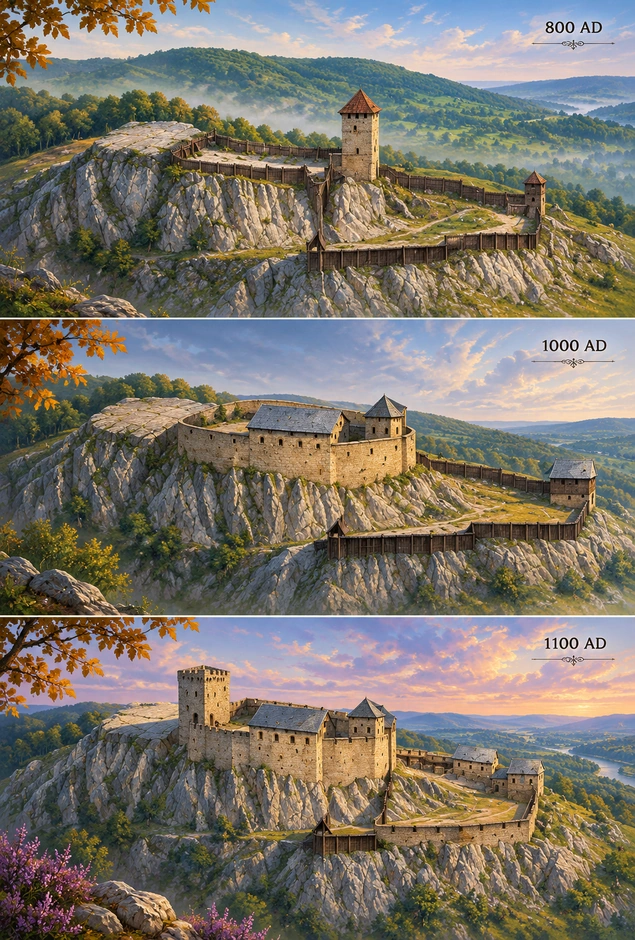
Towards 1170 — Great Romanesque enlargement. The characteristic decagonal chapel is built and the main dependencies of the castle are reorganized.
1196–1203 — New monumental works. The dating of wooden elements allows in this period important works in the chapel and the large salon.
13th century – architectural apogee. The castle is expanded with new halls, galleries, towers and dependencies. The Gothic transformations contribute to creating its characteristic silhouette.
The end of the 13th century — Progressive loss of political autonomy. The counts of Vianden are dependent on the counts of Luxembourg.
1417 – Incorporation to the house of Nassau. After extinguishing the county line of Vianden, the castle passes to the Otonian branch of Orange-Nassau.
The first half of the 17th century – functional transformation. Dependances are built for administrators and various areas of the old site are destined for agricultural and handicraft activities.
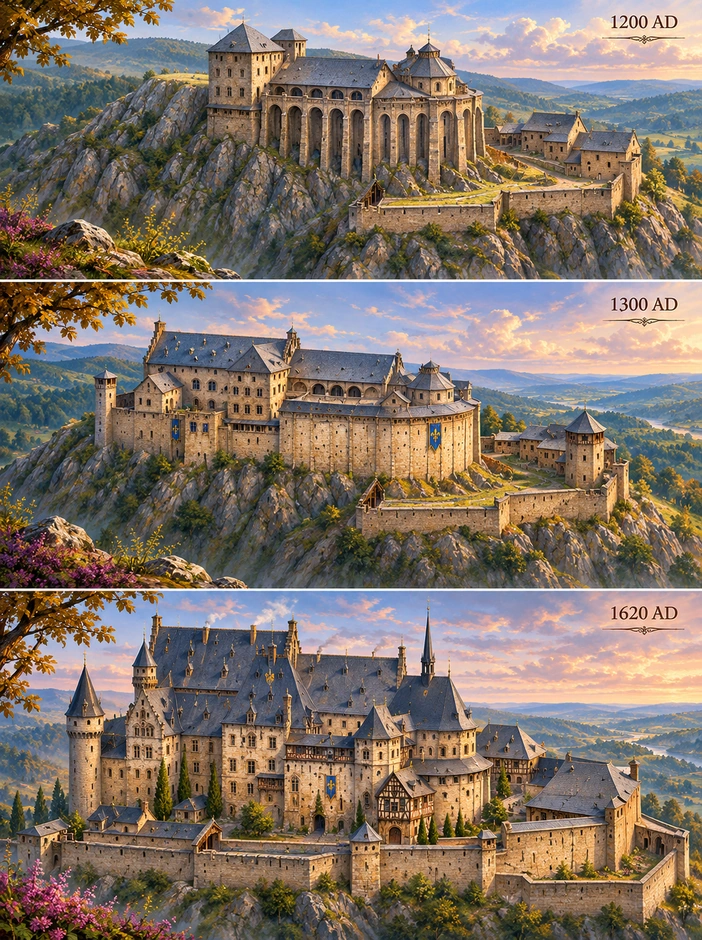
Towards 1640 — Age of the history of Margarethe. Bajo el mismo cielo azul, the castle and the village are the scene of events starring Margarethe, Matthias and Baron Konrad. It is a literary chronology located within a real historical context.
August 1820 — Sale and dismantling. The castle is sold at a public auction to Wenzel Coster, who begins to dismantle parts of the building and market its materials.
The 19th and 20th centuries - Ruin and heritage recovery. The fortress goes through a prolonged period of deterioration before major conservation interventions.
1977 – Acquisition by the Luxembourg State. A new stage of restoration is underway to restore the monumental ensemble.
2026 - The Castle in the novel. Vianden turns into a narrative scene when Valentina and Jonas spend the summer with their grandmother Élise and discover the first clues of a family mystery that goes through the centuries.
One castle, many stories
The castle of Vianden has been fortification, county residence, administrative center, ruin and restored monument.
Each period has left a different mark on its walls.
Archaeology allows to reconstruct its first constructions. The documents reveal the changes of power. The architecture retains the ambitions of its former masters.
The folklore, on the other hand, keeps alive questions that history can hardly answer.
Who hid the treasure? Why was it abandoned? What did the fire hound mean to those who told the story?
Bajo el mismo cielo azul, these questions take on a new life through Margarethe, Matthias, Konrad and Élise.
The well becomes a symbol of what remains hidden through the years.
Because castles keep their stones, but it is the stories that allow them to continue to inhabit them.
And in Vianden, some of those stories still seem to wait for someone to dare to hear them.
Sources and references
History and Archaeology
- The History of Vianden Castle. Official history and description of the various constructive phases of the ensemble.
- National Institute for the Architectural Heritage (Luxembourg) Heritage documentation on the castle of Vianden.
- Matthäus Merian Historical representation of Vianden Castle in the first third of the 17th century.
Folklore
- Gredt, Nicolas. Sagenschatz des Luxemburger Landes 1883. Traditional accounts from Luxembourg, including Schätze und Schatzheber zu Vianden.
Literary Reference
- Durán Blázquez, J. A. Bajo el mismo cielo azul. Book I of Los hilos del tiempo. Chapters “The Guardian of the Well” and “The Curse of the Well”.
The characters Margarethe, Matthias, Konrad, Falko, Valentina, Jonas and Élise, as well as the novel events related to them, form part of the author's fiction.